Sales, updated 15 min read
Load Balance DNS: A Guide for Scalability and Resilience
By InsecureWeb Team
A client’s site goes sideways at the worst possible time. A product launch lands, a promotion gets picked up, or a regional outage pushes users toward the only healthy path left. Support starts getting tickets, synthetic checks begin to flap, and everyone asks the same question: why is traffic still going to the wrong place?
That’s where DNS load balancing stops being a textbook topic and becomes an operations topic. MSPs and hosting teams use it because it gives them a control point before the application stack even sees the request. But load balance DNS only works well when you treat it as an imperfect control plane with sharp edges. Resolver bias, stale caches, uneven health signaling, and slow failover can all turn a clean design into a messy incident.
The High-Traffic Dilemma Every Provider Faces
The familiar version looks like this. A customer has one public hostname, several backend systems, and a confidence level that was based on normal traffic. Then something changes. Traffic spikes, one node degrades, users from another region arrive in bulk, and the application starts behaving like it only has one front door.
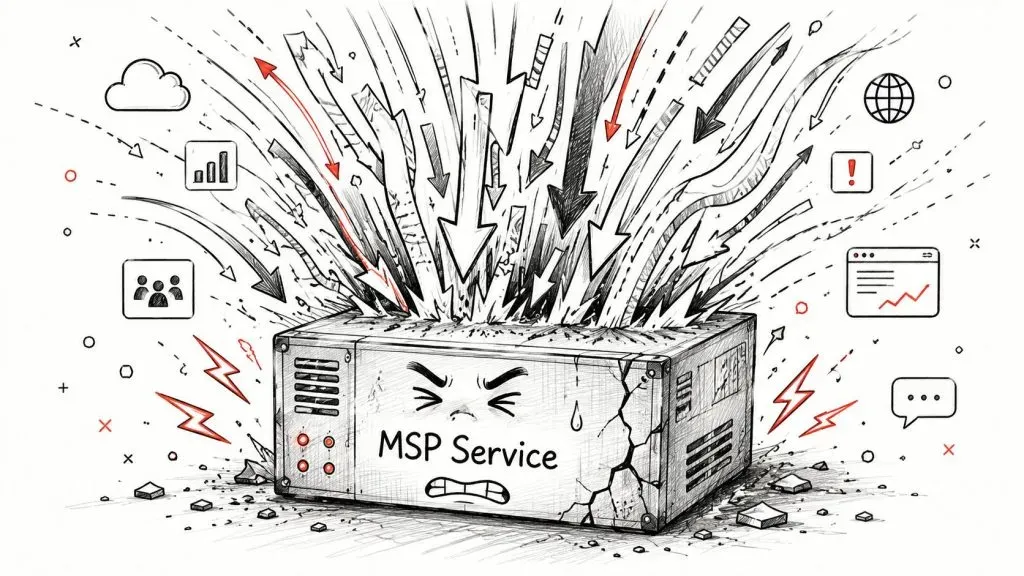
From the MSP side, the technical problem and the business problem arrive together. Users see timeouts. The client sees damaged trust. Your team sees alert noise, confused routing, and support engineers trying to answer why one healthy server is idle while another is drowning.
DNS load balancing is often the first lever available because it sits upstream of the application tier. It can distribute requests across more than one destination, steer users toward a better region, and give you a path to fail over when part of the stack is unhealthy. That matters in real environments where not every customer is ready for a full global traffic management platform.
Why this matters to providers
MSPs and hosting operators rarely inherit perfect architectures. They inherit mixed hardware generations, old apps that still depend on DNS behavior, and clients who want resilience without a full rebuild. In those environments, load balance DNS is attractive because it can be introduced with less disruption than redesigning the entire delivery path.
DNS is usually the first control plane you can change quickly across regions, providers, and customer environments.
The important part is knowing what DNS can solve and what it cannot. It can spread traffic. It can steer by policy. It can remove obviously bad endpoints when health checks are wired correctly. It cannot see live connection state the way a packet-level or application-level load balancer can.
The first layer, not the whole answer
Teams get into trouble when they think “multiple A or AAAA records” equals resilience. Sometimes it does, for a while. Sometimes it just distributes pain more evenly. The rest of this article focuses on that difference. The operational details decide whether DNS balancing helps during an incident or makes the incident harder to understand.
Core DNS Load Balancing Methods Explained
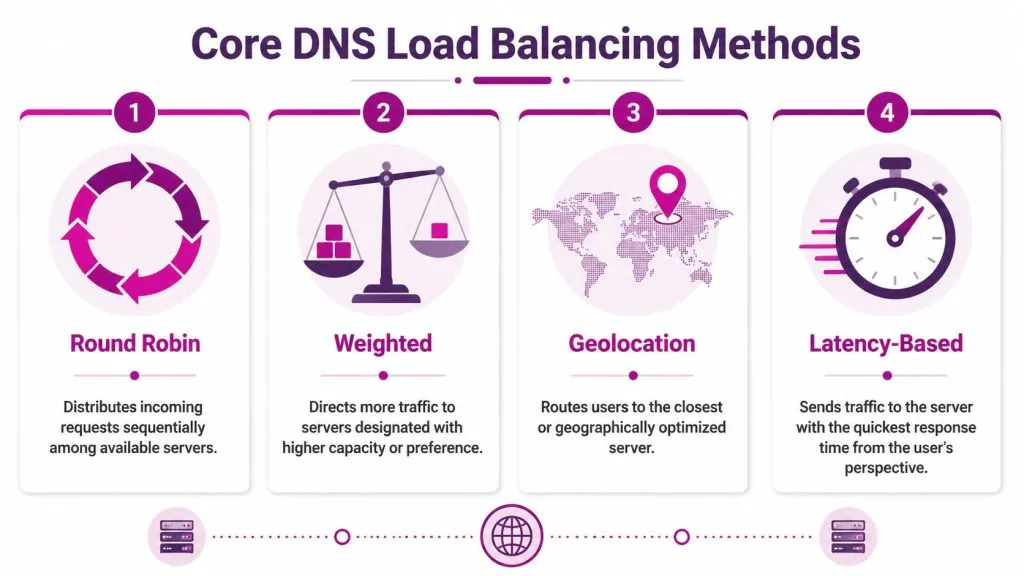
The mechanics are simple. The consequences are not. Different DNS balancing methods solve different problems, and using the wrong one usually shows up as uneven load, slow failover, or users landing in the wrong region.
A useful baseline comes from a 2023 study summarized by Relianoid’s DNS load balancing reference. It reported that DNS-based load balancing reduced server overload incidents by 47%, that round-robin algorithms handle 62% of global domain traffic, that geo-based routing cuts latency by 38%, and that DNS failover mechanisms ensure 99.9% uptime by activating in 94% of server breakdown cases.
Round robin for basic spread
Round robin returns multiple server answers in rotating order, like a dealer handing cards around the table one by one.
Round robin is the easiest entry point. You publish several possible destinations for the same service name, and the resolver rotates the answer order. It’s useful when backend nodes are roughly equal and you need a simple way to spread demand without placing another device inline.
Use it when:
- Servers are similar and can absorb roughly the same request volume.
- You need low friction setup for a straightforward service.
- You accept limited intelligence in exchange for simplicity.
Don’t expect round robin to notice that one node is slow, overloaded, or dead. By itself, it’s distribution without awareness.
If your team needs a quick refresher on aliasing and naming choices before implementing routing changes, this primer to learn about CNAMEs with Server Scheduler is useful because naming layout often gets tangled with balancing decisions.
Weighted routing for uneven capacity
Weighted DNS sends more queries toward some targets than others, based on deliberate preference.
Weighted routing is what you use when your server pool is not equal. That’s common in hosting environments where newer nodes have more headroom or where one region has more capacity than another. Instead of pretending every destination is interchangeable, you bias the traffic split.
Weighted routing fits these situations:
| Situation | Why weighted helps |
|---|---|
| Mixed hardware | Newer or larger nodes can take more traffic |
| Migration phases | You can ease users toward a new platform gradually |
| Cost-aware routing | You can prefer one site without fully excluding another |
This method is operationally cleaner than trying to fake weighting through crude record patterns. It also gives you better control when you’re introducing new infrastructure and want rollback options.
Geolocation and latency-aware steering
Geolocation routing directs users toward a region that should be closer or more suitable, like a postal system sending mail to the nearest sorting center.
Here, DNS balancing becomes more nuanced. Instead of rotating answers, you try to steer a user toward a region that offers a better experience. For global SaaS, content delivery, and multi-region application hosting, that’s often the primary reason to use DNS in the first place.
A lot of teams say “geo” when they really mean “closest.” Those are not always the same. DNS sees the resolver, not always the user. So if a user’s ISP or enterprise resolver is somewhere else, the DNS answer can be wrong for the actual client.
A short visual can help before going deeper:

Failover for service continuity
Failover DNS removes or deprioritizes an unhealthy destination so new lookups stop sending users into an outage.
Failover is the method people care about during incidents. It’s also the method they overestimate most often. DNS failover only helps new resolution events and only as fast as caching behavior allows. That means your health checks and your TTL strategy matter as much as the record type itself.
Good failover setups usually include:
- Independent health checks that test what users need, not just whether a host answers a ping.
- Clear priority rules so the platform knows which target should be primary.
- Documented cache expectations because clients won’t all honor your intent the same way.
The biggest practical lesson is simple. DNS methods are not interchangeable. Round robin is distribution. Weighted is policy. Geolocation is steering. Failover is continuity. Most real deployments need a combination, not a single trick.
How DNS Complements Traditional Load Balancers
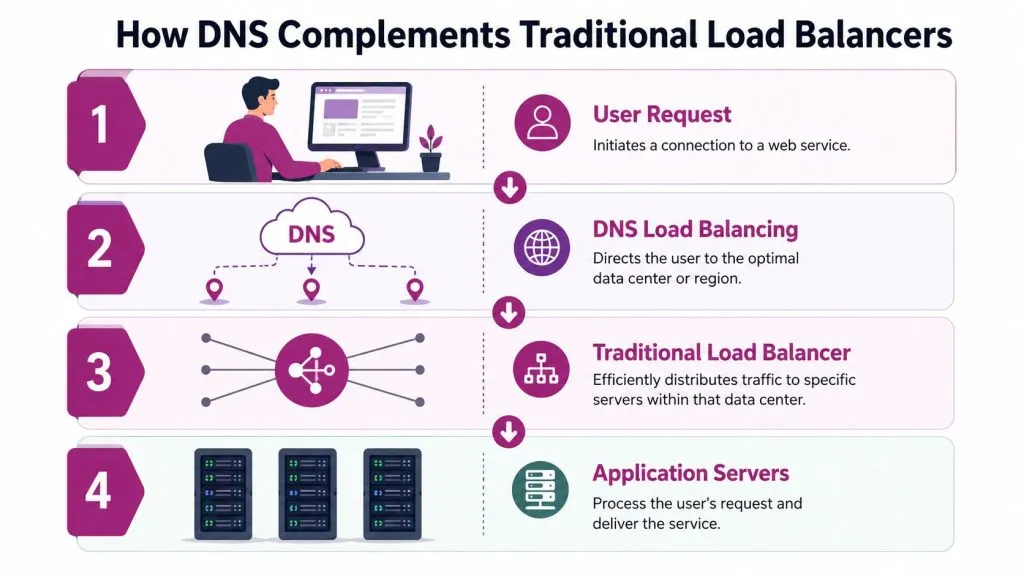
DNS and traditional load balancers solve different parts of the path. Treating them like substitutes creates bad designs. Treating them like layers gives you something useful.
The neighborhood and intersection model
Think of DNS as the highway signs that send cars to the right neighborhood. A traditional L4 or L7 load balancer is the traffic control inside that neighborhood, deciding which street and which building entrance the car should use.
DNS is strong at broad placement decisions:
- Region selection
- Basic policy routing
- Global failover initiation
Traditional load balancers are strong at local execution:
- Connection-aware distribution
- Session handling
- Per-request logic
- Application health awareness
Google’s SRE guidance makes this distinction clearly in its discussion of frontend load balancing. It notes that DNS answers can be adjusted based on geography, but that DNS balancing should be followed by a lower-level VIP or load-balancing layer for a more complete solution, especially because resolver location and client location can differ. That guidance is covered in Google’s SRE load-balancing frontend chapter.
Where teams get the architecture wrong
The common mistake is asking DNS to do the job of a local traffic manager. DNS can choose a site. It cannot inspect active connections, preserve stickiness reliably, or react to backend conditions at request time the way HAProxy, NGINX, Envoy, F5, or cloud-native L7 services can.
If DNS picks the datacenter, something closer to the application still needs to pick the actual backend safely.
For containerized environments, that second layer often lives inside the platform rather than in a separate appliance. Teams working through service exposure, ingress behavior, and balancing inside clusters will usually benefit from a complete guide to Kubernetes load balancing, especially when they’re connecting public DNS policy to internal service routing.
The practical design pattern is stable across many environments. Use DNS for global placement. Use a lower-level balancer for local correctness. Keep those roles separate in both architecture diagrams and incident runbooks.
Key Configuration Parameters for Service Providers
Good DNS balancing isn’t mostly about choosing round robin versus geo. It’s about the settings around those methods. MSP teams usually feel the pain in three places: TTLs, health checks, and record policy.
TTL is an operational decision
TTL controls how long answers can stick in caches. That makes it one of the most important reliability settings in the entire design. Short TTLs can support quicker changes. Longer TTLs reduce query volume and often make operations calmer during normal periods.
The trade-off is straightforward:
| Parameter choice | Operational effect |
|---|---|
| Lower TTL | Better chance of faster redirection, more DNS query activity |
| Higher TTL | Fewer queries, slower reaction when destinations change |
In this scenario, provider operations discipline matters. If a client expects quick failover, the TTL strategy has to match that expectation. If they want low churn and a stable platform with infrequent routing changes, longer TTLs may be acceptable. Trouble starts when clients expect near-immediate cutover from a design that still depends on resolver and client cache behavior.
Health checks decide whether DNS is smart or blind
A DNS policy without health checks is mostly a publishing mechanism. Add health checks and it becomes a control system. The question is what you’re checking.
Useful checks usually answer one of these:
- Can the endpoint accept a network connection
- Can the application serve the required function
- Can the region complete a transaction path the client depends on
A simplistic check may mark a server healthy when the app behind it is degraded. A deeper check may be more accurate but slower or more fragile. MSP teams should decide that trade-off based on service type. A marketing site and an authenticated SaaS control plane do not need the same health model.
Operational rule: Health checks should test the service clients need, not just the machine you hope is working.
Record strategy and provider features
The record layout affects both operations and change safety. Teams often make DNS harder than necessary by mixing aliases, failover records, and migration leftovers in one namespace without clear ownership. Keep service names purposeful, document which record set controls user traffic, and avoid hidden dependencies.
Weighted and geo-aware features from managed DNS providers can simplify real-world balancing, but they also create platform lock-in and more policy to audit. That isn’t automatically bad. It just means the configuration belongs in your change control process, not only in someone’s memory.
For MSPs building recurring services, the governance angle matters as much as the technical one. Your team needs a repeatable standard for who approves DNS routing changes, how health-check thresholds are reviewed, and how client expectations are documented. If you’re shaping that broader service delivery model, managed service provider planning is part of the conversation because routing decisions become customer-facing commitments.
A solid baseline for providers usually includes:
- A default TTL policy tied to service criticality.
- Health checks per service tier rather than one generic probe for every client.
- Runbooks for planned changes such as migrations, maintenance windows, and regional drain events.
- Validation steps that test answers from more than one resolver path.
None of that is glamorous. All of it determines whether your load balance DNS design behaves predictably under pressure.
Security and Reliability Pitfalls You Must Avoid
DNS balancing is easy to oversimplify because it looks clean on a diagram. In production, several failure modes show up at once. The hard part isn’t getting multiple answers published. The hard part is keeping routing trustworthy during degraded conditions.
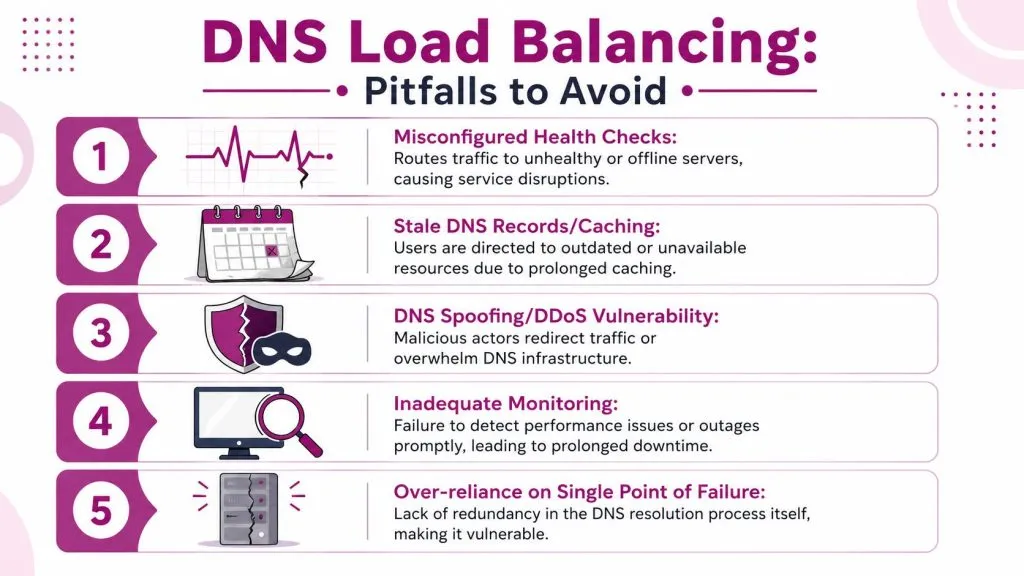
Caching hides failure longer than operators expect
A key operational limit is that DNS changes don’t instantly reshape all client behavior. As explained in Kalvad’s discussion of DNS load balancing limits, round-robin DNS is state-blind and doesn’t account for server health, while client-side caching means TTL choice directly affects failover speed. Kalvad also notes that a clear benchmark for failover latency across major resolvers is still lacking.
That last point matters more than many teams admit. You can tune your authoritative side carefully and still watch users hit stale paths because recursive resolvers and client systems don’t all behave the same way. During incidents, that creates a false sense that failover “didn’t work,” when the underlying issue is that not all clients asked the question again.
DNS itself becomes part of the attack surface
Balancing traffic at DNS means DNS is now a critical dependency in service continuity. If attackers can tamper with records, poison trust, or disrupt lookup paths, they can redirect users before your application-level controls ever see the request.
The big risks tend to cluster in a few areas:
- Unauthorized record changes caused by weak registrar or DNS account security
- Spoofing and impersonation that send users to hostile infrastructure
- Authoritative service disruption that leaves healthy backends unreachable in practice
- Operational mistakes where a rushed update creates the same effect as an attack
Security teams should treat DNS routing policy like production code. It needs access controls, review, logging, and rollback plans.
If you’re trying to reduce exposure before attackers abuse weak internet-facing assets, vulnerability scanning tools for external exposure management belong in the same operational picture. DNS won’t save a backend that’s already reachable and poorly hardened.
Monitoring has to follow the whole chain
A lot of monitoring setups only test one layer. They verify that the origin is up, or that the DNS answer exists, or that a single synthetic probe succeeds from one region. That’s not enough for DNS balancing.
What actually helps:
- Query-path validation from multiple networks, because answer behavior can differ by resolver path
- Service-level health checks that test the user journey, not just host availability
- Authoritative DNS monitoring so you notice provider-side trouble
- Change correlation between DNS updates, resolver behavior, and traffic shifts
A healthy server doesn’t help when cached answers keep sending users elsewhere.
The practical message is blunt. DNS load balancing improves resilience only when you design for its blind spots. Without that, it creates a slower, more confusing outage pattern.
Deployment Scenarios and Troubleshooting Tips
Theory helps. Incidents teach faster. These two patterns show up often in MSP and hosting work, and both expose the same lesson: DNS routing policy has to match the shape of the infrastructure you have.
Shared hosting with uneven server generations
A hosting provider often has a pool where not every node is equal. Some systems are newer, some are carrying older customer stacks, and some are mid-migration. In that environment, weighted DNS is usually the cleaner option.
The design goal is not “perfect distribution.” It’s controlled distribution. You want stronger nodes to attract more new traffic while older systems continue serving a smaller share until tenants move off. That lets the provider phase in hardware without a hard cutover.
Typical troubleshooting points look like this:
- One server appears too busy. Check whether the traffic pattern is being measured at the resolver level versus the application session level. DNS policy influences new lookups, not every request equally.
- Changes don’t seem to take effect. Look at cache persistence before assuming the DNS platform failed.
- A weak node still gets users. Confirm that weighting policy matches current capacity and that no stale aliases still point to the old path.
Global SaaS with regional steering and failover
The second common case is an MSP operating a client’s multi-region SaaS application. Here the requirement is usually a mix of regional routing and continuity. Some users should go to the nearest or most appropriate region. If that region becomes unhealthy, new resolutions should shift elsewhere.
Expectations require careful handling. DNS can support global continuity well enough that major organizations depend on it. F5 states that 78% of Fortune 500 companies rely on DNS load balancing, and that during the 2021 global internet outage, DNS-based failover mechanisms reduced downtime by 65% and saved an estimated $4.3 billion in lost revenue, as described in F5’s DNS load balancing overview.
That said, the first troubleshooting question is often the most important: is the user being misrouted because of DNS policy, or because the resolver is not where the user is?
A practical troubleshooting checklist for this pattern:
- Verify resolver geography. Geo steering may be accurate for the resolver and wrong for the user.
- Inspect health-check scope. A regional endpoint may answer basic probes while the app path users need is failing.
- Review fallback order. Some DNS policies fail over exactly as configured, but to a region with insufficient local capacity.
- Check application-layer balancing after DNS. If the regional entry point is healthy but local balancing is wrong, the issue is below DNS.
- Confirm what changed. Routing incidents often combine a DNS update, a backend problem, and stale caching.
Most DNS balancing incidents are not one bug. They’re a chain of mostly reasonable settings interacting at the wrong time.
That’s why troubleshooting has to move from resolver to region to local load balancer to application path, in that order.
Building a Foundation for Resilient Architecture
DNS load balancing is valuable because it gives you a global steering point before traffic reaches the application stack. That’s why it remains a practical tool for MSPs, hosting providers, and teams managing distributed services. But it isn’t magic, and it isn’t enough by itself.
The reliable pattern is layered. Use DNS to choose the region or entry point. Back it with meaningful health checks, realistic TTL policy, and a lower-level load balancer that can make connection-aware decisions. Protect the DNS control plane like production infrastructure, because that’s exactly what it is.
For day-to-day troubleshooting, simple client-side hygiene still matters. When a user keeps reaching an outdated destination, this guide on how to flush Windows DNS cache is often a useful first support step while you verify broader resolver behavior. And if your team is looking at brand abuse, exposure, and externally visible risk around public services, digital risk protection for internet-facing threats belongs alongside routing resilience.
If you manage client infrastructure and need better visibility into external threats that can undermine availability, trust, and incident response, InsecureWeb is worth a look. It helps MSPs, MSSPs, and hosting providers monitor exposed risk across the open internet, dark web, and social platforms, with white-label delivery and API access for integrating into existing service workflows.