Data Security, updated 13 min read
Digital Risk Protection: Your 2026 Guide to Cyber Defense
By InsecureWeb Team

An MSP owner usually learns the limits of perimeter security the hard way. A client can have solid firewall policy, EDR on endpoints, MFA on key systems, and still wake up to a fake Facebook page, a lookalike domain, or leaked credentials circulating outside the environment. None of that starts inside the LAN. It starts where most managed security stacks still have weak visibility.
That’s why digital risk protection matters. It gives MSPs and MSSPs an external view of risk across domains, social media, public web content, and underground channels, then turns that visibility into actions like validation, escalation, and takedown. For service providers, that makes DRP more than another detection feed. It’s a way to protect client revenue, customer trust, and executive reputation before an external threat turns into a support crisis.
Your Security Perimeter Is Bigger Than You Think
A client calls because customers are complaining about a scam page that looks exactly like their actual brand. Your team checks the tenant. No malware. No suspicious logins. No lateral movement. This is a genuine problem, but it isn’t inside the client network. It’s sitting outside the wire, using the client’s name, logo, and trust to do damage.
That gap is where digital risk protection belongs. It covers the parts of the attack surface most MSP stacks still treat as someone else’s problem: fake domains, impersonation accounts, leaked credentials, copied content, scam listings, and public references to assets your client didn’t even know were exposed. If you only monitor what you own directly, you’ll miss the infrastructure attackers build around your client before they ever touch a workstation.
This shift is no longer niche. MarketsandMarkets estimated the global DRP market at USD 64.4 billion in 2023 and projected it to reach USD 157.8 billion by 2028. That projection matters because it reflects a broader operating reality. Buyers now expect continuous monitoring and response across the external footprint, not just controls around the internal network.
For MSPs, that creates a service opportunity. Brand impersonation, executive spoofing, and social-channel abuse often land first with help desks, account managers, or marketing teams. If your practice can monitor and validate those risks before a client finds them on their own, you’re protecting more than systems. You’re protecting business operations.
A lot of this now extends into social channels, where scam accounts and fake engagement can spread faster than a normal security workflow can react. If you’re building coverage in that area, this guide on AI-driven social media monitoring is useful because it connects public-channel visibility to practical brand and fraud risk.
Practical rule: If a threat can hurt your client without logging into their network, it belongs in your security program.
MSPs that already run external visibility programs often pair DRP with attack surface analysis because the business problem is the same: clients have more exposed digital assets than their internal inventories show.
What Is Digital Risk Protection Really
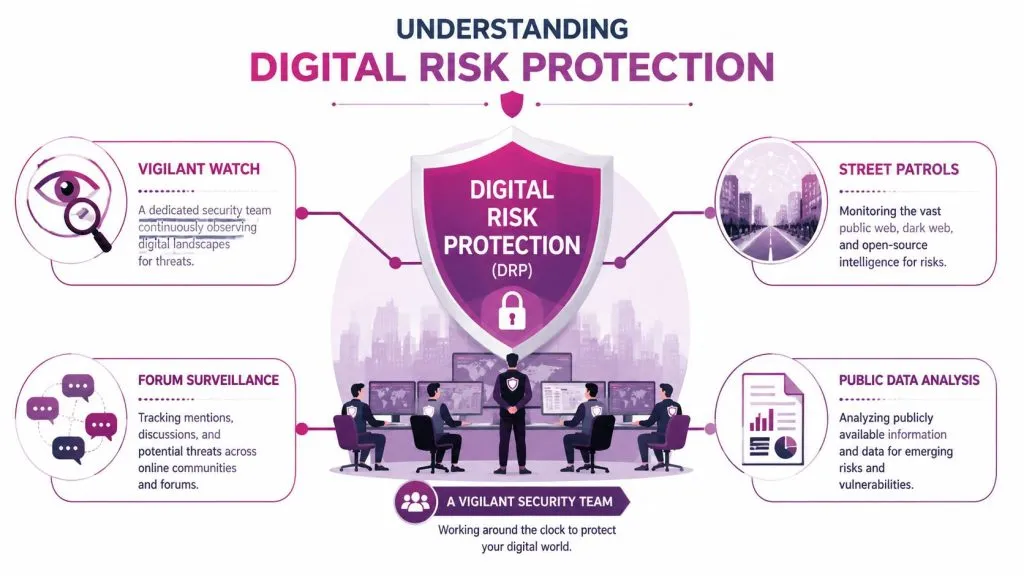
Digital risk protection isn’t just alerting on brand mentions. It’s an outside-in security function that looks for threats forming around the business in public channels, semi-open communities, underground spaces, and third-party platforms. The simplest way to explain it to a client is this: your firewall guards the building, but DRP watches the streets, alleyways, and parking lots around it.
Think of DRP as security cameras for the internet
A mature DRP program watches for signals that attackers leave in public before they execute, scale, or monetize an attack. That includes domain registrations that resemble the brand, social profiles that mimic executives, leaked credentials, fake apps, and references to internal assets posted where they shouldn’t be.
Modern guidance reflects that broader role. RiskProfiler describes DRP as scanning the public web, deep web, dark web, and social platforms for fake domains, impersonation, credential leaks, and counterfeit listings, with takedowns built into the workflow. That’s the core distinction. DRP is not a passive dashboard. It’s monitoring plus validation plus disruption.
A short explainer can help if you’re packaging this for nontechnical buyers:

The external threat surface DRP actually covers
Most MSP clients think of external threats in one bucket. In practice, it helps to break them into three.
- Underground exposure: Credential leaks, sensitive data mentions, and discussion of company assets in places that don’t show up in standard IT monitoring.
- Public-facing abuse: Fake social accounts, scam pages, copied branding, fraudulent support channels, and impersonation aimed at customers or employees.
- Technical impersonation and shadow assets: Lookalike domains, rogue mobile apps, exposed repositories, and internet-facing assets that have drifted out of inventory.
What fails here is simplistic monitoring. A keyword feed for the company name will generate noise, miss context, and train analysts to ignore alerts. Good DRP programs map the client’s real assets, identities, executive names, domains, and high-risk brands first. Then they monitor against that model.
DRP works best when it answers a practical question fast: is this external signal connected to a real asset, a real identity, or a real customer risk?
That’s why digital risk protection is better thought of as a control layer, not a tool category. It sits outside the traditional perimeter and helps your team act before an external issue becomes an internal incident ticket.
The Four Core Capabilities of a DRP Platform
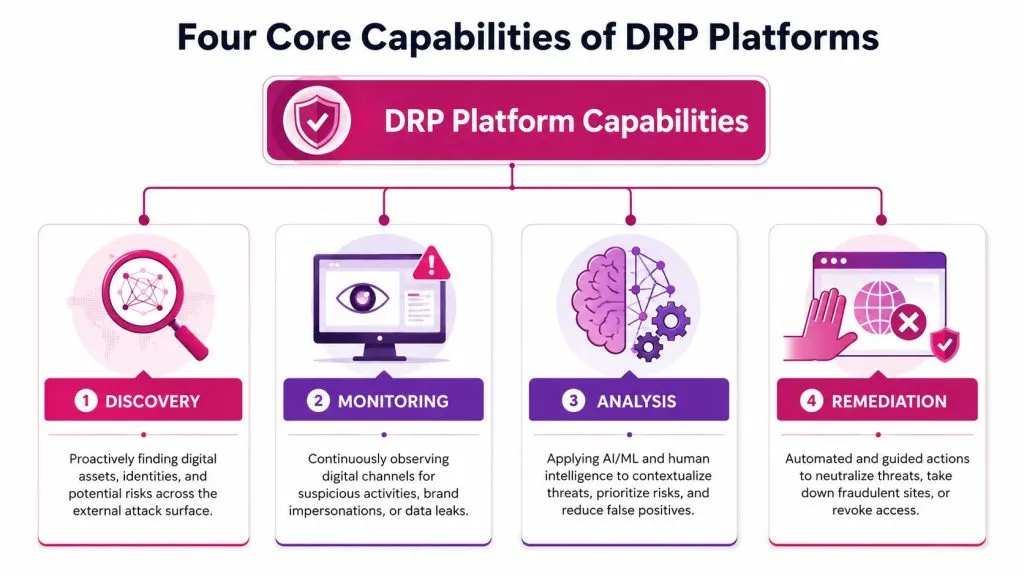
When MSPs evaluate DRP platforms, they often get distracted by source counts, logos, or dark web screenshots. The better question is whether the platform supports the full workflow from visibility to action. Most weak deployments break because one of the four core capabilities is missing.
Discovery starts the whole program
Discovery is the base layer. The platform needs to identify and maintain a living map of the client’s external footprint, including domains, subdomains, brand names, executive identities, public-facing services, social handles, and other internet-visible assets.
Many programs underperform, primarily when an incomplete client asset map weakens every subsequent step. You can’t prioritize a lookalike domain properly if you don’t know which business unit, campaign, or executive identity it resembles. Teams that need this view often combine DRP with dark web monitoring so credential exposure and impersonation findings map back to real client assets.
Monitoring without context creates noise
Monitoring is the collection engine. It scans the sources that matter and keeps doing it continuously. That includes public web pages, social channels, community content, underground spaces, and technical signals tied to domain or infrastructure abuse.
What doesn’t work is broad collection without scope. If the platform only says, “we found mentions,” you’ve bought noise. Monitoring has to tie findings to what the client owns, uses, or depends on.
Analysis decides what deserves action
Better platforms distinguish themselves. Wiz notes that the strongest DRP value comes from combining broad collection with context, and that without asset mapping and threat-feed correlation organizations may detect many mentions but miss which ones map to their actual brand, executives, or internet-facing assets.
That trade-off is real in managed service delivery. Analysts don’t need more sightings. They need high-confidence incidents with business context.
A practical triage model usually asks:
| Question | Why it matters |
|---|---|
| Does it impersonate a real brand, executive, or service? | Determines likely customer or employee impact |
| Is the asset active and reachable? | Separates dead noise from live exposure |
| Does it connect to known malicious patterns? | Helps prioritize response |
| Does it affect a regulated or high-value client function? | Drives urgency and escalation path |
Mitigation is where DRP proves its value
Discovery and detection are useful. Mitigation is what clients remember. That includes takedown requests, domain abuse escalation, social account reporting, workflow tickets, password resets after verified credential exposure, and handoff into incident response when needed.
A DRP platform that finds external abuse but can’t support response will create work, not reduce risk.
For MSPs, this is the commercial difference between selling a feed and selling a managed service. The more your workflow can move from validated finding to documented action, the easier it is to justify recurring value.
Key Technical Approaches and Methodologies
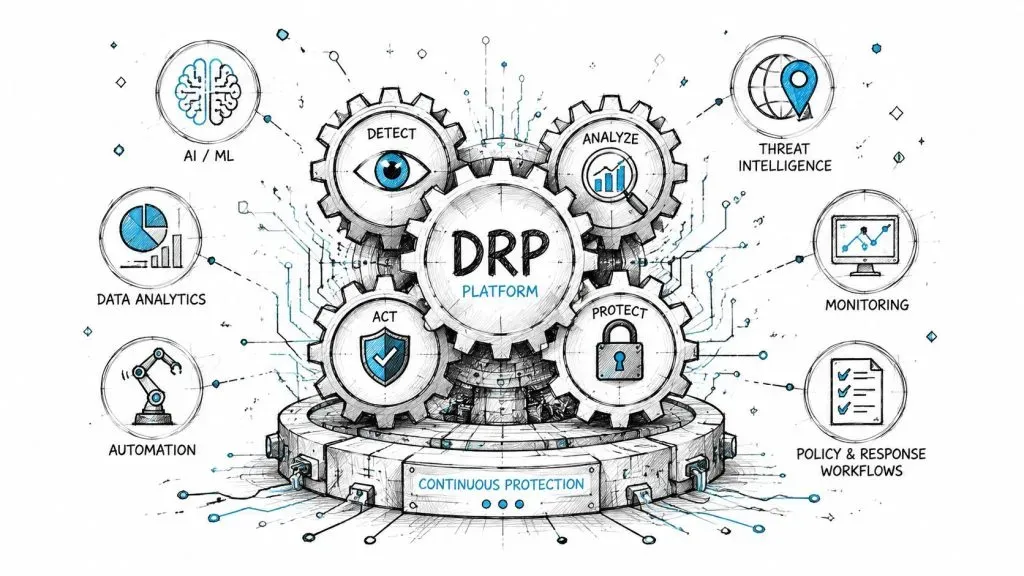
A good DRP platform looks simple in the dashboard and complicated underneath. That’s how it should be. External monitoring is messy because the sources are inconsistent, the signal quality varies, and attackers actively try to avoid detection.
Collection across hostile and noisy channels
At the collection layer, DRP tools pull from public web content, social platforms, app ecosystems, domain intelligence sources, paste sites, forums, and dark web locations where exposure or threat chatter appears. Some of that is accessible through normal crawling and APIs. Some requires adapted collection methods and manual validation.
The technical challenge isn’t only access. It’s continuity. New pages appear, domains change, fake accounts get renamed, and exposed data gets reposted. That’s why DRP has to be continuous rather than scan-based.
Detection logic that goes beyond keyword matching
The weak version of DRP is a pile of keyword alerts. The stronger version uses patterning and enrichment. A lookalike domain isn’t important because it contains a brand term. It’s important when the registration pattern, page content, certificate behavior, linked infrastructure, and visual branding all suggest misuse.
The same applies to social threats. A fake executive account might reuse images, naming conventions, bios, post cadence, or audience targeting that a human analyst can validate quickly once the system surfaces it. That overlap matters even more in fraud-heavy environments. Teams handling payment scams, impersonation, or synthetic media risk often pair DRP with broader research into enterprise fraud prevention so social abuse, impersonation, and media manipulation are handled as one business problem instead of separate tools.
Operational workflows that make DRP usable
The hardest part of digital risk protection isn’t collection. It’s operationalization. Most external findings aren’t useful until someone classifies them, ties them to a client, and decides what action is justified.
A usable workflow usually includes these stages:
- Normalize the signal: Convert raw sightings into a common case format.
- Enrich the case: Add brand, asset, identity, and campaign context.
- Score the urgency: Prioritize based on business relevance and potential harm.
- Route the response: Push the case into analyst review, takedown, client notification, or incident response.
The best DRP engineering is invisible to the client. They shouldn’t see your collection complexity. They should see fewer surprises and faster action.
For MSPs, that means choosing platforms that integrate with ticketing, reporting, and client-facing workflows. If analysts have to swivel between disconnected tools for every takedown or credential exposure, margins disappear fast.
Measuring Success What DRP Metrics Matter
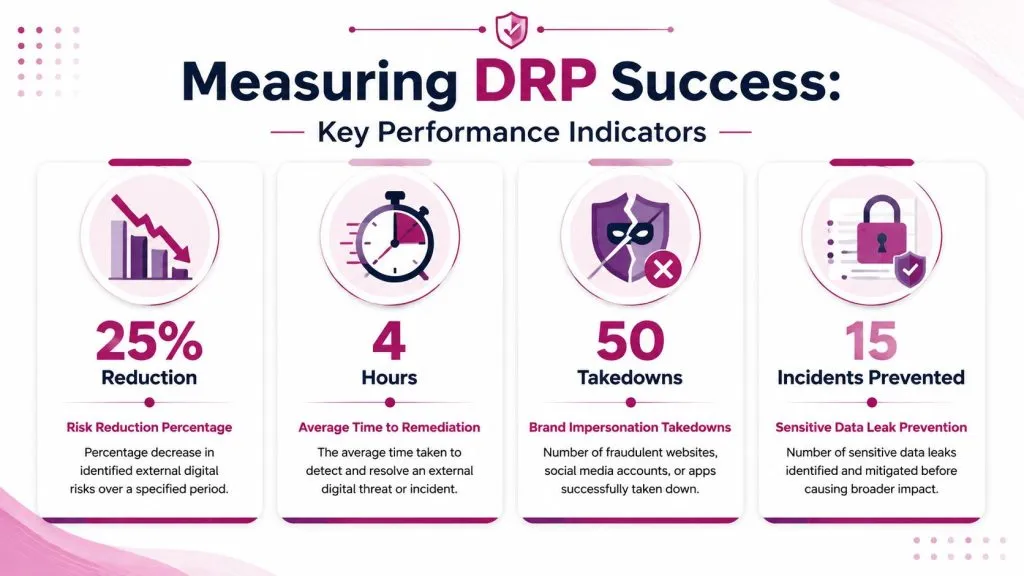
A DRP program that reports “we generated a lot of alerts” isn’t mature. It’s noisy. If you’re selling this as a managed service, your metrics have to show that the client is getting earlier visibility, faster containment, and fewer recurring exposures.
Metrics that matter to an MSP
Check Point’s DRP guidance says effective programs should be measured by operational outcomes such as time to detect an external risk, time to remediate a vulnerable exposure, and reduction in recurring exposures over time. That framing is right because it maps directly to service delivery.
The metrics worth tracking are usually:
- Time to detect: How quickly your service identifies an external risk after it becomes visible.
- Time to remediate: How quickly your team contains, escalates, or initiates takedown after validation.
- Recurring exposure trend: Whether the same client assets, brands, or identities keep reappearing in incidents.
- Actioned incident rate: How many validated findings led to a concrete response rather than sitting in review.
Those metrics support client conversations because they answer business questions. Are we finding threats earlier? Are we moving faster? Are repeat problems decreasing?
Metrics that look useful but usually mislead
Alert volume is the classic vanity metric. It makes the dashboard look busy, but it doesn’t prove risk reduction. In fact, a rising alert count can mean your asset inventory is better, your tuning is worse, or attackers are noisier. By itself, it says almost nothing.
The same goes for raw source counts. More monitored sources don’t automatically produce better outcomes if the platform can’t prioritize what matters.
If your monthly report leads with “total mentions detected,” you’re reporting activity. If it leads with detection speed, remediation speed, and repeated exposure patterns, you’re reporting security performance.
For MSP owners, this also affects packaging. Outcome-based reporting supports premium tiers. Noise-based reporting turns DRP into a commodity feed that clients will eventually challenge on price.
DRP for MSPs A Service and Deployment Guide
Most MSPs don’t need to invent a DRP practice from scratch. They need a delivery model they can operate efficiently and explain clearly to clients. The service should be positioned as external threat monitoring plus action, not as another generic threat intel add-on.
Two service models that actually work
The first model is straightforward resale. You license a DRP platform, manage onboarding, tune monitoring, validate findings, and report outcomes to clients. This can work well when your team wants a faster launch and the vendor already supports takedowns and analyst workflows.
The second model is white-label delivery. That’s usually stronger for MSSPs and mature MSPs because it lets you fold DRP into your own branded managed security service, integrate with your existing dashboards, and standardize the client experience across tenants. One option in that model is InsecureWeb, which offers digital risk protection features such as surface, deep, and dark web monitoring, brand impersonation monitoring, and API access built for MSPs, hosting providers, and security firms.
The service packaging itself should stay practical. Clients usually understand these bundles:
- Brand and impersonation protection: Focused on fake domains, fake accounts, and customer-facing scams.
- Credential and exposure monitoring: Focused on leaked usernames, emails, and references to sensitive assets.
- Executive and reputation monitoring: Focused on impersonation, deepfake-related abuse, and public-channel targeting.
A buyer checklist for platform selection
Rapid7 notes a common gap in the market: buyers are often told DRP can monitor broad external signals, but they aren’t given a concrete way to separate noise from high-risk exposures across social platforms, domain registrations, paste sites, and underground forums. That’s exactly the issue MSPs should screen for during evaluation.
Use a checklist that forces operational clarity:
- Multi-tenant workflow: Can analysts manage multiple clients cleanly without case confusion?
- White-label capability: Can you brand the portal, reports, and notifications under your own service?
- API depth: Can findings move into your ticketing, SIEM, SOAR, or reporting stack without manual re-entry?
- Coverage scope: Does monitoring include the channels your clients care about?
- Validation support: Does the platform help separate suspicious artifacts from confirmed risk?
- Response options: Are takedown support, escalation workflows, and evidence capture part of the service?
If a vendor demos lots of detections but can’t show how an analyst moves from signal to client-facing action, keep looking.
DRP in Action Best Practices and Case Examples
The fastest way to make DRP effective is to tie it to concrete operating habits instead of treating it like a research feed.
Start with full asset discovery
A client may think they have three active brands and a handful of public domains. Then onboarding uncovers old campaign microsites, dormant subdomains, unmanaged social accounts, and forgotten third-party landing pages. That changes the risk picture immediately.
Best practice is simple. Build the external inventory first, then monitor against it. If the inventory is wrong, every alert queue after that gets worse.
Protect executives and customer trust first
Executive impersonation and customer-facing brand abuse usually deserve priority because the business impact is immediate. A fake executive profile can trigger payroll fraud or reputational damage. A fake support account can pull customers into scams before the client’s IT team even hears about it.
Start where trust is most fragile. Executive identity, customer service channels, and payment-related brands tend to produce the fastest downstream harm.
Tie DRP to incident response
The strongest MSP workflows don’t stop at detection. If validated credentials appear in external monitoring, open a response path. Reset passwords, review affected accounts, notify the client, and preserve evidence. If the event might indicate broader compromise, route it into the same playbook you’d use after a confirmed exposure. A practical reference for those follow-on actions is this guide on steps after a data breach.
That’s the bigger point. Digital risk protection isn’t another dashboard to watch. It’s an external control layer that helps your team act before a scam, leak, or impersonation incident becomes a larger client problem.
If you’re building a managed digital risk protection service, InsecureWeb is worth evaluating as part of your shortlist. It’s built for MSPs, hosting providers, and security firms, and supports external threat monitoring across the open web, dark web, and social channels with API access for integration into your existing service stack.