You’re probably seeing the same pattern across clients. Someone buys an “AI security” product, runs a scan, gets a long list of findings, and then asks whether this means they can cut manual testing time in half. A week later, your team is still sorting noise from real risk, and nobody has answered the harder question: did the tool prove anything exploitable, or did it just relabel vulnerability scanning with better marketing?
That’s where AI penetration testing gets misunderstood. Used well, it gives red teams and security engineers a faster way to map attack paths, generate test cases, and validate weaknesses in environments that change too quickly for periodic manual checks alone. Used badly, it creates a false sense of coverage, burns analyst hours, and puts MSPs into messy scope disputes with clients and third-party AI vendors.
The practical view is simple. AI penetration testing is valuable, but only when it sits inside a disciplined process: clear scope, controlled validation, human review, and explicit rules for testing systems that learn, adapt, or sit behind someone else’s SaaS boundary.
The Evolution from Manual to AI Driven Security
A modern breach rarely looks like a single missed patch. It usually looks like a chain. An exposed API reveals too much metadata, a workflow accepts malformed input, an internal model leaks more output than it should, and a user-facing agent can be manipulated into doing something its designers never intended. Traditional security controls often see each piece in isolation. Attackers don’t.
That’s why AI penetration testing matters. Not because it replaces skilled operators, but because it helps teams test systems the way modern attackers approach them: iteratively, at speed, and across combinations of behavior that static checks often miss. For MSPs, that matters most in client environments with cloud apps, APIs, CI/CD pipelines, and embedded AI features changing every release cycle.
The history here isn’t speculative. A significant early milestone was MIT’s AI2 system, which detected 85% of security attacks while reducing false positives by a factor of five, as reported in Conner-Simons’ 2016 write-up on the AI2 research. That result mattered because it showed AI could do more than automate repetitive checks. It could improve signal quality while operating at a scale human analysts can’t match on their own.
What changed in the field
Security teams used to separate testing into neat categories. Vulnerability scanners found known issues. Pentesters explored logic and chaining. Monitoring tools watched production. AI started to blur those boundaries.
Today, an AI-assisted workflow can:
- Map fast-moving targets by correlating endpoints, parameters, auth paths, and response patterns.
- Generate adaptive tests instead of replaying a fixed library of payloads.
- Prioritize likely exploit chains so analysts spend time on attack paths with business impact.
Practical rule: If a tool can’t explain why it chose an attack path, don’t trust it to operate unattended in a client environment.
That doesn’t make manual testing obsolete. It changes where humans spend their time. Instead of hand-driving every reconnaissance step, senior testers spend more effort on assumptions, business logic, exploit safety, and interpretation.
Why MSPs should care now
MSPs sit in the most operationally difficult position. You don’t just need to find risk. You need repeatable service delivery, defensible reports, and client-safe methods across different stacks. AI helps most when attack surfaces are broad and changing. It helps least when teams expect it to think like a human attacker without supervision.
If your clients are still dealing with broad external exposure, incident response delays, and internet-facing risk you can’t manually revisit often enough, pairing regular testing with broader guidance on major breach patterns and response priorities is usually more useful than chasing another dashboard.
What AI Penetration Testing Actually Means
Most confusion starts with the word “AI.” Buyers hear it and think autonomy. Engineers hear it and ask what model, what training context, what constraints, and what validation loop. The second group is asking the right questions.
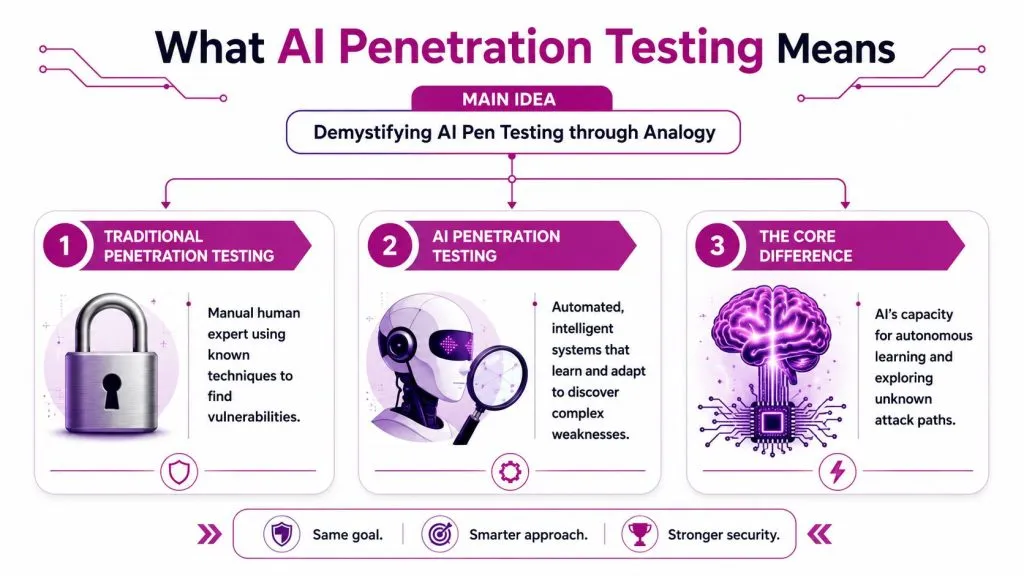
AI penetration testing is best understood as penetration testing that uses machine learning and automation to make better decisions faster, not as a magic system that replaces operator judgment. Traditional automation follows prewritten checks. AI-assisted testing can adapt based on what it learns from responses, environment structure, and prior attack outcomes.
Why scanning and pen testing are not the same
A simple analogy helps. Traditional vulnerability scanning is like checking every door in a building against a checklist of known lock defects. Penetration testing is closer to hiring someone to study the building, learn how people move through it, notice the service entrance no one documented, and test whether a small weakness in one area opens access somewhere more important.
AI penetration testing adds a system that can learn the building’s layout while it tests. It notices patterns, changes tactics, and proposes custom paths instead of only replaying canned checks.
That’s also why identity matters. Systems don’t fail in a vacuum. They fail in the context of users, roles, prompts, content, and trust boundaries. For teams working through how AI intersects with public exposure, brand impersonation, and user-level manipulation, this overview of managing online identity with artificial intelligence is useful context because it shows how AI-driven behaviors affect attack surfaces outside the app itself.
The three moving parts
AI penetration testing usually combines three capabilities:
| Component | What it does in practice | Where teams get misled |
|---|---|---|
| Decision-making models | Choose next steps based on responses, context, and prior results | Vendors call this “fully autonomous” when it still needs strict guardrails |
| High-speed automation | Run reconnaissance and test execution far faster than manual workflows | Speed gets mistaken for depth |
| Pattern analysis | Correlate findings across logs, endpoints, workflows, and outputs | Correlation gets mistaken for confirmed exploitability |
A good toolchain uses all three. A weak one leans on the second and markets it as the first.
AI penetration testing should change the quality of testing decisions, not just the number of requests sent at a target.
The easiest way to explain this to a client is blunt: if the platform can’t distinguish between “interesting” and “proven,” it’s still an assistant, not a tester. That distinction matters when you’re selling assurance, not activity.
Key Technical Approaches and Threat Scenarios
The technical side of AI penetration testing gets oversimplified fast. Most buyer-facing material talks about speed, autonomous discovery, or “smart payloads.” The harder part is knowing which techniques help in which phase, and which threat classes you’re trying to expose.
Where AI helps technically
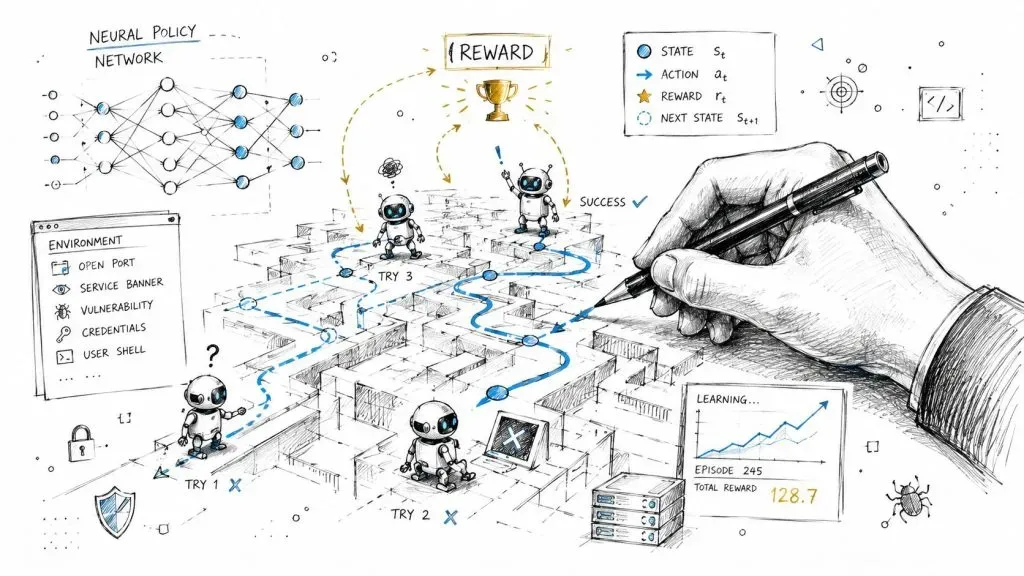
Some AI-driven testing engines behave like a fast analyst that never gets tired of trying permutations. They ingest responses, map likely attack surfaces, and adapt payloads based on what the target reveals. In practice, that’s most useful in API-heavy environments where parameters, states, and workflows create too many combinations for a tester to brute-force manually during a short engagement.
The underlying methods vary. Reinforcement-style approaches are useful for optimizing paths through multi-step attack sequences. Language-driven systems are better at generating context-aware inputs, especially where natural language interfaces, prompts, or business workflow text are part of the attack surface. Teams building internal automation around these ideas often benefit from reusable prompt and workflow design patterns, which is why resources on structured AI code solutions can be practical when you’re standardizing test logic rather than improvising every engagement.
Threats that require lifecycle testing
For machine-learning systems, testing the web layer alone isn’t enough. As SentinelOne notes in its guidance on AI penetration testing across the model lifecycle, attacks differ by phase: adversarial inputs target inference-time behavior, model inversion and extraction target repeated-query interfaces, and training-data poisoning targets the data or fine-tuning stage. A practical test plan should validate input sanitization, query-rate controls, output leakage, and training-pipeline integrity, not just the surrounding application.
That’s a big operational shift for MSPs. A client may say “test our chatbot,” but the actual scope could include:
- Inference controls that determine how the model reacts to crafted prompts or malformed inputs.
- API abuse resistance where repeated requests might expose patterns, outputs, or model behavior.
- Training and fine-tuning trust where upstream data quality can corrupt downstream decisions.
- Output governance that decides whether sensitive details leak through generated responses.
If your test plan starts and ends with the web front end, you’re not testing the AI system. You’re testing the wrapper around it.
A practical coverage model
A useful way to frame this internally is by attack layer, not by product feature.
- Application layer
Standard auth, session, access control, and input handling still matter. AI doesn’t erase old security failures. - Model interaction layer
Prompt injection, response shaping, output leakage, and repeated-query behavior live here. - Data and training layer
Poisoning, unsafe fine-tunes, and weak provenance controls appear within this layer. - Operational layer
Logging, rate limits, rollback paths, and deployment hygiene decide whether you can detect and contain abuse.
For MSPs, this model is easier to sell and easier to execute. It also aligns well with normal attack surface analysis practices because it forces teams to inventory not just systems, but interaction paths, trust boundaries, and places where AI changes how requests get interpreted.
The Real Benefits and Practical Limitations
The business case for AI penetration testing is strong when people describe it realistically. It’s weak when they describe it as autonomous security with minimal human effort.
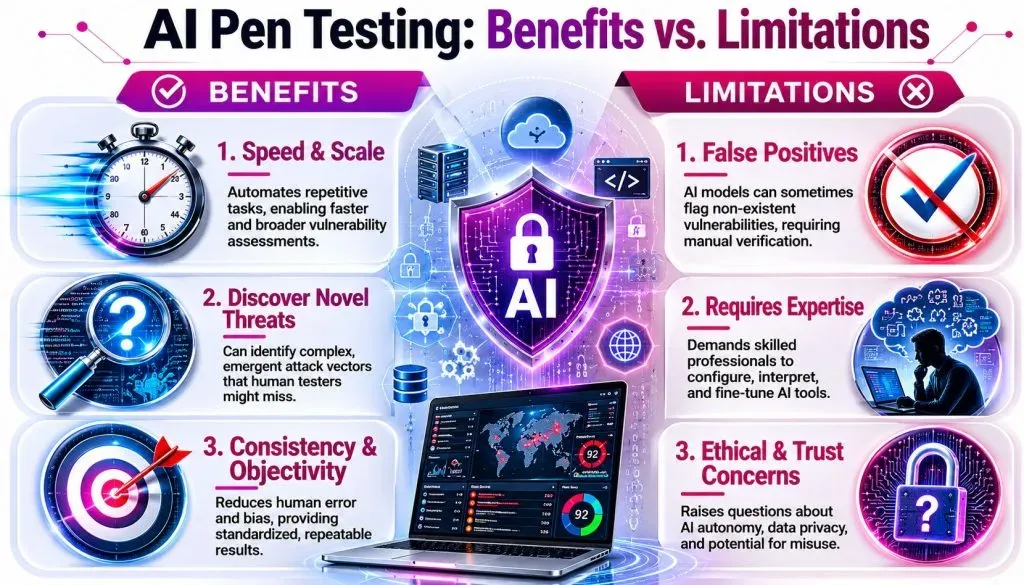
The strongest argument in its favor is the gap between broad automation and deep validation. According to a 2024 AppSecure/Straits Research study, manual AI penetration testing uncovered nearly 2,000% more unique security vulnerabilities than automated scanning tools alone. The same study noted that automated scanners increased detection by 39% over the past year, while manual AI-guided testing identified far more business-critical and logic-based issues. It also reported that 13% of organizations had breaches of AI models or applications, and 97% of those breached cases lacked proper AI access controls. Those figures were highlighted in industry coverage of the AppSecure and Straits Research findings. The takeaway is clear: AI contributes real value, but human-guided testing is what finds the failures that are critical.
Where the value is real
AI earns its place in three situations.
- Broad environments with constant change where applications, APIs, and cloud components shift too often for periodic manual coverage alone.
- Repetitive validation work where the same classes of tests need to be rerun after deployments, config changes, or remediation.
- Early pathfinding where analysts need help narrowing a large space of possible attack chains.
That’s especially useful for MSPs serving many clients with similar delivery constraints. You want faster triage, repeatable coverage, and fewer blind spots between scheduled engagements.
A short video summary can help teams align on the upside and the caution points before they buy into vendor claims.

Where the hype breaks down
The weak point is validation. AI can generate lots of candidate findings. It can’t eliminate the need for human confirmation in messy enterprise environments. The operational problem for MSPs isn’t just false positives. It’s the accumulated cost of proving which findings are real, safe to reproduce, and relevant to the client’s actual business risk.
The trade-off looks like this:
| Claim from vendors | What often happens in practice |
|---|---|
| Faster testing | Reconnaissance and candidate generation do get faster |
| Lower delivery cost | Savings drop when analysts must validate noisy output |
| Junior staff replacement | Senior review becomes more important, not less |
| Autonomous coverage | Coverage expands, but proof still depends on human judgment |
Field note: If your analysts spend most of the engagement reclassifying AI output, you didn’t buy efficiency. You bought another queue.
The mature position is simple. AI penetration testing is a force multiplier for good teams. It isn’t a replacement for exploit reasoning, business context, or client-safe validation.
Integrating AI into Your Security Workflows
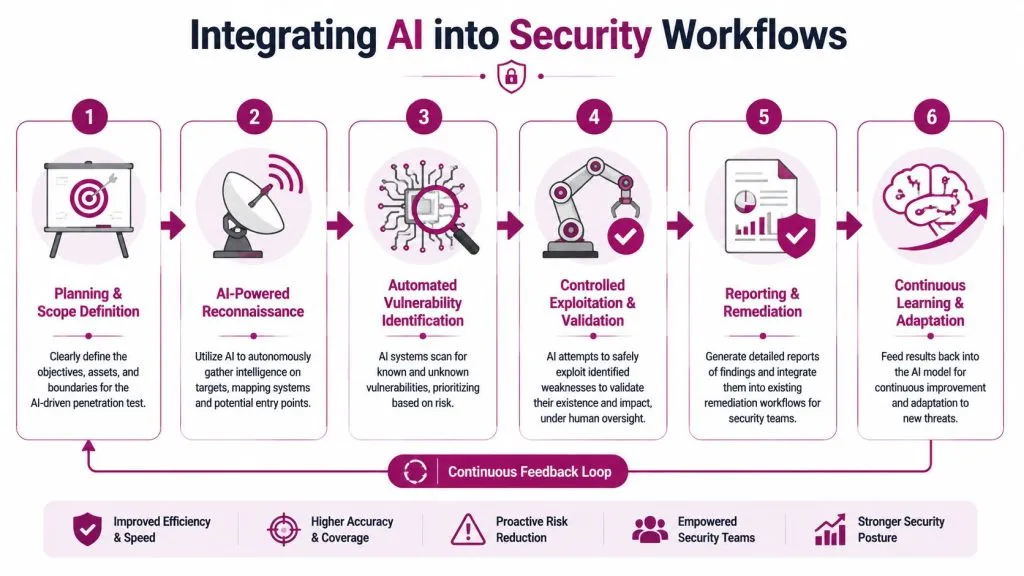
The teams that get value from AI penetration testing don’t treat it as a separate program. They plug it into the work they already do: external attack surface review, pre-release validation, red team simulation, and post-remediation retesting.
A workable operating model
A technically sound workflow starts with boundaries, then uses AI for speed where speed helps most.
- Define the target and off-limits areas
Include apps, APIs, model endpoints, data sources, and test accounts. Write down what the agent must never touch. - Run AI-assisted reconnaissance
Let the system map routes, parameters, auth patterns, and behavior differences. Automation saves time in this step without much downside. - Generate candidate exploit paths
Focus on paths involving privilege changes, sensitive outputs, prompt handling, or business workflow transitions. - Perform controlled exploit validation
Equixly’s guidance on AI penetration testing and exploit validation makes an important point: a robust AI pen test should include controlled exploit validation, not just detection, because AI-driven tools can map endpoints, generate context-aware payloads, and iterate until they reproduce a vulnerability. That changes the outcome from “possible issue” to confirmed exploitability, which is particularly valuable in CI/CD-backed environments. - Push findings into normal remediation channels
Tickets, risk ratings, proof artifacts, and retest requirements should look familiar to the delivery team.
Red team and blue team use
Red teams usually get the quickest win. AI helps them enumerate faster, adapt payloads, and revisit changed targets after releases. Blue teams benefit when the same findings feed detection engineering, alert tuning, and control validation.
A practical split looks like this:
- Red team usage includes attack-path exploration, payload mutation, and retest automation after fixes.
- Blue team usage includes validating detections, replaying known bad behaviors safely, and checking whether controls catch AI-specific abuse.
- DevSecOps usage focuses on pipeline gating, especially around APIs and externally exposed model functionality.
For email-heavy client environments, one overlooked integration point is message-layer security. If a client’s AI-enabled workflows depend on inbound or outbound email automation, it helps to pair testing with a clearer understanding of email security gateways, because abuse often starts before traffic reaches the application you’re testing.
Compliance Ethical and Scoping Challenges for MSPs
The hardest part of AI penetration testing usually isn’t technical. It’s contractual. MSPs run into trouble when they apply normal rules of engagement to systems that don’t behave like static targets.
A standard pentest scope assumes you can define assets, interfaces, allowed methods, and blast radius in advance. That works reasonably well for a web app, an API, or an internal segment. It works poorly for black-box AI systems, especially third-party SaaS models that accept unstructured input, adapt behavior over time, and may process client data outside the boundaries your team can directly verify.
Why traditional rules of engagement fail
The most important scoping problem is authorization. A client may own the workflow, the plugin, or the implementation, but not the underlying model service. If your test prompts trigger rate controls, data leakage, or service disruption in a third-party environment, who authorized that interaction?
That ambiguity isn’t theoretical. Recent legal analyses and CSA guidance for 2024 to 2025 found that 45% of AI penetration testing engagements face scope disputes because vendors can’t define authorized boundaries for unstructured model interactions. That creates liability risk for the MSP, especially when testing dynamic or third-party AI systems.
The moment a client says “test our AI assistant,” ask who owns the model, who owns the data path, and who approved adversarial interaction with both.
What to put in writing before testing starts
For AI engagements, your statement of work should be stricter than your normal pentest template. At minimum, define:
- Authorized interaction types
Prompt manipulation, repeated-query testing, output leakage checks, workflow chaining, and any attempt to induce unsafe actions. - Third-party boundaries
Name the SaaS providers, hosted models, plugins, and connectors included or excluded from testing. - Data handling rules
Specify what testers may submit, what they may store, and what must be redacted from evidence. - Stop conditions
Set explicit thresholds for service instability, abnormal model behavior, or signs of unintended data exposure. - Liability allocation
Spell out who is responsible if third-party terms are implicated or if a provider claims abuse.
That matters even more when your clients expect broader protective services around external exposure, impersonation, and credential risk. In those cases, pairing AI test engagements with supporting controls such as dark web monitoring for MSPs helps frame the work as part of a wider risk program, not a one-off experiment.
The operational rule is simple. If the scope language is vague, the liability is yours.
Frequently Asked Questions About AI Pen Testing
Can AI replace human penetration testers
No. It can automate reconnaissance, generate candidate attack paths, and accelerate retesting. It can’t reliably replace human judgment about exploit safety, business logic, legal boundaries, and reporting quality.
Is AI penetration testing just vulnerability scanning with better branding
Sometimes, yes. If a platform mostly runs known checks, produces a large finding list, and leaves your team to prove impact manually, it’s closer to enhanced scanning than real penetration testing. The difference is whether it can adapt intelligently and support controlled validation.
Where does AI help the most
It helps most in large, changing environments with many APIs, frequent releases, and enough complexity that manual enumeration becomes the bottleneck. It also helps where teams need continuous retesting after code and config changes.
What should MSPs ask vendors before buying
Ask how the system validates findings, how it handles false positives, what level of operator oversight it expects, and how it supports evidence collection. Also ask what guardrails exist for third-party systems and dynamic AI targets.
What skills matter if I want to build expertise here
Start with strong fundamentals: web app testing, API security, identity, logging, and threat modeling. Then add AI-specific understanding around prompt abuse, model interaction risks, training data trust, and output controls. The best practitioners in this area are still strong pentesters first.
What’s the simplest way to start
Pick one narrow use case. API retesting after each release is a good example. Define scope tightly, require human validation, and measure whether the workflow reduces analyst time without lowering confidence in the result.
If you want a practical way to expand AI-guided penetration testing, vulnerability visibility, dark web monitoring, and external threat detection for your clients, InsecureWeb is built for MSPs and security providers that need white-label delivery, API access, and tools that fit into existing operations rather than replacing them.