Data Breach News13 min read
Cyber Threat Assessment: A Playbook for MSPs in 2026
By InsecureWeb Team
This report reflects observations of dark web activity. InsecureWeb makes no representations regarding the accuracy of this data.
Attackers don’t need long windows anymore. In 2025, automated exploitation attempts surged to 122 billion globally, and new vulnerabilities are now exploited within hours or days instead of weeks, which leaves defenders with almost no response time, according to Fortinet’s threat landscape reporting.
That changes how an MSP should run a cyber threat assessment.
A lot of assessments still start and end with an internal scan. That’s too narrow for most SMB clients. The essential job is to combine what the client can see inside its environment with what attackers can already see from the outside. That includes exposed assets, leaked credentials, fake domains, impersonation, and signs that the client is already part of someone else’s workflow.
Most frameworks tell you what a mature assessment should include. Fewer tell you how to make that practical for a small or mid-sized client that doesn’t have a dedicated internal security team. That gap matters because 74% of SMBs lack dedicated security teams to correlate external signals with internal gaps, as noted by BIPC’s discussion of threat assessment realities.
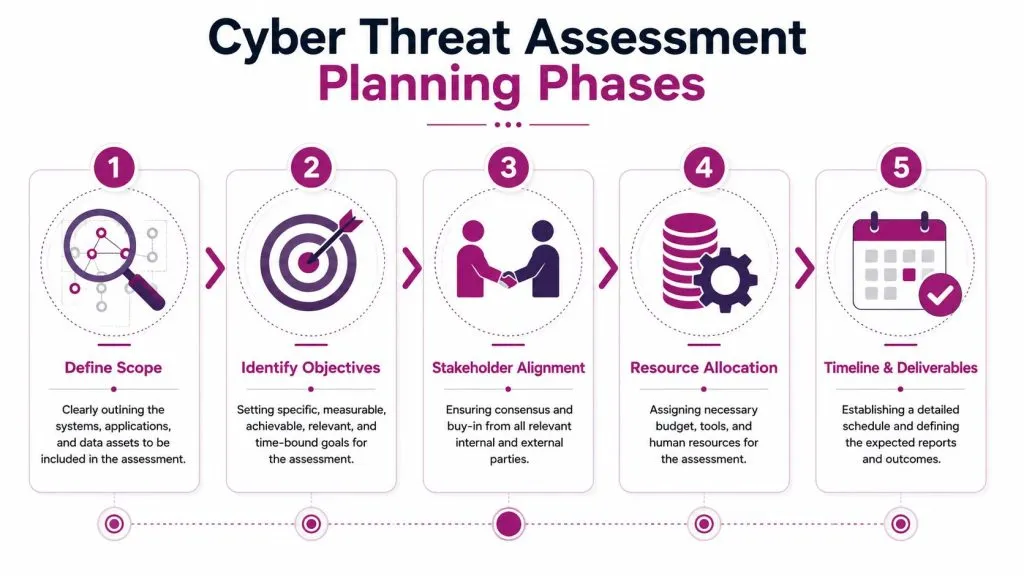
Framing the Assessment Planning Scoping and Objectives
A good cyber threat assessment is a business exercise first and a technical exercise second. If you start by asking which scanner to run, you’re already behind. Start by asking what the client can’t afford to lose, what would stop operations, and which systems would create legal, contractual, or customer fallout if they were compromised.
Start with business impact not tool output
For a typical SMB client, scope usually breaks into four buckets:
- Core business systems like email, identity, file storage, productivity platforms, CRM, ERP, and remote access.
- Sensitive data stores such as customer records, employee data, payment-related systems, contracts, and internal documents.
- Public-facing assets including websites, portals, VPN gateways, exposed apps, and cloud services.
- Third-party dependencies such as SaaS platforms, managed cloud environments, and key vendors that touch business data.
When I walk a new MSP partner through a first assessment, I usually ask for three things before any scan starts: an asset list, a list of critical business processes, and a list of recent changes. New cloud deployments, acquisitions, remote work rollouts, and vendor changes often tell you where to look first.
Practical rule: If the client can’t explain which systems generate revenue, support operations, or hold regulated data, the assessment isn’t ready to begin.
Use a structured method from day one
A disciplined process keeps the assessment from turning into a random list of findings. A widely used seven-step methodology includes defining scope and objectives, building an asset inventory, profiling likely threat actors, developing attack scenarios, assessing likelihood, prioritizing risk, and reporting for both technical and executive audiences, as outlined in Cynomi’s overview of cyber threat assessment methodology.
For MSP work, that model becomes practical when you turn each step into a client conversation.
| Assessment step | What you need from the client | What the MSP should produce |
|---|---|---|
| Scope and objectives | Business priorities, compliance needs, critical services | Clear boundaries and success criteria |
| Asset inventory | Systems, users, vendors, cloud apps | Classified asset register |
| Threat profiling | Industry, geography, customer type | Relevant attacker profile |
| Attack scenarios | Known exposures and likely entry points | Credible attack paths |
| Likelihood review | Exposure and existing controls | Risk confidence level |
| Prioritization | Impact tolerance and budget reality | Ranked remediation list |
| Reporting | Technical and executive stakeholders | Two versions of the same story |
The trade-off is simple. A narrow scope is faster and easier to sell. A realistic scope produces a better assessment. For SMBs, the right balance is usually to go deep on business-critical systems and broad on the external attack surface.
That’s also where an outside-in view helps early. Before the first internal workshop, an MSP should identify what the client already exposes publicly. That keeps scope grounded in the client’s actual attack surface rather than the inventory they think they have.
Fueling the Assessment with Threat Intelligence and Modeling
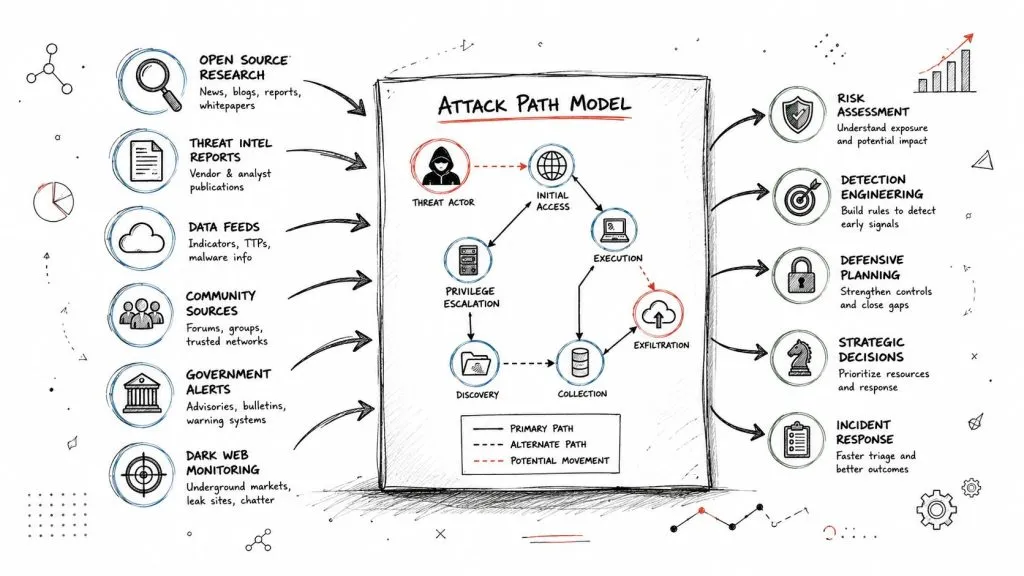
Most weak assessments fail for the same reason. They model attacks from the defender’s point of view, not the attacker’s.
An internal admin may think in terms of endpoints, patch levels, and user groups. An attacker thinks in terms of reachable services, stolen credentials, impersonation routes, supplier trust, and the fastest path to money or control.
Why external intelligence changes the model
External threat intelligence matters because it shows you conditions the client may never detect from inside the network. That includes breached employee credentials, typo domains, fake social accounts, cloned login pages, and other signs that someone is preparing or actively running a campaign around the business.
That’s not theoretical. If stolen credentials tied to the client are already circulating, your threat model should treat identity compromise as an active scenario. If a fake login page is live, your phishing model should move up the queue. If a new public asset appears that nobody internally recognizes, your scoping problem just became a security problem.
One practical reference for MSPs working from this outside-in angle is dark web monitoring for managed service providers, which describes how external monitoring can surface leaked credentials and other exposure indicators before they become incident tickets.
The best threat model usually starts with evidence that the client is already visible to attackers.
Build attack paths that match the client
Threat modeling gets more useful when you stop writing one-path stories. Real attackers pivot. They chain weak identity controls, exposed services, third-party trust, and user behavior.
For SMB clients, I like to sketch attack paths using this pattern:
- Initial access route. Exposed application, credential reuse, phishing, impersonation, or supplier compromise.
- Privilege path. Weak MFA coverage, stale accounts, over-permissioned admin roles, or unmanaged endpoints.
- Target asset. Finance systems, email, file storage, customer records, backups, or executive accounts.
- Business outcome. Extortion, fraud, downtime, data theft, or brand damage.
The speed of the current threat environment matters. Fortinet reported that attackers are exploiting new vulnerabilities within hours or days instead of weeks, and that AI and automation are pushing operations to machine speed across network, cloud, hybrid, and endpoint environments in its threat landscape report. That’s why static annual modeling isn’t enough by itself.
A short walkthrough can help clients visualize what you mean:
- Credential-led path where leaked employee logins combine with weak MFA enforcement.
- Brand-led path where a fake domain captures credentials, then email access is used for invoice fraud.
- Exposure-led path where an internet-facing service gives an attacker a foothold, then lateral movement reaches backups or file shares.
A quick primer can help less technical stakeholders understand how this works in practice:

Attack paths should feel uncomfortably plausible. If the scenario reads like a nation-state thriller for a regional accounting firm, it’s probably the wrong model. For most SMB clients, extortion, ransomware, phishing, account takeover, and impersonation deserve more attention than exotic tradecraft.
Finding the Gaps Through Data Collection and Analysis
Once the external picture is clear, the next job is to prove or disprove the attack paths with internal evidence. At this stage, many MSPs either drown the client in scanner output or oversimplify the work and miss the paths that matter.
A useful internal analysis looks for three things at once: exploitable weaknesses, weak controls around critical assets, and combinations that make a realistic attack path possible.
Collect internal evidence in layers
Start with broad collection, then narrow into validation. In practice, that usually means:
- Asset verification to confirm what’s live, not just what appears on the old inventory sheet.
- Vulnerability scanning across endpoints, servers, cloud workloads, and public-facing assets.
- Identity review for MFA coverage, privileged access, stale accounts, and admin sprawl.
- Configuration review on backup systems, remote access, email security, logging, and segmentation.
- Targeted validation to test whether the highest-risk findings are exploitable.
This work has to be disciplined because the volume of attacks and breach costs keep rising. Cybersecurity breaches increased by up to 40% globally in 2026, weekly attack volume reached 1,968 cyber attacks per week, and the global average cost of a data breach climbed to $4.88 million in 2024, according to SentinelOne’s cybersecurity statistics roundup.
That doesn’t mean every SMB needs enterprise-scale testing. It does mean you can’t stop at a surface scan and call it a cyber threat assessment.
Scanning finds breadth and testing finds chains
A vulnerability scanner is good at coverage. It will tell you where software is old, where services are exposed, and where obvious misconfigurations exist. That’s essential, but it isn’t enough by itself because scanners rarely explain business context and often miss chained attack paths.
Penetration testing is different. It asks whether separate weaknesses can be combined into actual compromise. That distinction matters when an exposed service, a weak admin policy, and a bad segmentation choice are harmless on their own but dangerous together.
A practical workflow for MSPs looks like this:
| Activity | Best use | Common mistake |
|---|---|---|
| Vulnerability scanning | Continuous discovery and trend tracking | Treating every finding as equally urgent |
| Configuration review | Control validation around key systems | Ignoring identity and cloud settings |
| Penetration testing | Proving exploitability and attack chains | Running it too late, after priorities are already set |
| Correlation | Tying external and internal evidence together | Keeping each dataset in its own silo |
For teams that want to connect outside-in and inside-out analysis, attack surface analysis is a useful operating model. It forces you to look at what the internet reveals about the client, then connect that to internal weaknesses that could turn exposure into impact.
This is also where regulatory context shapes the analysis. If you support government contractors, 2026 CMMC audit prep for contractors is a useful reference because it highlights how readiness work depends on evidence, control validation, and documentation rather than checklist claims.
The practical trade-off is time. Full testing on every asset isn’t realistic for most SMB budgets. The answer isn’t to skip validation. It’s to focus validation on the systems, identities, and paths that would hurt the client most if compromised.
From Data to Decisions Using Risk Scoring and Prioritization
Most clients don’t need a longer list of problems. They need a defensible answer to one question. What should we fix first?
That answer only gets better when the scoring model is consistent. If one consultant scores based on technical severity and another scores based on gut feel, the output won’t survive budget scrutiny or board review.
Score the scenario not just the flaw
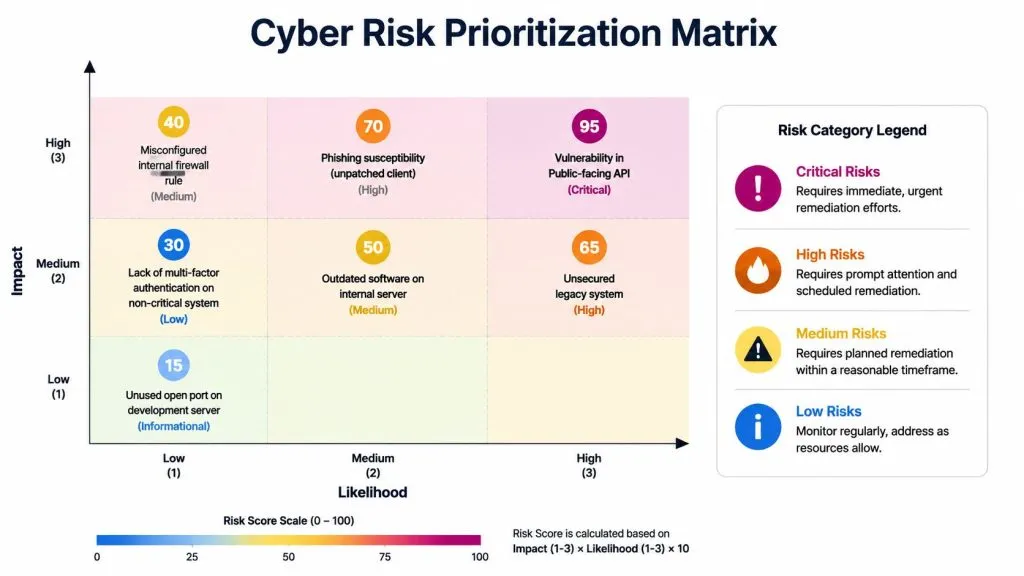
A useful risk score combines likelihood and impact, but the unit of analysis should be the scenario, not the individual vulnerability. “Unpatched server” isn’t a business risk on its own. “Unpatched internet-facing server that could provide access to customer data and interrupt billing” is.
I like a simple matrix because clients can understand it quickly and technical teams can still work with it.
Use plain criteria for each dimension:
- Likelihood should reflect exposure, attacker interest, exploitability, and current control strength.
- Impact should reflect downtime, data sensitivity, financial disruption, customer effect, and regulatory consequences.
- Confidence should note whether the score comes from confirmed testing, scanner output, or partial evidence.
A lightweight scoring rubric keeps the meeting focused:
| Factor | Low | Medium | High |
|---|---|---|---|
| Exposure | Hard to reach | Reachable with conditions | Directly reachable or already targeted |
| Controls | Strong and tested | Present but uneven | Weak, missing, or unverified |
| Business impact | Limited disruption | Department-level disruption | Company-level disruption or sensitive data loss |
Decision lens: Prioritization should tell the client what deserves immediate remediation, what needs scheduled treatment, and what can be formally accepted.
Avoid the mistakes that ruin prioritization
A lot of risk scoring breaks down because teams mix up inherent risk and residual risk. Inherent risk is the risk before controls. Residual risk is what remains after controls are considered. If those get blended together, ratings become inflated or misleading.
Another common failure is relying too heavily on automated scans. According to Optro’s guide to cybersecurity risk assessments, over-reliance on automated vulnerability scanning without complementary penetration testing can produce 30–40% false-negative rates for complex attack vectors, and inadequate integration of third-party and supply chain risks accounts for 62% of breaches in mid-sized organizations.
That should change how you prioritize. A clean scan on a critical workflow with weak third-party controls shouldn’t create false confidence.
Use treatment categories in the report so decisions are explicit:
- Mitigate when the risk is real and the control is feasible.
- Transfer when insurance or contractual allocation makes sense.
- Avoid when the business can remove the risky process entirely.
- Accept when the exposure is understood and the client consciously keeps it.
What works is consistency. What doesn’t work is moving findings up or down the list based on who shouts loudest in the review meeting.
Driving Action with Effective Reporting and Remediation
The report is where a cyber threat assessment either becomes operational or dies as a PDF attachment.
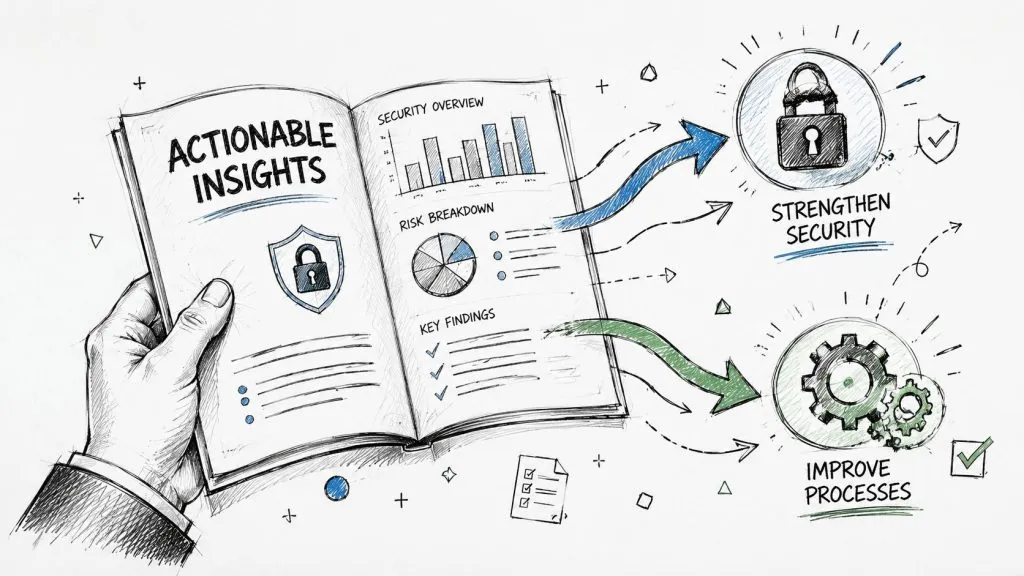
A weak report lists findings. A useful report creates movement. It tells executives why the issue matters, tells technicians what to do next, and gives the MSP a structure for follow-through.
Write two reports from one assessment
One document rarely serves every audience. Executives want business risk, priorities, cost logic, and decisions. Technical teams want evidence, affected assets, attack paths, and remediation detail.
That means the best reporting package usually has two layers.
For executives:
- Top risks in plain language tied to operations, revenue, customer trust, and compliance exposure.
- Why now based on realistic attacker behavior and current exposure.
- Remediation sequence showing what should happen first, next, and later.
- Decision points that require budget, ownership, or policy change.
For technical teams:
- Affected assets and identities with enough detail to act.
- Validation notes showing whether a finding was observed, inferred, or exploited in testing.
- Remediation guidance that maps to the client’s environment, not generic vendor boilerplate.
- Retest criteria so closure means something.
A report should reduce debate, not create more of it.
This matters even more for SMB clients because many of them don’t have internal security staff to translate findings into action. BIPC notes that 74% of SMBs lack dedicated security teams in its discussion of the practical challenge of correlating external intelligence with internal gaps for smaller organizations, which is why reporting has to do some of that translation work for them.
Turn findings into a remediation motion
Remediation planning should look like an operating plan, not a wish list. Every high-priority item needs an owner, a treatment decision, a target date, and a way to verify closure.
A simple structure works well:
| Finding | Business effect | Treatment | Owner | Validation |
|---|---|---|---|---|
| Exposed login path with weak identity control | Account takeover risk | Mitigate | IT lead | Retest access flow |
| Leaked employee credentials | Fraud and unauthorized access | Mitigate and monitor | Security contact | Confirm password resets and MFA |
| Fake domain or impersonation | Brand abuse and phishing | Mitigate | Marketing and IT | Confirm takedown and monitoring |
This is the point where tools can make the MSP workflow more efficient if they support both detection and reporting in one place. InsecureWeb is one example used by MSPs for outside-in monitoring and internal security testing, including dark web monitoring, fake site detection, vulnerability scanning, AI-guided penetration testing, and brandable reports under the provider’s own identity.
If the assessment uncovers evidence of active exposure or compromise, don’t let the client jump straight to “we’ll patch later.” They also need an immediate response track. A practical follow-up resource for that moment is steps after data breach, which outlines the actions teams should take once exposure is confirmed.
What works here is cadence. Review remediation weekly at first, then monthly once the backlog stabilizes. What fails is dropping the report, scheduling a retest for six months later, and assuming the client will self-manage the middle.
Adopting a Continuous Threat Assessment Mindset
A cyber threat assessment shouldn’t be treated as a yearly event with a final binder and a forgotten spreadsheet. The useful version is a cycle. Scope changes. Exposures change. Vendors change. Staff changes. Attackers change faster than any of them.
For MSPs, the practical model is clear. Keep the business context current, watch the external environment continuously, validate internal weaknesses on a recurring basis, and keep risk scoring tied to real attack paths instead of isolated findings.
That’s the missing bridge for many SMB clients. High-level frameworks are still useful, but they become operational only when you fuse external threat intelligence with internal validation and then turn that into a ranked remediation plan people can follow.
The MSP that does this well stops acting like a scanner operator and starts acting like a security partner. That changes retention, reporting quality, and the client’s ability to make decisions before an incident forces them to.
If you want to turn cyber threat assessment work into a repeatable MSP service, InsecureWeb is worth evaluating as part of your stack. It gives teams an outside-in view of leaked credentials, impersonation, fake sites, and other external threats, alongside internal security testing capabilities that help connect exposure to remediation.