Data Breach News16 min read
What Is OSINT? a Practical Guide for Cybersecurity
By InsecureWeb Team
This report reflects observations of dark web activity. InsecureWeb makes no representations regarding the accuracy of this data.
OSINT is the practice of collecting and analyzing publicly available data to produce actionable intelligence, and it has become mainstream enough that over 78% of Fortune 500 companies use it for threat detection. For security teams, that matters because attackers also mine public data, often spotting exposed credentials, risky social posts, or forgotten internet-facing assets before defenders do.
A familiar scenario plays out every week. An employee posts a screenshot that reveals more than intended. A developer leaves a clue in a public code repository. A forgotten service is visible through internet scanning tools. None of that required a breach to discover. It was already out in the open, waiting for someone to connect the dots.
That’s where OSINT matters in business security. It gives IT teams, MSPs, and MSSPs a disciplined way to see their organization from the outside. Not through guesses or broad “awareness,” but through repeatable collection, filtering, analysis, and reporting. Used well, it helps answer practical questions such as: What can an attacker learn about us right now? Which exposed details increase phishing risk? Are our client brands being impersonated? What public data could create legal trouble if we handle it carelessly?
The compliance part is where many teams get sloppy. They hear “publicly available” and assume “safe to collect and reuse.” That assumption creates real risk, especially for MSPs serving clients across the EU, the UK, the US, and other jurisdictions with different privacy standards. The technical side of OSINT is only half the job. The other half is knowing where the legal and ethical lines are, documenting why you collected what you collected, and limiting how that data is stored and shared.
Introduction The Growing Need for OSINT in Business Security
Most breaches that involve OSINT don’t start with advanced malware. They start with visibility. An attacker learns who the finance lead is, which vendor the company uses, what cloud stack appears in job postings, and which staff members are likely to click a well-crafted message. That’s enough to shape a phishing campaign or identify a weak point.
For defenders, the practical value of OSINT is simple. It reduces blind spots outside the firewall. That includes public social profiles, exposed services, leaked mentions of credentials, archived web content, impersonation domains, and discussion threads that reveal operational details no one meant to publish.
Over 78% of Fortune 500 companies use OSINT for threat detection, which tells you this isn’t a niche analyst hobby anymore. It’s now part of mainstream defensive practice for organizations that need to identify threat signals early and convert raw public data into something operationally useful, as noted by Recorded Future’s overview of open-source intelligence.
Practical rule: If an attacker can learn it without touching your network, your security team should assume it belongs in scope.
That matters even more for MSPs. You’re not protecting one environment. You’re protecting many, often across different industries and legal regimes. One client may need brand impersonation monitoring. Another may need exposed asset discovery. Another may care more about leaked executive details or social engineering exposure. OSINT supports all of those, but only if the work is scoped well and tied to a clear security question.
Many teams still treat OSINT as ad hoc searching. That doesn’t hold up in real operations. Without process, you collect noise. Without legal discipline, you create liability. Without a decision path, you end up with screenshots and bookmarks instead of intelligence.
The OSINT Framework Explained From Data to Decisions
An analyst flags a GitHub repository tied to a client brand. On its own, that looks routine. Thirty minutes later, the same brand appears in a typo-squatted domain registration, an archived careers page naming a legacy VPN product, and a forum post discussing a recent credential dump. That is the point where raw public data becomes security work, and where sloppy handling can also become a legal problem for an MSP operating across borders.
OSINT is a formal intelligence discipline. Its definition was codified in 1998 as “intelligence produced from publicly available information that is collected, exploited, and disseminated in a timely manner,” and by 2015, over 60% of U.S. federal intelligence agencies reported using OSINT for at least 30% of their daily operational requirements, according to research published in The International Journal of Intelligence, Security, and Public Affairs.
Why OSINT is more than searching
Search gets you artifacts. OSINT gets you answers that support a security decision.
That distinction matters because public information is messy. You will find stale employee records, reposted breach data, fabricated personas, abandoned infrastructure, and content that is legal to view in one jurisdiction but problematic to collect or store in another. An MSP cannot treat all publicly accessible data as equally usable just because a browser can reach it.
Good OSINT starts with a requirement. Find exposed assets linked to a client acquisition. Confirm whether leaked credentials are current enough to trigger reset actions. Determine whether an executive impersonation campaign is isolated or part of a wider fraud pattern. The work is scoped to a business question, and the collection method has to match the legal and contractual boundaries around that client.
The difference is discipline. Teams collect relevant data, record provenance, verify context, and document why a finding matters. If your analysts cannot show how a screenshot, record, or dataset connects to a risk decision, they are doing research, not intelligence.
For MSPs, this is also where compliance enters the process. A public source can still create exposure if your team scrapes personal data at scale, stores it longer than necessary, or transfers it across jurisdictions without a lawful basis. That matters as much as the technical finding.
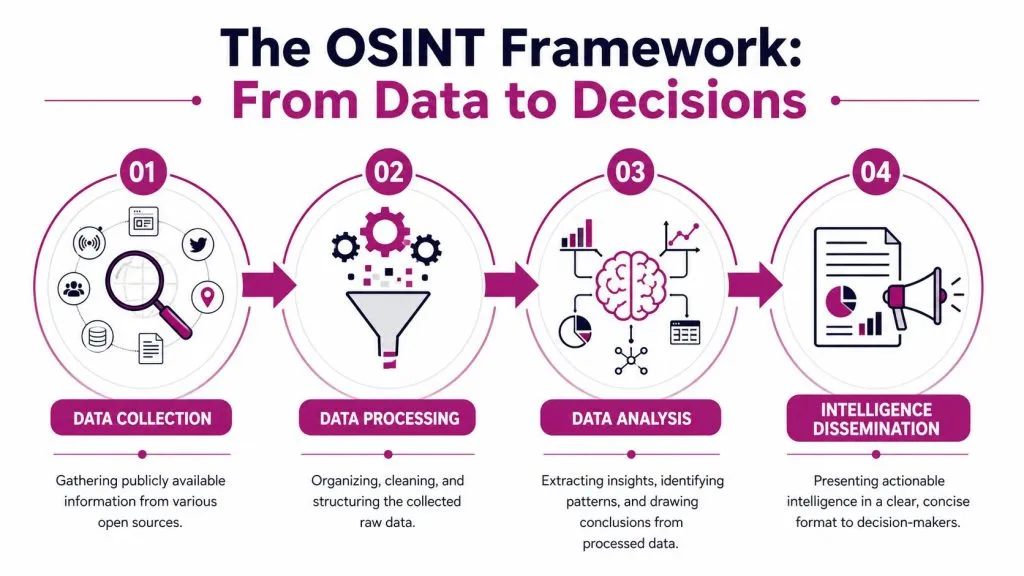
The four-stage workflow
A reliable OSINT workflow follows four stages. The model used by SANS’ overview of OSINT and intelligence analysis maps well to day-to-day security operations.
- Collection
Teams gather public information from sources that fit the intelligence requirement. That can include domain records, code repositories, archived pages, breach discussions, procurement data, and public infrastructure indexes. Start narrow. Broad collection creates review overhead, raises handling risk, and often pulls in data your team has no reason to retain. - Processing
Raw material needs cleanup before anyone can trust it. Remove duplicates, normalize formats, timestamp findings, and label source reliability. If your team is collecting structured content from websites or public platforms, understanding what is web data helps when you need to turn pages, fields, and metadata into something analysts can filter and compare. - Analysis
Here, disconnected records become an exposure story. Analysts correlate identities, assets, timelines, and technical indicators to answer a specific question. Tools such as Shodan, Censys, Maltego, SpiderFoot, and dark web monitoring workflows can help, but the tool output still needs human judgment, especially if the result could trigger client notification, takedown requests, or legal review. For teams tracking leaked mentions and criminal-market exposure, dark web monitoring for client risk detection is often part of this stage. - Dissemination
Intelligence has to reach the person who can act on it. A SOC team needs indicators and affected assets. A vCISO needs business impact, scope, and remediation priority. A compliance lead needs enough detail to assess lawful collection, retention, and cross-border handling.
Good OSINT reporting answers three questions: what was found, how confident you are, and what action the client should take.
A lot of OSINT work fails here. Analysts gather interesting evidence, but the output never changes detection rules, password reset scope, executive protection steps, vendor review, or legal handling procedures. For security teams and MSPs, the standard is simple. If the result does not support a decision, the workflow is incomplete.
Common OSINT Sources and Techniques
The easiest way to understand what is OSINT in practice is to stop thinking about “the internet” as one source. It’s a collection of different environments, each with different signal quality, legal constraints, and security value.
Where useful intelligence usually comes from
Public social platforms are obvious, but they’re only one layer. Analysts also pull from company websites, press releases, code repositories, archived pages, domain registration records, court filings, procurement portals, news coverage, breach discussions, and underground spaces that aren’t indexed by standard search engines.
If your team works with scraping, extraction, or large-scale collection, it helps to understand the difference between pages people browse and the underlying structured information behind them. This short guide on what web data is and how teams use it is a useful reference when you’re turning public content into something analyzable.
Key OSINT Source Categories
| Source Category | Examples | Potential Intelligence |
|---|---|---|
| Social media | LinkedIn, X, public Facebook pages, Telegram channels | Employee roles, executive travel clues, hiring trends, impersonation targets |
| Corporate web presence | Official websites, archived pages, blog posts, press releases | Tech stack hints, acquisitions, office locations, vendor references |
| Public records | Government filings, procurement portals, court records, business registries | Ownership details, legal disputes, licensing, partner exposure |
| Code and developer spaces | GitHub, package registries, public issue trackers | Hardcoded secrets, internal naming conventions, infrastructure references |
| News and research | Trade publications, local news, academic papers | Incident details, supply chain issues, public criticism, conflict indicators |
| Deep and dark web | Forums, leak sites, hidden services | Stolen credentials, breach chatter, fraud activity, brand abuse signals |
One important category sits just outside routine web searching. Dark web monitoring can reveal credentials, internal documents, or brand references before they show up in customer complaints or incident tickets. For teams building that capability, dark web monitoring for external exposure detection is worth understanding as a dedicated discipline, not just an extension of search.
Technique matters as much as source
A junior analyst can drown in public data in an afternoon. The difference between noise and value usually comes down to technique.
- Cross-referencing identities helps verify that a username, email format, or alias appears across multiple places before you treat it as meaningful.
- Relationship mapping is useful when you need to connect people, domains, subsidiaries, or exposed assets that don’t look related at first glance.
- Passive reconnaissance is safer from both a legal and operational standpoint because it avoids intrusive probing.
- Context checking prevents a common OSINT failure, which is reporting something publicly visible that’s old, unrelated, or misunderstood.
Public data lies all the time. OSINT works when analysts verify before they escalate.
A mature team treats every open source artifact as untrusted until corroborated. That habit improves both security decisions and compliance posture.
Practical OSINT Applications for Businesses and MSPs
The value of OSINT becomes obvious when it solves an operational problem. MSPs don’t need another abstract framework. They need services that help clients reduce exposure, respond faster, and spot risks before they become tickets, outages, or legal issues.
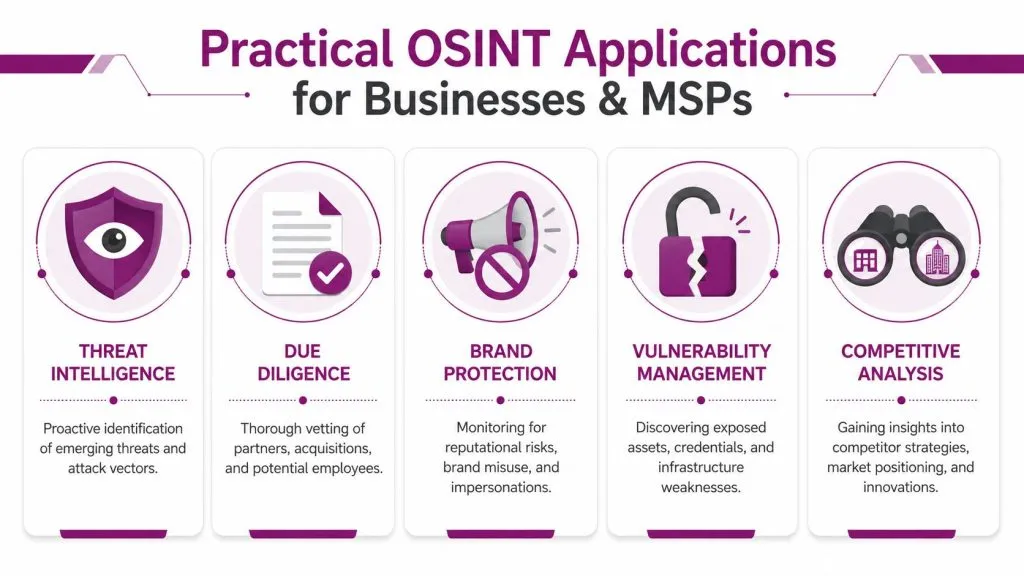
Use cases that actually help security teams
One of the strongest uses is external exposure management. Publicly visible subdomains, login portals, stale cloud assets, and old marketing microsites often sit outside normal vulnerability management cycles. OSINT helps identify what’s reachable, what looks abandoned, and what gives an attacker useful reconnaissance.
Another strong use is brand impersonation monitoring. Fake domains, fake executive profiles, and fake support accounts don’t stay confined to marketing problems. They become phishing infrastructure. They erode trust. They also create incident response work for teams that could have caught them earlier through external monitoring.
Third-party and acquisition due diligence is another area where OSINT pays off. Before an MSP onboards a client or a business signs a strategic partner, public evidence can reveal sloppy security hygiene, exposed infrastructure, or high-risk public behavior. It won’t replace formal assessment, but it sharpens where you look.
A fourth use case is credential and leak awareness. If executive accounts, employee details, or client identifiers appear in public breach chatter, the issue isn’t just that the data exists. It’s that attackers can operationalize it quickly. Security teams should pair that intelligence with account review, reset workflows, and user communication. If the worst already happened, this guide on steps to take after a data breach is a practical follow-on for response planning.
OSINT beyond digital risk
Many teams still think OSINT stops at cyber threat hunting. It doesn’t. Recent OSINT platforms are being used to assess physical risk as well. According to Flashpoint’s overview of open-source intelligence, 72% of physical security incidents in 2024 were detectable 3-5 days early via OSINT-enabled AI, yet less than 15% of organizations had integrated OSINT into their physical security frameworks.
That matters for clients with offices, executives, public events, retail sites, or exposed field teams. Public sentiment, geotagged posts, protest chatter, and discussion in fringe forums can indicate that a digital issue is about to become a physical one.
For MSPs, the practical lesson is broad. OSINT isn’t one service. It’s a layer that supports several services:
- Threat intelligence support for phishing, impersonation, and early warning
- Vulnerability visibility for public-facing assets and forgotten infrastructure
- Due diligence for partners, vendors, and acquisitions
- Executive protection for impersonation, doxxing, and hostile attention
- Physical risk monitoring when online signals point to offline disruption
The teams that get the most value don’t treat OSINT as a separate project. They embed it into recurring security operations.
Navigating the Legal and Ethical Minefield
OSINT is legal in principle because it relies on public information rather than unauthorized access. That distinction matters. It’s not hacking, and it’s not espionage in the technical sense described by Vaadata’s breakdown of OSINT methods and tools. But legality doesn’t end at access. It extends to collection method, purpose, retention, sharing, and jurisdiction.
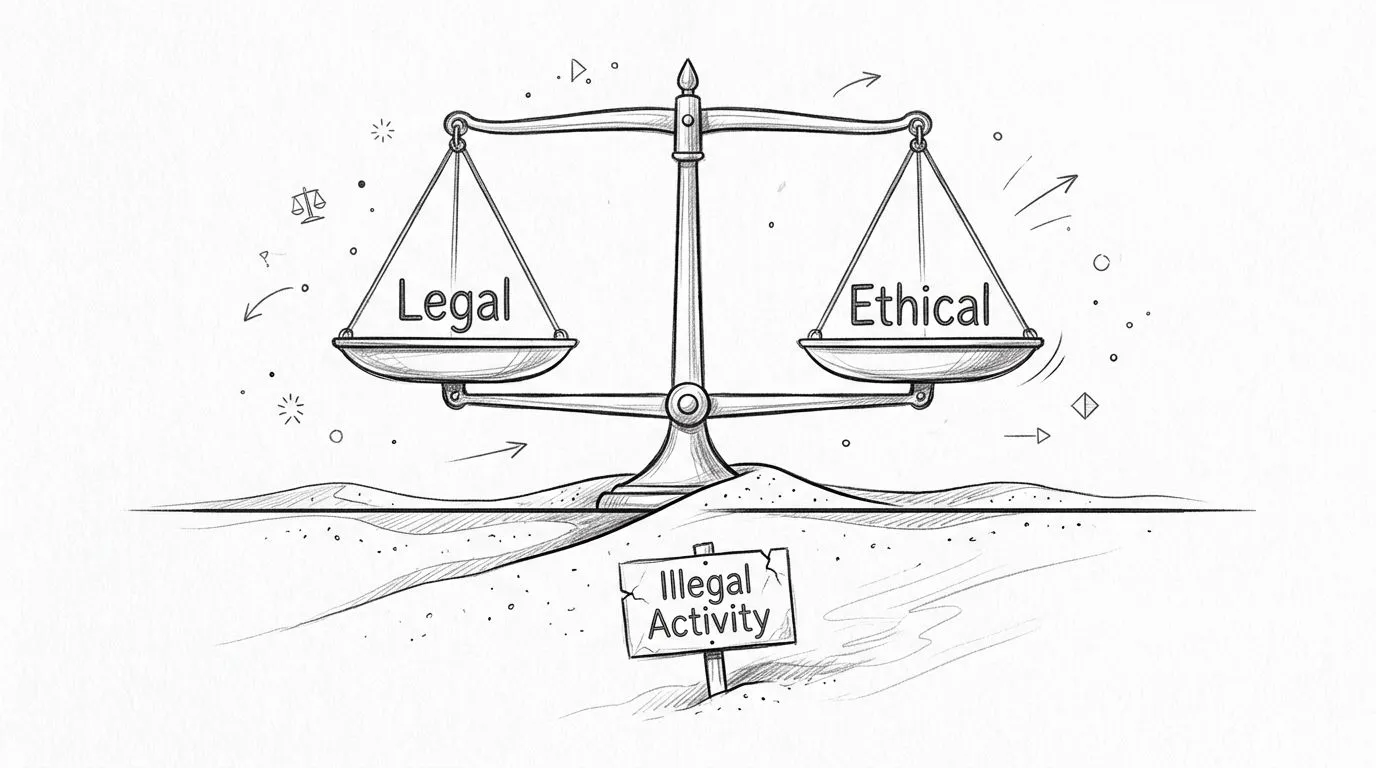
Public does not mean unrestricted
This is the mistake that causes most compliance trouble. Teams assume that if a profile, post, or public database is visible without authentication, they can scrape it, enrich it, store it indefinitely, and reuse it for any client purpose. That’s not a safe assumption.
A 2024 SANS Institute study found that 68% of organizations using OSINT had faced at least one compliance violation or legal challenge due to non-consensual data scraping of public profiles, particularly in EU markets, as discussed in SANS’ article on open-source intelligence. For MSPs operating across jurisdictions, that number should change how OSINT programs are designed.
The core issue is purpose limitation. Privacy regimes often care less about whether data was technically public and more about how you collected it, why you processed it, whether consent was relevant, whether personal data was minimized, and whether individuals could be harmed by secondary use.
If your OSINT process can’t explain why each category of personal data is necessary, you don’t have a collection strategy. You have a liability pipeline.
That’s especially true when analysts scrape personal profiles in bulk, merge them with client records, or use AI enrichment on identifiable individuals. Even when the security intent is legitimate, the workflow can still violate policy, terms, or privacy obligations.
To help teams think through the operational side of the issue, this video gives a useful overview of the legal and ethical tensions involved in open-source intelligence work:

A workable compliance framework for MSPs
A defensible OSINT program usually has these elements:
- Defined purpose
Tie every collection activity to a specific security objective. “General monitoring” is weak. “Detect impersonation targeting client executives” is stronger. - Data minimization
Collect only what supports the question. If a public profile reveals identity, role, and employer, don’t capture unrelated personal details just because they are available. - Jurisdiction review
Before collecting at scale, check whether the target market creates extra obligations. Cross-border MSP work makes this non-optional. - Retention limits
Don’t keep raw scraped data forever. Hold the minimum necessary, and separate evidence from analysis notes. - Human review before escalation
Sensitive findings involving named individuals should be reviewed before they enter client reporting or automated workflows. - Terms and procurement controls
If you use a vendor or scraping platform, verify how they collect data and what contractual safeguards exist.
The best OSINT teams don’t just ask, “Can we get this?” They ask, “Can we justify getting it, storing it, and acting on it if counsel reviews the process later?”
Integrating OSINT with Your Security Stack
Manual OSINT is useful, but it doesn’t scale well. Analysts can do targeted investigations, verify findings, and build context. They can’t manually monitor every mention, asset, impersonation attempt, or leak signal across all clients all the time.
Why manual OSINT breaks at scale
The problem isn’t effort alone. It’s timing. Public signals move fast. A fake account can appear, attract engagement, and disappear before a human analyst sees it. A leak mention can spread through multiple channels. A newly exposed service can remain visible long enough to matter even if someone eventually catches it.
That’s why OSINT works best when paired with automated collection, alerting, and case routing. Automation should handle repetitive monitoring. Humans should handle validation, prioritization, and decision-making.
This is the same shift many teams have made in broader governance and security operations. If you’re thinking about OSINT as one part of a larger risk discipline, DataLunix’s piece on modern risk management is a useful way to frame where external intelligence fits into decision-making.
What integration should look like
A practical OSINT stack should connect with the rest of security operations, not sit in a side folder.
- Feed findings into triage so exposed assets, impersonation alerts, and leak references become actionable cases.
- Map external findings to attack surface work so public exposure informs remediation planning. For teams formalizing that process, attack surface analysis in security operations is the right adjacent discipline.
- Correlate with internal telemetry because an external clue becomes far more valuable when it aligns with authentication events, endpoint activity, or reported phishing attempts.
- Separate signal from collection by defining severity thresholds. Not every mention deserves an escalation.
- Preserve auditability so you can show what was collected, when, under what purpose, and who reviewed it.
Automation should widen visibility. It shouldn’t remove analyst judgment.
That hybrid model tends to work best for MSPs. The platform handles continuous observation. The team applies context, client knowledge, and legal discipline.
A Starter OSINT Workflow for Your Team
An MSP gets a late-night ticket from a client. A fake login page is live on a lookalike domain, and the client wants to know two things fast. How long has it been public, and did anyone on the team miss earlier warning signs? That is the right moment for a workflow. Without one, teams collect screenshots, bookmarks, and loose notes that are hard to verify, hard to escalate, and harder to defend if legal questions come up later.
Start small and build a process your team can repeat under pressure. The standard flow is simple: collect public data, process it into something usable, analyze what it means, and pass the result to the person who needs to act. For MSPs, one more step belongs in the workflow from day one. Check whether the collection method, storage, and client reporting are allowed in the jurisdictions you operate in.
- Define the intelligence goal
Start with one concrete question tied to a business decision. Are executive credentials being discussed in public forums? Are fake domains imitating the client brand? Is a cloud asset exposed that should be restricted? A narrow question keeps collection focused and reduces the chance that analysts gather irrelevant personal data they never needed to touch. - Set collection boundaries before searching
Decide what sources are in scope, who approves expanded collection, and what your team should avoid. This matters for MSPs handling clients across regions with different privacy rules, employment laws, and evidence-handling expectations. Public does not always mean risk-free to collect, store, enrich, or redistribute. - Map the public footprint
Review domains, subdomains, social accounts, archived pages, public code repositories, hiring pages, breach references, and executive mentions. The goal is not to create a huge spreadsheet. The goal is to establish a defensible baseline of what an attacker, competitor, journalist, or regulator could already see. - Use a small toolset that matches the question
Search engines and archive services are enough for early work. Add tools such as Shodan, Censys, Maltego, SpiderFoot, or GitHub search only when they answer the question better than manual review. More tools create more noise, more retention issues, and more training overhead. - Document before you interpret
Capture the source, date, screenshot, query used, and why the finding matters. Note whether the data includes personal information or content from a jurisdiction with stricter handling requirements. If a client challenges your conclusion, or a regulator asks how a record entered your system, this recordkeeping protects your team. - Make one decision and assign one owner
Each finding should end in an action. Remove the exposure. Escalate to the client. Monitor for recurrence. Send to legal review. If nobody owns the next step, the finding turns into trivia instead of risk reduction.
Good teams keep the workflow narrow, verify before escalation, and store only what they can justify. That last part is often ignored. It is also where preventable legal exposure starts.
If you want help monitoring the open internet, dark web, social media, exposed assets, and impersonation risks without building every workflow from scratch, InsecureWeb is built for MSPs, hosting providers, and security teams that need external threat visibility they can operationalize for clients.