Sales, updated 13 min read
Attack Surface Management: A 2026 Guide for MSPs & SMBs
By InsecureWeb Team
A client calls after a rushed Friday afternoon. Their website is fine, email is fine, endpoint tools are green, and yet someone found a way in through a forgotten internet-facing system nobody remembered existed. For most MSPs, that story isn’t hypothetical. It’s the natural result of modern IT sprawl.
That’s why attack surface management matters. It gives you a way to see the business the way an attacker sees it. Not as an org chart or a ticket queue, but as a set of reachable doors, weak locks, exposed services, leaked credentials, and abandoned paths into sensitive systems. The hard part isn’t just finding assets. The hard part is explaining to a client why one exposed asset is routine noise and another is the first step in a breach.
What Is Attack Surface Management
Attack surface management is the discipline of continuously finding, understanding, and reducing the digital exposures an attacker could use against a business. That includes the obvious assets, like public websites and remote access portals, and the assets people forget about, like test environments, expired vendors, cloud instances left behind after a project, or a SaaS tenant nobody formally offboarded.
A simple way to explain it to clients is this. Traditional security often guards the front gate. Attack surface management checks every side door, window, roof hatch, contractor entrance, and hidden tunnel. If you only secure what’s already in your inventory, you’re defending a map that may already be outdated.
Many organizations already know they need visibility. The primary gap is context. A lot of security programs stop at “we found an asset.” That’s not enough. As Rubrik’s attack surface management overview notes, 70% of vulnerabilities are never exploited, yet teams still burn time patching without understanding actual attacker exploitability. That’s the difference between raw findings and meaningful risk.
A mature ASM program asks better questions:
- What is this asset really for and who owns it?
- What data or systems does it touch if someone compromises it?
- Is it exposed in a way an attacker can use right now
- Would this be a nuisance issue or a business issue
That’s why I don’t treat attack surface management as a scan or a dashboard. It’s a working security process. Discovery matters, but it’s just the opening move.
If you want a deeper grounding in the broader concept of external exposure, this explanation of attack surface analysis is a useful companion. It helps frame the difference between listing assets and understanding how they create risk.
The best ASM work doesn’t end with “we found seven subdomains.” It ends with “this subdomain gives an attacker a path to payroll data, and here’s why that matters this week.”
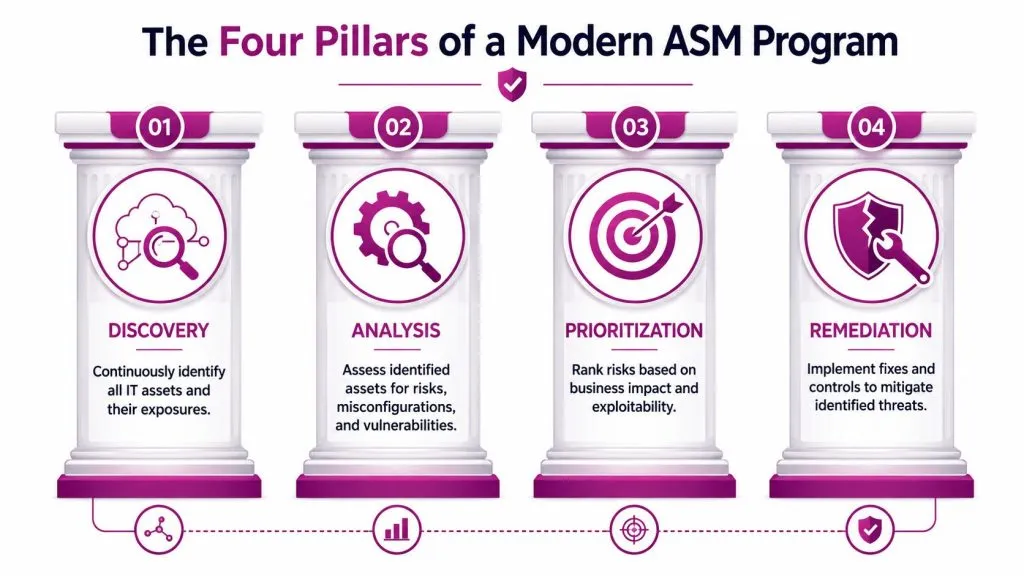
The Four Pillars of a Modern ASM Program
A solid attack surface management program stands on four pillars. If one is weak, the whole process starts producing noise, missed assets, or half-closed tickets that come back later as incidents.
Discovery has to include the assets nobody owns on paper
Discovery is where many teams overestimate their maturity. They assume their RMM, CMDB, firewall inventory, and cloud console together tell the full story. They don’t.
Modern discovery has to account for organization-owned assets, plus internet-facing systems hosted by cloud providers, business partners, and even rogue infrastructure tied to the brand. Traditional manual discovery yields a 30-40% false negative rate for shadow IT assets, while automated ASM tools reduce this to under 5%. Evidence also shows that 60% of successful breaches in 2024 originated from unmanaged digital assets.
That changes the conversation for an MSP. Discovery isn’t an admin exercise. It’s breach prevention.
Analysis turns an asset list into usable security context
Once you find an asset, the next question is whether it matters. Classification and analysis answer that by identifying what the asset does, what data it handles, how it authenticates users, whether it’s production or staging, and what else it can reach.
An exposed login page for a brochure site and an exposed admin interface tied to customer records are not the same thing. They might both show up as “internet-facing asset discovered,” but the business risk is very different.
Useful analysis usually includes:
- Business role. Is this revenue-facing, internal-only, or a legacy leftover?
- Data sensitivity. Does it host customer data, internal documents, credentials, or nothing important?
- Connectivity. Can it reach core systems, identity providers, or storage?
- Exposure type. Is the problem an outdated service, open port, weak config, forgotten certificate, or leaked secret?
Prioritization decides where your team spends its week
Many security programs often break down. They rank by technical severity alone, then waste effort treating all critical findings like equal emergencies.
Good ASM uses risk-based scoring. It weighs data sensitivity, exposure level, and exploitability so teams focus on the small set of exposures most likely to hurt the client. In practice, that means your analysts stop drowning in lists and start escalating the few findings that create realistic attack paths.
Practical rule: If a finding can’t answer “why this asset matters to an attacker now,” it isn’t ready for a client-facing priority report.
Remediation only counts if you validate the fix
A ticket marked complete is not the same as a closed risk. Remediation has to include verification. If a team says a port is closed, a certificate was replaced, or a vulnerable service was isolated, the ASM process should confirm it.
This final pillar is what makes attack surface management a lifecycle instead of a periodic clean-up effort. Discover, analyze, prioritize, remediate, validate, then keep monitoring for the next change. That loop is what keeps your client’s external footprint from drifting back into unmanaged territory.
ASM Versus Traditional Vulnerability Management
A lot of MSPs already run vulnerability management, so the obvious question is whether attack surface management is just the same thing with new branding. It isn’t.
The easiest analogy is this. Vulnerability management is like an annual health checkup. It tells you what known issues exist on systems you already track. Attack surface management is more like a 24/7 wearable monitor. It notices when a new problem appears, when something changes, or when a device you forgot about suddenly starts signaling trouble.
They answer different questions
Vulnerability management usually starts with known assets. Attack surface management often starts by asking whether your asset list is incomplete in the first place.
| Attribute | Vulnerability Management (VM) | Attack Surface Management (ASM) |
|---|---|---|
| Primary focus | Known vulnerabilities on managed assets | Exposed assets, unknown assets, and exploitable exposure |
| Starting point | Existing inventory | Real-world external footprint |
| Operating model | Periodic scans | Continuous discovery and monitoring |
| Perspective | Defender-centric | Attacker-centric |
| Typical output | Vulnerability list | Asset exposure map plus prioritized risk context |
| Best use | Patching and hygiene on known systems | Finding blind spots and reducing reachable paths into the business |
That difference matters more now because many modern exposures don’t begin as a classic CVE problem. They begin as drift, forgotten cloud resources, weak access paths, leaked credentials, or an internet-facing service nobody meant to leave exposed.
Security teams seeing the same pattern in AI-assisted development and automation pipelines may also want a technical read on Claude-related security risks for engineering teams. It’s useful because it shows how fast new tooling can expand exposure outside older control models.
Where MSPs get into trouble
The failure mode I see most often is assuming quarterly or monthly vulnerability scans are enough. They aren’t, because they only tell you about assets already inside the program. If a contractor launches a new public service, marketing spins up a microsite, or a retired workload remains reachable after a migration, a VM tool may never flag it because it was never in scope.
The reverse mistake also happens. Some teams buy an ASM platform, get broad visibility, then assume that replaces disciplined patching and host-level remediation. It doesn’t. VM and ASM are complementary. One manages known weaknesses on known assets. The other keeps your inventory honest and your prioritization anchored in actual exposure.
How MSPs and SMBs Can Implement ASM
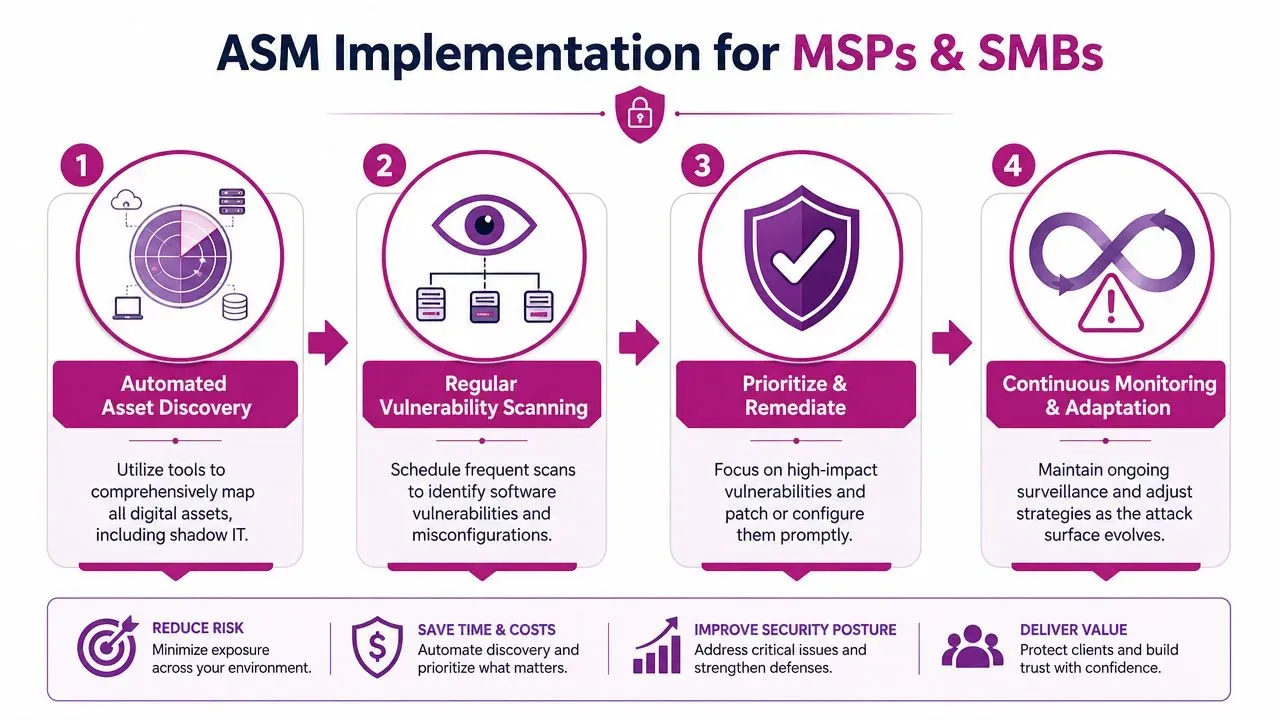
Most MSPs don’t need a huge transformation to start attack surface management. They need a practical operating model, a repeatable toolchain, and a way to explain findings in business language.
Start small, but start correctly.
Start with the external edge
For most SMBs, the biggest immediate gain comes from external discovery. Inventory public domains, subdomains, certificates, cloud-hosted applications, remote access portals, exposed storage, SaaS entry points, and third-party services tied to the brand.
From there, build a simple operating rhythm:
- Automate discovery first. Manual spreadsheets won’t keep up with cloud and SaaS changes.
- Tag what matters. Identify business-critical assets, client-facing systems, and systems touching sensitive data.
- Score for exploitability and impact. Don’t flood the queue with low-context severity alerts.
- Create an owner path. Every finding needs a team or person who can act.
- Verify closure. Recheck the asset after remediation.
This is also the point where tooling matters. Open source components can help, and many MSPs combine them with commercial platforms for scale and reporting. One option in that category is InsecureWeb, which provides external attack surface analysis, vulnerability scanning, and monitoring for exposed assets. The practical value isn’t that it replaces your stack. It’s that it gives MSPs a usable external view and client-facing visibility in one workflow.
A lot of MSP leaders also struggle with where ASM fits inside the broader managed service model. This guide for tech leaders on MSPs is worth reading because it frames how service expectations, accountability, and delivery models shape what clients will ultimately buy and use.
Build reporting around risk stories
Most ASM reports fail because they read like scanner exports. Clients don’t need a giant list of discovered assets. They need to understand what an attacker could do with them.
A better client narrative looks like this:
- Asset found. Unused staging app still publicly reachable.
- Why it matters. Shares identity path with production environment.
- Likely attacker value. Lower-friction way to harvest access or pivot.
- Business consequence. Creates a path toward customer records or service disruption.
- Recommended action. Remove exposure, isolate access, confirm decommissioning.
That shift changes ASM from “more alerts” into an advisory service. It also gives account managers and vCISOs something meaningful to discuss in quarterly reviews.
Don’t send a client a list of ports and certificates and call it strategy. Tell them which exposure creates a credible path to data loss, fraud, downtime, or impersonation.
The same principle applies when you expand beyond public infrastructure into external intelligence. Dark web monitoring for managed service providers fits naturally alongside ASM because stolen credentials and exposed assets often become part of the same risk story.
A short walkthrough can help when you’re introducing ASM internally or to a client team:

Turn ASM into an actual service line
For MSPs, ASM works best when it isn’t buried inside a generic security bundle. Package it with a defined cadence, deliverables, and escalation path.
A workable service structure often includes:
- Monthly exposure review. Summarize newly discovered assets, ownership gaps, and priority exposures.
- Continuous monitoring. Watch for changes between reporting cycles.
- Remediation coordination. Push findings into ticketing and validate fixes.
- Quarterly risk briefing. Translate technical trends into business decisions.
That model also gives you a measurable outcome. Organizations implementing continuous ASM reduce mean time to remediate critical vulnerabilities by 55% compared to those using quarterly scans. For an MSP, that’s one of the clearest ways to show clients why continuous monitoring is worth paying for.
Measuring the Success of Your ASM Program
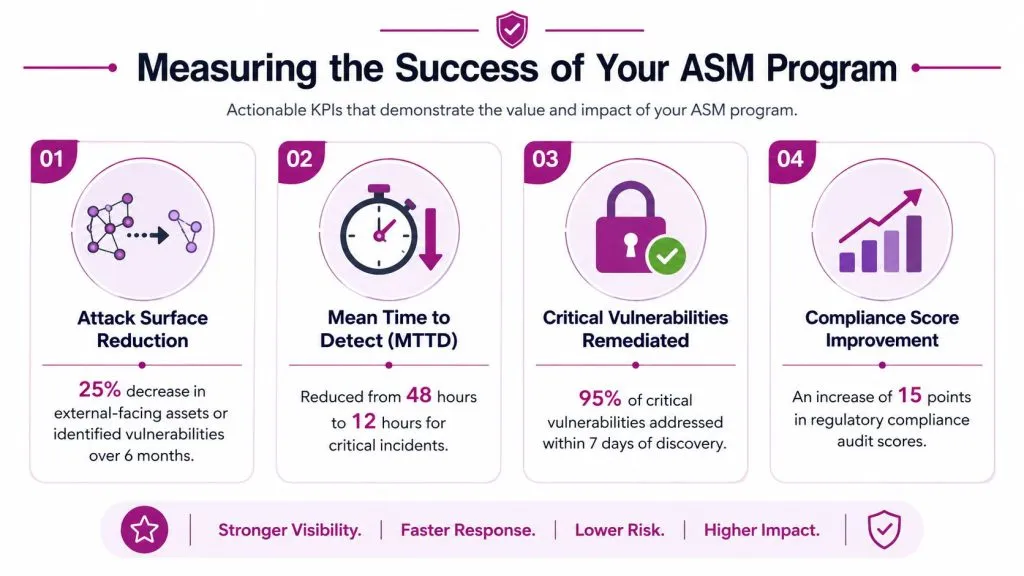
If you can’t measure attack surface management, clients will eventually treat it like background noise. The good news is that ASM is measurable. The mistake is picking only technical metrics that mean little outside the security team.
Measure visibility first
Before you claim the program is reducing risk, prove that it’s improving visibility.
Track metrics such as:
- Time to discover new external assets. How quickly do newly exposed systems show up in your workflow?
- Unknown asset reduction. Are you finding fewer unmanaged assets over time?
- Ownership coverage. What share of discovered assets has a confirmed owner and business function?
- Exposure recurrence. Which findings keep returning after teams say they’re fixed?
These metrics matter because early-stage ASM maturity is mostly about shrinking blind spots. If an MSP can show that discovery is faster, ownership is clearer, and unknown exposure is falling, that’s a meaningful win even before deeper optimization.
Measure response and closure next
Once visibility stabilizes, focus on operational performance.
Good program metrics include:
| KPI | Why it matters |
|---|---|
| Time from discovery to triage | Shows whether findings are entering a real workflow |
| Time from triage to remediation | Exposes process bottlenecks between security and operations |
| Validation rate | Confirms whether “fixed” issues are actually closed |
| Client risk narrative quality | Indicates whether reports support decisions, not just awareness |
For client reporting, I like to pair one operational metric with one business-facing interpretation. If remediation speed improves, say what that means. Shorter exposure windows. Fewer lingering external weaknesses. Less chance that a forgotten asset sits open long enough to become a practical entry point.
Mature ASM reporting answers two questions at once: “Are we finding things faster?” and “Are we reducing meaningful exposure?”
You don’t need dozens of KPIs. You need a handful that connect visibility, accountability, and closure.
Real-World Attack Surface Management Use Cases
Attack surface management becomes easier to sell when clients can see where it changes an outcome. The value usually shows up before an incident, during change, or in the messy space between systems and ownership boundaries.
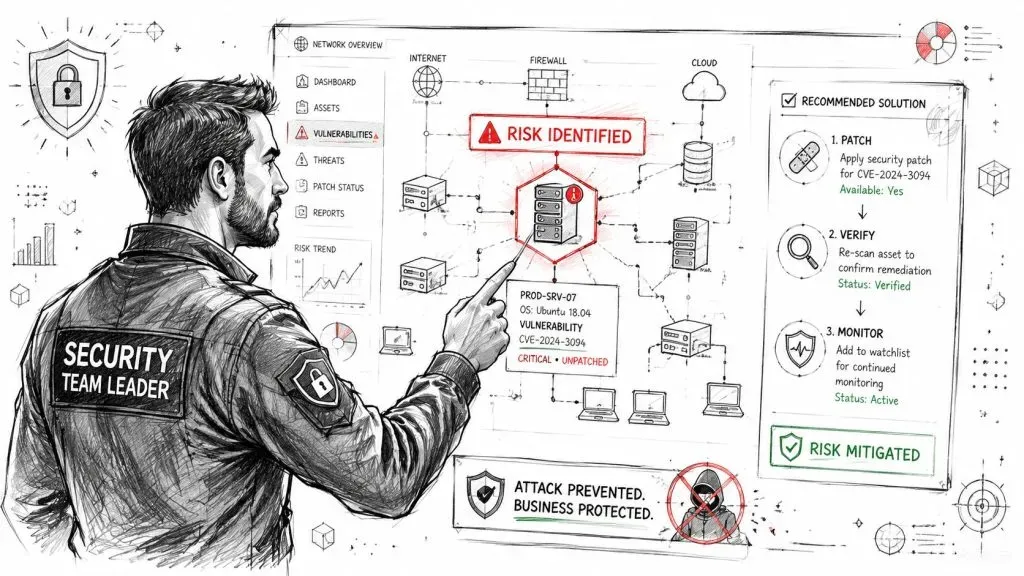
A forgotten cloud asset before it becomes an incident
A former developer leaves. A temporary cloud-hosted application used for testing remains reachable from the internet. No one has malicious intent. It falls outside day-to-day operations.
ASM catches it because the program isn’t waiting for someone to remember it exists. Value emerges when the finding is translated correctly. Not “unknown app discovered,” but “public app still tied to internal identity and not covered by the normal patching workflow.” That’s a risk story a client understands.
If a team discovers this after suspicious access or data exposure, the response work gets much harder. In that situation, a practical next step is following a structured post-breach response checklist so containment, evidence handling, and communication don’t turn into improvisation.
M and A due diligence that reveals hidden exposure
MSPs involved in acquisitions often inherit an incomplete picture. The acquired company may have legacy vendors, old domains, unmanaged remote access services, or cloud projects nobody fully retired.
ASM helps because it evaluates what’s reachable, not just what appears in provided documentation. During due diligence, that can uncover inherited security debt before systems are integrated into the parent environment.
This use case matters commercially too. An MSP that can assess exposure during transition becomes more than a support vendor. It becomes part of the client’s risk evaluation process.
Brand abuse and attacker infrastructure outside your tenant
Not every exposure sits inside a client-owned environment. Some of the most damaging ones live outside it, including lookalike login pages, impersonation domains, and fake support portals built to steal credentials or payments.
Traditional infrastructure monitoring may never see those. ASM, especially when paired with brand and web monitoring, gives the client a broader view of how attackers are using their public presence against them.
That’s often the moment SMB leaders understand the scope of the problem. Their attack surface isn’t just what they host. It’s also what attackers can create around their identity.
Moving Beyond Inventory to True Security Posture
The market doesn’t need another asset list. Clients already have too many lists.
What they need is a disciplined way to understand which exposed systems create real attack paths, which findings are noise, and where to spend limited remediation time. That’s the shift attack surface management makes when it’s done well. It moves security from inventory to context, from detection to prioritization, and from technical output to business action.
For MSPs, that shift is strategic. It creates a service clients can understand because the conversation changes from scanner noise to operational risk. You’re not handing over another spreadsheet. You’re showing how a forgotten app, weak identity path, exposed third-party system, or impersonation site can turn into fraud, downtime, or data loss.
That outside-in view also matters because attackers don’t respect your documentation boundaries. They study your public footprint, your vendors, your leaked data, and the signals your infrastructure gives away. If you want a sense of how fast public-facing systems get probed and protected against automation, even outside pure security contexts, this technical breakdown of web scraping anti-bot solutions is a useful reminder that internet exposure gets tested continuously.
Attack surface management isn’t optional hygiene anymore. It’s foundational security work for any business that depends on cloud services, SaaS, vendors, and public digital channels.
If you want to turn external exposure data into client-ready risk stories, InsecureWeb is built for that workflow. It helps MSPs and security teams monitor external assets, dark web exposure, brand abuse, and vulnerabilities so discovered risks can be tracked, explained, and acted on.