You’re probably seeing the same pattern across clients right now. Their endpoint protection is in place, Microsoft 365 has some baseline controls, backups are tested, and patching is decent. Then a breach notice, credential leak, or phishing wave lands anyway, and nobody can answer the uncomfortable question fast enough: was our data already circulating before the incident became visible?
That’s where dark web monitoring fits. It gives MSPs and SMBs visibility into the places attackers use to trade credentials, leak stolen data, and discuss targets. But visibility alone isn’t enough. An alert that sits in an inbox is just delayed bad news. The value comes from what happens next: validation, containment, credential resets, ticketing, customer communication, and, when possible, automation.
The Unseen Threat to Your Business
A small business owner gets a message from a customer: “Why am I getting strange emails from your staff?” The internal review starts with the usual checks. Mailbox rules, login history, MFA prompts, password changes. Then the underlying issue emerges. An employee reused a password that had already been exposed, and those credentials were being traded in places the company never sees.
That’s the operational problem behind what dark web monitoring is. It isn’t curiosity about a hidden part of the internet. It’s about finding evidence that your users, domains, or company data are already in the hands of people who intend to use them.
The dark web acts as a concentrated hub for cybercriminal activity, and projected cybercrime costs are expected to reach $10.5 trillion annually according to Prey’s dark web statistics and trends overview. If an organization doesn’t monitor those channels, it can miss early indicators of compromise, including exposed credentials and leaked data, until attackers have already moved from access to action.
For MSPs, this matters because clients rarely distinguish between “the original breach” and “the moment business pain started.” They remember the locked account, the fraudulent invoice, the legal notice, or the downtime. That’s why surface controls alone aren’t enough. You also need external visibility into where stolen information gets traded.
A good way to frame this for clients is to pair dark web visibility with the fundamentals covered in Finchum Fixes IT’s guide to network security. Internal defenses reduce exposure. Dark web monitoring tells you when something still escaped.
Practical rule: If your client says, “We’d know if our passwords were exposed,” they’re assuming attackers will announce it politely. They won’t.
How Dark Web Monitoring Technically Works
Dark web monitoring isn’t a fancy keyword alert. It’s closer to running a reconnaissance team that knows which alleys, forums, channels, and leak sites are worth watching, then handing the raw findings to analysts and systems that can sort signal from junk.
Why search engines can’t do this job
A standard search engine indexes public pages that want to be found. Dark web sources often work the opposite way. They’re hidden behind anonymizing networks, access controls, invitation systems, rotating addresses, or private communities. Some activity also moves through encrypted messaging platforms and stolen log marketplaces instead of public forums.
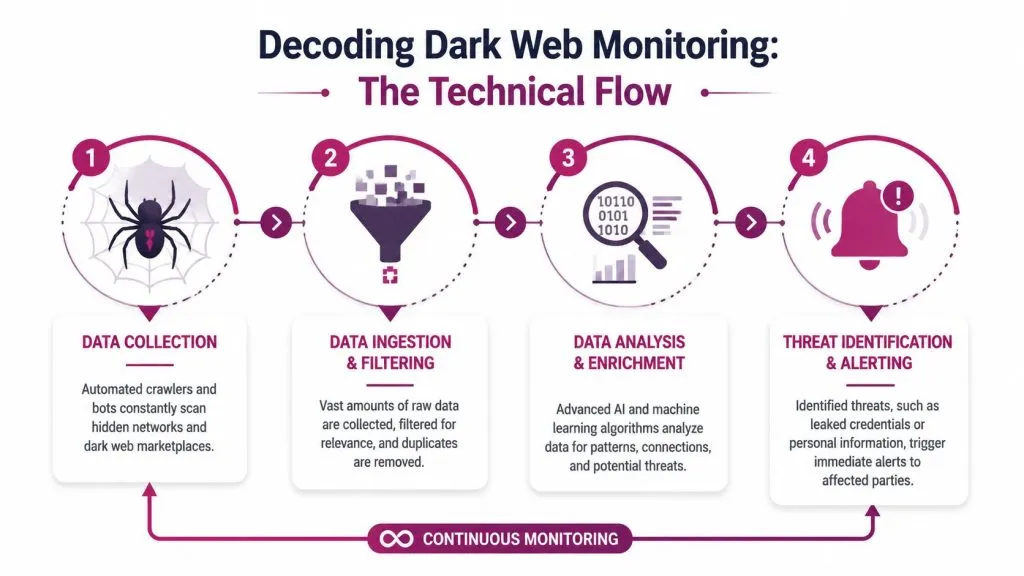
That’s why effective monitoring relies on specialized collection. According to this dark web architecture project on GitHub, dark web monitoring uses a Big Data architecture that continuously ingests and analyzes millions of Tor sites, then turns that ingestion into alerts that include context such as source of exposure and risk score.
A useful comparison is this: Google is a map of public roads. Dark web monitoring is a field team checking warehouses, side entrances, and fenced lots that don’t appear on the map.
The monitoring pipeline in practice
The collection side starts with crawlers, scrapers, and source access workflows built for hidden services and criminal ecosystems. Those systems pull in forum posts, marketplace listings, breach dumps, infostealer logs, and channel chatter. Then the platform has to filter out duplicates, stale data, recycled dumps, and false matches.
From there, matching and enrichment matter more than raw collection volume. Useful monitoring ties findings back to real client assets such as:
- Corporate domains linked to exposed accounts
- Employee email addresses found in breach data
- Keywords and brand names appearing in forum posts
- Leaked secrets such as credentials or internal references
- Infrastructure identifiers that indicate targeting or reconnaissance
A mature workflow doesn’t stop at “match found.” It adds context. Was this credential part of an old breach or a recent infostealer log? Does the exposed account have admin access? Is the mention a generic reference, or is someone discussing access to a client environment?
For teams that use dark web data for broader investigations, this guide on using dark web monitoring for OSINT and investigations is a useful operational extension. It reflects the real overlap between exposure monitoring and threat intelligence work.
A noisy alert feed creates work. A contextual alert creates a decision.
Key Benefits for MSPs and Their Clients
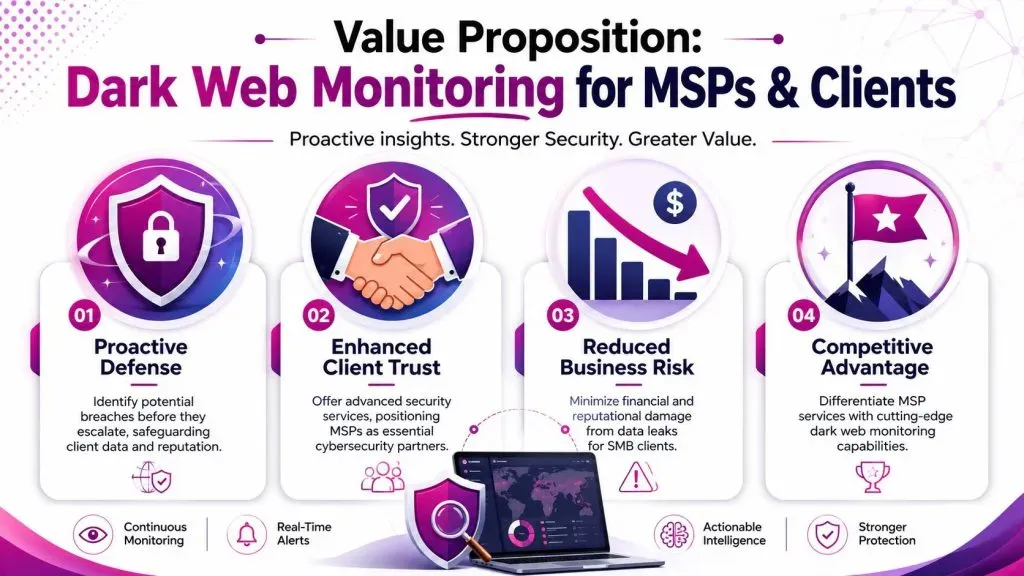
MSPs don’t buy security tools for abstract visibility. They buy them to reduce client risk, improve response time, and prove value in a way clients understand. Dark web monitoring does all three when it’s positioned correctly.
Why MSPs care
The clearest MSP benefit is earlier notice. According to ID Agent’s profile of today’s dark web users, 56.8% of dark net content is illegal, including stolen passwords and compromised credentials, and there are around 2.5 million daily active users. In practical terms, there’s a large, active market for exactly the data your clients hope never leaks.
That gives MSPs a better chance to act before a password reuse issue turns into mailbox compromise or VPN access. It also supports stronger client conversations. When you can show a client that real accounts or company references appeared in criminal channels, security stops being theoretical.
For service providers, the business upside is straightforward:
- Stronger retention: Clients are less likely to view you as a help desk vendor when you’re bringing external threat intelligence into regular security reviews.
- Better packaging: Monitoring fits naturally into managed security bundles, incident response retainers, and identity protection services.
- More defensible recommendations: It’s easier to justify MFA hardening, privileged access cleanup, and password policy changes when you can point to actual exposure.
If you want a provider-focused view of how this fits into managed services, this article on dark web monitoring for MSPs is aligned with that use case.
Why clients care
Clients usually don’t ask for “dark web monitoring.” They ask for fewer surprises, faster answers, and less reputational damage when something goes wrong.
The value lands in business terms:
| Business concern | Monitoring helps by |
|---|---|
| Account takeover | Flagging exposed credentials before they’re reused against business systems |
| Client trust | Identifying leaks or impersonation issues early enough to respond cleanly |
| Sensitive records | Showing when data appears in criminal channels so legal and technical teams can assess impact |
| Executive anxiety | Giving leadership external visibility instead of relying only on internal logs |
This also pairs well with broader data handling discipline. If clients are serious about reducing exposure, internal controls matter alongside external monitoring. Something as simple as protecting sensitive information offline closes gaps that attackers often exploit after they gain access.
Real World Examples of Detected Threats
The fastest way to explain dark web monitoring to an SMB is to stop speaking in categories and start speaking in incidents.
Compromised credentials
A common finding is a file that contains work email addresses paired with passwords. Sometimes it comes from an old breach. Sometimes it comes from an infected machine where an infostealer pulled saved browser credentials.
That matters even if the affected user says, “I don’t use that password anymore.” If the password was reused anywhere, attackers will test it. They don’t need a specific campaign. They can run credential stuffing, look for mailbox access, then pivot into invoicing fraud or internal impersonation.
Leaked personal and corporate data
Another frequent category is leaked PII or company files. That might include customer records, employee details, internal documents, or fragments of database exports. The damage path changes depending on what was exposed, but the next steps are predictable: phishing, identity abuse, extortion, or reputational harm.
For MSPs, the key isn’t just detecting that data exists. It’s identifying whose data it is, whether it’s current, and whether the client needs legal review, customer notification, or containment work. A breach reference with no context just creates panic.
Treat every leak as both a technical event and a communication event. Clients remember how clearly you handled the second one.
Brand and infrastructure chatter
Not every useful alert is a dump of stolen records. Sometimes the signal is discussion. A company domain appears in a thread. A seller claims access to a mailbox. A forum user asks about a target’s VPN, cloud tenant, or remote access setup. Those mentions can surface before a broader incident becomes visible internally.
That’s where monitoring starts to look less like breach notification and more like early warning. A practical example is the kind of exposure discussed in this example of a USA business database breach detected on the dark web. The point isn’t that every mention means compromise. The point is that serious teams investigate before dismissing it.
Turning Alerts Into Action A Response Workflow
An alert without a response path is a false comfort. Often, many SMBs and even some MSPs fall short in this area. They can buy visibility, but they haven’t built the operational muscle to do something useful with it under pressure.
SecurityScorecard notes that effective dark web monitoring combines automated crawlers with human threat hunters to enrich detections with attacker TTP context, and that this approach helps teams detect threats faster and reduce exposure through faster incident response in its overview of dark web monitoring. That’s the right model. Detection should feed action, not just reporting.
Start with triage, not panic
The first question is simple: what kind of alert is this? A mention of a domain in a forum post is different from an active employee credential appearing in a fresh infostealer log.
A useful triage sequence looks like this:
- Classify the asset
Determine whether the alert involves an employee account, privileged credential, executive identity, customer record, or brand mention. - Assess likely abuse path
Ask what an attacker could do with it. Mailbox access, remote login, password reset abuse, fraud, or extortion all require different urgency. - Check current exposure
Confirm whether the account still exists, whether the password may still be valid, and whether the user has advanced privileges or sensitive access.
Move from validation to containment
Validation matters because dark web data can be old, duplicated, or misleading. But validation shouldn’t become an excuse for delay. If a corporate account appears in a credible source and there’s any chance the credential is still relevant, move to containment fast.
A practical playbook often includes:
- Force password resets for affected users and any linked accounts.
- Revoke active sessions where the platform supports it.
- Review MFA status and close any gaps immediately.
- Check access logs for suspicious activity tied to the exposed identity.
- Isolate impacted endpoints if infostealer activity is suspected.
- Rotate exposed secrets such as API keys or admin credentials.
- Document the source and timing so legal, compliance, and leadership have a clean record.
This is also the point where one body mention of a tool makes sense. Platforms such as InsecureWeb can provide dark web alerts and API access so MSPs can move detections into existing workflows instead of handling them manually.
Field note: Speed matters more than perfect certainty. If you wait for a fully polished intelligence package before resetting a risky credential, you’re helping the attacker more than the client.
Automate the handoff
The gap between alert and response is where value often dies. Someone sees an email, copies details into a ticket, checks the client inventory, pings the account manager, waits for approval, then starts remediation. That’s too slow for exposed credentials.
The better pattern is integration:
| Alert stage | Manual approach | Better approach |
|---|---|---|
| Detection | Inbox notification | API or webhook into PSA, SIEM, or ticketing |
| Assignment | Analyst forwards email | Auto-routing by client, severity, or asset type |
| Containment | Ad hoc checklist | Standard playbook attached to ticket |
| Reporting | Reconstructed later | Timeline captured as work happens |
For MSPs using ConnectWise, Datto, or similar systems, the goal is simple. The alert should create work in the same place technicians already operate. If the finding is high confidence and high risk, some actions should be automatic, especially password resets, secret rotation requests, and conditional escalation.
The operational lesson is blunt. Dark web monitoring is the front door to a response process. If there’s no process behind it, the monitoring program will disappoint everyone involved.
Common Misconceptions and Limitations
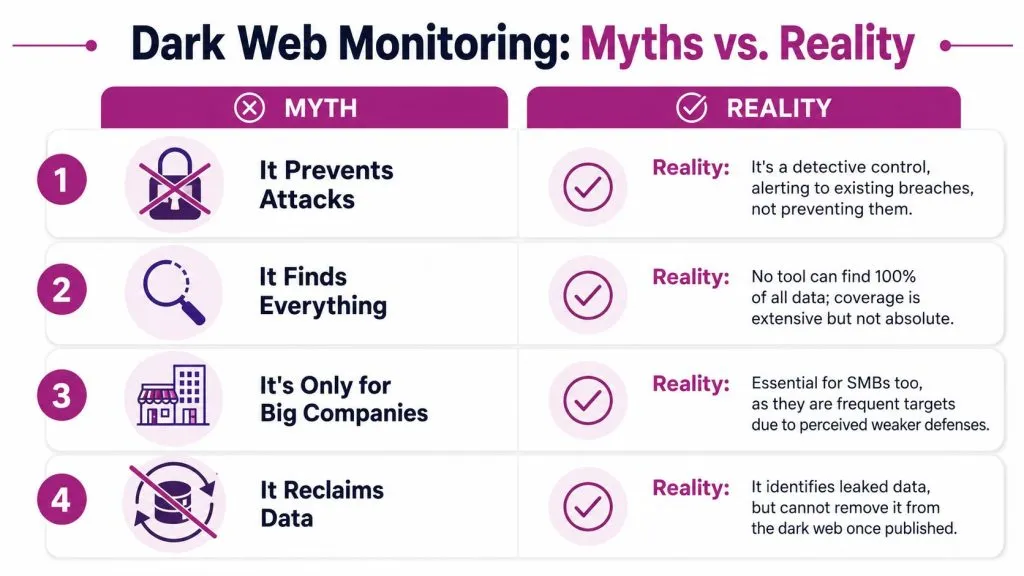
The most damaging misunderstanding is also the most common: people assume dark web monitoring prevents attacks.
It doesn’t.
No, it doesn’t prevent breaches
According to Ankura’s analysis of dark web monitoring and the attack cycle, 74% of cybersecurity buyers mistakenly believe dark web monitoring prevents attacks, while only 12% of vendors explicitly disclose that it is detective-only. That misunderstanding leads SMBs to underinvest in preventive controls such as MFA and over-rely on monitoring as if it were a shield.
This distinction matters because monitoring usually tells you one of three things:
- data was already stolen
- access is being discussed or sold
- your organization is showing up in attacker workflows
All of that is useful. None of it replaces patching, MFA, endpoint controls, privileged access management, or user training.
Coverage is powerful, not perfect
Another bad assumption is that one platform will find everything. It won’t. Criminal communities move. Sources disappear. New channels appear. Some data gets sold privately, traded in small groups, or posted briefly and removed.
That means dark web monitoring has limits:
- It can’t reclaim leaked data once it’s already circulating.
- It can’t guarantee full visibility into every closed or transient source.
- It can produce stale findings if the vendor doesn’t deduplicate well.
- It loses value quickly when the customer has no response capacity.
The last point is the one MSPs should care about most. A small business can receive an accurate alert and still fail to reduce risk if nobody resets credentials, checks endpoints, or contains access in time.
The tool tells you that the house smells like smoke. It doesn’t pick up the hose.
Monitoring as a Foundation of Modern Security
Dark web monitoring belongs in a modern security stack because it answers a question internal tools often can’t: what do attackers already know about us, and what are they doing with it?
For MSPs, that makes it practical, not optional. It improves external visibility, supports client conversations with real evidence, and creates a stronger bridge between threat intelligence and managed response. For SMBs, it reduces the chance that a credential leak or data exposure goes unnoticed until the consequences are public.
The mature view is simple. Monitoring is a foundation, not a finish line. It works when it’s tied to identity controls, endpoint response, ticketing, communication plans, and fast remediation. It fails when it’s treated like a dashboard that someone checks after damage is already underway.
That same thinking applies across adjacent areas of security design. External monitoring only helps when the systems around it are governed well, which is why controls such as OpenClaw agent security are part of the same broader conversation about trustworthy operations and response discipline.
The future isn’t just better alerts. It’s tighter integration between monitoring and action, so exposed credentials, leaked data, and brand threats trigger a response path immediately instead of becoming another unread warning.
If you want to see how this looks in practice, InsecureWeb provides dark web monitoring, external threat visibility, and API access that MSPs can connect to their existing workflows so alerts don’t stop at detection.