Your SOC gets an alert at 8:12 a.m. A client’s employee credentials have surfaced in a dark web monitoring feed. The first question isn’t whether the account was exposed. It’s where, who posted it, and what that context tells you about what happens next.
For MSPs and MSSPs, that distinction matters. A credential mention inside a dark web forum often carries more operational value than a simple breach notification. Forums are where threat actors test trust, vet buyers, package access, discuss tooling, and turn raw stolen data into active intrusion paths. If your workflow only watches for dumped passwords and ignores forum chatter, you’re seeing the smoke after the planning already started.
That’s why security teams need more than definitions. They need a workable process for monitoring, triaging, and acting on forum intelligence without drowning in noise or contaminating their own investigative environment.
Why Dark Web Forums Are Your Biggest Blind Spot
At 2:00 a.m., your SOC gets an alert for a credential pair tied to a client tenant. On its own, that looks like another exposure to validate, suppress, or escalate. Then an analyst finds the same account discussed in a forum thread with replies about MFA fatigue, mailbox rules, and resale value by region. The problem is no longer a leaked credential. It is an active operational lead for an attacker.
That is the blind spot for MSPs and MSSPs. Many teams still treat forum hits as background noise or as a duplicate of marketplace monitoring. In practice, forums are where intent becomes visible early enough to change response priority. They give analysts a way to separate stale data from access that is being packaged, tested, and prepared for use against a real target.
The operational difference matters. A marketplace post may confirm that data exists. A forum thread often shows what happens next. Actors ask whether the access still works, whether the victim uses a specific SaaS stack, whether the tenant is worth extorting, and whether someone has already used the same foothold for phishing or internal recon.
For service providers, that context changes workflow.
A mention of a client domain in a forum should trigger more than a passive watchlist hit. It should feed triage. Analysts need to score the post by actor credibility, freshness, client relevance, and signs of follow-on activity. If the thread includes replies about persistence, privilege level, or bypass methods, remediation should start before a buyer proves the access.
That is why forum monitoring belongs in the same pipeline as identity alerts, exposed credential checks, and external attack surface monitoring. The value is not the mention itself. The value is the surrounding discussion that helps an MSSP decide whether to open an incident, enrich a case, or push a client into immediate containment.
Why forum context changes triage quality
Forum data gives defenders signals that are hard to get anywhere else:
- Intent shows up in the replies, not just the original post. Buyers ask how the access can be used, how quickly it must be acted on, and whether the target fits a profitable vertical.
- Credibility is easier to judge when a seller has posting history, vouches, disputes, or visible relationships with other actors.
- Client impact becomes clearer when a thread references geography, SaaS providers, business unit access, or the type of data behind the login.
- Response urgency improves when analysts can tell the difference between bulk credential spam and a thread focused on fresh corporate access.
That distinction saves time across a managed operation. It prevents analysts from treating every leak mention as equal, and it helps account teams explain to clients why one forum post needs password resets and token revocation now, while another can stay in monitored status pending validation.
The same forums can also become intelligence sources for defenders when they fracture or get exposed. Cases like the BlackHatWorld hacking forum database leaked incident show that underground communities leave records, relationships, and behavioral patterns behind. Those failures do not make the forums less relevant. They show how much operational detail these communities hold, and why security teams should monitor them as live intelligence sources instead of treating them as isolated leak pages.
Deconstructing the Dark Web Forum
A dark web forum is best understood as a hidden trade community, not just a website. It combines discussion board mechanics, trust systems, private messaging, vendor reputation, and access controls inside an environment designed for anonymity. That combination is what makes it useful to threat actors and valuable to defenders.
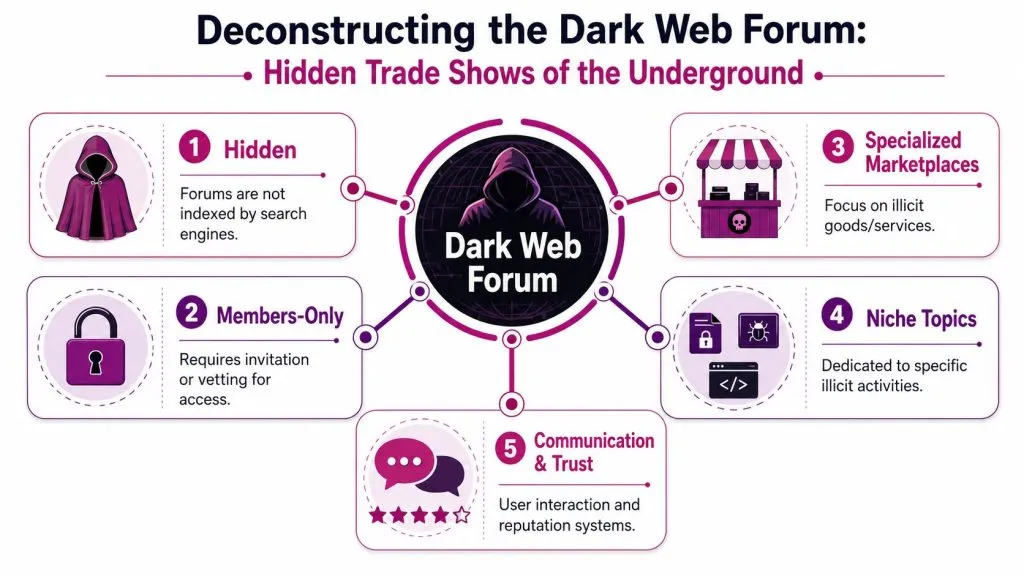
What makes a forum different
A marketplace is transaction-first. A forum is relationship-first. That difference changes what you can learn from it.
In a marketplace, an actor lists access, data, or tooling for sale. In a forum, actors negotiate, teach, recruit, vouch, dispute, and refine methods over time. The forum becomes a long-lived environment where less experienced criminals learn from more established ones and where specialist communities form around access brokerage, fraud, malware development, and data leaks.
Security teams monitoring these spaces for intelligence aren’t trying to “browse the dark web.” They’re trying to answer practical questions:
- Is this mention credible
- Is this actor established or opportunistic
- Does this post indicate immediate exploitation or speculative resale
- Does this community specialize in the kind of abuse that matches our client’s exposure
A useful primer on the defensive side of this work is how dark web monitoring can be used for OSINT and investigations, especially if your team is building collection and validation workflows rather than doing one-off searches.
How anonymity and trust coexist
The strange feature of a dark web forum is that anonymity doesn’t remove trust. It changes how trust is built. Users rely on handles, referral paths, moderation decisions, escrow mechanisms, posting history, and community reputation. In other words, identity is obscured, but credibility still has to be earned.
That’s why these environments are dangerous. They lower the friction for collaboration without requiring real-world attribution. Actors can compare malware, debate exploit reliability, or broker stolen access under pseudonyms while still participating in recognizable trust hierarchies.
Operational note: Defenders get more value from observing interaction patterns than from collecting isolated screenshots of listings.
For MSP and MSSP teams, this changes collection strategy. A raw mention of a client asset is useful. A mention tied to trusted sellers, active replies, or requests for post-sale support is much more useful. The first tells you exposure exists. The second tells you the exposure is entering an ecosystem that can operationalize it.
The Anatomy of Forum-Based Threats
At 2 a.m., an analyst on an MSSP shift sees three alerts tied to the same client. A credential set appears in a leak thread. Hours later, a seller references VPN access for a company in the same vertical. By morning, another post is offering a phishing kit tuned for Microsoft 365 help desk impersonation. Treated as separate events, each alert looks manageable. Viewed as one workflow, it points to an intrusion path that needs immediate containment.
That is how forum-based risk shows up in operations. Analysts need to classify the forum, identify what stage of the attack cycle the post supports, and decide whether the item belongs in monitoring, escalation, or response.
CloudSEK’s review of dark web forums and deep web communities found that active communities such as XSS, BreachForums, and Exploit.in serve different functions across exploit trade, leak circulation, and cybercrime collaboration CloudSEK’s review of dark web forums and deep web communities. For defenders, the practical takeaway is simple. A forum mention can indicate exposure, monetization, or active weaponization, and those states should not share the same severity score.
Forum type changes the triage path
MSP and MSSP teams get better results when they sort mentions by operational intent instead of using a single “dark web” bucket. A leak forum usually answers one question. What data is exposed? An access broker thread answers a different one. Can an actor use this access against a live environment now?
That distinction matters because remediation owners change with the forum category. Fraud teams, IAM teams, SOC analysts, and incident responders may all need the same alert, but not at the same priority or with the same evidence package.
Common dark web forum types and associated threats
| Forum Category | Primary Activity | Typical Threats for MSP Clients |
|---|---|---|
| Financial fraud forums | Payment bypass tools, carding methods, account monetization | Payment fraud, customer account abuse, brand damage |
| Exploit and malware forums | Tooling exchange, exploit discussions, malware refinement | Ransomware enablement, exploit chaining, post-compromise tooling |
| Data leak forums | Sharing and selling leaked databases, credentials, records | Credential exposure, privacy incidents, regulatory response |
| Initial access broker forums | Selling access into business systems and user environments | Network intrusion, lateral movement, extortion staging |
| Social engineering communities | Scripts, impersonation methods, trust abuse tactics | Help desk fraud, phishing escalation, BEC preparation |
The same client often appears across multiple categories. That pattern is more useful than a single hit. If a user credential first appears in a leak thread, then shows up in an access sale, then gets referenced in a phishing discussion, analysts should treat it as progression, not repetition.
Tooling maturity is a critical factor. Collection pipelines should group posts by actor, forum, and asset, then enrich them with identity data, exposed technologies, tenant information, and known controls. MSSPs using APIs for ingestion and enrichment can cut triage time significantly because the analyst is reviewing context, not rebuilding it from screenshots.
Named forums help analysts score risk correctly
Real forum names improve analyst judgment because each community has its own norms, moderation quality, and buyer base. XSS and Exploit.in are commonly associated with technically capable actors and higher-signal trade in access, tooling, and operational knowledge. BreachForums has been more closely tied to broad leak visibility and circulation. Altenen is associated with fraud activity at scale, as noted earlier.
For an analyst, that translates into different handling rules. A post on a mature, moderated forum with active replies and escrow history deserves more attention than the same claim on a fringe board full of reposts and scams. Severity should account for forum reputation, seller credibility, buyer engagement, and whether the post includes evidence that can be validated.
A practical scoring model for MSPs is straightforward:
- Exposure value. What asset is involved, and how sensitive is it?
- Forum credibility. Is the community known for verified trade or recycled noise?
- Seller maturity. Does the actor have history, vouches, or completed deals?
- Operational timing. Is this old data, fresh access, or an active service offer?
- Client impact path. Does this point to fraud, account takeover, network intrusion, or extortion?
That scoring approach helps teams decide whether to open a ticket, trigger automated resets, notify the client, or hand the case to IR.
Some posts still belong in lower-severity queues. A recycled breach mention with no buyer interest is different from a current access listing with screenshots, revenue details, and admin-level entry points. Analysts should reflect those trade-offs in the workflow. Broad collection is useful, but disciplined triage is what keeps dark web monitoring from turning into alert debt.
For smaller clients, triage often ends with simple hardening actions such as password resets, MFA enforcement, exposed service review, and patch validation. Those controls align with practical steps for SMB exploit prevention, especially when a forum post suggests attackers are pairing stolen data with exploit attempts rather than just reselling records.
Forum specialization should influence severity. Score the post based on what the community enables, how credible the seller is, and how quickly the exposure can turn into action.
Decoding Attacker Playbooks and Indicators
Attackers rarely move from data exposure to full compromise in one step. They chain low-cost opportunities together. A credential dump becomes validation. Validation becomes phishing, help desk impersonation, or resale to an access broker. Then someone else turns that foothold into ransomware deployment, fraud, or extortion.
That chain is why dark web monitoring works best when it focuses on behavior, not just artifacts.
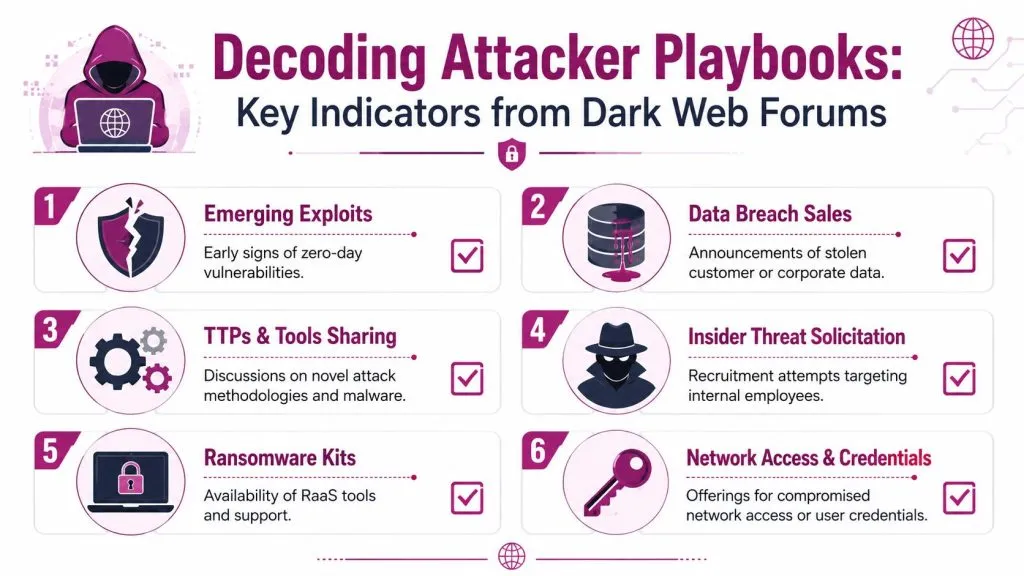
How low-cost access becomes a real incident
Two data points are especially useful for MSPs. Data shows that 68% of reported incidents in dark forums involve social engineering exploiting reputation-based trust, and credentials for high-value accounts are often sold for as low as $15, according to Dexpose’s analysis of dark web forums. Cheap access changes attacker economics. It lowers the cost of experimentation.
That means defenders shouldn’t assume low sale value equals low impact. A low-cost account can still yield mailbox intelligence, password reset paths, vendor impersonation angles, or tenant reconnaissance. In managed environments, attackers often look for the account that gives them the fastest route to trust, not the account with the highest theoretical privilege.
The forum’s behavior proves more revealing than the listing itself. Reputation-based communities amplify social engineering because users borrow trust from prior transactions, referrals, and moderator standing. That same dynamic appears in attacks against your clients. Threat actors test what works on each other, then apply those trust manipulation tactics to customers, employees, and support teams.
Indicators worth escalating early
A practical detection model should look for signs of progression. These tend to matter before the client sees an overt attack:
- Client technology mentions such as firewall brands, remote access tools, identity providers, or vertical software.
- Requests for “fresh” access into a sector, geography, or company size that matches your customer base.
- Credential validation chatter where actors discuss whether a dump is current or tied to active services.
- Discussion around bypass methods for MFA, help desk verification, or business email compromise workflows.
- Recruitment or insider solicitation aimed at employees, contractors, or support staff.
Watch for combinations, not single signals. A credential mention plus technology chatter plus seller reputation is far more actionable than any one of those alone.
MSPs supporting smaller organizations should also align dark web intelligence with basic hardening work. If a forum thread suggests exploit interest in internet-facing software your client uses, simple controls still matter. This guide on practical steps for SMB exploit prevention is a useful companion for translating forum-derived indicators into everyday patching and exposure reduction tasks.
Trust abuse is often the real precursor
Many teams still over-focus on breach dumps and under-focus on social mechanics. In forums, attackers don’t just exchange data. They test persuasion, credibility, and manipulation. That should push defenders to enrich alerts with context such as actor reputation, thread replies, and whether a claim is being endorsed, disputed, or packaged for resale.
If you only monitor for your client’s domain, you’ll catch exposure. If you monitor for the language around trust, verification, urgency, and buyer interest, you’ll catch where exposure is turning into operation.
An Actionable Workflow for Monitoring and Remediation
Dark web intelligence only pays off when it becomes a repeatable operational workflow. For MSPs and MSSPs, the model that works is simple: monitor, triage, remediate. The hard part is keeping each stage narrow enough to be actionable and rich enough to be worth automating.
Start with the workflow view.
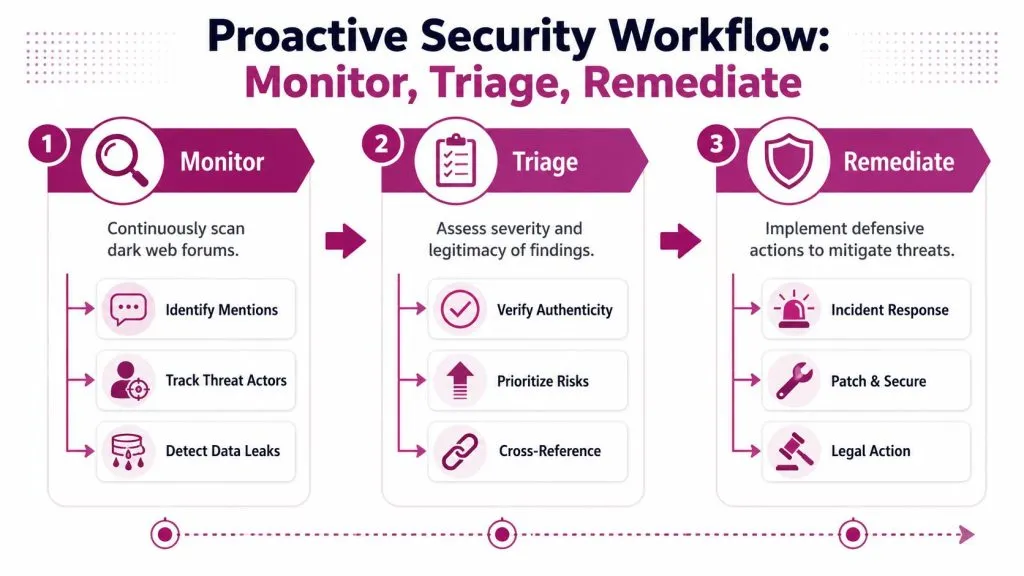
Monitor with scoped collection rules
Teams often fail here by collecting too broadly. They monitor for brand names and drown in noise, or they collect too narrowly and miss relevant actor discussion. Good monitoring starts with scoped client-specific indicators.
Prioritize terms that map to real business risk:
- Core identifiers such as client domains, executive names, and known email patterns
- Technology fingerprints tied to client environments, including identity platforms, remote access tools, and key vendors
- Business context terms like product names, internal project names, or region-specific references that attackers might use in listings
- Threat actor tracking for handles already associated with sectors your clients operate in
If you’re integrating collection into a larger pipeline, benchmark reliability matters. Teams comparing ingestion methods often look at web scraping API performance benchmarks to understand latency, error handling, and scale trade-offs before wiring data into SIEM, SOAR, or case-management systems.
A platform such as InsecureWeb’s dark web monitoring overview fits this stage because it monitors forums and marketplaces and provides API access for downstream processing. That matters for MSP operations because manual review doesn’t scale across tenants.
Later in the workflow, training can help align analysts and account teams on what good handling looks like.

Triage by credibility freshness and client impact
Not every alert deserves a ticket with the same severity. Triage should answer three questions fast.
First, is the source credible. Established actors, specialized forums, and corroborated replies should score higher than reposts or low-trust sellers.
Second, is the data fresh enough to matter. Old leaks still matter for password reuse and profiling, but they don’t deserve the same urgency as newly exposed access or active resale.
Third, what’s the client impact path. A leaked marketing list and a valid admin panel credential are not the same problem. One may trigger monitoring and user awareness. The other may justify incident response.
A simple internal triage rubric works well:
- Observe when the mention is low-confidence, stale, or not clearly tied to active systems.
- Escalate when the post appears current, credible, and linked to employee or customer access.
- Trigger response when the finding suggests active intrusion opportunity, account compromise, or extortion staging.
Remediate with clear ownership
Remediation fails when findings stop at “inform the client.” Security teams need predefined owners and action paths.
Use direct playbooks:
- Identity team actions include forced password resets, session revocation, MFA review, and account risk checks.
- Infrastructure actions include patch validation when exploit discussion matches deployed software.
- Security operations actions include log review, impossible-travel checks, mailbox rule analysis, and privileged account validation.
- Client-facing actions include notifying affected stakeholders, documenting evidence, and giving a decision window for urgent containment.
A major lesson from underground monitoring is that legality and safety depend on controlled collection. Monitoring these forums for threat intelligence is legally permissible, and professional protocols rely on controlled observation and system separation so analysts can track patterns without becoming entangled in the criminal ecosystem, as described in StealthMole’s dark web ecosystem overview.
Practical rule: If an alert can’t be mapped to an owner, an SLA, and a remediation action, it isn’t operational intelligence yet.
One more workflow lesson is worth keeping in view. Even dark web actors lose data. A major forum breach in 2026 reportedly exposed approximately 300,000 users, with around 70,000 directly linked to traceable IP addresses, highlighting how anonymity assumptions can fail at scale according to this reported breach summary. For defenders, that’s not just a curiosity. It’s a reminder that these ecosystems are unstable, and timely collection matters because infrastructure, operators, and access paths can change quickly.
From Reactive Cleanup to Proactive Defense
Reactive cleanup is expensive in analyst time, client trust, and decision quality. By the time a customer reports phishing, fraudulent payments, or suspicious mailbox rules, the attacker has often already moved through the easier stages of the operation. The planning happened earlier, often in the spaces most defenders still under-monitor.
That’s why dark web forum visibility belongs in routine security operations. It helps MSPs and MSSPs detect credential exposure in context, identify exploit interest before widespread abuse, and connect weak signals that don’t make sense when viewed in isolation.
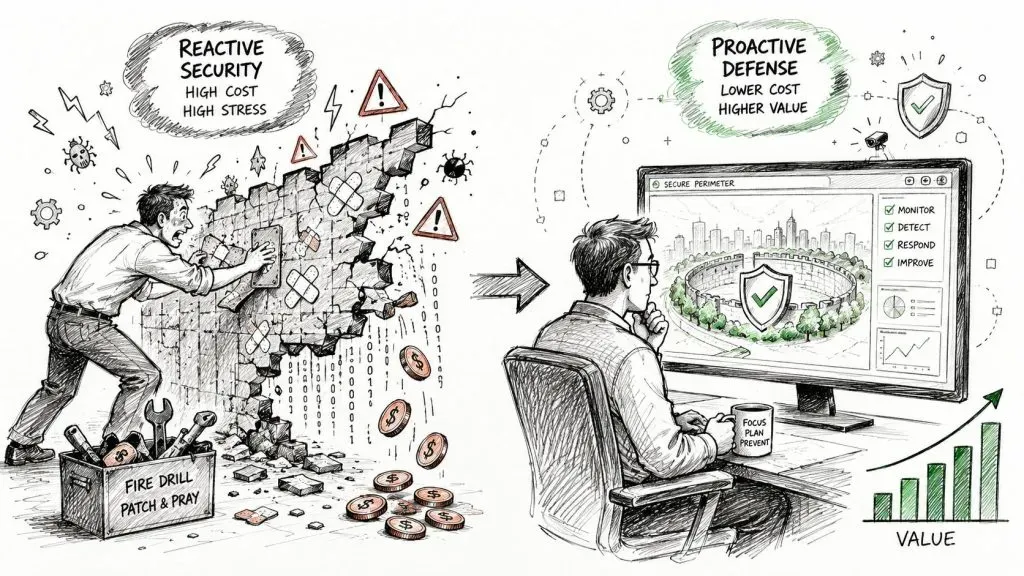
The business case is also getting harder to ignore. The dark web intelligence market is projected to reach $1.99 billion by 2030, growing at a compound annual growth rate of 21.3%, reflecting the rising value organizations place on monitoring these ecosystems for threat intelligence, according to this projected market figure in the reported breach discussion. Treat that as a projection, not a certainty. Still, the direction is clear. Organizations are moving this capability from niche research into standard defensive operations.
The teams that get the most from dark web monitoring don’t treat it as a dashboard. They treat it as a workflow. They monitor with precision, triage with context, and remediate with ownership. That shift is what turns hidden criminal discussion into usable defensive lead time.
If you need a way to operationalize this across multiple clients, InsecureWeb gives MSPs, MSSPs, and security teams a practical way to monitor dark web exposure, external threats, and related signals through a platform that can plug into existing tools with API access.