Data Breach News10 min read
Dark Web Threat Intelligence Guide for Security Teams
By InsecureWeb Team
This report reflects observations of dark web activity. InsecureWeb makes no representations regarding the accuracy of this data.
91% of organizations experienced an identity-related incident in 2024, and the average corporate user had 146 stolen identity records, about 12 times more than traditional detection methods catch. That makes dark web threat intelligence a frontline control, not a luxury.
Many teams still discover breaches too late, after credentials are already circulating and attackers have time to act. The right program tracks exposure early, correlates it to your assets, and turns that signal into containment work before account takeover starts.
Why Dark Web Threat Intelligence Matters Now
91% of organizations experienced an identity-related incident in 2024, and the average corporate user had 146 stolen identity records tied to their identity, about 12 times more than traditional detection methods surface, according to the 2024 exposure data set in the brief. That gap changes the security model. If your team waits for breach notifications or user complaints, you’re already behind.
Reactive alerts are the wrong control
Breach notices, password reuse alerts, and post-incident forensics are useful, but they’re late. They tell you what already escaped, not what’s about to be abused. Dark web threat intelligence matters because it pulls identity exposure into the defensive phase, where credential rotation, MFA enforcement, and targeted hardening still help.
The point isn’t to stare at criminal forums for entertainment. It’s to systematically track whether your usernames, domains, employees, or vendors are showing up in places where attackers buy access and operationalize stolen data. The earlier you see the exposure, the more options you have.
Practical rule: Treat any identity exposure as a containment problem, not an awareness problem. Awareness without action just creates noise.
A lot of teams still think of this as niche research work. That mindset is outdated. When identity-related incidents hit nearly every organization, the control belongs closer to the SOC than the compliance shelf. If you want a plain-language primer on business value, this overview of dark web monitoring benefits is worth keeping on hand, but the bigger lesson is simple, proactive identity intelligence is now core security work.
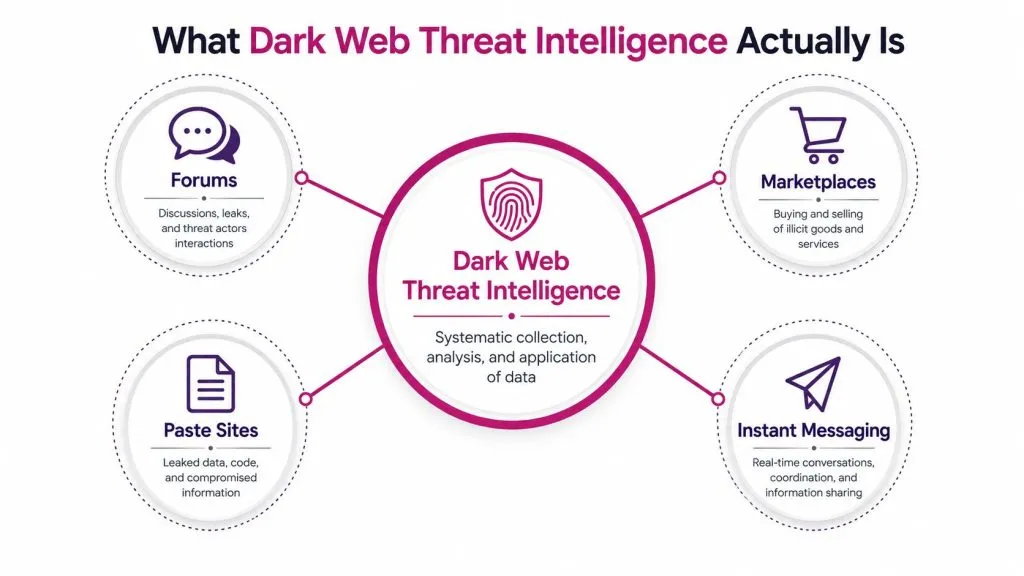
What Dark Web Threat Intelligence Actually Is
Dark web threat intelligence is the collection, analysis, and operational use of data from underground environments to identify threats before they reach your business. That includes forums, marketplaces, paste sites, leaked archives, and private messaging channels, but only the raw material matters until you can tie it back to a real asset.
Monitoring is not intelligence
Monitoring is passive. It scans for mentions, matches keywords, and raises alerts. Intelligence is structured. It correlates those findings with your domains, employee identities, vendors, and infrastructure so the result is a decision, not a dump of strings.
Monitoring tells you there’s rain somewhere in the region. Intelligence tells you which storm cell is moving toward your office, how severe it looks, and which team needs shelter first. MSPs need that distinction because they can’t afford to drown clients in generic alerts that don’t map to any actionable asset.
Dark web intelligence only works when the data is normalized. Unstructured posts, dumps, and archive files have to be turned into threat objects, then matched against the asset registry your team trusts. Without that step, every underground mention looks equally important, and most of them won’t be.
Bottom line: If your workflow ends at “we found a credential on a forum,” you’re doing monitoring. If it ends at “we know which client account, vendor, or executive is affected,” you’re doing intelligence.
That distinction matters because underground data is messy by design. A single account can appear in multiple places with different handles, stale passwords, or recycled breach fragments. The value comes from connection, context, and prioritization, not volume.
How Dark Web Threat Intelligence Data Is Collected and Processed
The technical backbone is boring on purpose, and that’s a good thing. Security teams should expect a pipeline that starts with asset registration and ends with structured outputs that the SOC can act on. Anything less is theater.
Start with the asset registry
Practitioners monitor corporate domains, employee and executive email addresses, IP ranges, subdomains, technology-stack identifiers, and third-party vendors, then correlate those assets against underground sources such as forums, dumps, and archives. Bitsight’s dark web threat intelligence overview describes that asset-driven approach clearly, and it’s the only way raw chatter becomes relevant to a specific organization. OSINT methods with PartnerScanX fits naturally here as a reference point for teams that want to understand how open-source collection feeds into broader intelligence work.
The logic is straightforward. If you don’t know what you own, you can’t tell whether a leak matters. A mention of an email address is just text until your system connects it to a named user, a business unit, or a client environment.
Operational rule: Build the asset registry first, then automate collection. Reversing that order gives you a fast way to generate false confidence.
Turn messy content into structured objects
Underground posts rarely arrive in a neat format. They need parsing, normalization, and enrichment before they can be used in the SOC. That means extracting usernames, email addresses, domains, hash references, vendor names, and context, then grouping them into a record that can be scored and routed.
The collection layer also has to survive hostile environments. Many forums and channels actively block automation, so rotating identities and protocol-level anonymization are common requirements if you want continuous access and fewer collection gaps. That isn’t an edge case. It’s part of operating in adversary-controlled spaces.
A practical pipeline looks like this:
- Asset registration first: Define the domains, people, vendors, and technologies you care about.
- Source collection second: Pull data from forums, dumps, archives, and messaging surfaces.
- Normalization third: Convert unstructured findings into records the platform can compare.
- Correlation last: Match each finding to an owned asset and score the risk.
If you want a serviceable baseline for discovery and external exposure checks, Dark Web Scan is the kind of capability that should sit inside a broader workflow, not replace it.
Real-World Use Cases for MSPs, MSSPs, and SMBs
MSPs use dark web threat intelligence to prove exposure, not just describe it. Scan a prospect’s domain and surface an executive credential for sale, and the conversation changes fast. You are no longer selling abstract monitoring. You are showing a concrete path from leaked identity to client risk.
MSPs need proof, not promises
The value for MSPs is repeatable differentiation. A client-facing dark web program lets you show exposed identities, leaked credentials, and vendor spillover across the environments you already manage. That matters because many SMBs do not buy monitoring until they see their own data tied to a real exposure path.
MSSPs should treat the feed as an operational input, not a reporting layer. If a leak-site post can be connected to a client asset and pushed into a response workflow, the service becomes part of detection and response. That is the level buyers remember, and it is also the level that supports dark web monitoring for managed service providers.
SMBs need early warning on pre-exploitation activity
SMBs need the signals that show up before the breach. Credential listings, access-auction activity, ransomware negotiation threads, and leak-site posts can appear before malware deployment or hands-on-keyboard activity. That window matters because it gives security teams time to reset access, cut off exposed accounts, and warn leadership before the incident spreads.
Google Cloud says its workflow analyzes millions of dark web events daily and filters them down to mission-relevant threats, which is the kind of scale needed to separate signal from noise in a busy environment. You do not need millions of events, but you do need discipline to turn large collection volume into a short list of actions. The benchmark is response speed and relevance, not raw intake.
MSPs should prioritize client domain scanning and executive exposure checks. SMB security teams should start with staff and leadership credentials, then move to vendor exposure. If you want a model for how centralized operations can absorb this signal without losing context, GSOC solutions for property managers show the same operational principle in a different environment.
“If the alert does not change a password, revoke access, or escalate a case, it is not intelligence yet.”
Implementation Roadmap for Security Teams
Start with the foundation and ignore the rest until that’s done. A dark web program without a clean asset registry turns into an alert factory, and nobody needs another one of those. The best implementations stay disciplined, tie every finding to ownership, and make SOC routing explicit from day one.
Foundation first, then scale
Phase one is asset registration and data normalization. If your team can’t map a finding to a business owner, a system, or a client, the alert should not reach the SOC as a high-priority event. That rule alone removes a lot of garbage.
Phase two is tool selection. Look for coverage breadth, not marketing slogans. Ask whether the platform can monitor the asset types you care about, whether it supports API access, and whether its outputs can be consumed by your existing SIEM or SOAR stack.
Phase three is integration. A useful feed should land where analysts already work, not in yet another dashboard that someone checks once a week. Route identity exposures into ticketing, enrichment, and response workflows so actions are visible and trackable.
Measure what matters
Use KPIs that tell you whether the program is changing outcomes. The most useful ones are mean time to detect credential exposure, alert-to-action ratio, percentage of assets covered by monitoring, and the trend in identity-related incidents over time. Those measures are operational, not decorative.
Here’s the sequence I’d hand to a team on Monday:
- Define ownership: Know which assets, executives, vendors, and clients matter most.
- Normalize sources: Get the data into a format the SOC can route.
- Test integrations: Confirm the feed reaches SIEM, SOAR, or ticketing without manual rework.
- Tighten triage: Decide what becomes a ticket, what becomes a watch item, and what gets dropped.
- Review monthly: Check whether detections are leading to action or just accumulating.
The technical goal isn’t visibility for its own sake. It’s to make dark web findings part of routine security operations, so the team can respond before exposure turns into abuse.
Legal, Ethical, and Operational Challenges
The biggest mistake is pretending these problems don’t exist. Dark web threat intelligence sits in a gray area operationally, and teams that ignore that reality create more risk for themselves than the forums do. You need boundaries, process, and evidence handling discipline.
Keep collection passive and policy-led
Legally, your collection must stay on the right side of access rules and computer misuse boundaries. That means passive collection, careful attribution, and no behavior that looks like participation in criminal activity. If a workflow requires active probing, the team is already off course.
Ethically, the line is simple. Monitoring criminal activity for defense is one thing. Helping it along is another. Set that expectation in policy, and make sure analysts know what they can collect, retain, and escalate.
Operationally, false positives are a significant tax. Underground content is noisy, recycled, and often deliberately misleading. If you don’t validate a match against asset context, you’ll waste analyst time and train the SOC to ignore the feed.
Design around the constraints
Use a few hard controls:
- Stay passive: Collect and correlate, don’t interact in ways that cross the line.
- Require context: Every alert should map to a known asset or person.
- Document handling: Track who accessed the finding, when, and why it mattered.
- Validate before panic: Make sure the data is current and relevant before you escalate.
When teams build the process this way, the legal and ethical constraints stop being an excuse to avoid the program. They become the operating rules that make the program defensible.
The risk is not over-collection. It’s missing the exposure entirely because no one wanted to put guardrails around the work.
Best Practices and Next Steps
Foundational programs should do three things well: register assets, monitor credentials, and feed findings into the SOC. If you can’t do those reliably, don’t jump ahead to more ambitious workflows. Weak basics just create expensive clutter.
Build in layers, not in leaps
Intermediate maturity adds automated triage, threat actor tracking, and vendor risk correlation. That’s where the program starts to save real analyst time, because repeated exposures and related identities can be grouped instead of handled as isolated events. The work becomes more about prioritization and less about raw detection.
Advanced teams connect dark web intelligence to vulnerability management and managed response workflows. That’s the point where identity exposure, exposed services, and remediation planning start to inform one another. MSSPs can package that into a managed detection flow, but only if the earlier layers are solid.
A practical decision framework is simple:
- If you’re an MSP: Start with client domain scanning and executive exposure checks.
- If you’re an SMB security team: Start with employee and leadership credential monitoring.
- If you run a SOC: Prioritize SIEM integration and KPI tracking before expanding coverage.
Best practice: Pick one ownership model and make it real. If every alert belongs to everyone, no alert belongs to anyone.
The right next step is to tie dark web findings to an actual response owner. Don’t let intelligence sit in a report. Turn it into password resets, access reviews, vendor checks, or executive escalation when it matters. That’s how the program earns its place.
InsecureWeb helps MSPs and security teams monitor dark web exposure, fake sites, and other outside-in threats from one place. If you want to turn underground findings into client-ready security workflows, visit InsecureWeb and see how its monitoring and API access can fit into your existing stack.