Data Breach News14 min read
Brand Reputation Monitoring Guide for MSPs in 2026
By InsecureWeb Team
This report reflects observations of dark web activity. InsecureWeb makes no representations regarding the accuracy of this data.
A client’s operations lead calls at 8:15 a.m. because someone has posted a video of the CEO promoting a cryptocurrency giveaway. The account uses the executive’s name, photo, and company branding. Customers are tagging the actual company, employees are forwarding screenshots, and the client’s internal team is debating whether the video is genuine. Your monitoring platform shows hundreds of mentions, but it doesn’t tell you which signals represent an active threat, who owns the response, or whether the issue has reached journalists and search results.
That’s the operational problem behind brand reputation monitoring for MSPs. Clients don’t need another dashboard filled with raw mentions. They need a service that identifies meaningful risk, routes it to the right person, preserves evidence, and supports a response within the time window when intervention still matters.
Why Brand Reputation Monitoring Matters Now
Brand attacks no longer depend on a single angry post or a poor review. An attacker can combine a fake social profile, a lookalike website, stolen employee credentials, and manipulated media into a campaign that appears credible before the client knows anything is wrong.
An MSP may first hear about the incident from the client’s CEO, who received a message from a customer asking why the company is requesting payment through an unfamiliar account. A search then reveals a fake profile using the CEO’s identity. A dark web search finds employee credentials circulating in a marketplace. Meanwhile, a deepfake video is gaining engagement in another language and hasn’t yet appeared in the client’s usual social listening feed.
Those signals belong in one operational workflow. Dark web credential exposure can support account takeover and targeted impersonation. Fake sites and social accounts can collect payments or harvest credentials. Deepfake content can fabricate endorsements, statements, or instructions. Coordinated attacks can also seed a narrative across forums, social platforms, review sites, and search results before mainstream coverage begins.
The shift matters for MSPs because traditional social listening usually answers only one question, “Who mentioned the brand?” A managed reputation service must answer harder questions:
- Is the content authentic or manipulated?
- Does the source have enough reach or credibility to create business risk?
- Are separate mentions part of one developing narrative?
- What action should happen next, and within what SLA?
Pew Research Center data captures an earlier milestone in this transition. In 2009, 57% of adult internet users said they had searched their own name, compared with 47% in 2006, while 46% of online adults had created a social networking profile, compared with 20% in 2006. The figures are summarized in this Pew Research Center reputation-monitoring reference, and they show how public identity moved into searchable, social spaces.
Practical rule: Treat reputation alerts as security and business-risk events, not as marketing notifications.
The commercial case has also strengthened. An industry review estimates the online reputation management market at about $6.9 billion in 2025, with projected growth to roughly $14.0 billion by 2031, a compound annual growth rate near 12.6%. The same review says 41% of companies experiencing a reputation crisis suffer a direct loss of brand value and revenue within the first year. These figures appear in the YouGov BrandIndex industry reference.
For an MSP, the opportunity isn’t to sell anxiety. It’s to package visibility, triage, evidence handling, and response coordination into a repeatable service. Clients already trust their MSP with security alerts. Reputation monitoring extends that responsibility to the public attack surface.
Email deliverability also affects reputation signals and customer communication during an incident. For practical guidance on reducing the chance that urgent customer messages get filtered, review Mailwarm’s 2026 spam guide.
Core Components of Effective Brand Reputation Monitoring
A useful monitoring stack combines several detection layers. No single feed reliably captures every threat, and collecting more data won’t help if your team can’t classify and route it.
Dark web monitoring
Dark web monitoring looks for exposed credentials, company names, domains, internal references, and stolen data in locations that ordinary search engines don’t index. The useful output isn’t a dramatic screenshot. It’s a validated finding with context, confidence, affected identity, discovery time, and a recommended action.
If an employee email and password appear in a credential dump, the first task is to determine whether the password remains usable, whether the account has privileged access, and whether the employee reused it elsewhere. Your platform should create a ticket, notify the designated client contact, and increase monitoring around related identities.
Social and review monitoring
Social monitoring collects direct mentions, indirect references, replies, reposts, complaints, and emerging sentiment changes. Review coverage adds a different signal because customers often describe service failures in detail there rather than on a social network.
Sentiment analysis helps prioritize, but it shouldn’t make the final decision on its own. Sarcasm, industry terminology, multilingual content, and quoted accusations can all create false classifications. Require human review for alerts that could trigger public statements or legal escalation.
Fake sites and accounts
Impersonation detection compares new domains, profile names, logos, biographies, contact details, and publishing behavior against approved brand assets. A fake account may have little mention volume but still pose immediate risk if it directs customers to a payment page.
The service should capture the URL, account identifier, screenshots, timestamps, and platform reporting path. That evidence supports takedown requests and gives the client a defensible incident record.
Deepfake and synthetic media detection
Synthetic-media monitoring looks for manipulated audio, video, images, and fabricated endorsements. A 2025 deepfake threat report says brand and reputation attacks, including impersonation and defamation, dominate reach in the threats it examined. The findings are discussed in Resemble AI’s 2025 deepfake threat report.
Detection alone isn’t enough. Your analysts need a confidence assessment, source history, language identification, distribution map, and evidence-preservation process. Deepfake incidents often move across platforms faster than a client’s legal or communications team can coordinate.
Threat intelligence correlation
Threat intelligence connects reputation events to broader attack patterns. A fake executive profile may share infrastructure with a phishing domain. A leaked credential may appear alongside references to a planned extortion attempt. Correlation turns isolated observations into a prioritized incident.
For MSPs, the key design principle is tenant-aware enrichment. Every event should carry the client, brand, executive, region, severity, source, and workflow owner. Without that structure, analysts spend their time sorting alerts rather than protecting customers.
Key Metrics and Signals That Actually Matter
Mention volume is easy to display and hard to interpret. A client can receive thousands of harmless brand references while missing a small cluster of high-credibility posts that signals an active attack.
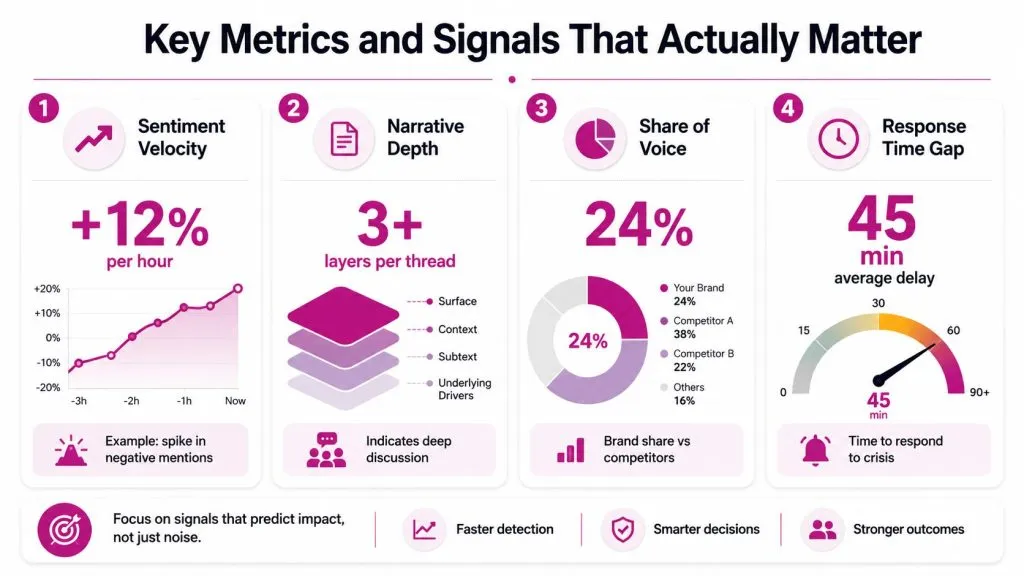
Start with sentiment velocity, not just sentiment direction. A gradual stream of neutral complaints may need customer-service action. A rapid increase in negative language around “scam,” “fake,” or “refund” requires a different escalation path, especially when the same terms appear across separate platforms.
Next, identify narrative formation. Look for repeated claims, shared wording, common images, linked accounts, and references that connect individual posts. The objective is to detect the story while it’s forming, before it becomes a search result, news item, or AI-generated summary.
A peer-reviewed study reported that an AI crisis-detection system identified brand crisis events an average of 6.2 hours before mainstream media and achieved an F1 score of 0.91 on a benchmark crisis dataset. The same study reported that brands responding to detectable negative sentiment spikes within six hours experienced 31% smaller brand-equity declines. The study is available in this peer-reviewed crisis-detection paper.
Build thresholds around risk
Use separate thresholds for different event types. A credential exposure should escalate based on identity and access context, not mention count. A fake account should escalate when it uses approved branding or contacts customers. A negative story should escalate when source credibility, engagement, cross-platform spread, and narrative consistency combine.
Source credibility weighting prevents a random post from receiving the same priority as a journalist, regulator, major customer, or industry analyst. It doesn’t mean low-reach sources can be ignored. Early indicators often appear in small communities, so preserve them while applying a lower immediate severity.
Cross-platform correlation closes the reputation detection gap, the period between meaningful narrative formation and organizational understanding. Recent guidance describes this gap as a weakness in many monitoring programs, which collect extensive data without connecting fragmented signals early enough. The issue is outlined in Reputation House’s guidance on real-time brand reputation monitoring.
Detection principle: Optimize for low-latency alerting and high precision. A larger alert count is not a better service.
For multi-tenant environments, tune thresholds per client. A national retailer, a professional-services firm, and a regulated healthcare provider won’t have the same tolerance for false positives or the same escalation contacts. Store those rules as configuration, not analyst memory.
Choosing the Right Tools and Integration Points
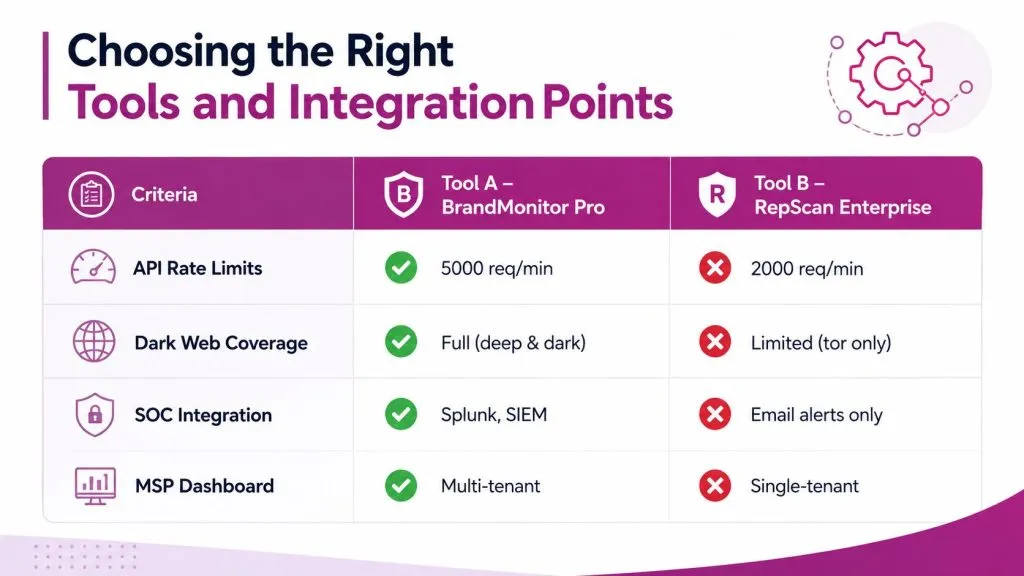
Tool selection becomes difficult when an MSP evaluates a platform for one client but operates it across many. A dashboard that works for a single brand may fail when API quotas, tenant separation, reporting permissions, and escalation routing become service-wide requirements.
Compare control with delivery speed
A custom stack gives you control over data models, enrichment, workflow logic, and branding. It also creates maintenance work around platform APIs, language coverage, detection quality, storage, access control, and vendor changes. Custom development makes sense when you have a strong engineering function and a clear need for differentiated workflows.
A white-label platform usually reduces time to market and simplifies tenant provisioning. The trade-off is less control over detection logic and possible constraints around export, retention, rate limits, or custom integrations. Ask for a working tenant demonstration, not a slide deck.
Test the integration surface
Before signing, test:
- API behavior: Check authentication, pagination, webhooks, rate limits, event deduplication, and tenant-level permissions.
- Security integrations: Confirm whether alerts can reach your SIEM, ticketing platform, SOAR workflow, and on-call system.
- Evidence handling: Verify export formats, timestamps, screenshots, chain-of-custody controls, and retention settings.
- Coverage claims: Test dark web sources, social platforms, review sites, languages, executive watchlists, and synthetic media workflows.
- Operational controls: Confirm suppression rules, severity mapping, analyst notes, client-visible views, and audit logs.
MSPs should also ask whether API access is included without a separate commercial barrier. Free API access can make the difference between a useful managed service and a dashboard that technicians must operate manually. The same principle applies when assessing real-time competitor tracking tools, because competitor movement can provide context for unusual narrative changes.
A practical test should use controlled indicators and historical examples. Measure whether the tool catches a known fake profile, separates a legitimate complaint from an impersonation event, and routes alerts to the correct tenant. Don’t evaluate only the interface. Evaluate the analyst’s workload.
For broader external exposure checks, an MSP may also connect a platform to an external dark web scan. The important question is how findings move into your existing case-management process.
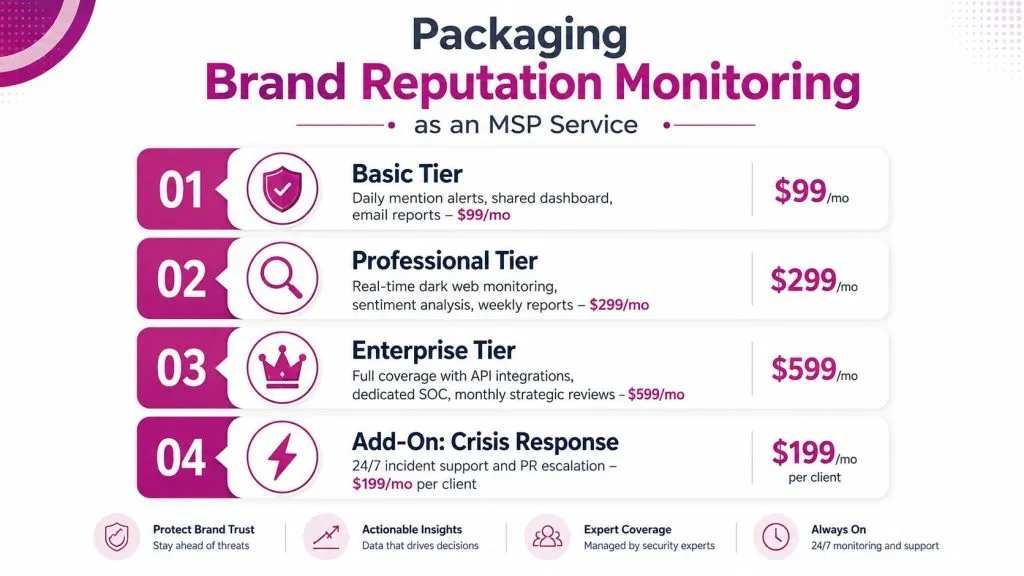
Packaging Brand Reputation Monitoring as an MSP Service
Start with the client’s exposure, not the tool’s feature list. A small business may need monitoring for its brand, domain, leadership team, and customer-facing accounts. A larger client may also need regional language coverage, executive watchlists, dark web correlation, legal escalation, and a formal crisis communications process.
A workable service model separates coverage from response. Monitoring can be recurring and standardized. Response support requires defined human effort, decision authority, and availability. If you combine both under an unclear “24/7 protection” promise, clients may assume that every alert receives immediate analyst action.
Design tiers around outcomes
A basic tier might provide daily review, verified alerts, a shared dashboard, and periodic reporting. A higher tier can add near-real-time alerting, dark web monitoring, sentiment analysis, executive watchlists, and ticketing integration. A crisis-response add-on should specify what happens during an incident, including analyst availability, communications coordination, evidence preservation, and third-party escalation.
Avoid copying the sample dollar amounts shown in the infographic into your pricing without validating your delivery costs. The right price depends on client count, coverage, analyst review, API expenses, storage, support hours, and the response commitments you’re willing to honor.
Make SLAs measurable
A reputation SLA should define:
- Acknowledgment time: How quickly your team confirms receipt of a qualifying alert.
- Triage time: How quickly an analyst classifies severity and identifies the likely threat type.
- Escalation time: How quickly the designated client contact and internal owner receive the case.
- Response scope: What your team will do, and what remains with the client, legal counsel, PR, or the platform provider.
- False-positive handling: How clients can challenge classifications and how suppression rules are updated.
A study of crisis response found that prompt responses within the first 24 hours were associated with more positive online sentiment and higher perceived credibility. Another review emphasized the influence of the first four hours in shaping the eventual outcome. Those findings are summarized in research on social-media crisis management and response timing.
Solve the tenant problem early
Each tenant needs isolated data, role-based access, custom keywords, suppression lists, escalation contacts, retention settings, and reporting language. Executive monitoring requires written authorization and careful handling because personal and corporate identities often overlap.
Onboarding should capture official brand assets, domains, executive names, approved accounts, business regions, critical products, sensitive terms, and known impersonation risks. Use a dark web monitoring service for managed service providers as a technical reference point when explaining how external exposure checks fit into the broader service.
Sell the service through evidence. A controlled brand audit or dark web scan can open a useful conversation, but don’t turn an unverified finding into a sales scare. Show how a verified alert becomes a ticket, an owner, an SLA clock, and a documented client decision.
Building Incident Response Playbooks for Reputation Threats
An alert has value only when it starts a controlled action. Your playbook should tell an analyst what to validate, whom to notify, what evidence to preserve, and which actions require client approval.
Credential exposure workflow
When a credential appears in a dark web source, validate the identity and exposure context without unnecessarily reproducing sensitive data. Notify the client through the agreed secure channel, recommend password reset and session revocation, assess privileged access, and increase monitoring for related accounts.
The MSP shouldn’t promise that a scan proves an account is currently compromised. It should distinguish exposure from confirmed misuse and document the confidence level. After containment, review authentication logs and access controls with the client’s security team.
Fake account or site workflow
Capture the account name, URL, branding elements, contact method, screenshots, timestamps, and visible audience. Check whether the impersonator is soliciting money, credentials, or personal information. Then prepare a platform report, notify the client’s communications and legal contacts, and draft a public warning if customers may be at risk.
Legal review matters when the content includes allegations or defamation. The RNC Group defamation guide can help teams frame the legal questions, but it shouldn’t replace advice from the client’s counsel.
Deepfake workflow
Preserve the original media, source URL, account metadata, reposts, and available timestamps before requesting takedown. Have a qualified reviewer assess manipulation indicators, then coordinate communications with executives, legal counsel, customer support, and platform contacts.
A crisis-detection study reported that responding to identifiable negative sentiment spikes within six hours was associated with 31% smaller brand-equity declines. Treat that as an operational reason to reduce handoffs, not as a promise that every incident can be resolved within six hours.
Response rule: The first alert should open a decision process, not start an argument about whether the content is embarrassing.
Create message templates for customer notices, employee guidance, platform reports, executive statements, and internal status updates. A decision matrix should identify who can approve a public response, who can authorize legal action, and who can contact law enforcement or regulators.
Run tabletop exercises with clients using realistic scenarios. Test after-hours contacts, language coverage, evidence storage, executive availability, and approval delays. After every exercise or real incident, review missed signals, duplicate alerts, unclear ownership, and client confusion. Update the playbook while the details are still fresh.
For broader breach coordination, connect reputation procedures with the client’s documented steps after a data breach. Credential exposure and public impersonation often overlap, so separate playbooks can create dangerous gaps.
Measuring Success with KPIs and Client Reporting
Client reports should explain what changed, what your team did, and why the action mattered. A list of alerts doesn’t demonstrate value. An executive needs to understand which risks were contained before customers, employees, or the media acted on them.
Track leading indicators such as verified threats, time to acknowledgment, time to triage, time to escalation, takedown progress, unresolved high-severity events, and recurring false-positive patterns. Track sentiment direction qualitatively unless your methodology is stable enough to support consistent comparisons.
| KPI Category | Specific Metric | Target Benchmark | Business Impact |
|---|---|---|---|
| Detection | Verified impersonation, credential, and synthetic-media findings | Set per client and threat type | Shows whether the service is observing the client’s real exposure |
| Response | Alert acknowledgment, triage, and escalation times | Defined in the client SLA | Demonstrates operational readiness |
| Quality | False-positive review rate and suppression changes | Reviewed periodically | Shows whether alert fatigue is under control |
| Coverage | Monitored brands, executives, domains, platforms, and regions | Mapped to the client profile | Reveals monitoring gaps |
| Outcome | Takedown progress, containment actions, and narrative stabilization | Assessed per incident | Connects technical work to business protection |
| Commercial | Renewal, expansion, and crisis-support adoption | Compared with account history | Helps refine packaging and identify service gaps |
Don’t claim that every avoided loss can be calculated precisely. Instead, document the credible counterfactual: what was detected, when it was detected, what action followed, and what exposure that action reduced. Over time, compare clients with similar coverage to identify where onboarding, thresholds, analyst review, or response ownership needs improvement.
A strong quarterly review can turn KPI evidence into a practical recommendation. If a client repeatedly sees executive impersonation attempts, propose enhanced watchlists and response support. If alerts remain noisy because of irrelevant terms, improve configuration before selling a higher tier. ROI becomes more credible when the report shows disciplined risk reduction rather than inflated alert totals.
InsecureWeb helps MSPs monitor dark web exposure, fake sites and accounts, threat intelligence, deepfakes, and reputation risks through a platform designed for client-facing service delivery, with API access included free for integration. Visit InsecureWeb to evaluate how its monitoring capabilities could fit your tenant workflows, escalation process, and brand reputation monitoring offering.