Data Breach News12 min read
Cybersecurity Threat Landscape 2026: Key Risks & Defenses
By InsecureWeb Team
This report reflects observations of dark web activity. InsecureWeb makes no representations regarding the accuracy of this data.

Fortinet’s estimate that global cybercrime will cost $10.5 trillion annually by 2025 reframes the cybersecurity threat domain as a macroeconomic pressure system, not a collection of isolated incidents, while IDC projects 12.2% growth in cybersecurity spending in 2025 and spending above $377 billion by 2028 (Fortinet cybersecurity statistics). That scale matters because attackers are probing environments continuously, not occasionally, and Microsoft says it sees 4.5 million net new malware file blocks every day with the United States, the United Kingdom, Israel, and Germany among the leading targets (Fortinet cybersecurity statistics). For MSPs and mid-market security teams, the practical question is no longer whether there are threats, but which exposure points matter most, which controls reduce real risk, and which assumptions about “malware” are already outdated.
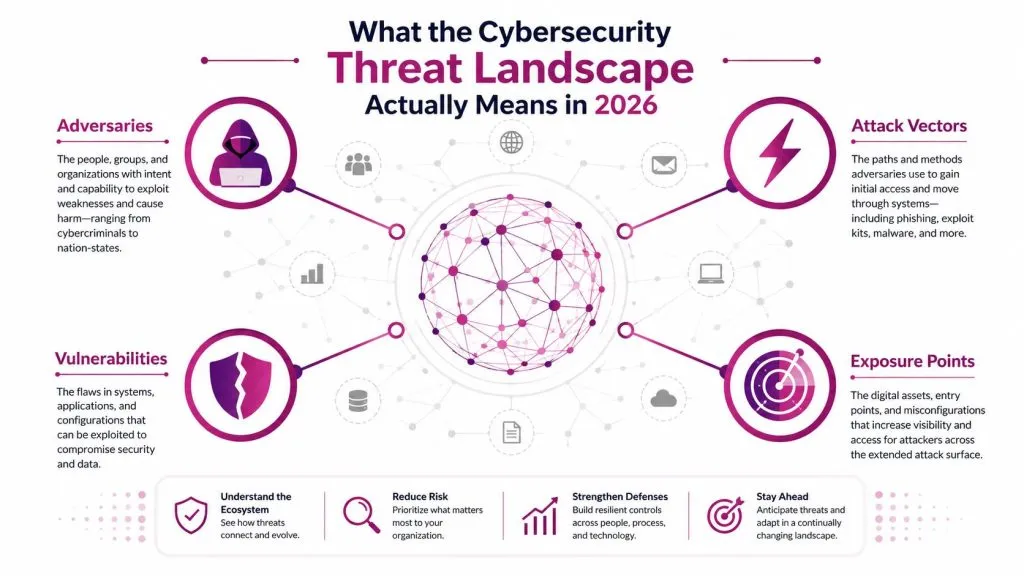
What the Cybersecurity Threat Landscape Actually Means in 2026
The cybersecurity threat environment is the full set of adversaries, techniques, vulnerabilities, and exposure points your organization faces at a given moment. In practice, that means you’re not defending against one threat, you’re defending against a changing mix of threat actors, exposed services, identity abuse, cloud misconfiguration, credential reuse, and social engineering.
From named threats to continuous pressure
The old mental model treated threats as discrete events. A phishing campaign landed, a worm spread, a ransomware gang struck, then the story ended. The current model is different. Threat activity now behaves more like persistent industrial pressure, with automated scanning, credential abuse, and opportunistic exploitation running in parallel across sectors and geographies.
That shift is visible in the scale of the market and the activity itself. Fortinet’s figures on $10.5 trillion in projected cybercrime cost and 12.2% cybersecurity-spending growth in 2025 point to a sector that is expanding because risk is expanding (Fortinet cybersecurity statistics). Microsoft’s daily malware-blocking volume shows the same pressure at the edge of the environment, where defenders see the flood before they see the breach (Fortinet cybersecurity statistics).
Practical rule: define your threat landscape by what can be reached, logged into, or impersonated, not just by what antivirus can detect.
Global view versus exposure view
The global view tells you how the market is moving. The exposure view tells you where your own organization is weak. A mid-market company with a small identity team, exposed SaaS apps, and a thin patching cadence faces a very different threat environment than a large enterprise with mature telemetry, strong access governance, and a dedicated exposure-management program.
That’s why threat content often misses the point. It describes the world in aggregate, then leaves readers to guess what it means for their environment. A better starting point is to ask which assets are reachable from the internet, which identities can be abused remotely, which third parties can open a path inward, and which internal systems would be most damaging if they were accessed with valid credentials.
For teams disposing of hardware, the same exposure logic applies after devices leave your control. A secure IT asset disposition guide is useful because it connects physical lifecycle decisions to data exposure risk.
Who Is Attacking and Why
CERT-EU’s 2025 reporting counted 174 distinct threat actors active against EU entities or their ecosystem, up from 110 in 2024 (CERT-EU threat landscape report 2025). That increase matters because it shows the threat environment is not just busier, it’s more fragmented. Defenders are dealing with a wider set of motives, tradecraft, and operational tempos at the same time.
The groups most teams actually need to plan for
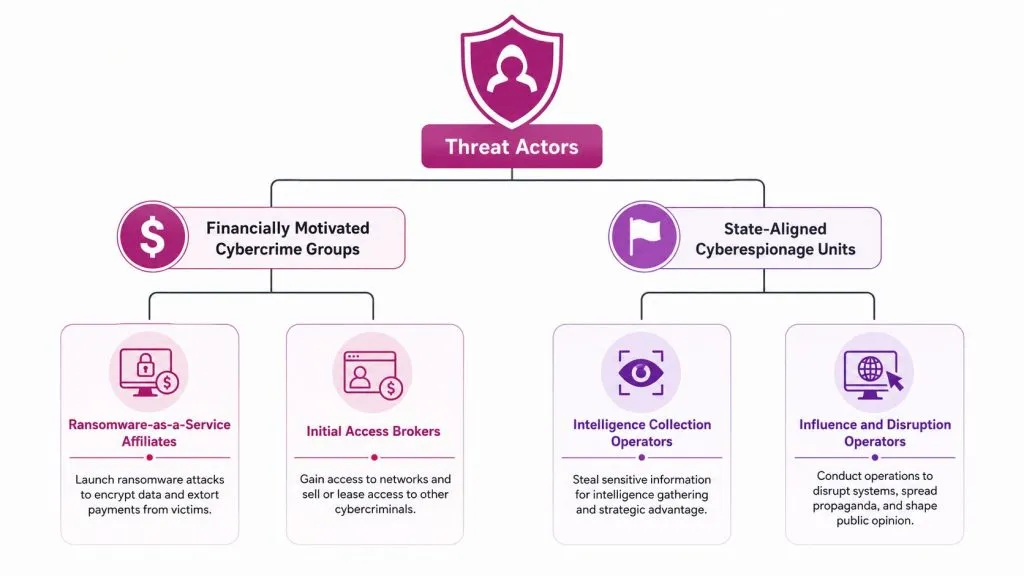
Financially motivated cybercrime groups still want fast monetization. They look for stolen credentials, exposed services, and any path that can be converted into extortion, fraud, or resale. Their choices are shaped by speed, not ideology.
State-aligned cyberespionage and prepositioning units are different. CERT-EU said cyberespionage and prepositioning accounted for 38% of recorded activity, while cybercrime represented 30% (CERT-EU threat landscape report 2025). That split shows that many intrusions are not trying to steal money immediately. They’re trying to establish access, learn the environment, or preserve options for later use.
Why motive changes defense priorities
If the attacker wants money, speed and resilience matter. If the attacker wants access for later, stealth, persistence, and identity control matter more. That difference affects which alerts deserve attention, which logs you retain, and where you spend on hardening.
Hacktivists and insider risk sit beside those categories, but they shouldn’t be treated as afterthoughts. Hacktivists often care about visibility and disruption, so reputational signals and public exposure can matter more than technical sophistication. Insider risk is often less about exotic tooling and more about misuse of legitimate access, poor process controls, or frustration inside the organization.
CERT-EU’s actor growth also suggests defenders need to stop assuming that one “main adversary” defines the year. The core challenge is portfolio management. Your environment may attract opportunistic cybercrime one day, then a more patient intruder the next.

How Attackers Are Getting In Now
The most important shift in initial access is not subtle. CERT-EU found that exploitation of vulnerabilities in internet-facing software was the top initial access vector for the second consecutive year, while e-mail spearphishing fell from 41% to 31% of initial access attempts (CERT-EU threat landscape report 2025). That doesn’t mean phishing is gone. It means exposed systems have become an equally reliable way in.
Internet-facing exploitation is the practical problem
Fortinet’s 2026 threat report says FortiGuard Labs observed 122 billion exploitation attempts in 2025 (Fortinet threat landscape report). That number matters because it shows that attack surface discovery is happening at machine speed. If a service is exposed and unpatched, the question is rarely whether it will be probed. It’s how long it stays probed before someone turns the finding into access.
This is why patch latency is now an exposure window, not just an operations issue. The practical priority is to reduce how long externally reachable assets remain vulnerable, then make sure the detection layer sees suspicious post-exploitation behavior quickly. That means exposure management, virtual patching, and web application firewall rules deserve attention alongside traditional patch queues.
Why the vector mix keeps changing
Newer techniques such as voice phishing, Adversary-in-the-Middle, ClickFix, and device-code abuse are gaining prominence because they bypass assumptions defenders still make about email and endpoints (CERT-EU threat landscape report 2025). Some of those techniques don’t need malware at the entry point at all. Others pair a social-engineering prompt with a legitimate login path, which makes the intrusion look normal until the attacker has already crossed the boundary.
For teams managing external exposure, a UK tracing agents resource can be helpful when you need to investigate the people or entities behind suspicious outreach, impersonation, or fraud patterns tied to a campaign.
When the first step is automated scanning, your most useful control is often the one that shortens the time between disclosure and remediation.
How external attack surface analysis works in practice is also relevant here, because exposed assets and exposed credentials often travel together.
Real-World Attack Patterns MSPs and IT Teams Are Seeing
The tickets many MSPs and internal teams see don’t look like classic “virus” incidents anymore. They start with a user who clicked, a login prompt that looked routine, a trusted SaaS integration that behaved badly, or credentials that worked somewhere they shouldn’t have. ENISA’s 2025 threat assessment found phishing-related activity, including vishing, malspam, and malvertising, accounted for about 60% of observed cases (ENISA threat landscape 2025), which explains why the front door still often looks like email or messaging.
The pattern behind the helpdesk ticket
One common chain starts with a convincing lure, then moves to session theft or MFA fatigue, then ends in mailbox access or SaaS compromise. Another begins with a compromised vendor account, where a trusted relationship gives the attacker a cleaner path than brute force would. A third uses AI-generated wording to make the lure sound local, current, and internally familiar enough to beat old user-training scripts.
These incidents are frustrating because each step can look legitimate in isolation. A login is a login. A shared link is a shared link. A vendor integration is supposed to work. Defenders need to look at the sequence, not just the event.
Dark web reuse is still part of the story
Stolen credentials often show up in places far removed from the breach where they were first taken, then get reused against unrelated systems. Dark-web monitoring becomes useful here because it can reveal when a credential, username, domain, or brand asset is being circulated before the abuse reaches your inbox or your identity provider. In the credential-reuse field, practitioners commonly see the same pattern repeat across web applications, email, VPNs, and SaaS accounts after a single password leak.
- User-initiated compromise: a fake invoice, delivery notice, or document share that leads to a login prompt.
- Trusted-path abuse: a vendor, contractor, or SaaS integration that becomes the entry point.
- Reused access: a password, token, or session that provides entry to unrelated environments because it was never rotated or invalidated.
Operational takeaway: if a ticket begins with “the account worked,” treat that as the incident, not as proof nothing is wrong.
The recurring theme is that attackers now build access from ordinary actions. The compromise is often quiet until the environment’s own trust model starts helping them move.
Why Most Intrusions Now Bypass Malware Entirely
The malware-centric model is too narrow for what teams are facing now. ENISA’s 2025 analysis found phishing and social engineering at about 60% of observed cases, vulnerabilities at 21.3%, supply-chain risk at 10.6%, and botnets at 9.9% (ENISA threat landscape 2025). That mix says attackers are using identity abuse, exposed services, and trusted relationships more often than they’re relying on a fresh file sample.
Access is the new center of gravity
Check Point’s 2026 framing puts continuous exposure from misconfigurations, identity weaknesses, unmanaged assets, and attack paths across cloud, edge, SaaS, and on-prem environments at the center of risk (ENISA Threat Landscape 2025 PDF). That’s the right lens because many successful intrusions now depend on legitimate access paths. Attackers log in with stolen credentials, exploit a trust relationship, or abuse a configuration gap instead of dropping a file that antivirus can quarantine.
This is why endpoint antivirus alone isn’t the center of gravity anymore. It still matters, but it can’t see everything that happens through native cloud controls, browser sessions, OAuth consent, or admin tooling already authorized by the tenant.
What MSPs need to watch more closely
Distributed client environments make the problem harder. MSPs often inherit a patchwork of identity systems, shadow IT, SaaS sprawl, and third-party integrations. If you can’t see where identities are over-permissioned, where assets are unmanaged, or where trust has been granted too broadly, your detection stack will keep seeing symptoms instead of sources.
The control gap is especially clear when a compromise never needs a payload. A stolen session, a rogue consent grant, or a misconfigured internet-facing service can be enough to trigger lateral movement, data access, or ransomware staging. That means identity telemetry, asset visibility, and dependency monitoring need to sit beside endpoint controls, not behind them.
What attack surface analysis actually looks for becomes useful in this context because it helps teams reason about reachable paths, not just known malware families.
The Uneven Reality of Who Actually Gets Hurt
The same attack can produce very different damage depending on who gets hit. NASCIO says criminals disproportionately target small local governments, K-12 schools, and underserved communities because they lack the resources and capabilities to defend themselves (NASCIO cybersecurity in underserved communities). That’s not a side note. It’s one of the most important facts in the threat environment.
Risk is not distributed evenly
A large enterprise may absorb a phishing incident with an identity reset, logging review, and a clean incident runbook. A smaller municipality or school district often can’t. Limited device access, weak digital literacy, and security features that don’t work well on older devices can turn a routine attack into a service outage or a public trust crisis.
The same logic applies across MSP customer bases. Your smallest clients often have the least margin for error, the least redundancy, and the fewest specialized staff. When attackers abuse identity or exposure, those clients don’t just face the same threat, they face a harsher consequence curve.
Why this matters for service providers
MSPs and MSSPs can create real advantage here by bringing monitoring and validation that clients could never staff on their own. That includes better visibility into exposed assets, more disciplined credential monitoring, and practical alerting that doesn’t assume a security operations center is available around the clock.
The right comparison is not enterprise versus small business. It’s defended versus under-defended.
That distinction changes pricing, packaging, and expectations. It also changes what “good enough” means. For under-resourced teams, the goal is often not perfect prevention. It’s reducing the number of ways an attacker can succeed without detection.
A Layered Control Map for MSPs and Small IT Teams
The most useful control stack starts outside the firewall and works inward. InsecureWeb’s product set maps cleanly to that idea because it focuses on what attackers can see, abuse, or impersonate from the outside, including dark web monitoring, fake site and account detection, vulnerability scanning, AI-guided penetration testing, and deepfake and reputation monitoring. Its attack surface analysis overview is a good reference point for the exposure side of that workflow.
Controls by risk layer
| Threat Category | InsecureWeb Capability | What It Detects or Reduces |
|---|---|---|
| Credential exposure | Dark web monitoring | Stolen usernames, passwords, and other exposed data that could be reused against client accounts |
| Brand and impersonation risk | Fake site and account detection | Fraudulent domains, copied brands, and social accounts used for scam campaigns |
| External exposure | Vulnerability scanning | Security gaps on reachable systems and services before attackers exploit them |
| Realistic validation | AI-guided penetration testing | Weak points an attacker could chain together after gaining a foothold |
| Executive and reputation risk | Deepfake and reputation monitoring | Fake content, impersonation, and hostile narratives targeting people or brands |
How to use the map operationally
Start with credential and brand exposure because those are the fastest paths to account takeover and fraud. Then validate the externally reachable surface, because unpatched or misconfigured assets are the easiest places for automation to work. After that, test how those weaknesses connect. That’s where AI-guided pen testing earns its keep, because it shows whether separate issues become a single intrusion path when combined.
For MSPs, the value is packaging. You can offer monitoring, scanning, and validation as part of a managed exposure program instead of selling disconnected tools. For internal teams, the benefit is discipline. Each control answers a different question: are we exposed, are we impersonated, are we weak, and can an attacker chain it together?
A start a cybersecurity career guide can be useful for teams building junior analyst capacity, since exposure monitoring still needs people who can triage alerts and understand context.
Where to Focus Next and What to Watch
Start with phishing-resistant MFA, because identity abuse remains central. Prioritize exposure management for internet-facing assets, because scanning and exploitation now happen continuously. Add dark web credential monitoring, brand and fake-account detection, regular AI-guided pen testing, and a deepfake and reputation workflow for executive identities.
What to do after a data breach is also worth keeping close, because response speed still matters when access has already been abused.
Watch three things through the rest of 2026. First, identity-driven intrusions should keep growing in importance. Second, attackers will use AI more heavily for social engineering and reconnaissance. Third, stolen access will keep circulating through dark-web marketplaces and reuse chains, which means visibility outside your perimeter will matter as much as controls inside it.
If you’re responsible for a small team or an MSP portfolio, the next investment shouldn’t be another tool that only sees endpoints. It should be a way to see exposure, identity misuse, and impersonation before they turn into tickets.
If you want a practical way to track dark web exposure, scan external attack paths, and validate weak points before attackers do, visit InsecureWeb and review the monitoring, scanning, and validation options it offers for MSPs and security teams.