Data Breach News11 min read
Cyber Intelligence Analysis: A Guide for MSPs & MSSPs
By InsecureWeb Team
This report reflects observations of dark web activity. InsecureWeb makes no representations regarding the accuracy of this data.
Cyber intelligence analysis has crossed from niche reporting into operational necessity. In a 2024 global survey, more than 67% of respondents said they frequently use knowledge bases such as MITRE ATT&CK in CTI analysis, while only about 28% use them occasionally, and 75% said CTI is used for threat hunting (Statista survey on CTI methods). For MSPs and MSSPs, that matters because the work is no longer about producing clever writeups, it’s about helping clients make faster decisions when the threat surface is already moving.
The pressure behind that shift is economic as much as technical. The global AI in cybersecurity market was estimated at USD 25.35 billion in 2024, rose to USD 31.48 billion in 2025, and is projected to reach USD 93.75 billion by 2030 (AI in cybersecurity market data). In the same source, 16% of all data breaches now involve attackers using AI, and organizations using AI and automation extensively reduced breach lifecycle time by about 80 days and saved roughly USD 1.9 million per breach. That’s why cyber intelligence analysis is becoming a billable service line, not a background function.
For MSPs, the strategic question isn’t whether to collect threat data. It’s whether that data turns into timely, defensible action for a client’s business. A good starting point is to connect intelligence work to breach readiness and response playbooks, then align it with the client’s most exposed assets and highest-value users. If you want a practical incident-response lens for that work, this guide on big data breaches and what to do next is a useful companion.
Why Cyber Intelligence Analysis Matters in 2026
The threat environment now rewards teams that can sort signal from noise quickly. When attackers use AI to scale phishing, impersonation, and campaign variation, the core value of cyber intelligence analysis is speed, prioritization, and context. If a client’s credentials appear in a leak, or a new campaign maps to their industry, the MSP that can validate the signal and explain the likely impact will usually out-respond a provider that only forwards alerts.
Intelligence is now an operational lever
That’s why the work belongs close to security operations, not in a disconnected reporting queue. The survey data matters here too, because it shows that major organizations already treat frameworks like MITRE ATT&CK as a baseline for analysis and use CTI for threat hunting at a high rate (Statista survey on CTI methods). In practical terms, clients want their MSP to answer questions like: Is this relevant to us? What should we watch? What should we block? What should we tell leadership?
Practical rule: if an intelligence output can’t change a control, a hunt, a detection rule, or a client decision, it’s just commentary.
For MSPs and MSSPs, this creates a clear commercial opportunity. Intelligence can support premium offerings around monitoring, incident readiness, executive reporting, and proactive threat hunting. It also sharpens the value proposition because clients don’t just buy alerts, they buy reduced confusion during incidents.
The financial case is the service case
The AI market figures show where the budget is going, and the breach-cycle savings show why clients care (AI in cybersecurity market data). Faster triage means less time spent chasing false positives. Better intelligence means fewer wasted escalations and a clearer path from detection to containment.
This is also where MSPs can separate from generic monitoring shops. A monitoring-only service says, “We saw something.” An intelligence-led service says, “We saw something, we validated it, we know why it matters, and here’s the action path.” That difference is what clients remember after a real incident.
The Cyber Intelligence Lifecycle Explained
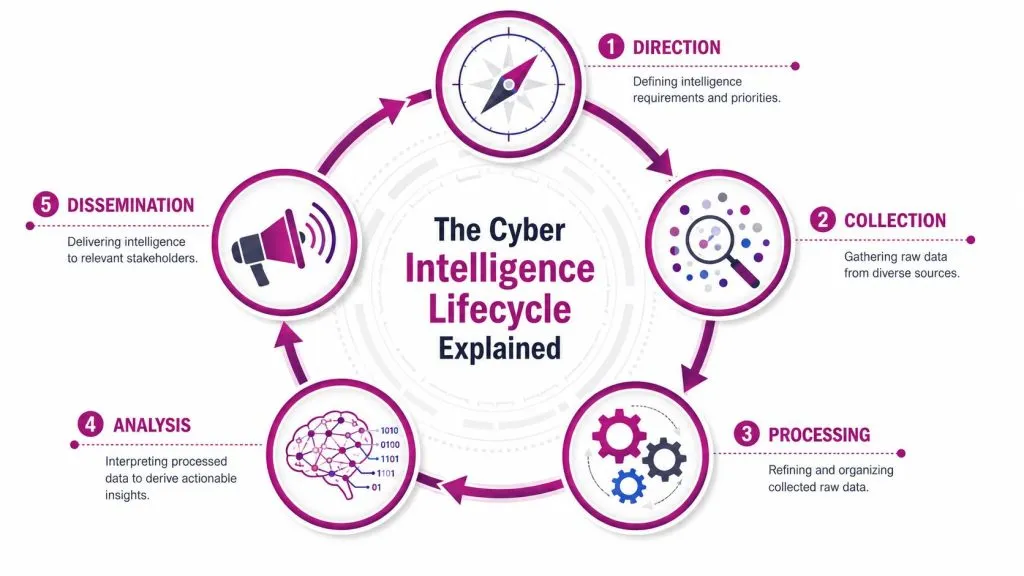
The most useful way to think about intelligence work is as a repeatable investigation, not a feed. A detective doesn’t start with a theory and then force every clue to fit it, and a strong analyst doesn’t start with a dashboard and call it insight. The cycle begins with a question, then gathers evidence, cleans it, interprets it, shares it, and uses the response to refine the next round.
Direction and collection
Direction is the case file. It defines the questions the analyst must answer, such as whether a client is being targeted by a specific actor or whether a new leak involves their users. Without that starting point, collection turns into hoarding.
Collection is the evidence-gathering phase. Analysts pull from internal telemetry and outside sources, then decide what matters enough to process. The purpose isn’t volume, it’s coverage that matches the question.
Processing and analysis
Processing is where raw material becomes usable. Logs get normalized, duplicates are removed, fields are standardized, and low-confidence records get separated from stronger ones. U.S. defense doctrine stresses that normalization and source handling are critical because poor quality inputs create false positives and weaken actionability (U.S. defense tradecraft on intelligence workflow).
Analysis is the point where clues connect. Here, the analyst pivots across indicators, tests hypotheses, and decides whether the activity represents a real risk or a false trail. A strong analytical outcome doesn’t just say what happened, it explains what it means for the client’s environment.
Dissemination and feedback
Dissemination is the handoff. Finished intelligence has to reach the people who can act on it, whether that’s a SOC analyst, a vCISO, or a client executive. A plain-language briefing with confidence levels and next steps is usually more useful than a dense PDF.
Intelligence becomes valuable when someone can do something with it on the same day.
The final piece is feedback. If the client didn’t use the output, or the output didn’t change a decision, the analyst should retask the workflow. That loop is what turns cyber intelligence analysis from reporting into a living process.
A short reference frame helps here. For a broader example of how external monitoring supports the lifecycle, this dark web scanning resource shows where collection can start before analysis even begins.

Core Analytical Techniques and Data Sources
Strong analysis starts by deciding which signals deserve attention. Not every source belongs in every workflow, and not every indicator deserves the same confidence. The best teams treat intelligence as a layered process, where raw observables become structured evidence, then contextual analysis, then client action.
OSINT means open source intelligence, the disciplined use of public information to support a decision.
TTPs are tactics, techniques, and procedures, the observable ways an adversary behaves.
IOCs are indicators of compromise, while IOAs are indicators of attack that point to hostile intent before full compromise is confirmed.
Where the analyst starts
The standard baseline for many teams is MITRE ATT&CK, and that makes sense because it helps analysts map behavior instead of just chasing isolated alerts. In the 2024 survey, over 67% of cybersecurity professionals said they frequently use knowledge bases like MITRE ATT&CK, and 75% said CTI is used primarily for threat hunting (Statista survey on CTI methods). That combination says a lot, because it shows the field is moving toward behavior-driven defense rather than just indicator matching.
The practical takeaway is simple. If a client only wants static blocklists, they’ll get short-lived value. If they want behavior mapping, analysts can connect a campaign’s tooling, sequence, and likely next move, which is much more useful for detection and hunting.
How source types fit together
Open-source reporting is useful for broad context, especially when you need to understand a campaign’s public footprint. Dark web monitoring adds a different dimension, because it can surface leaked credentials, brand abuse, and criminal references before those issues become internal incidents. For teams that want to operationalize broader exposure review, deploying network traffic monitoring is a good example of how visibility work supports intelligence rather than replacing it.
TTP analysis matters because it links what you observe to how an actor works. That lets you ask better questions about recurrence, persistence, and likely follow-on activity. Attribution, by contrast, should stay careful and evidence-based, because actor naming without strong context often creates more noise than clarity.
A useful split is this, raw data tells you something happened, indicators tell you what to look for again, and intelligence tells you why it matters now. MSPs that get this distinction right can move clients from reactive response to proactive hunting.
Essential Tooling and Integrations
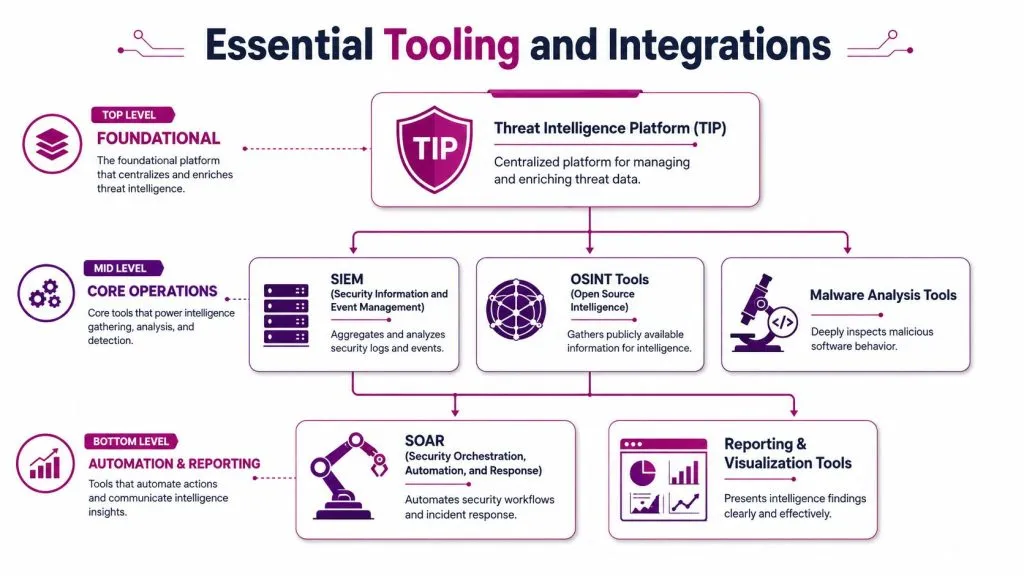
Intelligence work fails when the stack is fragmented. A SIEM may hold the logs, a TIP may hold the enrichment, and a SOAR platform may hold the playbooks, but none of those tools is enough by itself. The value comes from moving evidence through them without losing context.
The tools have different jobs
A Threat Intelligence Platform acts like the library and index. It stores, enriches, deduplicates, and correlates threat data so analysts can see relationships instead of isolated artifacts. A SIEM is the evidence room, where log data, alerts, and historical context come together for review.
SOAR is the action layer. Once a signal is strong enough, SOAR can trigger workflows, create tasks, push containment steps, and log outcomes. That matters for MSPs because repeatability is where margin lives. A one-off investigation is a service. A repeatable workflow is a service line.
APIs are the glue
APIs connect the stack into something usable. They let external monitoring services, internal ticketing systems, and analysis platforms share data without manual rekeying. If an MSP is using InsecureWeb in a client workflow, the relevant value is that its API access can feed monitoring and analysis data into existing processes, including dark web monitoring, fake site detection, threat intelligence, vulnerability scanning, and reputation monitoring, all under the MSP’s own brand.
The point isn’t to buy more tools. It’s to reduce swivel-chair work. Analysts shouldn’t have to copy the same indicator into three systems just to validate a single alert.
What a mature stack looks like
A practical stack usually has three layers.
- Foundational intelligence management: A TIP keeps enrichment and relationships organized.
- Core operations: SIEM and OSINT tools support collection and correlation, while malware analysis tools help inspect samples when the investigation goes deeper.
- Automation and reporting: SOAR and reporting tools turn findings into action and client-ready output.
If the stack can’t move from alert to decision without hand-copying data, it isn’t integrated yet.
That’s the key test for MSPs. The technology only matters if it shortens investigation time, improves confidence, and creates a cleaner handoff to the client.
A Practical Intelligence Workflow for MSPs
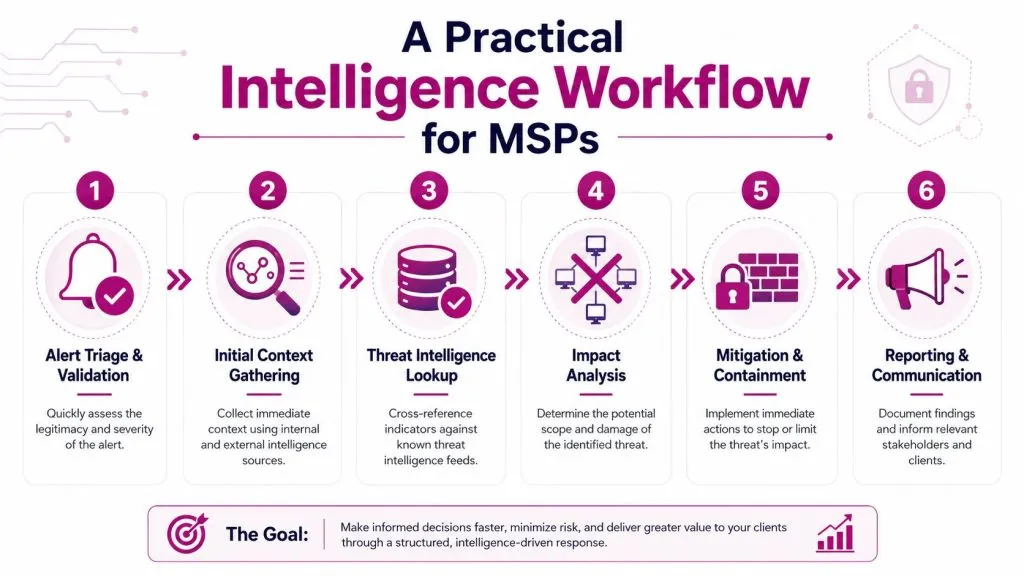
A useful intelligence service should feel like an assembly line with judgment, not a scramble with dashboards. If a client’s email address appears on a criminal forum, the workflow needs to validate the signal, assess whether it touches active systems, and tell the client what to do next. That process becomes repeatable only when every analyst follows the same decision path.
From alert to advisory
Start with alert triage and validation. Not every credential mention or leak reference is real, and not every real signal is urgent. The analyst checks source quality, client relevance, and whether the record contains enough context to matter.
Next comes initial context gathering. That means pulling matching usernames, domains, historical incidents, and related telemetry together so the analyst can avoid a narrow view. Then comes threat intelligence lookup, where the team checks whether the artifact aligns with known campaigns, criminal infrastructure, or prior reporting.
Turning findings into client value
The middle of the workflow is where MSPs create differentiation. Impact analysis should answer who could be affected, what access might be at risk, and which controls need attention first. Mitigation and containment then translate findings into action, such as password resets, MFA review, alert tuning, or tighter monitoring around the affected user or asset.
A useful internal rule is to write the advisory before the investigation is finished. That doesn’t mean rushing the analysis. It means thinking like the client, who needs a decision-ready summary, not a log dump.
The SEI’s cyber intelligence study is relevant here because it notes that many organizations still confuse cyber intelligence with general cybersecurity and lack repeatable workflows and feedback loops (SEI cyber intelligence study). MSPs can solve that gap by standardizing the output format, the escalation path, and the follow-up.
What to measure
The last step is reporting and communication. If the client can’t tell whether the issue was confirmed, prioritized, or closed, the workflow has failed. The reporting should include what was found, why it matters, what was done, and what the client should monitor next.
Good MSPs also track whether intelligence is changing outcomes. Useful internal metrics are whether alerts were validated faster, whether investigations were closed with higher confidence, and whether the advisory changed a client action. Those aren’t vanity metrics, they’re proof that the service is operational rather than decorative.
Best Practices for Implementation
Start with a narrow set of intelligence requirements. If every client issue becomes a CTI project, the team will drown in noise and miss the work that matters most. Define the assets, identities, and business risks that deserve routine monitoring, then build from there.
Keep the inputs high confidence
High-quality intelligence depends on structured collection and credibility scoring, and U.S. defense doctrine is clear that analysis should start with defined requirements and proper normalization to avoid false positives (U.S. defense tradecraft on intelligence workflow). That means fewer sources with better handling usually beat a wide but sloppy collection model.
Normalize fields early. Strip duplicates. Score confidence before you disseminate. If analysts can’t explain why a signal is trustworthy, clients won’t trust the recommendation.
Rule of thumb: collect less, but collect what you can defend.
Build the feedback loop
Every advisory should feed the next requirement update. If a client ignored a report because it wasn’t actionable, the problem may not be the threat, it may be the format or timing. Treat that as a workflow defect, not a communication mistake.
For MSPs, the maturity path is straightforward.
- Define the questions first.
- Collect only what supports those questions.
- Normalize and score before analysis.
- Disseminate in the client’s decision format.
- Retask based on what changed.
That’s the operating model that turns cyber intelligence analysis into a profitable, defensible service instead of a pile of feeds.
If you’re building or tightening a client-facing intelligence service, visit InsecureWeb to see how dark web monitoring, threat intelligence, vulnerability scanning, fake site detection, and API access can fit into an MSP workflow. It’s a practical way to turn external threat signals into repeatable analysis, reporting, and response for the clients you support.