Data Breach News13 min read
Dark Web Monitoring Software: A Practical Buyer’s Guide
By InsecureWeb Team
This report reflects observations of dark web activity. InsecureWeb makes no representations regarding the accuracy of this data.
Your board meeting is next week, and the question has changed. Nobody is asking whether stolen credentials exist anymore. They’re asking why your team can’t prove what’s exposed, how quickly you’ll know about it, and what happens after an alert arrives.
That pressure is justified. The dark web intelligence and threat monitoring market is projected to grow from USD 2.41 billion in 2025 to USD 5.50 billion by 2031, with a projected 15.04% CAGR from 2026 to 2031, according to Mordor Intelligence’s market analysis. The category is moving from niche intelligence work into a practical data-protection control.
This guide takes a security operations view of dark web monitoring software. It focuses on collection freshness, infostealer telemetry, stolen session tokens, alert routing, and the response process that determines whether monitoring prevents an incident or merely documents one after the fact.
Why Dark Web Monitoring Software Is Suddenly a Board-Level Question
Security leaders used to explain the dark web as an intelligence concern, separate from the tools protecting endpoints, identities, and networks. That distinction is fading. A leaked password, an infostealer log, or a fake login site can connect directly to an employee account, a cloud session, or a customer-facing brand.
The exposure problem is also difficult to summarize with one clean breach event. One industry source reports more than 59 billion compromised records indexed across third-party breaches and stealer logs, while another reports 100 million or more stealer logs and more than 20 billion leaked credentials. Those figures are compiled in BreachSense’s overview of dark web monitoring tools. They explain why buyers now need more than a search for corporate email addresses.
Boards, insurers, customers, and auditors increasingly expect evidence that the organization can identify external exposure and respond to it. The same conversation may include regulatory obligations, contractual security requirements, identity protection, and the risk of employees using personal accounts or devices for business activity. For additional context on workforce exposure and unauthorized outside employment, nexus IT group’s discussion of employee moonlighting is a useful complement to a dark web risk review.
The question has moved from existence to execution
A board-level answer shouldn’t be, “We have a monitoring subscription.” It should explain:
- What’s covered: Domains, identities, privileged users, exposed secrets, tokens, lookalike sites, and relevant third-party data.
- How fresh the data is: When the vendor first saw the exposure, when it was indexed, and when your team received the alert.
- Who acts: The SOC, service desk, identity team, account owner, or client contact.
- What happens next: Session invalidation, password reset, endpoint investigation, takedown, customer notification, or escalation.
Most vendor pitches spend too much time describing source volume and too little time explaining operational follow-through. That’s the wrong buying order. A smaller, well-scoped feed with reliable timestamps and direct remediation can be more useful than a huge archive that creates alerts nobody owns.
For an MSP, the problem is even sharper. One platform must support multiple tenants, separate permissions, repeatable workflows, and client-ready reporting. For an SMB, the same platform must avoid overwhelming a small team with raw findings. In both cases, the buying decision should begin with response capacity, not with a feature catalogue.
What Dark Web Monitoring Software Actually Does
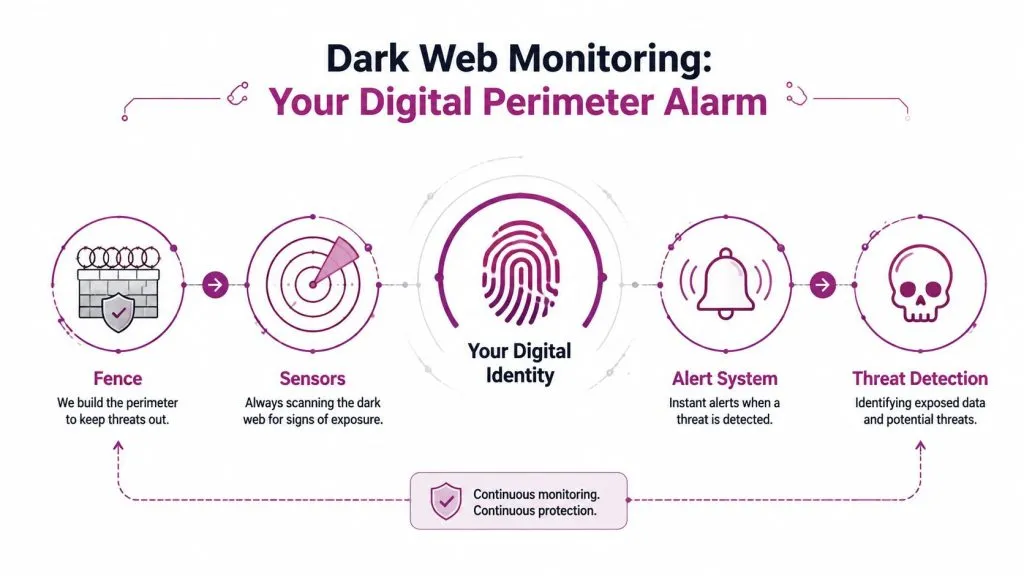
Think of dark web monitoring software as a perimeter alarm for digital identity. A physical alarm watches gates, doors, and motion zones. Monitoring software watches selected digital indicators across hidden forums, marketplaces, paste sites, leak channels, and other sources where criminals trade or discuss stolen information.
It isn’t a search engine for illegal content, and it shouldn’t give analysts an unfiltered dump of everything a crawler encounters. The useful system collects data, matches it against your organization’s indicators, enriches the match, and presents a finding that someone can investigate.
The monitored perimeter is broader than email
A serious scope can include:
- Corporate domains and employee addresses, especially identities with privileged access.
- Usernames and executive identifiers, which may appear in credential lists or threat discussions.
- API keys, secrets, and proprietary file fingerprints, where the organization can define reliable matching patterns.
- Brand and domain lookalikes, which support phishing and impersonation activity.
- Stealer-log evidence, including browser credentials, session information, device details, and the services associated with the infection.
The distinction matters because a simple email match says very little. A corporate address in an old marketing database may be low priority. The same address inside a fresh infostealer package, alongside a business application URL and device context, deserves immediate investigation.
For smaller organizations, a focused explanation of stolen credential protection for SMEs can help separate basic credential lookup from a broader exposure program. The principle is straightforward. Monitoring only creates value when the finding includes enough context for a human or automated workflow to make a decision.
Monitoring isn’t comprehensive threat hunting
Dark web monitoring answers a narrow but important question: Is information associated with this organization appearing in monitored external sources? It doesn’t replace endpoint detection, identity-provider logs, vulnerability management, incident response, or internal threat hunting.
The software’s role is translation. It turns chaotic external material into an alert with an affected asset, exposure type, source context, confidence, and recommended action. If the platform can’t show what was found, why it matters, and what the recipient should do, it’s functioning as a data feed rather than a security control.
Detection Methods, Data Sources, and the Latency Problem
The source determines both the value and the delay of a finding. Public paste sites may expose data quickly, but they’re noisy and often contain recycled material. Invite-only forums can offer higher-fidelity intelligence, though access and collection are harder. Underground marketplaces may contain credentials that attackers are actively selling, which raises the consequence of slow indexing.
Modern tools should match more than plain email strings. Pattern matching can identify domain-linked usernames, proprietary formats, exposed secrets, and other organization-specific indicators. Natural language processing can help classify forum discussions and distinguish a direct sale from an incidental mention, but no enrichment layer fixes stale collection.
Tor creates a practical freshness ceiling
Much of the hidden infrastructure runs through Tor’s multi-hop routing. Each hop adds encryption and transmission delay, so large-scale crawling can’t achieve the same freshness as surface-web collection. The IJSRET guidance on dark web monitoring constraints notes that scan frequency is limited by response-time overhead, not only crawler capacity.
That creates a direct operational risk. A broad crawl performed too frequently may be expensive, incomplete, or unreliable. A targeted watchlist focused on relevant forums, keywords, and marketplaces can produce more useful coverage than indiscriminate polling.
One experimental keyword-alert system tested across 50 live hidden services reported 92% detection accuracy and approximately 2.2 seconds of average end-to-end alert latency from page retrieval to push notification, as described in the JATIT experimental benchmark. That result shows that local matching and notification can be fast once a page is retrieved. It doesn’t remove the harder problem, which is reaching and retrieving the right hidden service promptly.
| Source Type | Data Quality & Fidelity | Typical Latency | Operational Risk |
|---|---|---|---|
| Public paste sites | Fast, but noisy and prone to recycled content | Often earlier than closed sources | Analysts may waste time on irrelevant matches |
| Invite-only forums | Potentially higher fidelity and stronger context | Slower access and indexing | Important posts may remain unseen without specialist coverage |
| Underground marketplaces | High consequence when active credentials are offered | Dependent on crawler access and vendor cadence | Credentials may be purchased or tested before response |
| Stealer-log feeds | Rich identity and device context | Can move quickly from infection to sale | Password-only controls may miss active sessions and tokens |
Don’t accept “near real time” as a marketing phrase. Ask for first-seen timestamps, source timestamps, retrieval timestamps, and notification timestamps from a recent finding. The right comparison is the gap between theft, posting, indexing, alerting, and containment.
For a practical starting point, review the InsecureWeb dark web scan against your own required domains and workflows. The test should measure usable detection and response, not just whether the platform returns matches.
Features That Separate Real Monitoring From Marketing
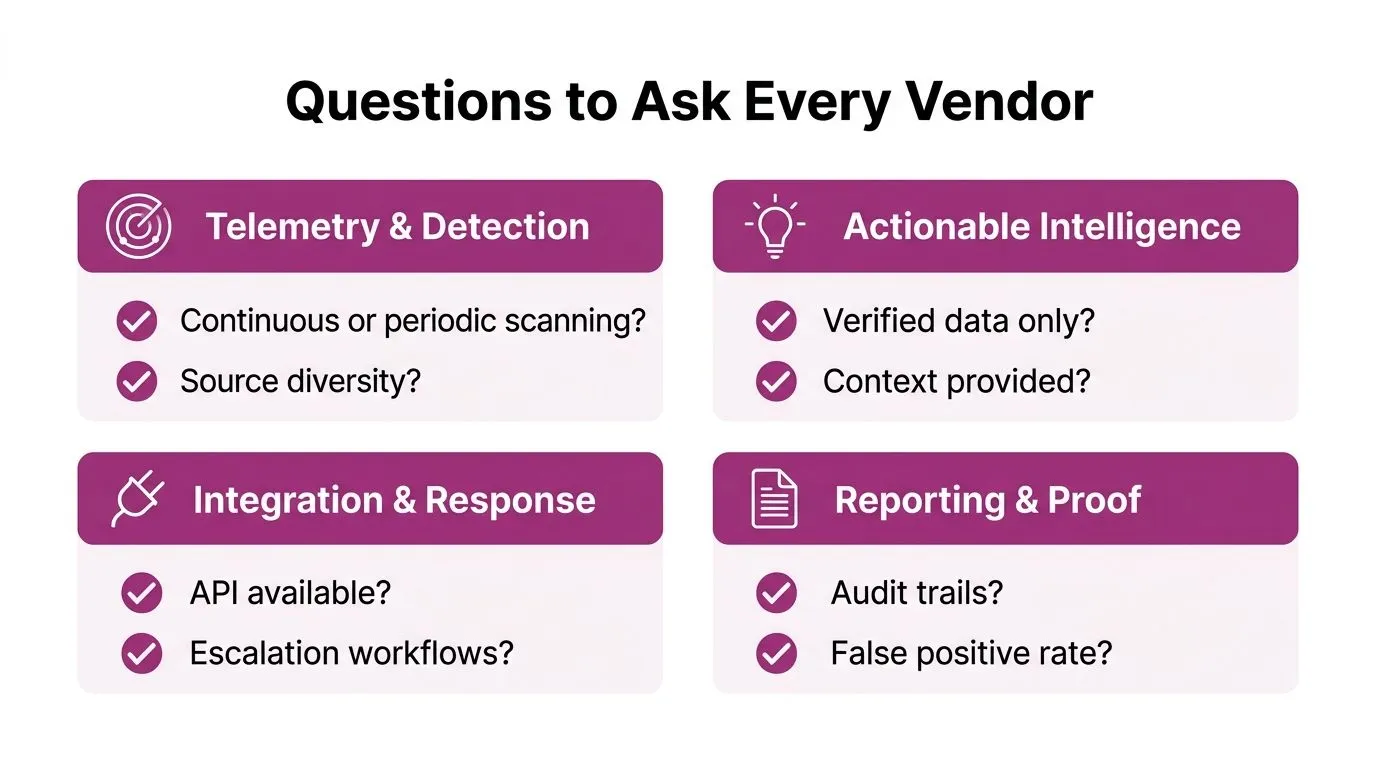
Put the same questions to every vendor. Don’t let a polished dashboard substitute for evidence that the data is current, relevant, and actionable.
Telemetry and detection
Ask whether the platform collects continuously, on a schedule, or through a mixture of source-specific methods. Then ask whether it covers infostealer logs, infected-host lookups, session cookies, tokens, typosquats, Telegram, I2P, forums, marketplaces, and public code exposure.
The revealing question is: “Show me a recent finding and tell me exactly when it was first seen, indexed, verified, and delivered.” If the answer only includes the date your team viewed the dashboard, you don’t know the true detection delay.
Alerting and workflow
An alert should be scoped to an asset, tenant, identity, or domain. It should include severity, confidence, source provenance, deduplication, and a recommended action. Email is useful as a fallback, but production workflows need ticketing, webhooks, SIEM, SOAR, and identity-provider connections where appropriate.
Ask: “Can this alert reach the correct owner automatically, and can the platform prove that it was acknowledged?” A high-severity finding sent to a shared inbox is not an escalation process.
Platform fit
MSPs and MSSPs need tenant isolation, role-based access, sub-tenant reporting, APIs, PSA integration, and white-label output. An in-house SMB may care more about deployment speed, plain-English findings, and a manageable alert queue.
Ask: “Can I demonstrate separate customer scopes, permissions, billing logic, and reporting without building the structure myself?” If the vendor treats multi-tenancy as a spreadsheet exercise, expect operational friction.
Data hygiene
Retention, source provenance, false-positive suppression, recycled-data handling, and evidence preservation determine whether analysts trust the platform. A large archive can be useful for investigation, but it shouldn’t bury current exposure under historical duplicates.
Ask: “How do you show that a finding is new, relevant, and supported by evidence?” Vendors that can’t answer this usually shift the cleanup burden to your team.
Broad social-media scraping often looks impressive in a demo. It matters only when the system can connect an impersonation or threat mention to an asset, assign a priority, and route an action. Source count without context is slideware.
Evaluating Tools for MSPs, MSSPs, and SMB Buyers
The same product can fit an SMB and fail an MSP. The difference usually isn’t the detection engine. It’s the operating model around that engine.
| Criterion | MSP / MSSP Priority | SMB In-House Priority |
|---|---|---|
| Tenant structure | Strong separation, delegated access, sub-tenancy, and client reporting | Simple asset and role management |
| Workflow | PSA, RMM, SIEM, API, and repeatable escalation | Ticketing, email, webhook, and identity workflows |
| Commercial model | Partner pricing, resale rights, predictable margin, and flexible scopes | Transparent total cost and limited analyst overhead |
| Reporting | White-label reports for QBRs and customer evidence | Plain-English reports for owners and internal leaders |
| Alert volume | Filtering and routing across many customers | A queue sized for a small security team |
| Deployment | Templates for domains, policies, and onboarding | Fast setup with minimal professional services |
A 50-seat SMB may need a focused watchlist, a short escalation path, and alerts that a generalist administrator can understand. A 200-endpoint MSP client base needs the same exposure logic repeated across tenants, with permissions and reporting that prevent one client’s findings from appearing in another client’s view.
Both buyers should test source transparency, false positives, remediation guidance, contract flexibility, and data export. The difference is scale. An SMB pays directly in analyst time for every noisy alert. An MSP pays that cost repeatedly across clients, then absorbs the reputational damage when an alert is missed.
A platform review should also sit beside the broader governance stack. For example, SOC2Auditors’ insights on Vanta can help buyers think about how security evidence, control ownership, and compliance workflows fit together, rather than treating monitoring as an isolated dashboard.
Use this guide to dark web monitoring for managed service providers when assessing whether the delivery model supports recurring client services.
Three signals predict post-sale regret:
- The vendor won’t provide timestamped sample findings.
- The contract excludes the integrations your service desk depends on.
- No one is assigned to own alerts after deployment.
Compliance, ROI, and Operational Best Practices
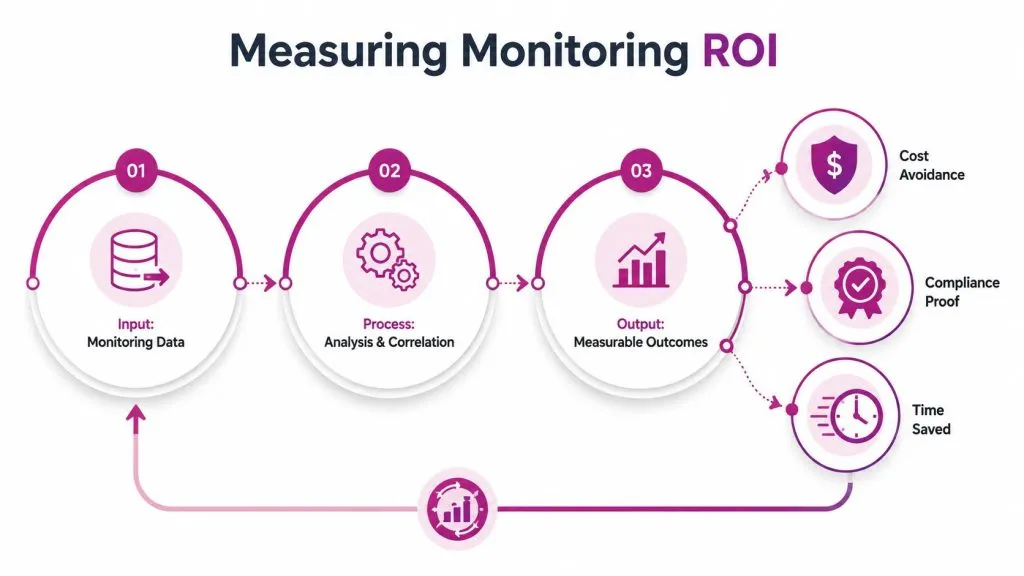
Monitoring earns its place when it changes decisions. A dashboard full of exposure records isn’t a return on investment. A verified finding that triggers access revocation, endpoint investigation, or domain takedown can be.
Use three outcome lenses:
- Incident avoidance: Track exposures that led to credential rotation, session invalidation, account review, or other preventive action.
- Compliance evidence: Preserve scope definitions, alert records, response tickets, ownership assignments, and review history for relevant control programs.
- Service margin: For MSPs, connect monitoring to recurring service value, documented analyst work, reduced reactive tickets, and client retention.
Don’t claim that monitoring alone satisfies SOC 2, ISO 27001, HIPAA, PCI, or Cyber Essentials. It can support evidence for controls involving credential risk, threat awareness, access management, and incident response, but auditors will still assess the wider control environment.
Build the operating discipline before tuning the dashboard
Start with scope. Identify domains, privileged identities, executive accounts, critical SaaS services, customer-facing brands, and sensitive data types. Then define severity thresholds and the action for each threshold.
Assign ownership between the SOC, service desk, identity team, and account manager. Schedule false-positive reviews, rehearse credential and session-rotation playbooks, and measure time from alert receipt to containment. If no team can answer who acts on a Sunday morning, the control isn’t operational.
Your governance pack should include:
- A scope register showing monitored assets and exclusions.
- An escalation matrix mapping severity to owners and deadlines.
- A response playbook for credentials, cookies, tokens, fake sites, and exposed files.
- An evidence log preserving source context, timestamps, actions, and closure decisions.
- A review record documenting tuning, false positives, coverage gaps, and ownership changes.
The benefits of dark web monitoring are realized through that closed loop. Detection starts the process. Response, verification, and evidence make it defensible.
How InsecureWeb Maps to These Needs
A practical InsecureWeb rollout should begin with tenant scope, not a broad crawl. Define each customer domain, monitored identity set, brand indicator, and escalation owner. For an MSP, keep those scopes isolated and align reporting with the service structure.
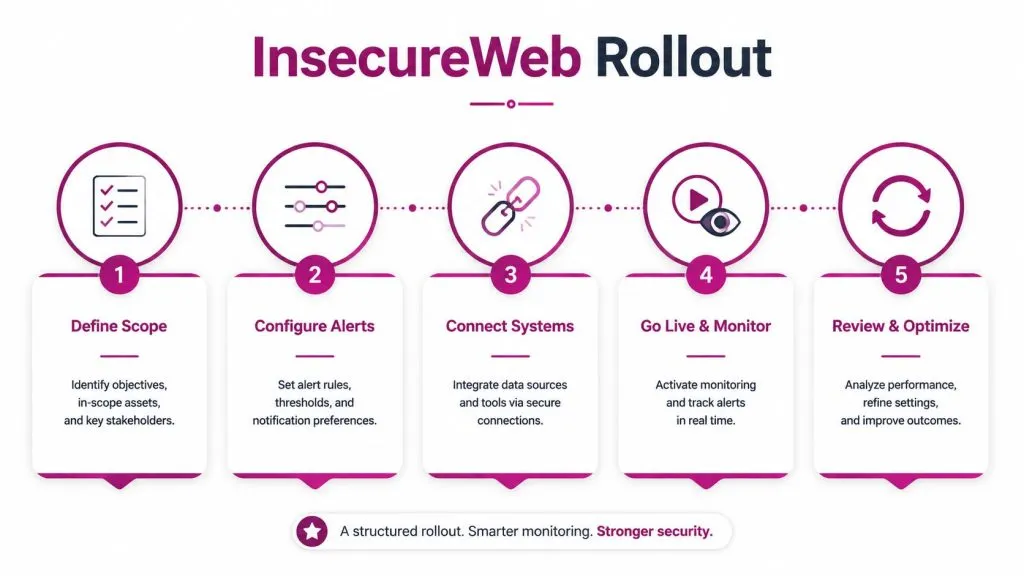
A five-step operating sequence
- Define scope. Register tenant domains and relevant identities, then decide which findings belong with the SOC, service desk, or customer contact.
- Configure alerts. Set thresholds and escalation rules so higher-confidence exposure reaches the right responder rather than a general inbox.
- Connect systems. Use the REST API and available PSA or SIEM connectors to place findings inside existing service workflows.
- Tune monitoring. Adjust review cadence and alert handling around the volume and type of infostealer telemetry affecting the monitored population.
- Review outcomes. Report exposure trends, response actions, unresolved findings, and areas needing additional identity or brand protection.
InsecureWeb is positioned for MSPs, hosting providers, and security firms that want to deliver external threat monitoring under their own brand. Its stated capabilities include dark web monitoring, fake-site and account detection, threat intelligence, vulnerability scanning, AI-guided penetration testing, and reputation monitoring. For this buying decision, the important test is whether its multi-tenant delivery, API access, client reporting, and alert workflows match your existing service operation.
Treat token and stealer-log coverage as a proof point, not an assumption. Ask what evidence appears in an alert, how confidence is assigned, how sub-tenancy billing works, and whether analysts can investigate without moving between disconnected tools. Domain takedown assistance for typosquat lookalikes can also matter, but only if ownership and escalation are clear.
The platform should enter the shortlist because its operating model fits the use case, not because a feature page says “real time.” Make the vendor demonstrate the complete path from finding to ticket, owner, action, evidence, and client report.
Buyer Questions You Should Ask Before Signing
Cadence and latency
Ask:
- How quickly do alerts fire after a credential appears in a dump, marketplace listing, or stealer log?
- Which timestamps do you expose, including first seen, indexed, verified, and delivered?
- Do different source types use different collection schedules?
- Can you show a recent alert with the full timeline?
The answer should identify the delay between source appearance and notification. “Continuous monitoring” without source-specific timestamps doesn’t tell you whether the control is preventive or forensic.
Token and session theft
Ask whether the platform detects stolen session cookies, OAuth refresh tokens, device fingerprints, and other MFA-bypass artifacts. Password resets may not terminate an active session, so the response playbook must include token invalidation and endpoint review where evidence supports it.
This is a major gap in many buying conversations. Reporting cited by UpGuard’s review of dark web monitoring tools notes 8.6 billion stolen session cookies in 2025 that standard scanners don’t collect, alongside more than 30 million infostealer logs circulating on the dark web. Ask for the exact evidence attached to each token-related alert, not just a risk label.
Operational fit
Ask how the vendor suppresses false positives, supports raw findings through an API, and handles onboarding for a multi-tenant MSP. Confirm the expected analyst-to-tenant workload, escalation support, retention period, exit rights, and service-level language before signing.
A useful contract answers what happens when coverage is unavailable, data must be exported, a tenant leaves, or an alert arrives without enough evidence to act.
InsecureWeb offers dark web monitoring, external threat intelligence, fake-site detection, vulnerability scanning, and related services designed for MSPs and security providers. Visit InsecureWeb to evaluate how its monitoring, API access, tenant delivery, and reporting workflows fit your response operation before you commit.