Synthetic identity fraud stopped being a niche fraud problem a while ago. TransUnion reported US$3.3 billion in exposure tied to synthetic identities across several U.S. lending categories in H1 2025, up 3% from the end of 2023, and the same reporting notes fraud rates rose for 67% of financial institutions (TransUnion fraud exposure findings). For security teams, fraud teams, MSPs, and MSSPs, that should change how this issue gets prioritized. This isn’t just a bad onboarding outcome. It’s a long-running operational failure that often starts small, looks normal, and only becomes visible when the money is gone.
What makes synthetic identity fraud so dangerous is that it doesn’t behave like classic identity theft. The attacker often isn’t impersonating one real person end to end. They’re assembling a believable person from mixed inputs, then patiently training your controls to trust that identity. If your stack validates fields one at a time, or if your monitoring stops after onboarding, you’re giving that synthetic profile room to mature.
For service providers, that creates a clear opportunity. Clients need more than a definition of the problem. They need detection logic, workflows, escalation paths, API integration patterns, and a realistic approach to KYC, AML, and false-positive management.
The Growing Threat of Synthetic Identity Fraud
Synthetic identity fraud has grown into a business-scale problem, not just a fraud-ops curiosity. Experian reported that confirmed and potentially fraudulent credit applications saw a 60% increase in false identity cases in 2024 versus 2023, and those cases represented nearly 29% of all identity-fraud cases. Javelin’s 2025 Identity Fraud Study also said U.S. consumer losses from identity fraud reached US$27.2 billion in 2024, a 19% year-over-year increase (Experian identity fraud reporting). Those numbers don’t describe only synthetic identity fraud, but they show the size of the environment it feeds.
The operational problem is simple. A synthetic identity can look acceptable at account opening, show no suspicious activity for a long period, and only trigger serious concern after it has accumulated trust. That’s very different from a stolen-account event where a customer often notices the misuse quickly.
Operational takeaway: If your controls focus only on proving that submitted data is plausible at one point in time, you’ll miss the fraud pattern that develops across weeks, months, or longer.
For MSPs and MSSPs, the key issue isn’t whether clients already know the term. Many do. The gap is that they still treat synthetic fraud as a point solution problem. It isn’t. It lives across identity proofing, application telemetry, account behavior, credit decisions, case management, and compliance review.
That’s why effective work on synthetic identity fraud has to connect the fraud lifecycle to actual service delivery. Clients need help deciding which events deserve friction, which signals belong in an API workflow, when to trigger manual review, and how to distinguish a risky synthetic profile from a legitimate thin-file applicant.
The Anatomy of a Synthetic Identity
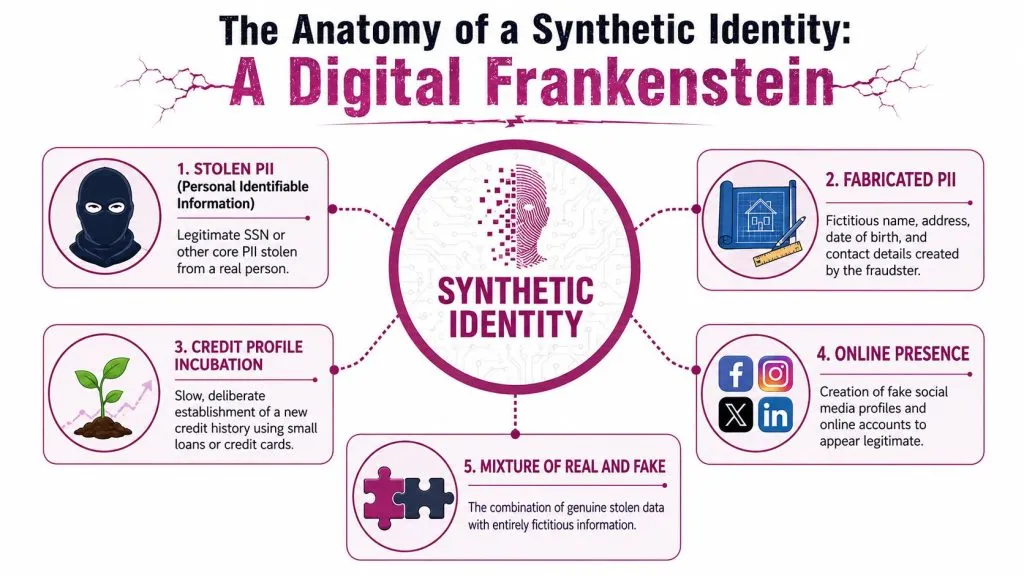
A synthetic identity is best understood as a digital Frankenstein. It isn’t fully stolen and it isn’t fully invented. An attacker stitches together enough truth to survive validation and enough fiction to control the identity without interference.
How the identity gets assembled
The most important detail is the mix. Expert sources note that fraudsters use real identifiers, such as a valid SSN from a child or elderly person, mixed with invented names, addresses, and birth dates. That lets the profile evade checks built on the assumption that every identity maps cleanly to one real person. The same source notes that generative AI now speeds this process by helping criminals create more believable identities faster (Plaid on how synthetic identities are built).
In practice, the profile usually includes a few anchor attributes that can pass validation and several flexible attributes that the attacker can tune until onboarding systems accept them. The invented parts don’t need to be perfect. They only need to be coherent enough across forms, documents, and digital interactions.
A useful way to think about the components is this:
| Component | What the attacker wants | Why it matters to defenders |
|---|---|---|
| Real core identifier | A data point that survives basic checks | It gives the synthetic a foothold inside automated verification |
| Fabricated personal details | Control over name, address, date of birth, contact data | It lets the attacker shape the identity around system requirements |
| Digital footprint | Email, phone, online accounts, social presence | It helps the profile look lived-in rather than freshly created |
| Early transactional history | Small, ordinary-looking activity | It conditions models and analysts to treat the identity as low risk |
Why isolated verification fails
Many onboarding stacks verify fields in isolation. The SSN format looks valid. The phone number works. The address can receive mail. The device has no obvious malware flags. Each check passes, but the entity behind them still doesn’t exist as a real person.
That’s the central weakness. Fraud systems often ask, “Is this attribute valid?” when they should also ask, “Do these attributes belong together over time?”
A synthetic identity often passes because every individual component looks acceptable when reviewed alone.
Security teams can help fraud teams by leveraging device intelligence, session telemetry, account-link analysis, and API abuse monitoring to reveal patterns that classic KYC workflows won’t catch on their own. The identity isn’t just a set of submitted values. It’s a network of relationships, timing, reuse patterns, and behavior.
From Creation to Cash Out The Synthetic Fraud Lifecycle
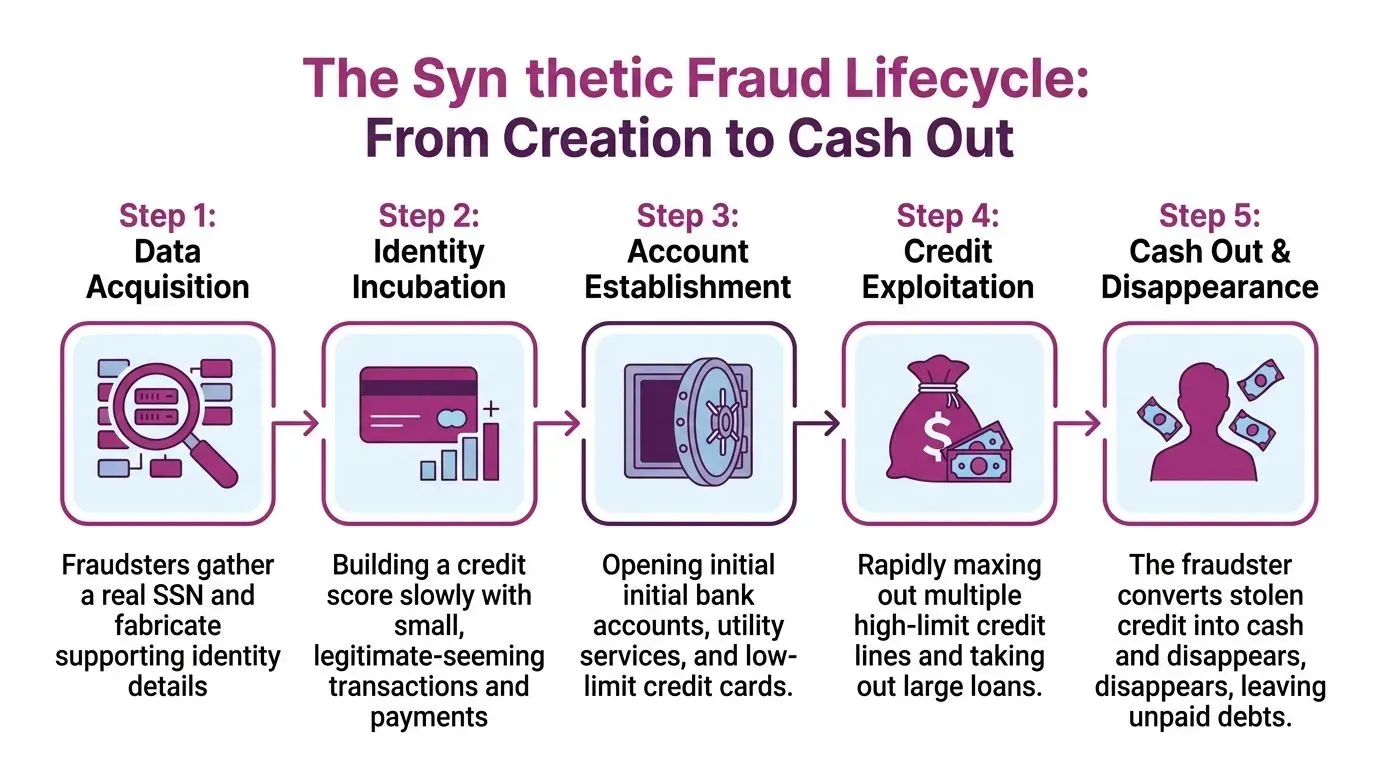
Synthetic identity fraud is a lifecycle attack. Criminals harvest breached PII, fuse real and fabricated attributes into a profile, then seed the identity through low-value accounts to accumulate trust before monetization. That same pattern can include web scraping and automated probing of APIs to learn validation rules (synthetic fraud lifecycle overview).
Stage one through stage two
The lifecycle starts before the application hits your front door. Attackers collect raw materials from breached records, purchased datasets, brokered information, scraped public data, and trial-and-error interaction with forms and APIs. They learn what your system accepts, which fields are required, and where your validation is weak.
Then comes fusion. The attacker combines a real anchor attribute with fabricated personal details and tests combinations until the profile becomes internally consistent enough to pass. This part is less dramatic than many teams expect. It looks like normal form completion, normal retries, and normal low-volume customer behavior.
A practical mistake here is treating repeated failed applications as noise. In many environments, those attempts are reconnaissance. They tell the attacker which values trigger decline logic and which combinations survive.
Before the fraud gets profitable, the identity has to look boring. That’s the incubation stage.

Stage three through stage four
During incubation, the synthetic identity gets seeded into low-risk channels. The attacker opens entry-level accounts, creates light activity, pays on time where needed, and builds just enough history to stop looking new. Some profiles stay in this stage for a long time because patience improves the eventual payout.
For defenders, this is the stage that gets mislabeled. Teams often see a quiet account with routine behavior and assume the risk has decayed. In synthetic fraud, low-friction normality can be part of the attack path.
By the time monetization starts, the identity has already earned system trust. Then the pattern changes quickly. Credit lines are exploited, loans are drawn, goods are converted, funds are moved, and communication drops off. Collections teams may discover there is no real customer to recover from because the underlying identity was fabricated from the start.
A concise way to map the lifecycle operationally:
- Acquire inputs through breached data, scraping, and testing.
- Assemble the identity until validation succeeds.
- Incubate the profile with low-value, low-noise activity.
- Expand trust across products, channels, or institutions.
- Cash out before the synthetic network is fully linked.
The best time to stop synthetic identity fraud is before account approval. The second-best time is during incubation, before the account gets treated as trustworthy by default.
Unmasking Ghosts Detection Signals and Investigative Techniques
The detection challenge isn’t finding one perfect indicator. It’s combining weak signals that, together, expose a fabricated identity. Teams that wait for a single conclusive flag usually lose time they can’t recover.

Signals worth escalating
Start with inconsistencies, but don’t stop there. A synthetic profile often looks clean if each field is checked in isolation. The stronger approach is to compare identity data, account behavior, and technical telemetry across a population.
Analysts should watch for patterns like these:
- Shared infrastructure: Multiple applications reuse the same device, browser pattern, IP range, phone number, or mailing address in ways that don’t fit normal household behavior.
- Repeated identity anchors: One identifier appears with changing names, dates of birth, or contact details over time.
- Thin but oddly stable behavior: The profile has very little history, yet the behavior looks artificially tidy and consistent.
- Application sequencing: Retry patterns suggest the applicant is learning your validation logic rather than correcting honest mistakes.
- Cross-client overlap: In a managed-services setting, the same technical artifacts appear across unrelated client environments.
These signals matter because synthetic identities are built to pass static checks. They’re much worse at hiding relationship patterns and infrastructure reuse.
How investigators connect weak clues
Link analysis proves its value. Repeated SSNs, address overlap, device sharing, and reused contact points rarely look decisive on their own. Combined, they can reveal a cluster.
ACAMS notes that synthetic identities can go undetected for years and that the strongest guidance is a multi-layered approach using manual review, automated analytics, link analysis, document verification, and biometric checks (ACAMS guidance on layered synthetic fraud detection). That aligns with what experienced investigators already know. You catch these cases by correlating signals, not by hoping one tool will declare “synthetic.”
A useful investigative workflow looks like this:
| Investigation step | What to review | What you’re trying to prove |
|---|---|---|
| Entity review | Name, DOB, SSN, address, phone, email | The identity is internally coherent or suspiciously flexible |
| Technical review | Device, session traits, IP reuse, application timing | The applicant belongs to a broader fraud cluster |
| Relationship review | Shared attributes across accounts or clients | The profile is linked to other suspicious entities |
| Document review | Consistency between submitted docs and digital behavior | The identity story breaks under cross-checking |
| Outcome review | Payment behavior, product expansion, drop-off patterns | The account is aging toward bust-out, not ordinary use |
When hunting for these networks, external breach context helps. Teams that already use dark web and open-source intelligence in investigations will recognize the value of correlating exposed identifiers with application activity. A practical primer on that workflow is this guide to dark web monitoring for OSINT and investigations.
What usually doesn’t work
Teams often over-trust three things: a successful onboarding pass, a clean document image, and a low initial fraud score. None of those proves the applicant is real. They only prove the first gate wasn’t enough.
Another common failure is handing synthetic fraud entirely to credit-risk teams after onboarding. Security telemetry, fraud operations, compliance review, and customer-support records often hold the missing context. If those systems stay siloed, the synthetic profile keeps moving as a “good enough” customer until losses force a closer look.
Building a Resilient Defense Program
Synthetic identities can stay active long enough to look ordinary. That is why defense design has to cover the full account lifecycle, with controls that adapt as the profile matures and the fraudster shifts from testing to monetization.
Design controls around the full identity lifecycle
Programs break when they concentrate budget and analyst attention at a single checkpoint. In practice, synthetic fraud defense works better when controls are mapped to three operating periods: pre-application, onboarding, and post-onboarding account management.
Pre-application controls are often overlooked. They include monitoring exposed infrastructure, abused signup paths, credential-stuffing pressure, and referral or promo abuse that can feed synthetic account creation. Security teams that want that upstream view should understand attack surface analysis because external weaknesses often shape how synthetic applications reach internal systems.
At onboarding, the job is broader than validating whether submitted data can pass point-in-time checks. Teams need to detect mismatched identity elements, reused infrastructure, scripted behavior, and signs that the applicant is probing workflow tolerances. The orchestration layer should support variable friction, step-up review for clustered risk, and fast approval for clean cases so fraud controls do not create unnecessary abandonment.
Approval is the midpoint, not the finish line.
Post-onboarding monitoring catches the stage many fraud programs miss. Synthetic profiles often look cleaner early than they do later. Shared attributes begin to accumulate, repayment behavior can look overly managed, and product usage starts to diverge from genuine customers. If monitoring stops after account opening, the institution gives up the period when the synthetic identity is often easiest to separate from a legitimate thin-file customer.
Field rule: Treat identity trust as revocable. Approval should place an account into continued review with the right triggers, thresholds, and case-routing rules.
Operational layers that hold up in practice
The strongest programs combine fraud, security, and customer-risk controls in a way analysts can effectively operate. In most environments, that means six layers:
- Identity proofing at entry: Check submitted elements for validity, then test whether the full identity story is internally coherent.
- Document and biometric review: Use these signals as supporting evidence within a broader decision model.
- Link analysis and graphing: Identify reused devices, contact points, addresses, and cross-portfolio relationships that single-application review will miss.
- Behavioral monitoring: Track how the account develops after approval, especially repayment patterns, product expansion, transfers, and withdrawal behavior.
- Manual investigation: Send analyst time to clustered cases where several weak signals align into a stronger fraud hypothesis.
- External exposure intelligence: Add context from breached, recycled, or abused identity data and from hostile infrastructure associated with application activity.
For providers building fraud services across client environments, adjacent guidance on preventing business fraud is useful because it frames fraud as an operational risk issue that extends beyond compliance.
Where teams usually create gaps
Static rules are the first failure point. Synthetic fraud patterns change too quickly for fixed thresholds to stay reliable, especially when fraud rings learn approval limits and tune their submissions around them. Rules still matter, but they need regular review against confirmed cases, challenger logic, and clear exception handling.
Ownership is the second gap. Fraud operations may control onboarding decisions, while security owns device, network, and infrastructure telemetry. Compliance may hold due diligence records that explain why an account deserves more scrutiny. Support teams may see address changes, phone swaps, or suspicious account recovery attempts first. If those functions do not share a case model, investigators end up reconstructing the same identity from disconnected systems.
Escalation design is the third gap, and it is usually the most expensive one. Teams collect indicators without defining the response path. A workable program spells out who reviews suspicious clusters, what evidence supports a hold or re-verification step, when a case should be routed for AML review, how API-driven alerts flow into case management, and what documentation must be retained for audit and client reporting. MSPs and MSSPs should care about that last point because service quality depends on repeatable handling, clean integrations, and evidence their clients can use in both compliance review and post-loss analysis.
An MSPs Playbook for Offering Synthetic Fraud Protection
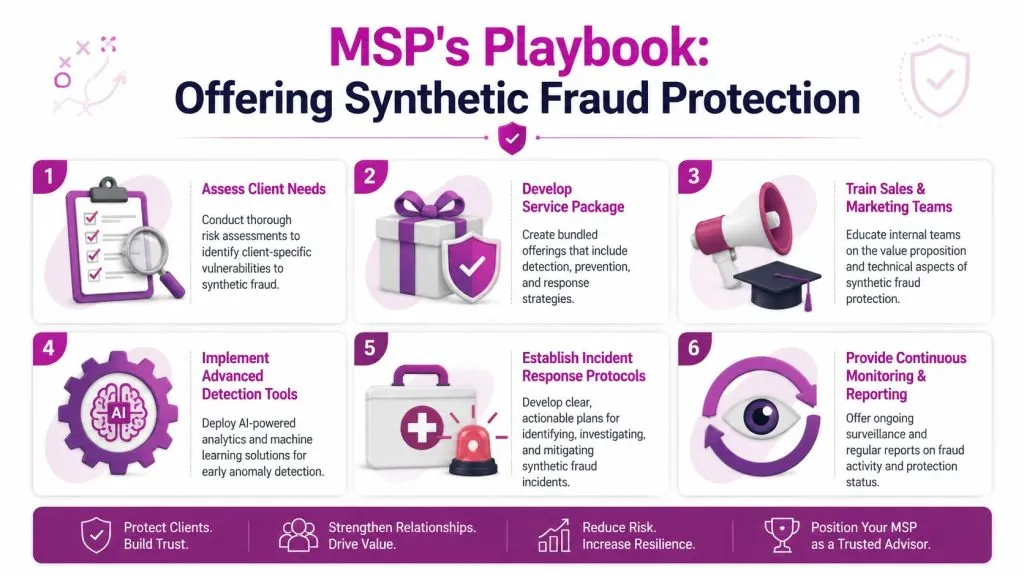
For MSPs and MSSPs, synthetic fraud protection works best as a managed workflow, not as a one-off tool resale. Clients don’t buy “synthetic fraud” as an abstract category. They buy reduced onboarding risk, better investigative visibility, cleaner escalations, and fewer expensive surprises.
Package the service around client outcomes
Lead with client use cases, not product names. A lender, fintech, marketplace, telecom provider, or credit union will all experience synthetic identity fraud differently. The service package should reflect that.
A practical managed offering usually includes:
- Application risk review for onboarding flows, including field logic, step-up design, and case triggers.
- Shared-signal detection across devices, contact points, addresses, and repeated identifiers.
- Exposure monitoring for breached or abused identity data relevant to client risk models.
- Incident investigation support for suspicious applications, portfolio reviews, and post-loss analysis.
- Reporting and tuning so clients can adjust controls without rebuilding the program every quarter.
Don’t position this as “fraud prevention software.” Position it as a decision-support service with technical enrichment, analyst review, and response playbooks.
Build the workflow around APIs and analyst queues
The service has to fit into client operations. That means API-first orchestration, clear handoffs, and documented thresholds for action. If a client can’t wire your output into onboarding, case management, or compliance review, the service becomes shelfware.
A workable flow often looks like this:
- Ingest client events: New applications, document submissions, login telemetry, and account changes.
- Enrich automatically: Add device, behavioral, breach, and link-analysis context.
- Score and route: Low-risk cases proceed, medium-risk cases get step-up checks, high-risk cases go to analyst review.
- Preserve evidence: Every escalation should include the indicators that triggered it.
- Feed outcomes back: Confirmed cases and cleared cases should tune future workflows.
The operational tradeoff is a real concern. The Institute for Financial Integrity highlights that stronger detection can create false positives, and aggressive screening can exclude legitimate thin-file customers, immigrants, or younger borrowers. The same source argues for tunable, adaptive systems rather than static rules (Institute for Financial Integrity on false-positive tradeoffs).
If your managed service can’t explain why a case was escalated and how to tune that decision path, clients won’t trust it for long.
For MSPs building adjacent cyber and fraud services, this resource on dark web monitoring for managed service providers fits well because it shows how monitoring can become part of a recurring client offering rather than a one-time check.
Handle compliance and customer friction deliberately
Synthetic fraud often lands in regulated workflows. That means your playbook has to support KYC and AML obligations without turning every suspicious case into a compliance fire drill.
Use a tiered response model. Some cases need more identity proofing. Others need portfolio review, enhanced due diligence, or internal escalation to compliance. A smaller set may justify account restrictions or closure. The point is to map risk types to actions before an incident happens.
Customer experience also matters. A blunt control strategy can block legitimate applicants whose records are sparse or unusual. That’s why service providers should define segment-aware logic. A thin-file first-time borrower and a synthetic identity may look similar in a narrow dataset. They don’t look similar once you include relationship analysis, account history development, and contextual review.
Sales teams should understand this nuance too. The best pitch isn’t fear. It’s operational maturity. You help clients reduce fraud exposure while preserving access for legitimate customers who don’t fit neat identity models.
Staying Ahead in the Fight Against Fake Identities
Synthetic identity fraud keeps winning when organizations split onboarding from monitoring, fraud review from security telemetry, and compliance from day-to-day operations. That gap creates blind spots at the exact points where synthetic identities mature from low-confidence applications into accounts with real loss potential.
The teams that stay ahead treat synthetic fraud as an operating model issue, not a single control failure. They connect application signals, device and network intelligence, transaction monitoring, case management, and compliance escalation into one workflow. That is what lets analysts spot weak identity construction early, revisit risk as behavior changes, and stop cash-out activity before exposure grows.
AI will make fabricated identities harder to spot at intake. It will also help defenders process more signals and investigate faster, but only if the underlying data is clean and the escalation logic is usable by fraud, security, and compliance teams. Success will depend on clean workflows and strong decision-making, not just the number of tools deployed.
For MSPs and MSSPs, the opportunity is practical. Package synthetic fraud protection as a recurring service with clear inputs, defined handoffs, API-based integrations, and reporting that maps to both fraud outcomes and client compliance needs. For organizations evaluating long-term support, guidance on choosing an ideal IT partner is worth reviewing because synthetic fraud defense depends as much on operational fit as on technical capability.
If you want to turn this into a repeatable service, InsecureWeb gives MSPs, MSSPs, and security teams practical ways to monitor external exposure, spot abused data, detect impersonation, and integrate those signals through white-label workflows and API access. That makes it easier to build a synthetic fraud protection offering that clients can use day to day.