A client’s line-of-business app locks up at 8:07 a.m. The monitoring stack throws alerts into email, Teams, and a PSA queue at the same time. The helpdesk sees “server issue,” the security analyst sees suspicious login noise, and the account manager gets the first angry message from the client before engineering has even agreed on what broke.
That’s a normal day for a lot of MSPs and MSSPs.
The problem usually isn’t effort. It’s structure. Teams work hard, but they work in parallel without a common operating model. One person starts troubleshooting the host, another opens a ticket against the firewall, a third messages the client with an update that’s already outdated. Time gets burned on handoffs, duplicate work, and internal clarification instead of containment and recovery.
An incident management system fixes that when it’s treated as an operating discipline, not just a ticketing feature. It gives your team a shared workflow for intake, triage, escalation, ownership, communication, resolution, and review. For service providers, it gives you a repeatable way to handle pressure across multiple clients without turning every major issue into improvisation.
From Chaos to Control with an Incident Management System
Most providers don’t notice the weakness in their response model during quiet weeks. They notice it during pileups. A backup job fails for one client, a phishing escalation hits another, and a core SaaS dependency starts timing out across several tenants. Suddenly the team is juggling severity, ownership, client messaging, and technical investigation at once.
Without an incident management system, the work tends to fragment. Engineers chase symptoms instead of impact. The SOC logs activity in one tool while the NOC tracks recovery in another. The account team asks for ETA updates that nobody can safely give. Clients read that confusion fast.
A good incident management system creates control in three ways:
- It standardizes intake so every event enters the same decision process.
- It forces prioritization so the team works on business impact, not alert volume.
- It creates accountable ownership so one person leads the response, even when several teams contribute.
Practical rule: If two teams are responding and nobody clearly owns next action, you don’t have coordination. You have parallel effort.
For MSPs and MSSPs, that distinction matters more than it does for an internal IT team. You’re not protecting one environment. You’re balancing contractual obligations, multiple communication paths, and very different client maturity levels. Your response process has to scale across all of them.
The value isn’t abstract. Clients buy confidence. They want to know that when service degrades or a security signal turns real, your team can classify it fast, route it correctly, and keep them informed without drama.
That’s why an incident management system should sit at the center of your operating model. It’s the mechanism that turns alert noise into managed work, and managed work into a service clients trust.
What Exactly Is an Incident Management System
An incident management system is best understood as the operational framework your team uses to restore normal service quickly and limit business damage when something breaks, degrades, or becomes suspicious. Software supports it, but the system itself is broader than software. It includes the decision logic, escalation rules, communication model, and evidence trail your team follows under pressure.
Think Like an Emergency Department
The closest practical analogy is a hospital emergency department. Patients arrive with different symptoms, urgency levels, and risks. The hospital doesn’t treat every case in arrival order or hand every patient to the same clinician. It triages, routes, stabilizes, treats, documents, and follows up.
Your incident management system should work the same way.
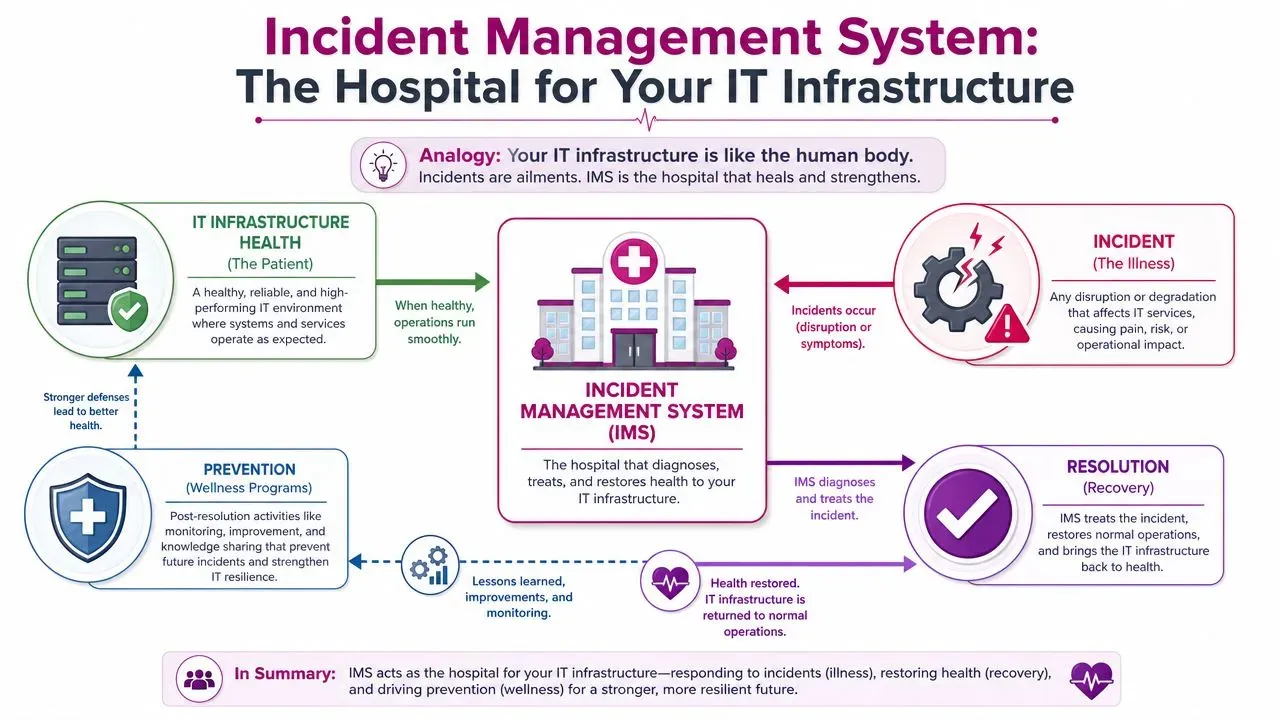
In MSP operations, that means the system answers practical questions fast:
- Is this an incident or a request
- How much business impact does it create
- Who owns response right now
- Who needs status updates
- What evidence must be captured before changes are made
If your tooling can open tickets but can’t answer those questions consistently, it isn’t doing incident management. It’s just recording activity.
What Counts as an Incident
Not every ticket belongs in the incident lane. A password reset, routine software install, or planned maintenance task is work, but it isn’t an incident. An incident is an unplanned interruption, a material degradation, or a security-relevant event that requires coordinated response.
That distinction matters because incident workflows need urgency, not queue fairness.
A mature setup also separates related records. The IMS should manage incidents, service requests, problems, and Requests for Change together, because those objects influence one another. The architectural requirement to handle all four, and to correlate incidents with RFCs, matters because 30-40% of service disruptions are directly attributed to recent configuration changes according to the IEEE specification on incident management system requirements.
When teams can’t connect an outage to a recent change, they often “fix” the symptom and leave the cause in production.
This is also why the market is so large. The global incident and emergency management market was valued at USD 141.79 billion in 2025, highlighting how central these systems are to resilience and continuity according to Fortune Business Insights on the incident and emergency management market.
For a service provider, the takeaway is simple. An incident management system isn’t a helpdesk upgrade. It’s the control plane for service stability, security operations, and client confidence.
The Core Components of a Modern IMS
A modern incident management system isn’t one screen or one queue. It’s a chain of connected functions. If any link is weak, the whole response slows down.
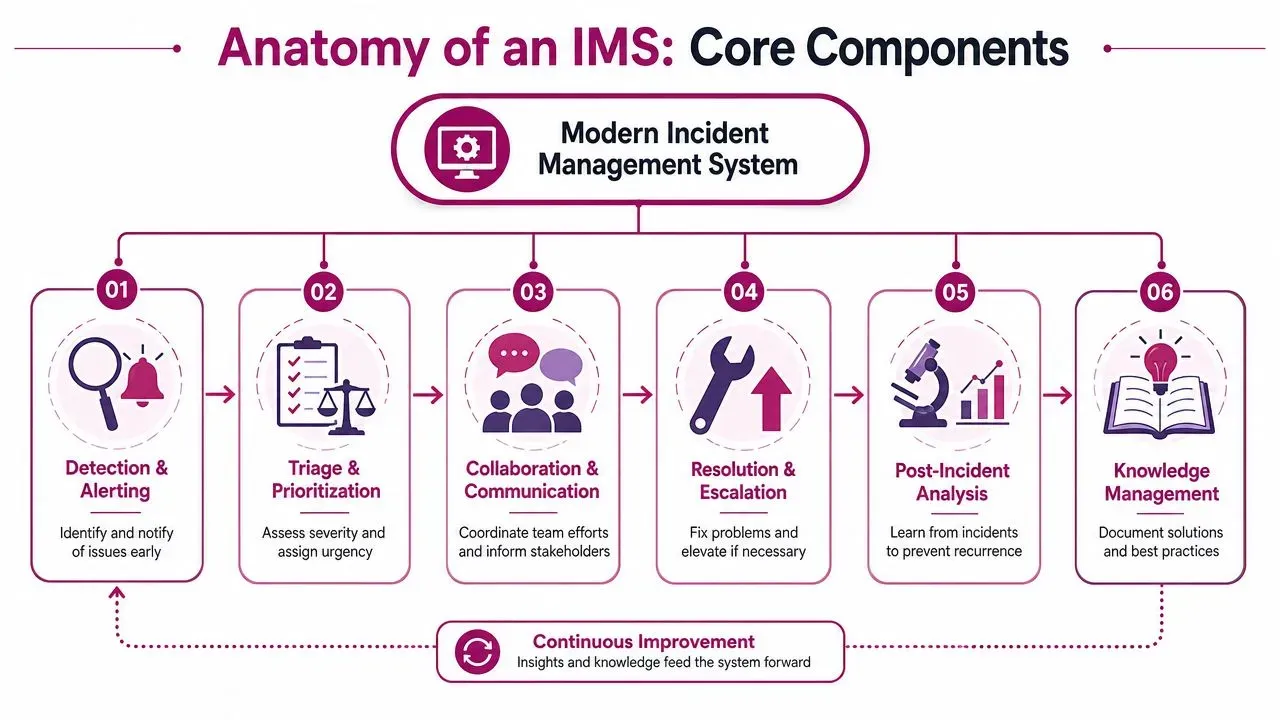
The Workflow Layers That Matter
At the front end, you need detection and logging. Alerts can come from SIEM, EDR, cloud telemetry, firewall events, uptime checks, user reports, or account manager escalation. The IMS should normalize those inputs into a single intake path. If analysts have to manually reconcile five different alert channels before triage begins, your process is already late.
Next comes categorization and prioritization. Weaker teams often make avoidable mistakes at this stage. They categorize by technology instead of business effect. “Database issue” is useful for assignment. It is not enough for priority. Priority should reflect impact, urgency, and downstream risk.
Then comes communication and escalation. This phase reveals whether the system is operational or merely administrative. A real IMS routes incidents to the right responder pool, pulls in stakeholders when required, and creates a visible command thread for decisions. If you want to tighten this layer, it helps to study structured dispatch workflows outside traditional IT. Emergency coordination models often solve the exact handoff problems MSPs struggle with.
A short comparison helps:
| Component | What it does | What goes wrong without it |
|---|---|---|
| Detection and logging | Captures alerts in a usable record | Teams miss context or duplicate tickets |
| Prioritization | Assigns urgency based on impact | Loud but low-value alerts consume time |
| Communication | Coordinates responders and client updates | Engineering and account teams drift apart |
| Investigation | Validates cause and scope | Fixes become guesswork |
| Resolution and recovery | Restores service safely | Service returns but root issue remains |
| Closure and documentation | Preserves timeline and lessons | The same incident repeats |
For providers expanding offensive and defensive services together, upstream visibility matters too. A broad attack surface analysis process improves intake quality because it gives triage teams asset context before they start guessing what an alert touches.
Why Correlation Changes Outcomes
The strongest IMS environments link incidents to adjacent operational records. That means tying service disruptions to changes, linking recurring incidents to problem records, and separating user requests from actual interruptions.
This sounds procedural, but it has real operational value. A mail flow issue after a firewall rule adjustment shouldn’t live as an isolated outage ticket. It should point back to the change that likely caused it. A recurring application crash shouldn’t reopen as a fresh mystery every week. It should roll into problem management.
MSPs often miss this because they’re built around fast closure. Closure matters, but isolated closure creates repeat work. Correlation creates an advantage.
Good incident management restores service. Great incident management reduces the chance your team sees the same failure again.
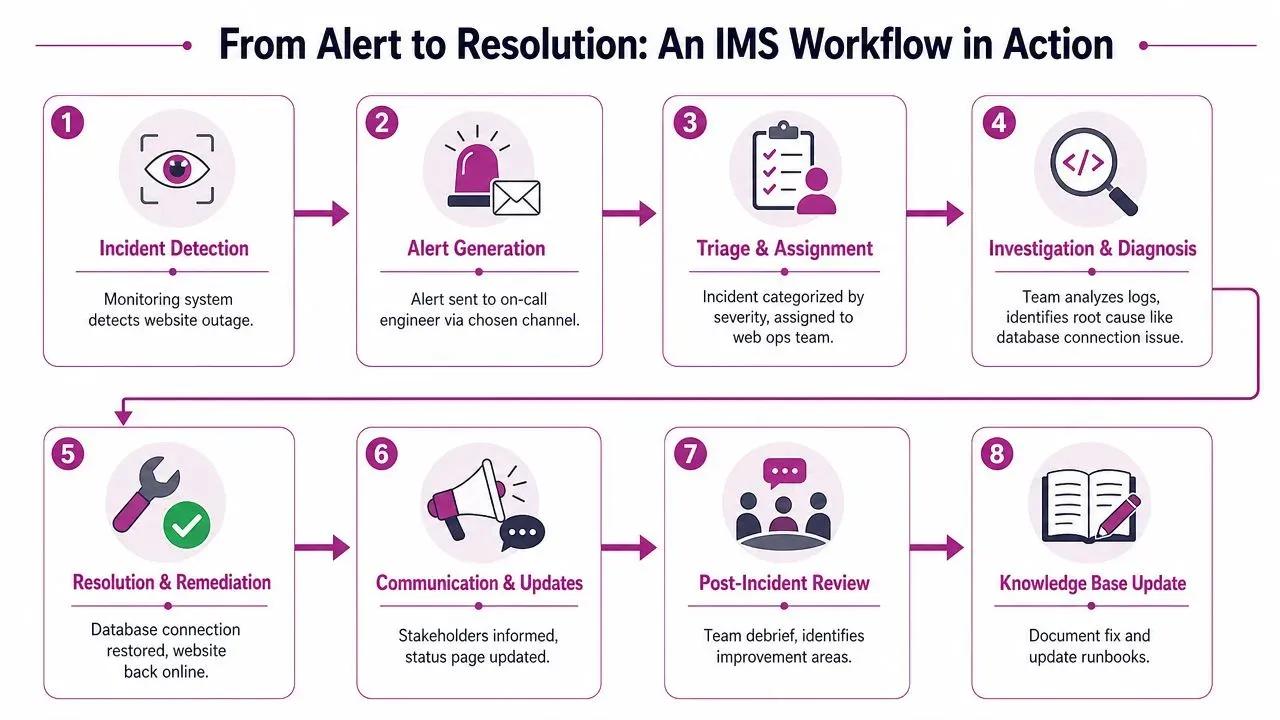
A Typical Incident Management Workflow in Action
Theory matters less than execution. Here’s what the workflow should look like when a real client incident lands.
Early in the process, a visual workflow helps align teams on what “good” looks like.
A Realistic MSP Scenario
A client’s e-commerce site becomes intermittently unavailable. Monitoring detects failed checks and opens an incident record. The IMS automatically attaches the affected service, recent alerts, ownership group, and client communication profile. That alone saves several minutes of manual enrichment.
The duty analyst reviews the record, confirms customer impact, and marks the incident as critical. In a mature model, that matters because critical incidents should escalate to Level 3 support within 15 minutes of logging, and organizations that ignore that threshold experience a 40% increase in incident duration according to Atlassian’s incident management guidance.
The on-call engineer joins the incident channel, checks logs and dependency health, and spots a database connectivity failure after a recent application-side change. The communications lead posts a client-safe update while engineering validates whether the issue is isolated or part of a larger pattern.
This is also the point where adjacent playbooks matter. If the outage turns out to involve exposed data or confirmed compromise, the workflow must branch immediately into breach handling and evidence preservation. Teams that haven’t documented that pivot should review practical steps after a data breach before they need them.
A quick walkthrough video can help teams compare their current process to a cleaner model.

Where Mature Teams Gain Time
The recovery itself may be straightforward. The engineer restores database connectivity, confirms application health, and validates checkout flow. But mature teams gain time in the parts many providers neglect:
- They capture a timeline in real time so nobody reconstructs events from memory later.
- They separate client communication from technical chat so updates stay coherent.
- They schedule review before closing so lessons don’t disappear into the next queue.
A clean incident closeout should answer three things without debate: what happened, what changed, and what must be different next time.
In practice, immature workflows often break. Someone fixes the symptom, the ticket is marked resolved, and the team moves on. No one checks whether the change process failed, whether monitoring fired too late, or whether the client got contradictory updates.
An incident management system earns its value by making those misses harder to repeat.
Defining Roles and Measuring Success with KPIs
Tools don’t run incidents. People do. Even highly automated environments still need clear authority, clean handoffs, and metrics that reflect operational reality instead of vanity reporting.
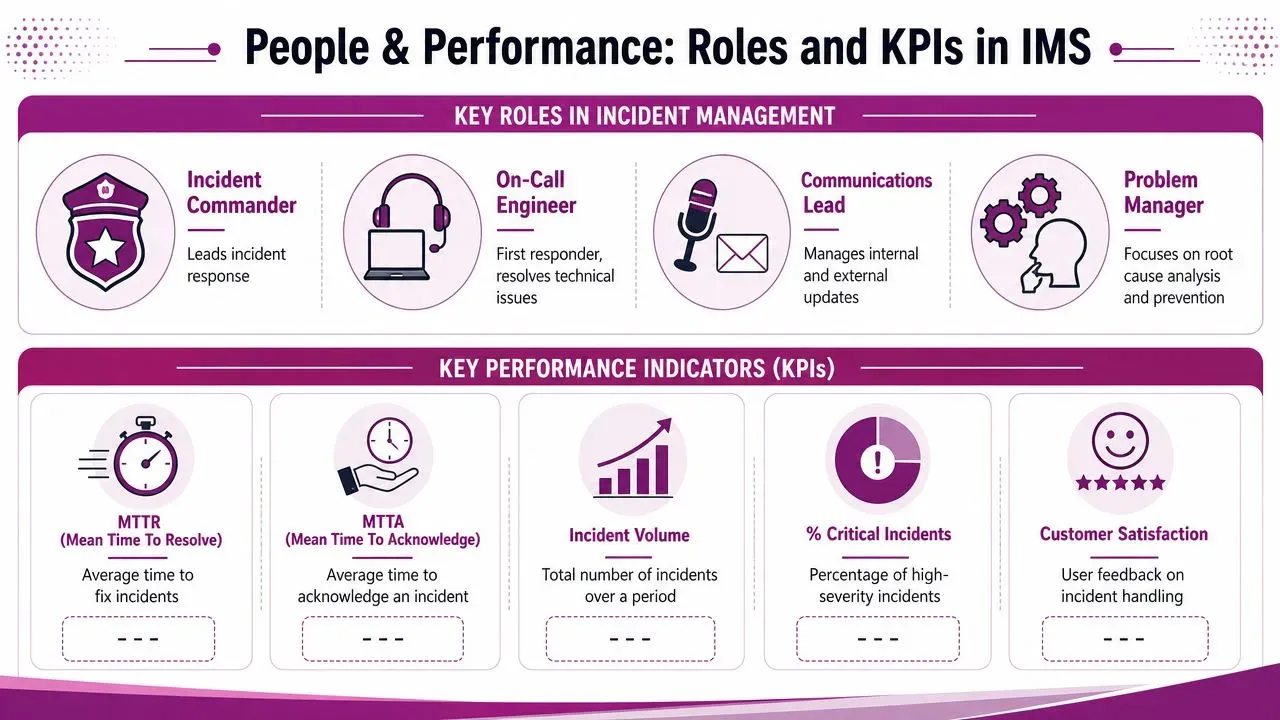
Roles That Keep Incidents Moving
A lot of MSPs overload the on-call engineer with every responsibility. That works until the first serious cross-functional incident. Then the same person is expected to troubleshoot, brief the client, coordinate vendors, and decide escalation. That’s too much cognitive load.
The core roles should be explicit:
- Incident commander handles direction, decisions, and escalation authority.
- Technical responder works the issue, gathers evidence, and executes remediation.
- Communications lead updates the client, internal stakeholders, and status channels.
- Problem owner turns recurring incidents and root-cause findings into preventive action.
In smaller teams, one person may hold more than one role. That’s fine as long as responsibility is still clear. What fails is ambiguity.
A simple role split looks like this:
| Role | Primary concern | Common mistake |
|---|---|---|
| Incident commander | Control and prioritization | Getting pulled into hands-on troubleshooting |
| Technical responder | Diagnosis and fix | Making changes without recording decisions |
| Communications lead | Accurate updates | Overpromising timelines |
| Problem owner | Long-term prevention | Joining too late, after evidence is lost |
KPIs That Actually Help an MSP Improve
The most useful metrics are the ones your team can act on. Start with Mean Time to Detect, Mean Time to Acknowledge, and Mean Time to Resolution. These tell you whether your issue is visibility, response discipline, or engineering depth.
One benchmark is especially useful for security-focused providers. A key industry reference point for Mean Time to Detect is 5 hours, meaning that on average it takes a security team that long to identify an incident after it occurs, according to Splunk’s explanation of incident response metrics. If your detection path depends heavily on client reports, manual review, or disconnected alert sources, you’ll struggle to beat that.
That’s why MTTA matters alongside MTTD. Detection without acknowledgement still leaves the incident idle. And MTTR, while important, is easy to misread if the team is closing low-impact noise quickly while major incidents linger.
Track a small scorecard consistently:
- MTTD shows how quickly your tools and analysts surface meaningful issues.
- MTTA shows whether alerts reach a human who accepts ownership.
- MTTR shows how effectively the team restores service.
- Incident volume shows operational load and pattern shifts.
- First-touch resolution rate shows whether the team is solving issues cleanly on initial handling.
Don’t present KPIs to clients as proof of activity. Present them as proof that your process is getting tighter.
The most credible MSP reporting ties these metrics to action. If acknowledgement is slow after business hours, fix the on-call path. If detection lags, tune telemetry and enrich alert context. If resolution drags on change-related incidents, improve correlation between incident records and change records.
Integrating External Intelligence for Proactive Defense
An incident management system built only on internal telemetry is reactive by design. It tells you what your environment is already showing. That’s necessary, but it’s not enough if you want to deliver a stronger managed security service.
Why Internal Telemetry Is Not Enough
Many early-stage incidents look harmless when viewed in isolation. A single failed login, a strange endpoint process, a support request about account lockouts, or a suspicious domain mention may not cross the threshold for escalation on its own. But triage changes when outside context arrives.
That’s one reason external intelligence has become so important for service providers. Recent data shows that 68% of security breaches begin with minor incidents misclassified as non-critical, according to the University of New Mexico incident management program component guidance. The operational lesson is obvious. If your analysts lack context during triage, they will underrate events that deserve faster action.
External intelligence helps close that gap. Dark web monitoring can reveal exposed credentials before a client notices suspicious account behavior. Brand monitoring can show fake domains or impersonation activity before users start reporting fraud. Threat intelligence feeds can change the severity of an alert by showing that a file hash, sender pattern, or infrastructure artifact aligns with an active campaign.
The fastest way to improve triage quality is to give the analyst more context at the moment of decision, not more paperwork after the fact.
How To Feed Intelligence Into the IMS
For MSPs and MSSPs, the right model is integration, not analyst swivel-chair work. External signals should create or enrich records inside the incident management system so the same workflow handles them.
A practical design usually includes:
- Credential exposure events that open security incidents or remediation tasks when client accounts appear in criminal marketplaces or leak collections. Providers building this capability should understand how dark web monitoring supports managed service providers.
- Vulnerability findings that generate prioritized work tied to affected assets, owners, and change windows.
- Threat intelligence matches that raise severity when internal alerts align with known tactics or active campaigns.
- Brand abuse signals that route to the team handling phishing, impersonation, and user-facing fraud.
This is also where analyst judgment still matters. External intelligence increases relevance, but it doesn’t replace verification. A dark web credential hit may require reset and validation, not panic. A malware-related artifact may need endpoint review before containment. For junior staff, a plain-language guide to identifying malware is useful because it translates suspicious behavior into recognizable categories during triage.
The service value is clear. You stop selling “we respond when something breaks” and start delivering “we identify conditions that often lead to incidents, then move before impact spreads.” That’s a stronger story for clients and a more defensible operating model for your team.
The Complete IMS Playbook for MSPs and MSSPs
The best incident management system for an MSP isn’t the one with the longest feature list. It’s the one your team will operate under pressure across many clients, with clean integrations and low administrative friction.
What To Look For in an IMS Platform
Start with the business model, not the interface.
If you manage multiple clients, multi-tenancy matters. You need tenant separation in records, permissions, automation, and reporting. Bolting client separation onto a single-organization workflow creates mistakes fast.
Then look at integration depth. Your IMS should connect cleanly with PSA, RMM, SIEM, EDR, cloud monitoring, identity systems, and external intelligence sources. APIs aren’t a bonus for service providers. They’re the difference between a central operating system and another console your analysts have to babysit.
A practical shortlist should include:
- Multi-tenant design so client records, workflows, and evidence stay isolated.
- Flexible automation for routing, severity changes, enrichment, and escalations.
- Role-based access control because account managers, analysts, engineers, and clients should not all see the same data.
- White-label or client-facing options if your service model includes branded portals or reporting.
- Usable audit trails so you can prove what happened, who acted, and when.
Don’t overbuy orchestration if your team hasn’t agreed on basic severity rules. Automation only accelerates the process you already have. If the process is vague, automation spreads the confusion faster.
A Deployment Checklist That Works in Practice
A phased rollout works better than a big-bang launch. Most failed implementations don’t fail because the tool is weak. They fail because the team never translated real service operations into durable rules.
Use this order:
- Define incident types and severity rules
Separate outages, degradations, security events, client-reported incidents, and change-induced failures. Write down what makes something low, medium, high, or critical in your environment. - Map ownership by service and function
Every monitored service should have a default responder path, backup path, and escalation authority. Do this before onboarding more alert sources. - Standardize communication templates
Write client-safe messages for acknowledgement, investigation underway, workaround in place, service restored, and review pending. Good teams don’t improvise external messaging during live incidents. - Integrate telemetry and enrichment sources
Connect the systems that detect issues, then the systems that add context. Start with what the team already trusts. Add external intelligence and vulnerability inputs once the base workflow is stable. - Build runbooks for the incidents you see most often
Focus on recurring realities like Microsoft 365 issues, firewall changes, certificate problems, endpoint containment, phishing response, backup failures, and cloud access disruptions. - Train by role, not just by tool
The incident commander needs decision discipline. Engineers need evidence and remediation habits. Communications staff need accuracy and timing. Tool demos alone won’t create that. - Run tabletop and live drills
Pick realistic scenarios. Include one operational outage, one security event, and one ambiguous incident that crosses both. Measure whether the workflow stays clear when facts are incomplete.
A compact deployment matrix helps:
| Phase | Priority | Expected outcome |
|---|---|---|
| Design | Severity, ownership, service mapping | Fewer triage arguments |
| Integration | Monitoring, PSA, security tools, enrichment | Better intake and context |
| Operations | On-call, runbooks, comms templates | Faster coordination |
| Improvement | Reviews, problem records, tuning | Fewer repeat incidents |
Common Failure Patterns
The same mistakes show up over and over in MSP environments.
One is treating every alert like an incident. That burns analysts out and hides the events that deserve urgency. Another is running incident response inside email. That creates private side channels, missing decisions, and terrible records. A third is closing tickets without review, which keeps teams trapped in a cycle of symptom resolution.
The subtler failure is organizational. Many providers still split operational incidents and security incidents so cleanly that neither side sees the full picture. In reality, clients don’t care which internal team owns the event. They care whether your organization recognized impact, acted quickly, and communicated clearly.
Build the system around that reality.
A strong MSP incident capability should let you answer these questions at any moment:
- What is happening
- Who owns it
- Which client or clients are affected
- What changed recently
- What are we doing next
- When will we update the client again
If the team can answer those six questions under pressure, the incident management system is working. If not, you still have tooling, not command and control.
MSPs and MSSPs that want stronger proactive security services need more than a ticket queue. They need external visibility, clean integrations, and workflows that turn early warning into action. InsecureWeb helps providers monitor the dark web, detect fake sites and accounts, surface threat intelligence, run vulnerability scanning, and add AI-guided penetration testing under their own brand. With included API access, it fits naturally into an incident management system built for faster triage, better client reporting, and higher-value managed security offerings.