Data Breach News15 min read
What Is Retail Fraud and How It Actually Works
By InsecureWeb Team
This report reflects observations of dark web activity. InsecureWeb makes no representations regarding the accuracy of this data.
Retail fraud cost merchants $138.56 billion in 2025, and merchants lost $52.84 billion to online payment fraud that same year. That’s why what is retail fraud can’t be treated as a simple theft question anymore, it’s an operating-risk question that affects checkout, returns, chargebacks, and brand trust.
Retail teams still picture a shoplifter at the door when they hear the term. In practice, the problem is broader, messier, and much more digital, which is why newer analysts need a cleaner definition before they can defend against it.
What Retail Fraud Really Means in 2026
Retail fraud is no longer just a shelf-side problem. Consumer guidance now groups it with fake retail sites, counterfeit goods, non-delivery scams, and other deceptive schemes that affect buyers and merchants across physical and digital channels, not just in-store theft.
A clearer working definition is this, retail fraud is any deceptive behavior that causes a retailer to lose money, inventory, or trust through checkout, return, refund, account, or fulfillment workflows. That includes in-store abuse, but it also covers fraud that starts online, moves through a customer account, or shows up later as a charge dispute or a manipulated return.
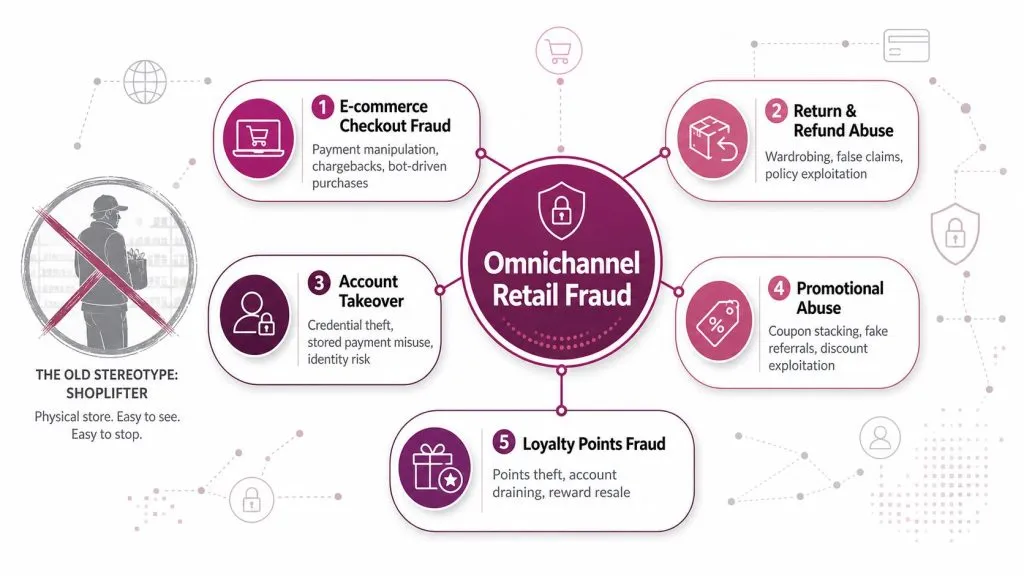
Why the old shoplifting mental model falls short
The old picture is too narrow because retail now runs through multiple systems, not a single cash register. A fraudster can abuse the checkout flow, trigger a refund, exploit a loyalty account, or move stolen value through returns and credits without ever walking out with a physical item.
That is why senior fraud teams treat retail fraud as a pattern of abuse across channels. They look for inconsistent signals across point-of-sale activity, refunds, collections, cash deposits, procurement, vendor ledgers, and inventory adjustments, then trace the gap back to the process, system, or person that let it happen. The useful clue is often not one dramatic theft event, but a mismatch between records that should agree.
Practical rule: if the loss shows up in one system but the proof is scattered across three others, you are no longer looking at a simple theft issue.
Why the definition matters operationally
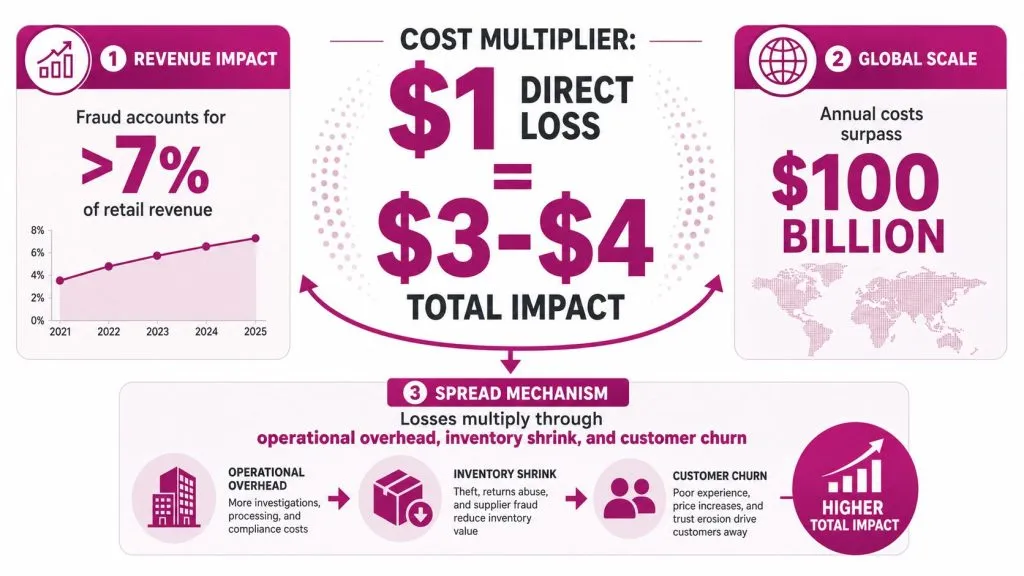
The definition matters because the cost does not stop at the first lost item. A 2025 retail and e-commerce study reported that the total cost of fraud exceeds $5 for every $1 of direct loss in both the U.S. and Canada, at about $5.13 and $5.23 respectively, and said that multiplier has more than doubled from roughly $2.40 in 2016 Vision Monday summary of the 2025 retail and e-commerce study. That is why retailers need to account for chargebacks, investigations, customer support, compliance work, and reputation damage, not just the original loss.
For a board deck or a plain-language policy, keeping your finances secure is a useful framing point because it ties fraud to cash flow, operations, and customer trust. On the threat side, dark-web monitoring helps surface leaked credentials and related exposure before they turn into account takeover, refund abuse, or other downstream loss.
The Main Types of Retail Fraud You Need to Know
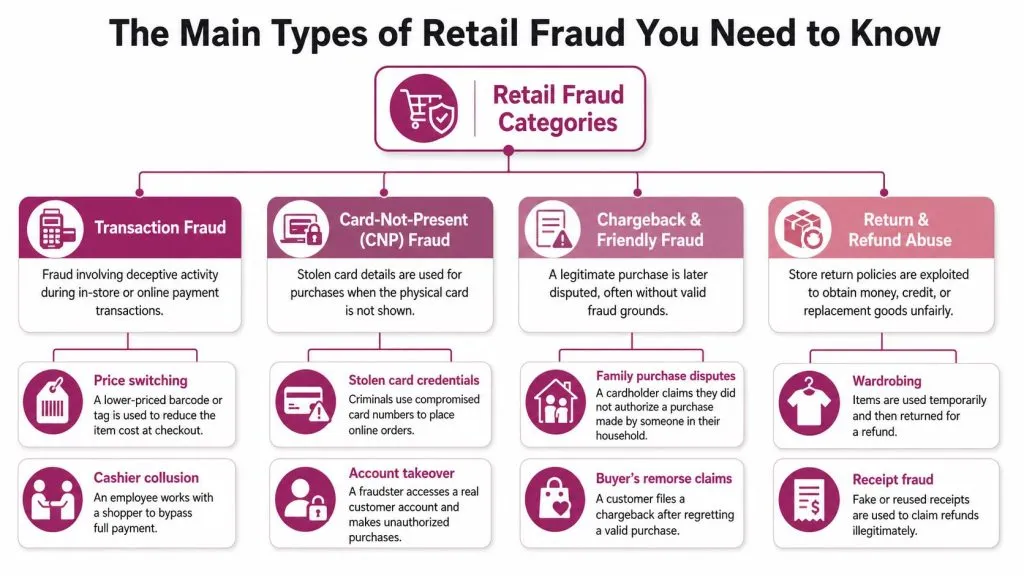
Retail fraud is a broad label, but teams need sharper buckets if they want to detect it. The cleanest way to organize it is by the workflow the fraud touches, because each workflow leaves different evidence behind. A checkout problem, a return problem, and an account problem rarely look the same on a dashboard.
The core categories you’ll see on a dashboard
Transaction fraud is the classic stolen-payment problem. A fraudster uses compromised card details or fake identity data to place an order, and the merchant usually learns the charge was bad after the fact. The order may look ordinary until payment, shipping, or dispute signals start to clash.
Card-not-present fraud is the online version of that same issue. The card isn’t physically swiped, so the merchant depends on digital checks like AVS, CVV, device data, and fulfillment evidence. That makes it a signal problem as much as a payment problem.
Chargeback and friendly fraud happen when a real buyer disputes a legitimate purchase or says the item never arrived. The bank pulls the money back while the merchant assembles proof. In practice, the merchant is trying to show that the order, delivery, and customer history fit together.
Return and refund abuse covers fake returns, worn-item returns, receipt manipulation, and policy gaming. A customer can turn a lenient return process into a cash-out path. Refund queues often show the pattern before the rest of the business does.
Other patterns that matter just as much
Promotional abuse happens when someone exploits sign-up offers, coupon rules, or welcome bonuses beyond the intended limit. It often looks small on a single order, but it can be repeated at scale. The clue is usually a cluster of low-value baskets tied to the same device, address, or payment pattern.
Account takeover is when someone gets into a legitimate customer account and uses saved payment methods, loyalty balances, or stored addresses. The fraudster looks like a real customer because they are sitting inside a real account. That is why login anomalies, address changes, and unusual fulfillment behavior matter together.
Inventory or shrink manipulation is the operational side of retail fraud. Someone alters inventory records, suppresses write-offs, or hides losses in ways that do not match actual sales velocity. It may show up as a mismatch between what was sold, what was refunded, and what the shelf count says should be there.
Retail fraud is easier to understand once you ask a simple question, “Which workflow did the person abuse?” That answer usually tells you what evidence to collect next.
KPMG’s retail fraud diagnostics show the same practical idea from the finance and inventory side. Analysts compare sales-to-cash flows, refund ratios, and inventory write-offs against actual sales movement, then test the records against invoices, order documents, credit notes, and deposit evidence. For a fraud team, the useful lesson is simple, retail fraud is not just a loss event. It is also a detection and attribution problem, and the strongest clues often live across systems that were never built to talk to each other.
Real-World Examples That Make Each Type Stick
A stolen card lands in checkout. The order may look normal for a few minutes, then the cardholder disputes it, and the merchant has to show why the transaction appeared legitimate from the evidence available at the time.
A customer says a package never arrived, even though the delivery system shows it was left at the address. The purchase itself is not the core issue. The fraud shows up in the chargeback that follows the dispute.
A shopper brings back worn merchandise with a receipt that does not match the item. Store staff see a return at the counter, while the fraud team sees a pattern of policy abuse.
A bot creates new accounts to burn welcome bonuses and discount codes. On the surface, it looks like a pile of small, cheap orders. Underneath, the merchant is paying for repeated promotional leakage.
One organized group pushes refunds through a lenient process quickly and repeatedly. The loss appears in the refund queue long before anyone connects the activity into a single case.
What the merchant actually sees
The frontline view is usually fragmented. Store staff see a return, e-commerce teams see a dispute, finance sees a settlement issue, and fraud analysts see an account pattern. That fragmentation is why retail fraud gets missed when each team only watches its own screen.
Consumer scams can widen the picture even more. The OCC’s guidance on consumer product and retail fraud covers cases that never touch a physical store floor, including fake sites, counterfeit goods, and non-delivery claims OCC consumer guidance on retail fraud. That matters for analysts because the same loss can present as a checkout anomaly, a shipping dispute, or a complaint that looks harmless until the signals are tied together.
Why these short stories help analysts
A good fraud stand-up uses concrete scenes, not jargon. “A card used at midnight and refunded the next morning” is easier to reason about than “potential policy misuse,” and it points the team toward the right logs, timestamps, and exception paths.
Browse the anomaly detection guide for a simple way to think about unusual patterns without turning every odd event into a fraud case. The point is to narrow review and separate true outliers from normal retail noise.
How Much Retail Fraud Really Costs and Why It Spreads
A fraud case rarely ends with the first bad order. Analysts at Vision Monday summary of the 2025 retail and e-commerce study found that the wider cost can run far beyond the direct loss, because review time, refunds, chargebacks, fulfillment work, and customer support all get pulled into the response. That is the part newer teams often miss, the original transaction is only the starting point, while the expense shows up in the cleanup.
A separate industry estimate put the global cost of e-commerce fraud at $138.56 billion in 2025, with merchants losing $52.84 billion to online payment fraud that same year and projected losses rising to $225.86 billion by 2029 Capital One Shopping ecommerce fraud statistics. Those figures show why fraud cannot be treated as an isolated loss event. It behaves more like a recurring drain on margin, inventory, and staff time, especially when the same weakness keeps getting reused.
Why the bill keeps growing
Fraud spreads when one weak point becomes a repeatable path. A loose return rule, a brittle checkout control, or a weak dispute packet can turn a single fraud attempt into a workflow that scales across stores, channels, and accounts. For an MSP or security lead, that is the key shift in thinking, the problem is not only whether a loss happened, but whether the same weakness is visible in other logs, other locations, or other customer journeys.
The evidence package matters as much as the incident itself. Thomson Reuters cites a Javelin study saying fraud costs retailers more than 7.5% of annual revenue and recommends cross-checking AVS/CVV, delivery confirmation, IP location, and receipt data when disputing charges Thomson Reuters modern retail fraud landscape. That guidance maps directly to how analysts should think about attribution. A chargeback is easier to defend when the merchant can line up the payment signal, the shipping trail, and the account behavior in one record.
A weak control can also become a signal to attackers. If a refund clears too easily, bad actors learn which path works. If a chargeback cannot be defended, payment fraudsters learn that the merchant will absorb the loss. If a coupon rule can be replayed, promo abusers will keep testing it until the offer stops looking like a limit and starts looking like an invitation.
For analysts, that is where broader intelligence helps. A dark web scan can show whether stolen cards, account credentials, or merchant data are already circulating, which helps separate a one-off customer complaint from a pattern that is being reused elsewhere. Paired with normal transaction and support data, it gives defenders another clue about whether the abuse is local or part of a wider campaign.
The expensive part of retail fraud is usually the process that lets more bad orders through before anyone notices.
That is why fraud teams care about signals across channels. When customer service, finance, and fraud operations do not share evidence, a pattern can look like isolated noise until the losses have already spread. The fastest path to better control is not a single rule. It is tying together the clues that show whether the same behavior is repeating in checkout, returns, refunds, and disputes.
Browse the anomaly detection guide for a simple way to think about unusual patterns without turning every odd event into a fraud case.
Detecting Retail Fraud in Real Time
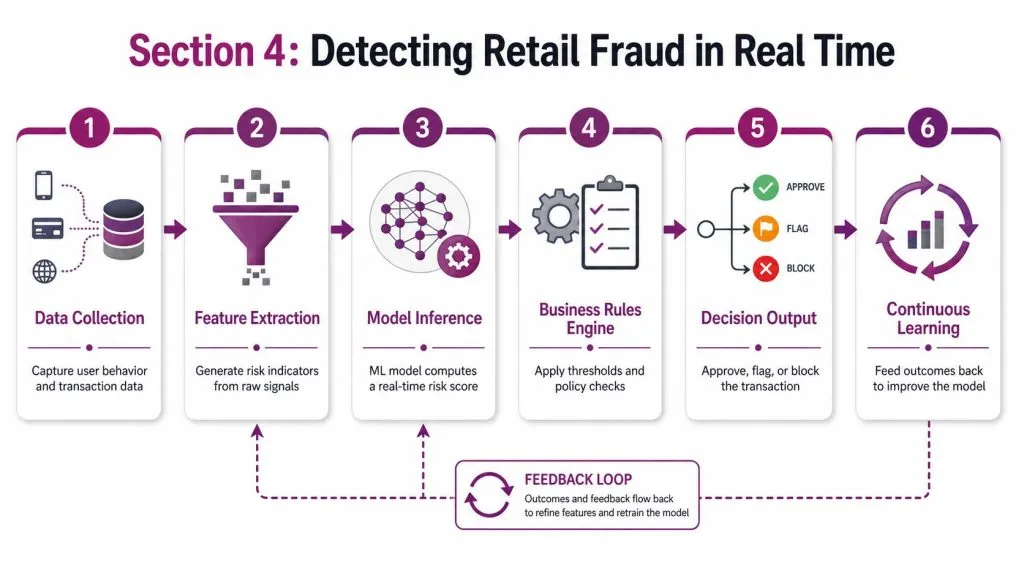
Real-time detection works like a scoring pipeline, not a single alert button. The system pulls in transaction and behavioral data, cleans and normalizes it through ETL or ELT, scores it with rules and models, and sends only the highest-risk cases into review so analysts do not drown in false positives technical overview of retail fraud detection pipelines.
That order matters because the goal is prioritization, not perfection. A good pipeline does not flag every odd event. It ranks the cases most likely to become chargebacks, refund abuse, or identity-driven loss.
What data belongs in the scoring layer
The strongest signals usually come from combining context, not from any single field. A checkout event becomes more useful when it is paired with device history, location clues, payment verification, fulfillment data, and prior account behavior.
That is why disputes often hinge on evidence like AVS/CVV matches, delivery confirmation, IP location, and receipt data. Retailers that can assemble those records can explain why a transaction looked legitimate at the moment it was approved, while teams that cannot document the trail are left arguing from memory instead of proof.
Credential exposure can also show up before the fraud attempt reaches the cart. A dark web scan helps teams check whether stolen cards, account logins, or merchant data are already circulating, which can turn a single suspicious order into a broader attribution question. If the same credentials are reused elsewhere, the fraud pattern is usually larger than one channel or one store.
How alerts stay useful instead of noisy
A fraud queue gets noisy fast when every anomaly is treated the same way. High-quality detection uses thresholds, rules, and model scores together, then routes only the riskiest cases into human review.
Practical rule: if your team reviews too many low-quality alerts, the detection layer is telling you more about its tuning than about fraud.
For teams that want a broader model of unusual behavior, browse the anomaly detection guide and compare it to the evidence you already collect in disputes. The best systems connect the two, they do not substitute one for the other.

Prevention Controls That Actually Reduce Loss
Prevention works when the controls line up with the abuse path. If the fraud starts at checkout, you need stronger authentication and verification. If it starts in returns, you need policy enforcement in the workflow. If it starts with stolen credentials, you need signals before the login ever reaches the cart.
Layered defense beats a single gate
At checkout, address verification, device checks, and step-up authentication help block weak signals before they turn into losses. In returns and refunds, policy rules need to live in the system, not just in a handbook, or staff will end up making inconsistent calls.
Inventory and discount controls matter too. When promo abuse or shrink manipulation shows up, the useful defense is cross-system analytics that tie POS, e-commerce, and inventory data together so a bad pattern doesn’t hide in a single application.
Where external signals fit
Dark-web monitoring helps when stolen credentials are circulating before they hit checkout. Fake-site and impersonation detection protect shoppers from copycat storefronts. Vulnerability scanning helps keep the retail platform from becoming the easy target in the first place.
In a retail-defense stack, InsecureWeb is one option for those external signals, along with dark web monitoring, fake site detection, and vulnerability scanning. That matters most for MSPs that need to map outside threats back to a client’s fraud stack and not just their security stack.
| Control Category | Primary Fraud Types Addressed | Example Signal |
|---|---|---|
| Address and device verification | Card-not-present fraud, account takeover | Shipping address and device history don’t match the customer’s normal pattern |
| Return policy enforcement | Return and refund abuse | Repeated refunds from the same account or store location |
| Promo and loyalty monitoring | Promotional abuse, loyalty fraud | Bonus codes or points are used in a way that breaks normal customer behavior |
| Cross-system analytics | Inventory manipulation, refund abuse | POS sales don’t reconcile with refunds or inventory adjustments |
| Dark-web monitoring | Stolen-credential driven fraud | Customer or employee data appears in leaked credential sets |
| Fake-site detection | Impersonation, counterfeit retail scams | A lookalike brand or domain is detected before shoppers are routed to it |
The right question isn’t whether a control can stop every case. It’s whether it closes a known path, produces evidence, and makes repeat abuse harder.
How MSPs and MSSPs Can Operationalize Retail Fraud Defense
MSPs and MSSPs can package retail-fraud defense as a service built around evidence, exposure, and early warning. Start with credential exposure, fake-site monitoring, and vulnerability scanning, then connect those findings to the retailer’s checkout, returns, and account workflows so the alerts mean something to the business.
That crosswalk matters because retail fraud isn’t just a cyber problem. A stolen credential alert becomes more useful when it’s tied to chargeback risk, account takeover risk, or a suspicious return pattern. Without that mapping, the client hears “security issue” instead of “loss prevention issue.”
What to put in the service blueprint
A practical offering usually includes a few repeatable pieces:
- Credential exposure checks for customer and employee data that appear in leaked sources.
- Fake-site and impersonation monitoring to catch copycat storefronts and misleading brand usage.
- Vulnerability scanning to reduce the chance that the merchant platform itself becomes the easiest entry point.
- Chargeback evidence support so the client can pull the right artifacts when a dispute hits.
- Refund and policy review to find the workflows most likely to be abused.
Dark web monitoring as a powerful tool for managed service providers fits naturally into that package because it gives the service team a concrete source of exposure signals they can act on.
How to make the work commercially useful
The first wins often come from showing the client where policy, data, and evidence don’t line up. A retailer with recurring refund disputes may need better documentation. A retailer with fake-site exposure may need brand monitoring. A retailer with weak omnichannel visibility may need a tighter link between POS, e-commerce, and inventory data.
That creates a clean renewal conversation too. When the service proves it can surface fraud-relevant risk before losses grow, the client sees it as operational protection, not just another security line item.
Key Takeaways for a Stronger Retail Fraud Posture
Retail fraud is an omnichannel operating risk, not a single theft event. A shopper dispute, a stolen account, a refund abuse case, and a fake storefront can all start in different places and still end in the same loss. The merchant has to track the direct transaction, the follow-on work, and the evidence trail that proves what happened.
The strongest programs treat detection and defense as connected tasks. Real-time scoring helps surface suspicious checkout behavior, but the score only matters if the team can tie it to usable evidence for a chargeback, a refund review, or an account takeover investigation. Prevention also works better when controls are layered across checkout, returns, accounts, and outside exposure signals, because fraudsters usually test whichever step is easiest to exploit first.
A useful quarterly checkpoint is the return and refund workflow. Review the approval rules, the documentation required at each step, the exceptions that staff can grant, and the time it takes to spot repeat abuse patterns. If the retailer also tracks credential exposure, employee data leaks, and impersonation activity, the team is less likely to be surprised by fraud that begins outside the storefront and shows up later inside it.
A stronger retail fraud posture is measured by how quickly the merchant can connect a suspicious event to a customer, a device, a transaction history, or a policy violation. That is the difference between reacting to losses after they spread and spotting the pattern early enough to contain them.