Data Breach News17 min read
10 Marketplace Risk Examples and How to Mitigate Them
By InsecureWeb Team
This report reflects observations of dark web activity. InsecureWeb makes no representations regarding the accuracy of this data.

Unmasking the Hidden Threats in Digital Marketplaces. The danger is bigger than often anticipated. Which? says the UK’s Office for Product Safety and Standards found 81% of products tested on online marketplaces failed safety tests, and Which? also estimates that one in seven people who bought from an online marketplace in the last two years reported a problem, which it says equals at least 7.2 million consumers exposed to unsafe products, scams, or fakes. That is why marketplace risk examples matter for MSPs, MSSPs, and security teams, not just consumer protection staff. The risk is not limited to bad listings. It includes credential theft, impersonation, vendor compromise, malware distribution, insider abuse, and reputational attacks that spread before a buyer ever checks out, as the OECD’s discussion of online marketplaces and fraud shows in its broader framing of the problem.
In practice, marketplaces reward speed, scale, and anonymity, which gives attackers room to hide in plain sight. A platform can host legitimate commerce and hostile activity at the same time, and the same discovery path that helps buyers find products can help criminals find victims. InsecureWeb’s mix of dark web monitoring, fake site detection, vulnerability scanning, AI-guided penetration testing, and deepfake and reputation monitoring fits that threat model because each risk leaves different external signals. The key is to watch for those signals early, then act before trust erodes across customers, partners, and internal teams.
1. Dark Web Data Breaches and Credential Exposure
Stolen access tends to appear on criminal marketplaces long before a company finishes its breach narrative. That gap is what makes dark web exposure so dangerous for MSPs and security providers, because attackers can buy usernames, passwords, API keys, and authentication tokens and start probing environments while defenders are still working through incident triage. Which? ties this broader marketplace problem to real consumer harm, but the operational lesson for businesses is different. If compromised credentials are circulating externally, your control problem is no longer theoretical.
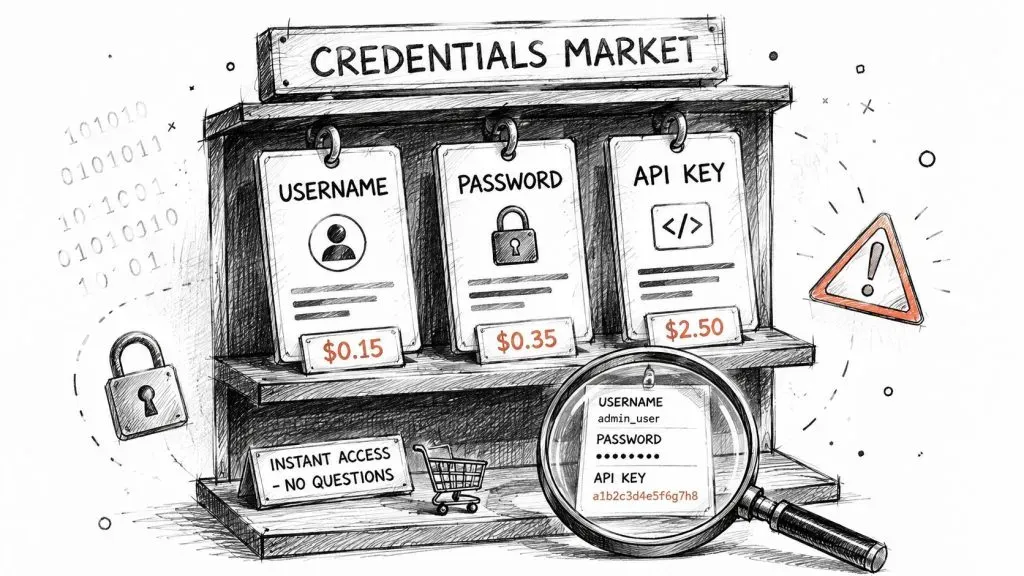
What the signal looks like
A dark web listing may mention a brand name, an email domain, or a partner system name. It can also surface through bundled leaks that expose staff logins, vendor credentials, or support portals tied to your environment. InsecureWeb’s dark web scan is relevant here because it is designed to surface those mentions before they become a second incident.
Practical rule: Treat any exposed credential as an active intrusion path, not a passive data point.
Mitigation should be immediate and scripted.
- Reset exposed passwords fast: Force resets for affected users, then invalidate sessions and refresh tokens where possible.
- Map third-party exposure: Track vendors, contractors, and service accounts so you can tell whether the leak touches your own perimeter or a partner’s.
- Alert by brand and domain: Watch for your company names, customer sub-brands, and admin portals in marketplace chatter.
- Trigger response playbooks: Tie exposure events to incident response steps, legal review, and customer communication.
A strong program doesn’t wait for a login anomaly after the fact. It uses external exposure data to narrow the window between compromise and containment.
2. Brand Impersonation and Fake Domain Registration
Impersonation attacks work because buyers and employees trust familiar names. Attackers register lookalike domains, create fake social profiles, and spin up counterfeit sites that resemble a real company closely enough to capture credentials or redirect payments. The technical trick is simple. The business impact is not. Once a fake domain or social account starts harvesting trust, every message from the authentic brand has to work harder.
Marketplace dynamics matter. Domain registrars, privacy services, and social platforms make it easy to launch a believable front door in minutes. A fake Microsoft login page, an Apple lookalike such as app1e.com, a LinkedIn recruiter account, or a counterfeit AWS login prompt all exploit the same weakness, which is user recognition under time pressure. InsecureWeb’s fake site and account detection fits this environment because it helps teams watch for domains, pages, and profiles that imitate the brand rather than attack the perimeter directly.
Detection and response
The most useful signals are often small. A new registration containing your brand, a misspelled support address, or an account claiming to be hiring can be the first sign of a wider phishing run. Teams should also monitor registrar activity and social channels in near real time, since impersonation campaigns often move faster than manual review queues.
- Register common variations early: Capture misspellings and alternate TLDs before criminals do.
- Watch registrar and DNS activity: Look for new registrations that include your name, product names, or support language.
- Scan social platforms routinely: Search for fake customer service, sales, or recruiting profiles.
- Use email authentication: Enforce DMARC, SPF, and DKIM so spoofed mail is easier to reject.
Brand impersonation is often dismissed as reputation noise. It isn’t. It’s a direct path to credential theft, fraudulent payments, and support desk overload.
3. Third-Party Vendor and Supply Chain Compromise
A marketplace business rarely depends on one vendor alone. It depends on software suppliers, MSPs, payment tools, logistics providers, and cloud services, all of which can become entry points if an attacker lands inside the trust chain. That’s why third-party compromise sits near the center of marketplace risk examples. A vendor breach can cascade into customer exposure even when your own staff never clicked a phishing link.
The scale of this problem is easy to underestimate. The OECD describes online marketplaces as key e-commerce channels globally, but it also highlights the risks created by third-party sellers and fraudulent behavior. The same logic applies to vendors. When a supplier’s tools or update channels are abused, the downstream impact spreads quickly because customers trust the upstream relationship. In the public incidents often cited in this context, SolarWinds showed how a compromised build pipeline can reach many organizations at once, while other cases such as Kaseya and MOVEit reinforced how indirect dependencies create fourth-party exposure.
Why this matters to MSPs
MSPs sit in the highest-risk segment because they inherit trust from multiple clients at once. A single privileged integration or remote management path can turn one vendor event into many client incidents. That makes vendor tiering, access review, and continuous reassessment more important than annual questionnaires.
Security teams should ask one question first, not ten. What can this vendor actually reach?
Control priorities should be concrete.
- Inventory every vendor with access: Include MSP tools, support platforms, and sub-processors.
- Separate privileged accounts: Use dedicated service accounts with the minimum access needed.
- Require MFA on every integration: No exception for “trusted” partners.
- Review vendor announcements continuously: Treat security notices as operational triggers, not background reading.
A mature marketplace program doesn’t assume trust survives contact with scale. It verifies who can reach what, then limits that reach.
4. Zero-Day Vulnerability Exploitation in Marketplaces
Zero-days are dangerous because attackers get a head start while defenders wait for a patch that doesn’t exist yet. In marketplace environments, that head start matters even more, since exposed web apps, customer portals, and admin tools are reachable from the internet and often tied to revenue. The attacker doesn’t need full platform compromise to cause damage. One exploited edge service can open the door to credential theft, session hijacking, or ransomware staging.
Security teams also need to think like marketplace operators here. If exploit code is discussed, traded, or tested in underground forums, the threat is already moving through a market. The challenge is visibility. InsecureWeb’s threat intelligence, vulnerability scanning, and AI-guided penetration testing are relevant because they help organizations find weak points before attackers scale them into incidents. Behavior-based detection matters too, since exploit activity often leaves system-level anomalies even when signatures lag behind.
Operational response
Fast inventory is the difference between containment and scramble mode. If you can’t identify affected assets quickly, patching becomes guesswork and exposure lasts longer than it should. The same is true for segmentation. If a zero-day lands in one exposed application, blast-radius control can keep the incident from reaching internal systems or connected tenants.
Practical rule: If a system is internet-facing and business-critical, it needs a patch path, a monitoring path, and a rollback path.
- Keep an accurate asset list: Know which systems are exposed, which are internal, and which depend on vendors.
- Monitor for exploitation behavior: Look for unusual authentication attempts, process spawning, and web-shell activity.
- Segment critical systems: Limit lateral movement if a public-facing app is compromised.
- Use vendor pre-disclosure channels: Get information fast when suppliers identify a flaw.
Zero-days are not just vulnerability events. They are timing events, and the faster you see them, the smaller the compromise window becomes.
5. Deepfake and Reputation Attacks on Social Media
Synthetic media has changed how fast a reputation attack can spread. A fake executive video, manipulated audio clip, or AI-generated statement can move across social platforms before internal teams have confirmed it’s fake. That makes deepfakes a marketplace risk example with unusual characteristics, because the attack often targets belief first and systems second. A company can suffer operational disruption from a rumor before any technical breach is proven.
A digital illustration helps here, because these attacks often look legitimate at a glance.
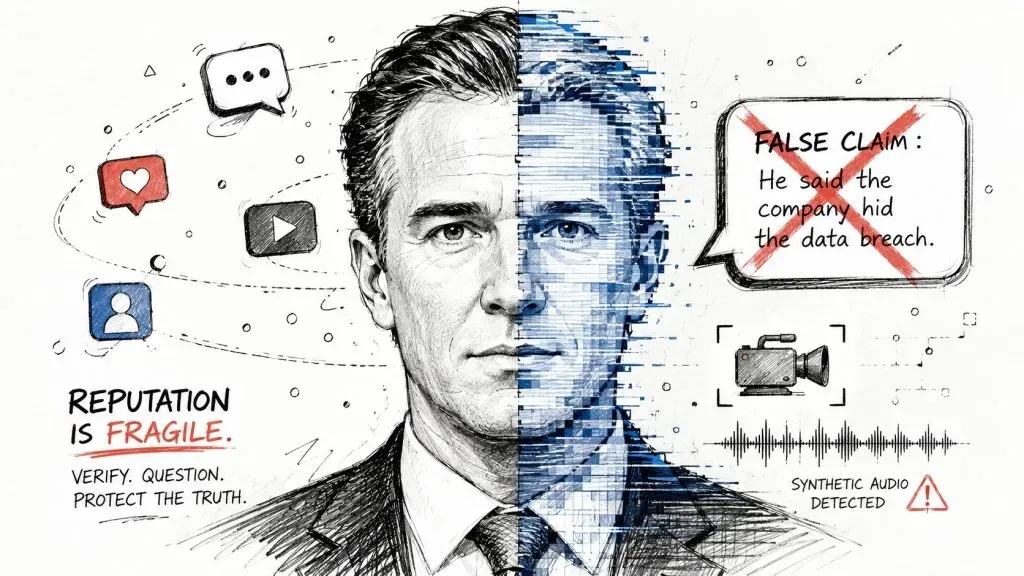
The business problem is trust erosion. If a fake bankruptcy clip, bogus financial tip, or manipulated CEO statement starts trending, customers and partners may hesitate before checking facts. InsecureWeb’s deepfake and reputation monitoring is relevant because it focuses on the external signals that signal an attack is underway, not just whether the content is convincing.
How teams should respond
Response speed matters more than perfect certainty in the first hour. Companies need an internal path to validate media, a public path to correct it, and a social platform contact path to request removal or labeling. Executives should know who approves statements, who posts them, and what evidence is needed before escalation.
- Monitor executive mentions daily: Watch for manipulated images, clips, and audio tied to leadership.
- Authenticate official media: Use signatures, official channels, and consistent brand assets.
- Pre-brief executives: Train leaders on what a deepfake looks like and how to respond.
- Document every incident: Keep logs for legal, compliance, and platform escalation.
A fake message can cause real damage even if no system is breached. That’s why reputation monitoring belongs in the same control stack as fraud and vulnerability detection.
6. Ransomware-as-a-Service Marketplace Operations
Ransomware-as-a-Service turns intrusion into a subscription business. Affiliates rent tools, infrastructure, and negotiation support, then split proceeds with the operators. That business model lowers the skill barrier and increases the number of groups capable of launching enterprise-grade attacks. In marketplace terms, it is a supply chain for extortion.
The risk for defenders is that RaaS behaves like a service ecosystem, not a one-off attack. Operators advertise tooling, affiliates reuse infrastructure, and leaks or public takedowns can move victims into new targeting pools. The China Aviation Oil case is a reminder that weak controls around high-risk operations can create large losses, and the same principle applies here. A ransomware marketplace scales damage by distributing capability broadly. InsecureWeb’s Superfund ransomware leaked by Hydra Market data breach summary is useful context because it reflects how criminal marketplaces package and recycle attack capability.
Defense priorities
Segmentation, backup discipline, and behavioral monitoring matter more than generic awareness training once ransomware is in play. If encryption activity starts, endpoint response needs to isolate systems before the blast radius expands. Dark web monitoring also helps, because many ransomware crews publicize victims or leak data to pressure payment.
Practical rule: The best time to stop ransomware is before lateral movement, not after encryption starts.
- Keep offline backups: Make sure backup systems aren’t reachable from the same malware path.
- Watch for encryption behavior: EDR should flag file renaming, mass writes, and suspicious process trees.
- Segment critical assets: Separate user workstations from servers that hold sensitive data.
- Track victim mentions: Search for your brand in leak sites and extortion channels.
RaaS is attractive to criminals because it removes friction. Defenders should respond by raising friction at every stage of execution.
7. API and Integration Security Vulnerabilities
APIs are the connective tissue of modern marketplaces, and that makes them a favorite target. Exposed keys, weak authentication, and poorly governed integrations can reveal data or allow unauthorized actions without any obvious front-end compromise. For MSPs, that’s a major blind spot, because many client-facing services depend on API trust rather than human logins.
The risk shows up in familiar ways. A leaked Stripe key can create unauthorized charges, a misconfigured AWS S3 bucket can expose stored data, or a compromised GitHub token can be used to push malicious code. The issue is not just the API itself. It’s the lack of visibility around who can call it, from where, and with what privilege. InsecureWeb’s vulnerability scanning and AI-guided testing are a practical fit here because they help teams identify exposed services and integration weaknesses before attackers exploit them.
What strong API governance looks like
API security needs inventory, not assumptions. If teams don’t know which APIs exist, they can’t rotate credentials, define rate limits, or verify which tokens are still active. Logging matters too, because anomalous call patterns often appear before downstream abuse becomes obvious.
- Maintain a full API inventory: Include internal, partner, and customer-facing endpoints.
- Rotate keys regularly: Replace long-lived keys before they become silent liabilities.
- Store secrets safely: Keep them out of code repositories and chat tools.
- Enforce MFA and least privilege: Limit what each integration can do.
- Monitor access logs: Look for unusual geographies, volumes, and error patterns.
API risk is easy to ignore because it looks like plumbing. In practice, it’s the control layer that decides whether a marketplace stays stable or becomes a data-exfiltration engine.
8. Phishing and Social Engineering Infrastructure
Phishing used to require more effort. Criminal marketplaces changed that by selling kits, spoofing services, and turnkey infrastructure that lower the barrier to entry. That means even low-skill attackers can launch convincing campaigns against employees and customers. A phishing kit aimed at Office 365, a bulk sending service, or an SMTP relay that bypasses weak controls can turn social engineering into an industrial process.
The marketplace angle matters because the infrastructure is the product. Attackers don’t need to build the whole campaign from scratch if they can buy templates, delivery services, and stolen credentials. That’s why one of the most effective defenses is not just email filtering, but a broad trust model that includes user verification, conditional access, and threat feeds. InsecureWeb’s fake site detection and dark web monitoring support that model by looking for infrastructure tied to your brand and login surfaces.
How to harden the inbox and the user journey
Phishing defense works best when technical controls and user behavior reinforce each other. Sandbox detonation can catch attached payloads, while DMARC enforcement reduces spoofed mail. Password managers also help, because users are less likely to reuse credentials across fake and real sites.
Security teams should assume the attacker will find the easiest path, then remove that path one control at a time.
- Use sandboxing for email attachments: Detonate suspicious files before they reach users.
- Enforce DMARC with rejection: Make spoofed domains much harder to exploit.
- Train through simulation: Run realistic phishing exercises and give feedback quickly.
- Watch for phishing kits aimed at your brand: Criminal tooling often shows up before a campaign peaks.
Phishing remains popular because it scales. The response has to scale too, with layered controls instead of one defensive wall.
9. Malware and Botnet Distribution Networks
Criminal marketplaces don’t just sell access. They also distribute malware, trojans, and botnet infrastructure as services or packaged tools. That structure makes infection easier to buy and easier to repeat. A threat actor who lacks coding skill can still deploy a banking trojan, launch a botnet, or rent command-and-control support if the ecosystem is mature enough.
The operational aspects of marketplace risk examples are clearly highlighted. Malware campaigns often depend on the same distribution paths over and over, including spam, exploit kits, compromised downloads, and shared control servers. That means defenders can hunt not only payloads, but the infrastructure behind them. InsecureWeb’s threat intelligence and monitoring features fit this use case because they help teams track malicious hosts, unusual outbound connections, and indicators tied to active botnet or malware campaigns.
Containment over cleanup
Once a workstation is infected, the main goal is to stop spread. That requires endpoint detection, network segmentation, and blocking known malicious destinations. Application whitelisting can also help on critical systems, because it limits what can run even when a user clicks the wrong file.
- Deploy behavior-based antivirus: Catch suspicious activity, not just known signatures.
- Use EDR everywhere possible: Endpoint visibility helps find lateral movement early.
- Monitor outbound traffic: Flag unusual command-and-control connections.
- Keep offline backups: Recover without relying on infected hosts.
Malware marketplaces thrive on repetition. The defense is to break repetition by making each stage of the infection chain harder to repeat at scale.
10. Insider Threat and Employee Credential Abuse Marketplaces
Insider abuse is one of the harder marketplace risk examples to control because the attacker already has legitimate access. Criminal forums often recruit current or former employees who can sell credentials, system knowledge, or sensitive data. That path bypasses many external controls and gives an outsider a shortcut into systems that would otherwise be difficult to reach.
The risk is not always a visible breach. Quiet access sales can let an outsider operate like an insider, which delays detection and expands the window for misuse. InsecureWeb’s internal-risk-adjacent visibility helps here through dark web monitoring and exposure tracking, including coverage that can surface recruitment attempts, leaked credentials, or references to employee access. Teams that want a broader starting point for this control layer can also review InsecureWeb’s free dark web monitoring for credential markets. In insider cases, speed matters because perimeter-only monitoring can miss activity until after data has already moved.
Offboarding creates a separate failure point. If a former employee still has active access, the risk becomes avoidable rather than merely likely. Just-in-time access, privileged access management, and separation of duties reduce that exposure by limiting standing privileges and making it harder for a single account to move through sensitive systems without review.
Practical rule: Revoking access at departure is not an administrative task, it’s a security control.
- Monitor recruitment chatter: Watch for forums that solicit employee access or internal data.
- Use privileged access management: Grant high-risk access only when needed.
- Run behavior analytics: Look for unusual data pulls, access times, or download patterns.
- Revoke access immediately on exit: Don’t let offboarding drift into next week.
Insider threats are difficult because they are personal, opportunistic, and often invisible from the outside. Strong process discipline, paired with dark web visibility and access tracking, remains the most practical defense.
Top 10 Marketplace Risks Comparison
| Threat | 🔄 Complexity (Implementation) | ⚡ Resource requirements | 📊 Expected impact (Outcomes) | 💡 Ideal use cases | ⭐ Key advantages |
|---|---|---|---|---|---|
| Dark Web Data Breaches and Credential Exposure | High, continuous automated scraping & correlation | Moderate–High, darknet feeds, tooling, 24/7 monitoring | Critical, rapid account takeover and lateral access | Online services, MSPs, regulated data holders | Early exposure alerts; enables proactive credential rotation |
| Brand Impersonation and Fake Domain Registration | Medium, detection across domains & platforms; takedown workflows | Low–Moderate, domain monitoring, registrar relationships | High, phishing, customer fraud, brand dilution | Retail, finance, SaaS, large consumer brands | Prevents customer phishing; protects reputation and trust |
| Third-Party Vendor and Supply Chain Compromise | High, governance, vendor assessments, integration controls | High, vendor inventory, audits, continuous monitoring | Critical, broad downstream compromise and access | Enterprises, MSPs, regulated industries with many integrations | Reduces blast radius; enables rapid isolation of compromised vendors |
| Zero-Day Vulnerability Exploitation in Marketplaces | Very high, behavioral detection & rapid response workflows | High, specialized intel feeds, advanced detection, segmentation | Critical, exploitation before patches; high-impact breaches | Organizations running widely used enterprise software; high-value targets | Early warnings allow compensating controls and tuned detection |
| Deepfake and Reputation Attacks on Social Media | Medium, monitoring plus PR/legal response playbooks | Moderate, social monitoring, forensic tools, platform contacts | High, reputational damage, market/operational disruption | Public companies, executives, consumer-facing brands | Fast detection enables counter-messaging and takedown requests |
| Ransomware-as-a-Service (RaaS) Marketplace Operations | High, detection of evolving affiliate behaviors and infrastructure | High, EDR, offline backups, segmentation, threat feeds | Critical, encryption, extortion, operational downtime | Healthcare, manufacturing, finance, any high-value data holder | Predictive intel and containment reduce impact and recovery time |
| API and Integration Security Vulnerabilities | Medium, API discovery, testing, and gateway enforcement | Moderate, API scanners, secrets management, gateways | High, data leaks and unauthorized system access | SaaS, fintech, cloud-native organizations with many APIs | Finds blind spots; prevents token/key misuse and excessive permissions |
| Phishing and Social Engineering Infrastructure | Medium, adversary infrastructure tracking and filtering tuning | Moderate, advanced email security, training, threat feeds | High, credential theft, BEC, malware distribution | All organizations with email users; high-target sectors (finance) | Behavioral detection + training lowers success rates of campaigns |
| Malware and Botnet Distribution Networks | High, behavioral analytics and C2 infrastructure tracking | High, NGAV/EDR, network monitoring, threat intelligence | Critical, widespread infection, data theft, service disruption | All internet-connected orgs; financial & industrial sectors | Behavioral detection and C2 blocking limit spread and damage |
| Insider Threat and Employee Credential Abuse Marketplaces | High, UEBA, PAM, DLP, HR alignment; complex detection | High, privileged access controls, UEBA, continuous monitoring | Critical, bypasses perimeter controls; IP/data exfiltration | Tech, finance, government contractors, IP-heavy firms | Limits privileged abuse; detects anomalous insider activity early |
Turning Insights into Action
These 10 marketplace risk examples show the same pattern from different angles. Attackers use marketplaces, forums, fake listings, and service layers to move faster than traditional defenses expect. Which? shows that online marketplace harm is already a consumer-safety issue at scale, the OECD shows that marketplaces are now core e-commerce channels with built-in abuse potential, and the broader research on unsafe products reinforces that this is a governance problem, not a niche fraud problem. For MSPs and security providers, that means the right response is continuous visibility, not occasional review.
InsecureWeb fits this use case because its controls line up with the external threats that matter most. Dark web monitoring helps catch exposed credentials and brand mentions. Fake site and account detection helps spot impersonation early. Vulnerability scanning and AI-guided penetration testing help identify weak points before attackers exploit them. Deepfake and reputation monitoring adds a layer that many security stacks still miss, since social manipulation can damage trust before technical alerts appear.
The practical move is to connect these signals to action. Build playbooks for credential exposure, vendor compromise, impersonation, and reputation attacks. Tie each alert to an owner, a deadline, and a containment step. Reassess vendors when risk changes, not only on a calendar. And if you support clients as an MSP or MSSP, package these controls as a continuous marketplace defense program, since your customers need the same visibility you do.
A stronger marketplace security posture starts with detection, but it ends with response discipline. If you want to reduce exposure across dark web listings, fake domains, exposed vulnerabilities, and reputation attacks, evaluate how InsecureWeb’s monitoring and testing tools can fit into your current security workflow and client service stack.
A CTA for InsecureWeb.