Data Breach News14 min read
Vendor Risk Assessment: Your 2026 Comprehensive Guide
By InsecureWeb Team
This report reflects observations of dark web activity. InsecureWeb makes no representations regarding the accuracy of this data.
A client calls before your first coffee. Their team didn’t click a phishing link. Their firewall didn’t fail. The incident traces back to a trusted vendor that had the right paperwork, passed procurement, and still opened a path into the environment.
That’s the reality most MSPs are dealing with now. The risky vendor usually isn’t the one everyone argued about. It’s the browser plugin approved by marketing, the cloud file-sharing tool used by operations, the payroll processor with broad data access, or the SaaS integration nobody revisited after onboarding.
A solid vendor risk assessment program isn’t procurement theater. It’s one of the few ways to reduce third-party exposure before it turns into a client incident, a contract problem, or a reputation hit you have to explain during an executive call.
Your Blind Spot is Another Attacker’s Backdoor
The worst vendor incidents rarely start with an obviously reckless supplier. They start with a vendor everyone considered normal. The tool had a contract. The business owner liked it. IT knew the name. Nobody asked deeper questions about privileged access, API integrations, inherited cloud permissions, or where the vendor sat in the client’s wider attack surface.
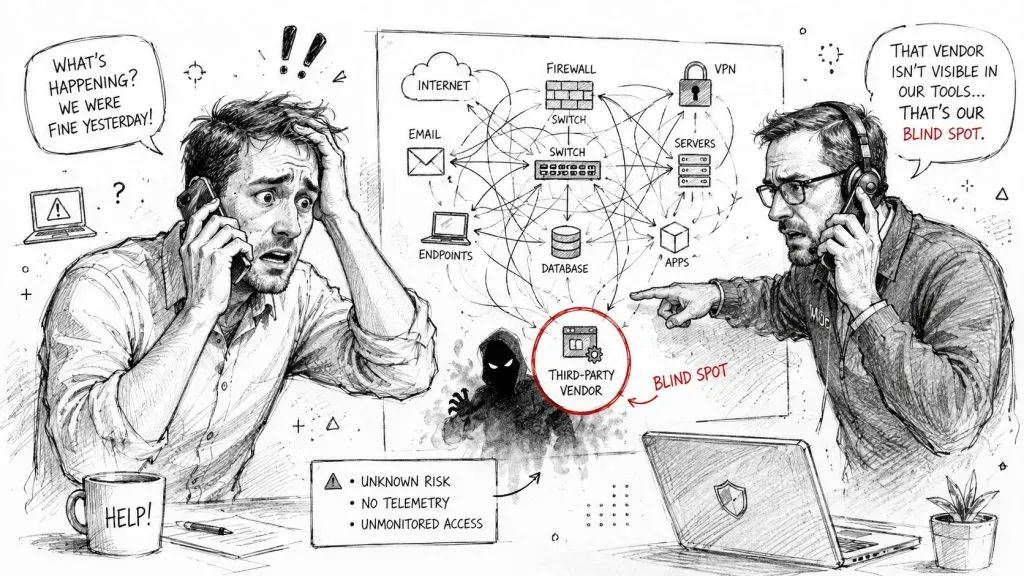
That’s why vendor risk assessment has to sit beside security operations, not underneath administrative paperwork. When a vendor touches identity systems, customer records, backups, collaboration platforms, or payment workflows, that vendor becomes part of your defensive boundary whether your client recognizes it or not.
A practical way to think about it is simple. Every third party adds access, data flow, dependency, and blast radius. If you’re already helping clients map external exposure, work like attack surface analysis should inform vendor reviews because the primary question isn’t whether a vendor exists. It’s how that vendor expands reachable risk.
The oversight problem most teams inherit
MSPs usually step into environments where vendor governance grew organically. Procurement owns contracts. IT owns access. Security owns incidents. Legal owns terms. Nobody owns the full chain.
That fragmentation matters. A vendor can look acceptable in one lane and still create material risk in another.
Practical rule: If no one can show who approved the vendor, what data it touches, and how its access is reviewed, treat that relationship as unmanaged risk.
For multi-client programs, visibility into downstream providers matters too. Public vendor transparency pages such as DPP Grid subprocessors are useful because they show how a single service relationship can extend into additional processors and infrastructure dependencies that aren’t obvious from the contract summary alone.
Vendor risk assessment, done properly, answers a short list of operational questions. What does this vendor access. What would break if it failed. What controls can you verify. What has to change before you trust it. That’s not bureaucracy. That’s basic survival for anyone responsible for client security outcomes.
Why VRA is a Service Not a Suggestion
Most MSPs don’t lose credibility because they missed an exotic zero-day. They lose credibility because a third party caused a preventable mess and nobody had a process for evaluating it. That’s why vendor risk assessment belongs in your service catalog. Clients may think they’re buying patching, monitoring, and compliance support. In practice, they’re paying for risk judgment.
Shadow vendors are already inside the environment
The biggest gap in many programs isn’t the known vendor with a messy questionnaire. It’s the unknown vendor that bypassed procurement entirely. According to Fraxtional’s vendor risk assessment analysis, shadow vendors account for up to 30% of third-party exposures in mid-sized enterprises, and 42% of 2025 supply chain breaches originated from unauthorized or shadow vendors.
Those numbers line up with what many MSP teams see on the ground. Business units subscribe first and inform IT later, if they inform them at all. Browser-based tools, file-sharing platforms, lightweight SaaS apps, and contractor-selected services often enter the environment without security review, contract terms, or monitoring.
That creates a service opportunity, not just a control gap.
Why clients need this from their MSP
Clients usually don’t have the staff to run a repeatable vendor review process across every department. Even when they have a compliance lead, that person often has authority over policy but not visibility into actual tool usage. MSPs can close that gap because they already see identity data, endpoint behavior, admin sprawl, cloud changes, and exposed services.
A good VRA service helps clients in ways they understand immediately:
- Reduce preventable exposure: You identify vendors with unnecessary access, weak evidence, or poor security fit before they become incidents.
- Improve purchasing decisions: Business owners can still move fast, but they do it with clear guardrails.
- Support compliance expectations: Regulated clients need documented third-party oversight, not just generic policy language.
- Strengthen resilience: A critical vendor outage, breach, or access issue stops being a surprise because the dependency was known in advance.
A mature VRA service doesn’t slow down procurement. It stops risky shortcuts from becoming expensive projects later.
What doesn’t work
The weak version of VRA is familiar. Send the same questionnaire to every vendor. File the answers. Renew the contract next year. That approach creates records, but not much reduction in risk.
What works is operational. Find unknown vendors through access reviews and app discovery. Tier vendors by exposure. Escalate high-risk cases into technical validation. Treat exceptions as tracked business decisions, not casual approvals in email. When you package VRA that way, clients don’t see it as another form. They see it as managed protection around their supplier ecosystem.
The Complete Vendor Risk Assessment Lifecycle
A strong vendor risk assessment program runs as a cycle. If it behaves like a one-time intake task, it will drift out of sync with how vendors operate, how clients change tools, and how access expands after the original contract.
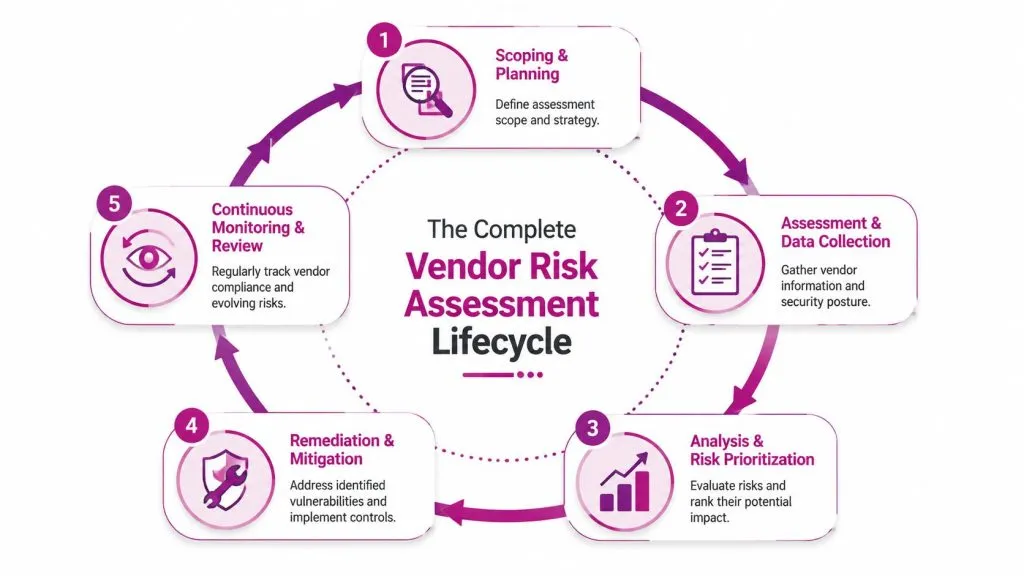
Mature programs now use risk-based continuous monitoring rather than relying only on annual questionnaires. As noted by Deepstrike’s vendor risk statistics overview, critical and high-risk vendors are assessed annually or after incidents, medium-risk vendors every one to two years, and low-risk vendors every two to three years. That model tiers vendors based on data sensitivity, access depth, and business criticality, and it extends validation into the operational exposure chain, including API integrations and cloud roles.
Start with scope, not forms
The first mistake teams make is jumping straight to questionnaires. Before you send anything, decide whether the vendor belongs in the program and how thoroughly it should be assessed.
Build a basic profile that answers:
- Business purpose: Why does the client use this vendor at all.
- Data exposure: Does it process sensitive records, regulated data, or internal-only information.
- Access level: Does it have user-level access, admin access, API tokens, or federated identity links.
- Operational dependency: If it fails, what client process stops.
- Compliance impact: Does the relationship affect audit scope, contractual commitments, or customer obligations.
This stage should also identify hidden complexity. A simple SaaS tool with no direct login can still pull data through integrations. A “read-only” tool can still expose sensitive reporting. A support vendor may have temporary admin access that was never deprovisioned.
Collect evidence that maps to real exposure
Once the vendor is tiered, gather evidence that fits the relationship. At this juncture, many programs either over-collect or under-validate.
For low-risk vendors, a lightweight review may be enough. For higher-risk vendors, you’ll want a package that can include security questionnaires, policy summaries, audit reports, architecture notes, incident response commitments, and proof that the controls in scope cover the service your client uses.
Good evidence collection focuses on specifics:
- Control scope: Does the vendor’s assurance material apply to the exact product and environment in use.
- Identity controls: How are admin accounts protected, reviewed, and removed.
- Data handling: Where does data move, who can access it, and how is it retained.
- Dependency visibility: Which subprocessors or external services support delivery.
- Operational readiness: What happens during outages, incidents, or material changes.
Don’t accept a polished trust page as evidence. Ask whether the control statement matches the product, tenant model, and permissions your client actually relies on.
Score risk so decisions become consistent
At this point, teams need a method, not a vibe. Scoring brings consistency across clients, assessors, and vendor types.
Use two lenses. One is inherent risk, which reflects the vendor’s role before mitigation. The other is residual risk, which reflects the position after available controls, contract terms, and remediation commitments are considered.
A practical scoring model usually includes:
- Severity of impact if the vendor fails or is compromised.
- Likelihood based on exposure, control strength, and dependency complexity.
- Confidence in the evidence provided.
- Gap weighting for issues such as missing control scope, weak access governance, or unverified subprocessors.
Fix issues before the contract locks you in
Assessment without remediation turns into recordkeeping. If the vendor presents unacceptable risk, address it before engagement or renewal.
Common remediation actions include narrowing access, requiring stronger authentication, updating data-handling terms, clarifying breach notification duties, demanding clearer evidence of control coverage, or adding cybersecurity SLAs and audit language to the contract. A thorough assessment should evaluate multiple vectors, including regulatory, operational, reputational, financial, and geographic risks, and use both quantitative and qualitative scoring so risks can be rated by severity and likelihood and remediated before engagement, as described in Panorays’ guide to vendor risk assessment.
Some vendors will push back. That’s normal. The point isn’t to win every argument. It’s to decide whether the business case justifies the residual risk, and if it does, whether leadership accepts that risk explicitly.
Monitor the relationship, not just the intake packet
The final stage is where mature programs separate themselves from checkbox exercises. Vendor risk changes after onboarding.
Watch for events that should trigger reassessment, such as:
- Ownership changes: Acquisitions, mergers, or private equity transitions.
- Service expansion: New modules, broader integrations, or increased data access.
- Security incidents: Breaches, credential exposure, or sustained outages.
- Access drift: Privileges expanding beyond the original approval.
- Subprocessor changes: New infrastructure or dependency shifts that alter exposure.
If you build the lifecycle this way, your program becomes scalable. Each client gets the same operating model, but the depth of work matches the actual risk.
Choosing Your Assessment Frameworks and Tools
Framework selection trips up a lot of teams because they assume there must be one correct questionnaire. There isn’t. The right framework depends on the vendor’s role, the sensitivity of the client relationship, and how much validation you need before making a decision.
Use the framework that fits the vendor
Start with the risk vectors that matter to the relationship. A thorough assessment should examine regulatory, operational, reputational, financial, and geographic risks, then apply quantitative scoring where hard evidence exists and qualitative scoring where expert judgment is needed. It should also establish acceptable thresholds by vendor tier and use contractual requirements such as security SLAs to enforce the result, as outlined in the earlier-cited Panorays guidance.
That means your tool choice should follow the risk profile.
A lower-risk software vendor might justify a short, standardized questionnaire plus contract review. A payroll processor or cloud platform needs deeper validation, stronger evidence requirements, and tighter decision controls. The mistake is using the heavyweight path for every vendor or the lightweight path for critical ones.
Common VRA Frameworks at a Glance
| Framework | Best For | Scope |
|---|---|---|
| SIG Lite | Lower-risk vendors and early screening | Shorter due diligence on baseline security and governance topics |
| SIG Core | Medium to high-risk vendors | Broader review of security, privacy, operational, and compliance controls |
| CAIQ | Cloud service providers | Cloud control validation aligned to Cloud Security Alliance control areas |
| SOC 2 review | Hosted services and SaaS providers with independent assurance | External attestation review of control design and operation within the stated scope |
| ISO 27001 control mapping | Vendors with formal ISMS programs | Management system alignment and control governance review |
| NIST 800-171 control mapping | Vendors handling controlled or sensitive data in regulated contexts | Detailed control expectations for protecting sensitive information |
What good tool selection looks like
Use frameworks as building blocks, not identity badges. A SOC 2 report doesn’t replace a questionnaire if the vendor’s scope is vague. A CAIQ doesn’t answer contractual questions. An ISO certificate tells you something about governance maturity, but not necessarily whether a specific integration is over-privileged in your client’s tenant.
For MSPs, standardization matters. You want a core intake model your analysts can repeat across clients, with escalation paths for higher-risk vendors. In practice, that often means a short baseline review for all vendors, then framework-specific depth based on the tier.
There’s a parallel here with AI suppliers and embedded model providers. If your clients are adopting AI-enabled vendors, governance questions expand beyond classic security review into accountability, usage constraints, and data-handling design. A practical AI governance roadmap is useful context when a “software vendor” also makes automated decisions or processes sensitive content in nontraditional ways.
The best toolset is the one your team can use consistently. Clear tiering, consistent evidence standards, and a documented exception path will outperform a bloated framework library every time.
Automating VRA with Your Security Stack
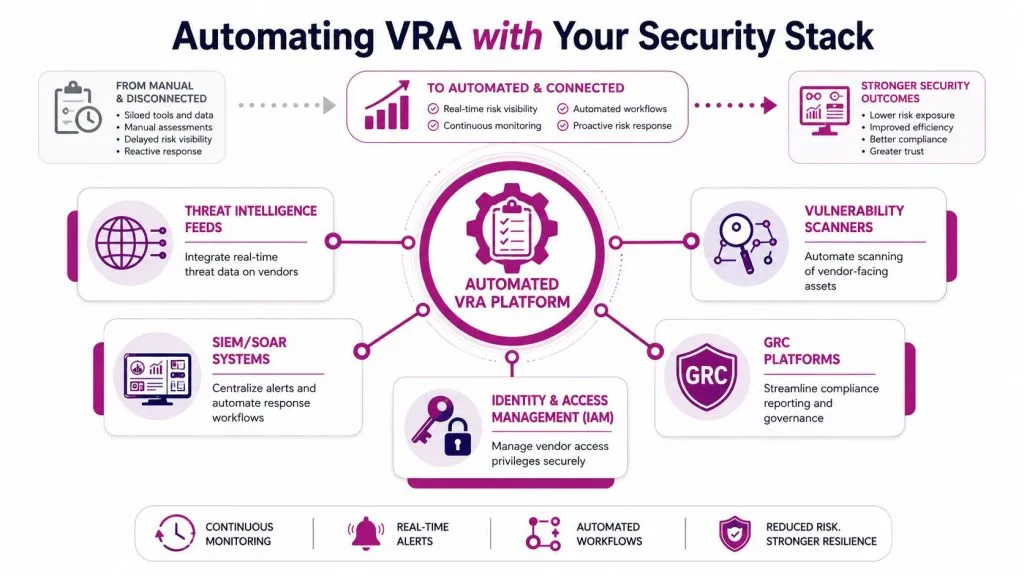
Manual vendor risk assessment breaks down when the program grows beyond a few strategic vendors. The issue isn’t effort alone. It’s separation. The questionnaire sits in one system, the contract in another, the IAM records somewhere else, and the technical signals live in scanners, SIEM tools, and external monitoring feeds.
Why spreadsheets break first
A spreadsheet can track vendor names, owners, and review dates. It can’t tell you when a vendor’s exposed assets changed, when a leaked credential appeared, or when a once-limited integration gained broader privileges.
That’s why automation matters. Not because automation replaces analysis, but because it feeds analysis with current signals. A vendor that claimed strong controls during onboarding may still present fresh risk if technical evidence points the other way.
Where automation actually helps
The most useful integrations are practical and narrow:
- Identity and access data: Validate which vendors have active accounts, privileged roles, service principals, or federated trust.
- Vulnerability and exposure data: Compare vendor-facing dependencies and connected assets against your broader external risk view.
- Threat monitoring: Watch for incident chatter, leaked credentials, impersonation, and other indicators tied to third parties. For credential exposure in particular, services like a dark web scan fit naturally into vendor monitoring workflows when a vendor holds shared accounts, admin credentials, or sensitive client data.
- Ticketing and GRC systems: Turn findings into owners, due dates, exceptions, and evidence trails.
- Contract repositories: Trigger reassessment before renewal, scope expansion, or material service changes.
Automation should verify vendor claims, not just remind you to ask for them again.
Fourth-party risk needs a trigger model
Fourth-party risk is where traditional VRA programs often become blind. The vendor looks fine on paper, but its own dependencies introduce exposure your client inherits without ever approving them directly.
According to Risk Insights Hub’s vendor risk assessment guide, only 15% of standard VRA questionnaires explicitly probe fourth-party dependencies, and organizations relying on annual audits miss 73% of critical risk shifts caused by events like ownership changes or new subcontractor engagements. That’s the strongest argument for event-driven reassessment you can make to a client.
A workable automation model watches for triggers such as vendor mergers, new subprocessors, product architecture changes, expanded integrations, and incident disclosures. When one of those events appears, the system shouldn’t just log it. It should reopen the vendor record, notify the owner, and force a scoped reassessment.
That’s how VRA becomes operational. It stops being a yearly memory test and starts behaving like a live control.
KPIs for a High-Impact VRA Program
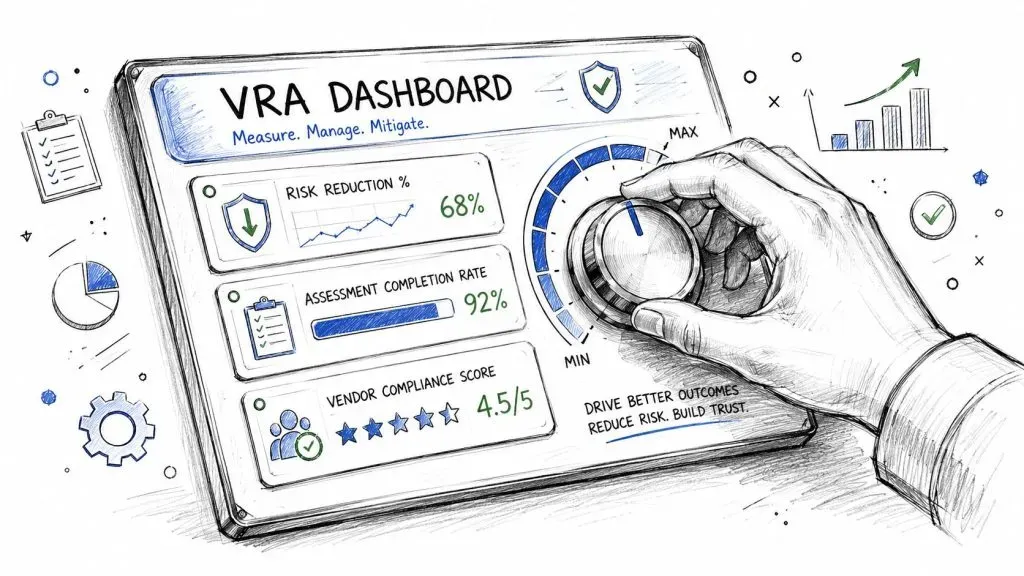
If you can’t show movement, clients will treat vendor risk assessment as overhead. The right KPIs fix that. They show whether the program is covering the right vendors, resolving the right issues, and reducing exposure in a way leadership can understand.
Track coverage, speed, and risk movement
Don’t overload the dashboard. A small set of metrics is usually enough if each one supports a decision.
Focus on measures like these:
- Critical vendor assessment coverage: Show whether the vendors with the highest client impact have current reviews on file.
- Time to complete initial assessment: Useful for balancing business speed against due diligence quality.
- Time to remediate high-severity findings: This tells clients whether identified problems are being fixed or just documented.
- Open exceptions by business owner: Good for governance. It shows where risk acceptance is accumulating.
- Reassessment backlog by tier: Helps you see whether the operating rhythm is keeping pace.
- Access reduction after review: A strong indicator that the program is changing real exposure, not just paperwork.
- Vendor incident correlation: Track whether security incidents involved vendors that were assessed, overdue, or unknown.
Build reports clients can understand
Most clients don’t want a wall of control language. They want to know which third parties matter, what changed, and whether unresolved risk is growing or shrinking.
A client-facing VRA report should answer:
- Which vendors are considered critical right now.
- Which ones have unresolved high-priority issues.
- Where contract renewals or access reviews are approaching.
- Whether new vendors entered the environment outside the expected process.
- What actions the client needs to approve or enforce.
Report risk in business terms first. “This vendor has privileged access to production backups and hasn’t completed required remediation” lands better than a control-family code.
If you already educate clients on external threat exposure, content similar to the benefits of dark web monitoring can help frame why ongoing third-party watchfulness matters after the assessment is complete. The KPI report then becomes evidence that your team is watching the vendor ecosystem, not just filing forms.
Moving from Assessment to Secure Partnership
The best vendor risk assessment programs don’t treat vendors as adversaries. They treat them as part of the security ecosystem. That shift matters because the goal isn’t to “catch” suppliers failing a questionnaire. The goal is to build relationships where expectations are clear, evidence is current, and risks are addressed before they become shared incidents.
For MSPs, that mindset is what makes the program scalable across clients. You aren’t creating a pile of one-off reviews. You’re building a repeatable operating model for vendor discovery, tiering, evidence review, remediation, and monitoring. That model helps clients make faster decisions with fewer surprises.
Begin with a narrower scope than might initially seem necessary. Tier the vendor list. Identify the vendors with sensitive data, privileged access, or operational criticality. Review those first. Then build outward. A focused program that gets used is better than an extensive program nobody can sustain.
Vendor risk assessment works when it connects directly to real-world outcomes. Less unmanaged access. Fewer hidden dependencies. Better renewal decisions. Faster incident response when a supplier problem appears. That’s not administrative overhead. That’s security work.
If you want to turn vendor oversight into a live security function, InsecureWeb gives MSPs and security teams practical visibility into external exposure, leaked credentials, dark web activity, impersonation risks, and internet-facing weaknesses that often surround third-party relationships. It fits especially well when you need to validate vendor claims with real-world signals and package that visibility into a client-ready service.