Data Breach News15 min read
Reputation Management on Social Media: A Practical Playbook
By InsecureWeb Team
This report reflects observations of dark web activity. InsecureWeb makes no representations regarding the accuracy of this data.
At 2 a.m., the on-call phone lights up because a fake executive account has started posting “updated guidance” to customers, and the screenshots are already moving faster than your team can delete them. By the time someone in marketing sees it, support is getting flooded, a sales rep has forwarded the post to a prospect, and nobody is sure whether the account is spoofed, compromised, or both. That’s the point where reputation management on social media stops being a branding task and becomes an incident.
The first mistake teams often make is treating social listening like a dashboard problem. The second is assuming the social manager owns the first hour. In practice, the first hour belongs to whoever can classify the threat, preserve evidence, and stop the story from mutating while the rest of the business wakes up.
Why Social Media Reputation Is Now a Security Problem
A few years ago, an ugly post on social media was mostly a comms headache. Now it can be the front edge of an impersonation campaign, an account takeover, or a broader trust failure that crosses into legal, support, and executive response. The threat surface is wider too, because people are watching tagged mentions, untagged mentions, executive names, fake support handles, hashtags, and adjacent industry chatter at the same time.
Pew’s data shows how quickly this changed. In 2010, 46% of online adults had created a profile on a social networking site, up from 20% in 2006, and 57% of adult internet users were already using search engines to look themselves up, up from 47% in 2006, which is a good proxy for how visible reputations had become online by then (Pew Research). The practical takeaway is simple, once people can continuously monitor one another, reputation stops being abstract and becomes searchable, replayable, and weaponizable.
The 2 a.m. problem is usually not a marketing problem
The alert rarely arrives as a neat “brand mention.” It shows up as a fake executive video, a repost from a look-alike account, or a burst of complaints that start repeating the same accusation across channels. By the time it reaches a general inbox, the details are already muddy.
Practical rule: if the post can influence customers, staff, regulators, or partners before business hours, it’s a security event as much as a reputation event.
That’s why security teams need to own the first classification pass. Marketing can shape the response tone, but security is better positioned to check whether an email domain has been reused, whether the account is part of a broader impersonation pattern, or whether credentials have leaked elsewhere. The work is closer to incident handling than to campaign monitoring.
The line between cyber and brand risk has mostly disappeared. A fake support account can harvest passwords. A deepfake executive clip can trigger panic among customers or channel partners. A compromised employee account can make a false statement look authentic long enough for the damage to spread.
The monitoring surface is bigger than most dashboards
Teams that only watch direct brand mentions are missing the most important warning signs. The noise often starts in indirect spaces, like customer complaints that repeat a phrase, competitor comparisons that suddenly turn hostile, or hashtag hijacks that attach your name to a wider controversy.
That’s also why single-platform thinking fails. Social platforms, review surfaces, forums, and off-platform signals all reinforce one another. If a brand only watches the obvious handle mentions, it will miss the early shape of a campaign and only see the aftermath once the story has escaped its original lane.
Setting Up Monitoring and Detection That Catches Threats
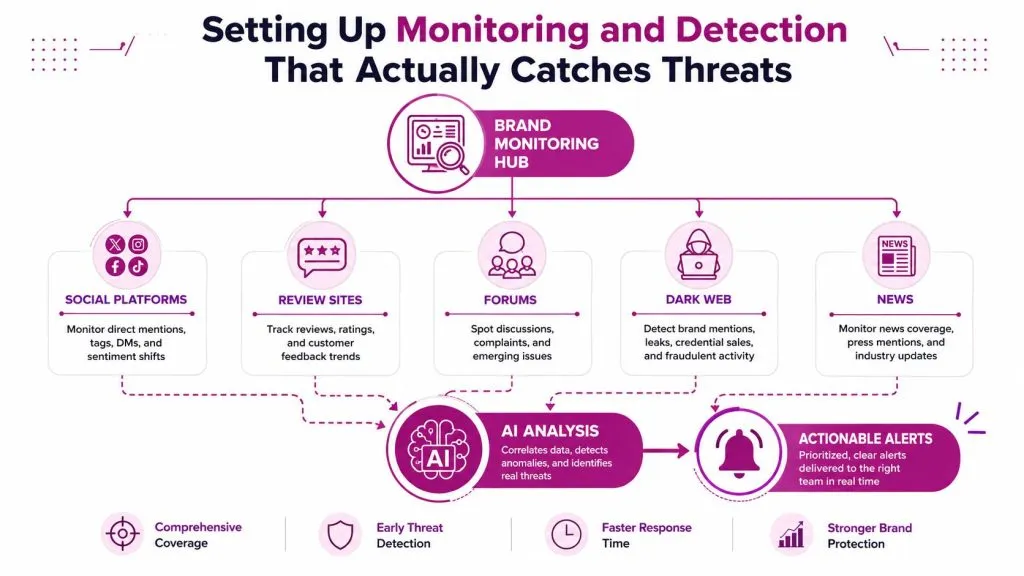
A useful reputation program starts with a wider net than most social teams build. Watch the brand name, product lines, executive names, common misspellings, campaign hashtags, and the words people use when they compare you with competitors. Include both tagged and untagged mentions, because the most damaging posts are often the ones nobody thought to address.
The fastest way to get this wrong is to let every alert behave the same way. A typo in a product review should not wake up the same people who handle a fake executive account. An impersonation burst should not sit in the same queue as routine customer feedback. Build the monitoring layer so it separates signal from clutter before anyone touches the reply button.
Build the listening surface in layers
Start with the obvious inputs, then add the ones that catch impersonation and abuse. Social platforms matter, but so do forums, review sites, news mentions, and dark web signals tied to your corporate email domains. Credential dumps can be an early sign that a social account takeover is coming, even before a suspicious post appears.
For teams that need a practical overview of tool categories, reputation monitoring tools for SMEs is a useful external reference point. It is not a substitute for a runbook, but it helps frame the difference between a lightweight listening setup and something security-aware.
A useful detection stack usually includes:
- Brand and executive watchlists, including common misspellings, nicknames, and product aliases.
- Impersonation checks, such as look-alike handles, fake support pages, squat domains, and fraudulent job posts.
- Dark web monitoring, especially for compromised credentials associated with your email domains.
- Adjacent keyword coverage, so you catch conversations that mention your business indirectly rather than tagging it directly.
For deeper context on the credential side, the internal dark web monitoring overview is the right place to connect reputation risk with broader threat intel.
Tune alerts for usability
A noisy alerting setup burns people out fast. If every mention is urgent, nothing is urgent. The better model is tiered, with real-time pings for high-severity events, daily digests for medium-priority items, and weekly trend reviews for lower-level chatter.
If a queue cannot tell the difference between a complaint and an impersonation attempt, it is not monitoring, it is a backlog.
Ownership matters just as much as signal quality. A 2 a.m. alert should already know who gets paged, who checks evidence, and who decides whether the case belongs with PR, legal, HR, or leadership. API ingestion helps because feeds can go directly into the tools your team already uses instead of sitting in a shared inbox waiting for someone to notice.
Triage, Evidence Capture, and Crisis Classification
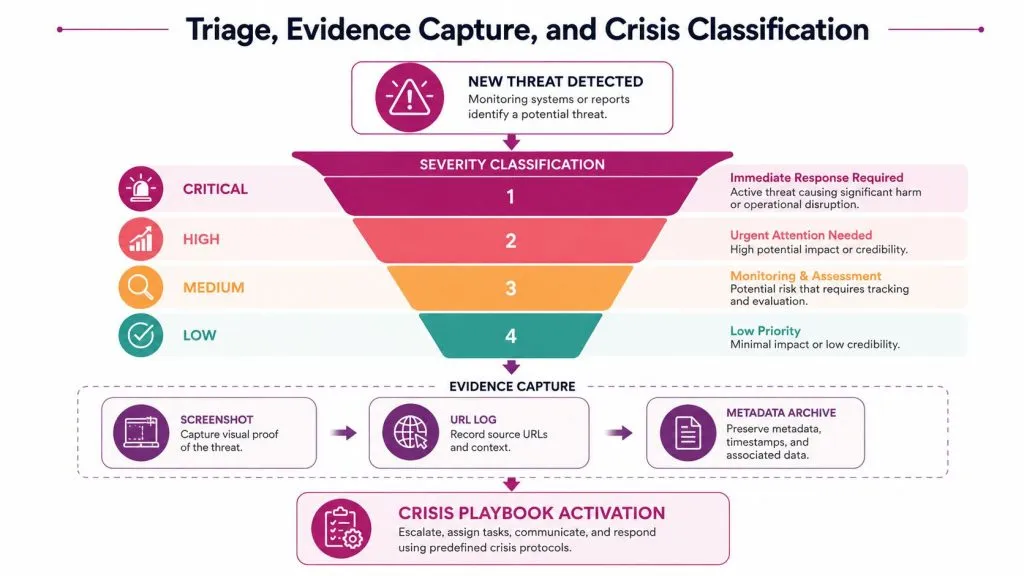
The first thirty minutes decide whether the post becomes a story or stays a footnote. The team has to classify what it’s looking at, preserve the evidence, and route the issue by severity before anybody fires off a generic apology or a defensive reply. That discipline matters because posts get edited, deleted, reposted, and screenshotted out of context.
A solid triage model is blunt, not clever. Classify the event as informational, complaint, coordinated attack, impersonation, regulatory, or executive threat. Then use that label to decide whether the case stays in social support or escalates into a formal crisis bridge.
Capture evidence before the reply
Evidence capture is a forensic step, not busywork. Save the original post URL, screenshots with timestamps, account metadata, engagement velocity, related claims, and any linked off-platform content before the platform changes the record. That habit saves arguments later, especially when an attacker edits or deletes the original content.
The workflow should be the same whether the threat is public embarrassment or a compliance issue. If the report is serious enough to move beyond routine support, the bridge needs a clean record of what happened, who saw it first, and what the post looked like at detection time.
The internal steps after a data breach page is relevant here because the discipline is similar, preserve facts first, then coordinate action.
Use a reply framework that avoids self-inflicted damage
A structured response helps responders stay calm under pressure. The common pattern is Hear, Empathize, Apologize, Resolve, Diagnose. In plain English, that means naming the exact issue, acknowledging the impact, promising a fix where appropriate, and capturing the root cause so the same failure doesn’t recur.
Practical rule: never reply with a statement that could have been copied and pasted under a different complaint.
Generic acknowledgments usually make things worse. Defensive language does too. If the post is false, the response still needs to be specific and calm. If the post is true, the response needs to show ownership and a path to resolution.
The escalation trigger is not just volume. Pull in legal when impersonation, trademark misuse, or regulatory exposure appears. Pull in HR when the post targets staff or executives. Pull in leadership when the issue is spreading across channels fast enough that the public story is outrunning the internal one.

Mitigation, Response, and Takedown Workflows
Once the case is classified and the evidence is secured, response speed starts to matter in a very practical way. A recent industry compilation says 63% of social media users expect brands to reply within one hour, 52% of customers expect businesses to respond to reviews within seven days, and businesses actively replying to reviews generate 12% more revenue than those that do not (Sci-Tech Today). Those numbers do not mean every issue needs a rushed reply, but they do show that silence has a commercial cost.
The mistake is treating speed as the only goal. A fast, vague response can look evasive, while a slower, accurate response can preserve trust if the team has already acknowledged the issue and set expectations clearly. Response time matters, and so do tone, credibility, and whether the reply helps the person on the other side.
Match the response to the platform and the abuse type
Different platforms demand different evidence packages. Impersonation reports often need screenshots, profile URLs, and proof of identity or trademark ownership. Deepfake content may require more context, especially when the account is newly created or the clip has already been mirrored elsewhere.
Use the platform’s reporting flow for the first step, then move to takedown or legal notices when the content crosses a threshold. That threshold is often obvious, trademark abuse, fake support pages, coordinated harassment, or manipulated media that targets executives. For MSPs and MSSPs, the practical move is to keep a standard packet ready so legal is not rebuilding it at 3 a.m.
The response tone matters as much as the form. Do not argue in public. Do not post a canned denial. Do not let a responder improvise. A controlled reply keeps the situation from becoming a debate, which is exactly what attackers want.
Treat takedown as a workflow, not a wish
Reporting is only one stage. Real mitigation can include platform trust-and-safety escalation, verified partner channels where available, and legal notices for trademark or copyright violations. If a fake executive video is spreading, the first-hour goal is not perfection. It is to contain the spread, preserve the chain of evidence, and keep the company from contradicting itself across channels.
A practical runbook for a deepfake executive video looks like this:
- Confirm the clip is synthetic or manipulated before public response.
- Preserve every version you can find, including reposts and captions.
- Classify the issue as impersonation, brand abuse, or a broader crisis if it is crossing channels.
- Notify legal and communications with a single evidence packet.
- Issue a holding statement only if the case needs breathing room while the facts are verified.
For teams that also need review management as part of the same operating motion, compliance reporting best practices are useful for keeping escalation records, sign-off paths, and auditability consistent.
The point is not to collect activity for its own sake. The point is to prove that response actions, takedown requests, and platform escalation are effective, because vanity metrics do not protect revenue or brand trust.
Prevention, Policy, and Pre-Incident Readiness
The cheapest incident is the one that never gets momentum. That starts with a social media policy that people can follow, not a document buried in a handbook. If executives, comms staff, and front-line responders don’t know who owns what, the response will fail before the first reply goes out.
Deepfake awareness training now belongs in executive and communications prep. So does basic social hygiene for high-profile staff, including MFA, app permission reviews, and recovery contact checks. A compromised account is still one of the fastest ways to turn a small issue into a reputational mess.
Pre-incident readiness is mostly boring work
The best teams maintain a content buffer so they can pivot the narrative quickly without waiting for new creative. They also run tabletop exercises before a real event forces everyone to learn the process under pressure. Those drills expose the weak links fast, especially around approval chains and who can speak publicly.
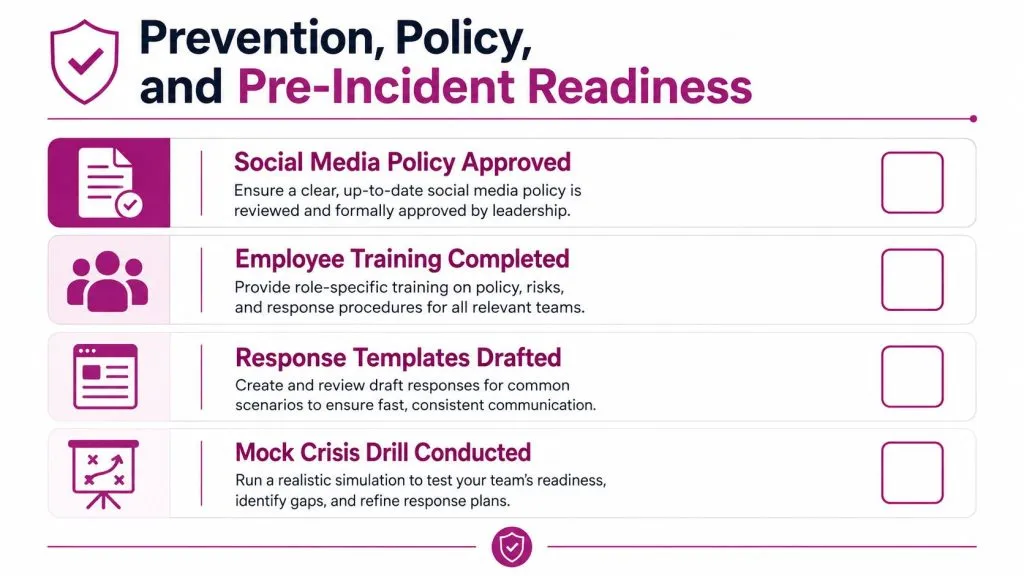
A prevention checklist should include:
- Policy approval, so everyone knows who can post, who can respond, and who can escalate.
- Employee training, especially for executives and client-facing teams.
- Response templates, with language that sounds human instead of canned.
- Mock crisis drills, because the first live incident shouldn’t be the first rehearsal.
Close the loop back into detection
Prevention isn’t separate from monitoring. Every real incident should feed new terms, new account patterns, and new escalation cues back into the watchlists. If a fake account uses a new naming trick this month, the monitoring layer should learn it before the next attacker copies the same move.
That’s also where registered trademarks, verified accounts, and pre-registered look-alike domains help. They won’t stop every attack, but they reduce ambiguity, which is often what attackers exploit first. The goal is to make impersonation harder, faster to spot, and easier to prove.
Measurement, Reporting, and Proving the Program Works
A hostile post lands, the inbox lights up, and the first question is not how many likes it got. The key question is whether the team saw it early, classified it correctly, and kept it from turning into a revenue problem or a brand trust problem. That is the standard for reputation management on social media.
Mention volume is not a risk metric. Follower growth is not either. A reputation program only earns trust when it shows faster detection, faster classification, better response choices, and less damage after a hostile post.
The cleanest reporting model splits metrics into leading indicators and lagging indicators. Leading indicators show whether the process is functioning. Lagging indicators show whether business impact is moving in the right direction. Both matter, but they answer different questions.
| Metric | Why It Matters | Target Benchmark |
|---|---|---|
| Time to detect | Shows whether the monitoring surface catches threats early enough to matter | Short enough to leave room for triage before escalation |
| Time to classify | Measures whether the team can separate noise from incidents without delay | Fast enough for the on-call owner to decide next steps during business hours or overnight |
| Time to respond | Shows whether the reply path holds up under pressure | Aligned to the severity of the event and the channel where it appeared |
| Takedown success rate | Tells you whether reporting, legal notices, and platform escalation are effective | High enough to justify the playbook and the escalation path |
| Sentiment shift after incident | Indicates whether the reply reduced confusion or amplified it | A trend back toward stability instead of repeated escalation |
For MSPs and MSSPs, client reporting works best when it is predictable. Weekly operational summaries keep the queue honest. Monthly trend reviews show whether the same patterns keep coming back. Quarterly executive readouts help leadership see risk reduction instead of raw alert counts.
The internal logic has to hold up outside the operations team too. If a client asks why an account was escalated, the answer should show what was seen, what was preserved, who approved the response, and what changed afterward. For a compliance-friendly format, compliance reporting best practices can help shape how findings are summarized, signed off, and retained without drowning the reader in operational noise.
A high-quality reply can outperform a rushed one when the issue is still developing and the audience needs clarity more than speed.
That is the part many playbooks miss. Speed matters, but a generic answer can lock the company into the wrong narrative. The right metric is not just how quickly someone answered, it is whether the answer changed the outcome.
Evidence quality matters here as much as response speed. If your reporting cannot show timestamps, screenshots, post URLs, account handles, and escalation notes in one place, the conversation gets messy fast. That is also why a dark web scan and other monitoring feeds should land in the same case record, so analysts do not have to reconcile separate logs when a complaint, impersonation attempt, or credential leak starts to overlap with a public incident.
For teams that run real programs, the report also has to answer one blunt question. Did the control set lower risk, or did it just create more dashboards? Vanity metrics make a team look busy. Decision-grade reporting shows whether the alert was caught, whether the evidence was preserved, whether the platform response worked, and whether the business avoided a worse outcome.
Tooling, API Integration, and Your First 90 Days
A workable stack usually has five parts, social listening, impersonation and domain monitoring, dark web credential and mention monitoring, deepfake and synthetic media detection, and a case-management layer that assigns ownership. The key is not collecting more alerts. It’s turning those alerts into a queue someone can run.
API-first integration is what makes that possible for MSPs and MSSPs. InsecureWeb helps protect businesses from online threats across the open internet, the dark web, and social media, including fake site and account detection, threat intelligence, and deepfake and reputation monitoring, with free API access to connect to existing tools. That matters because reputation signals are much more useful when they land in the same SIEM or SOAR workflows your team already handles.
A 30 60 90 day rollout that won’t collapse under its own weight
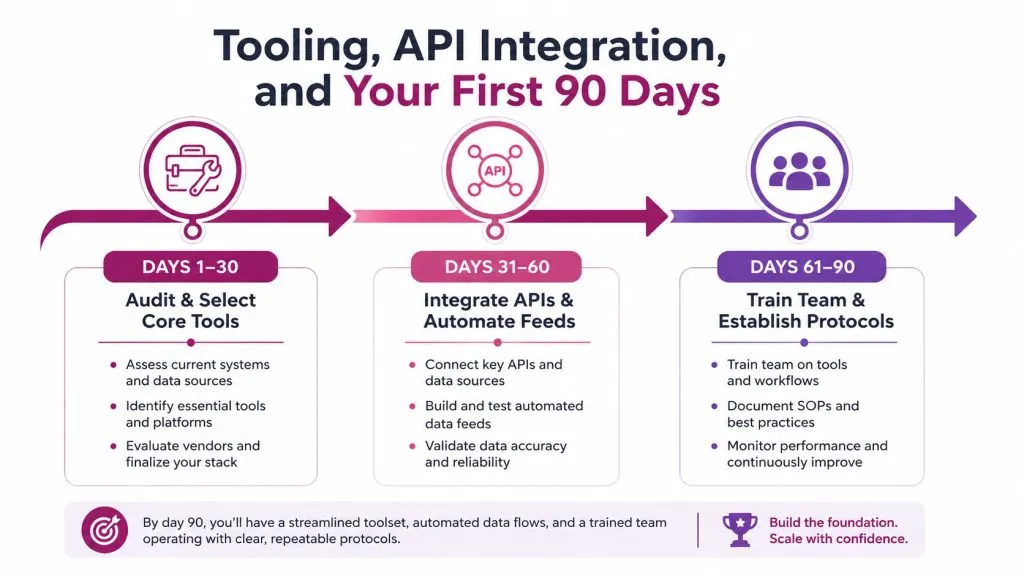
Days 1 to 30 should focus on the basics. Define the listening surface, stand up the evidence vault, build the severity labels, and write runbook version one. If the team can’t preserve a post cleanly or decide who owns it, the rest won’t matter.
Days 31 to 60 are for rehearsals and tuning. Run tabletop exercises. Trim false positives. Tighten the watchlists. Test what happens when a fake account, a review spike, and a dark web credential hit arrive close together. The goal is to see where handoffs break before a real incident finds the gap.
Days 61 to 90 should lock the reporting cadence and the client deliverables. That’s the point where MSPs and MSSPs can package the service into weekly summaries, monthly reviews, and a documented escalation workflow. If the stack is right, the output should feel calm, not noisy.
For tool selection and market comparison, the guide to monitoring your online reputation is a useful companion when you’re deciding what to keep in-house and what to integrate.
A short field FAQ
What about AI-generated impersonation? Treat it like any other high-severity abuse. Preserve the evidence, classify quickly, and route it to the right people before the clip or image spreads.
How should MSPs handle multiple clients? Separate watchlists, evidence stores, and escalation maps by client from day one. Shared tooling is fine, shared context is not.
How often should the playbook be audited? Quarterly works well for many organizations, especially when new impersonation tactics or platform changes show up.
For broader monitoring coverage, the internal dark web scan page fits naturally into a program that needs both reputation and credential visibility.
If you want a reputation program that behaves like a real risk function instead of a vanity dashboard, InsecureWeb is built for that operating model. It ties social, web, and dark web signals into monitoring and response workflows that MSPs and security teams can run. Visit InsecureWeb and start turning reputation alerts into evidence, ownership, and action.