Data Breach News14 min read
What Is Deepfake and How Businesses Can Defend Against It
By InsecureWeb Team
This report reflects observations of dark web activity. InsecureWeb makes no representations regarding the accuracy of this data.
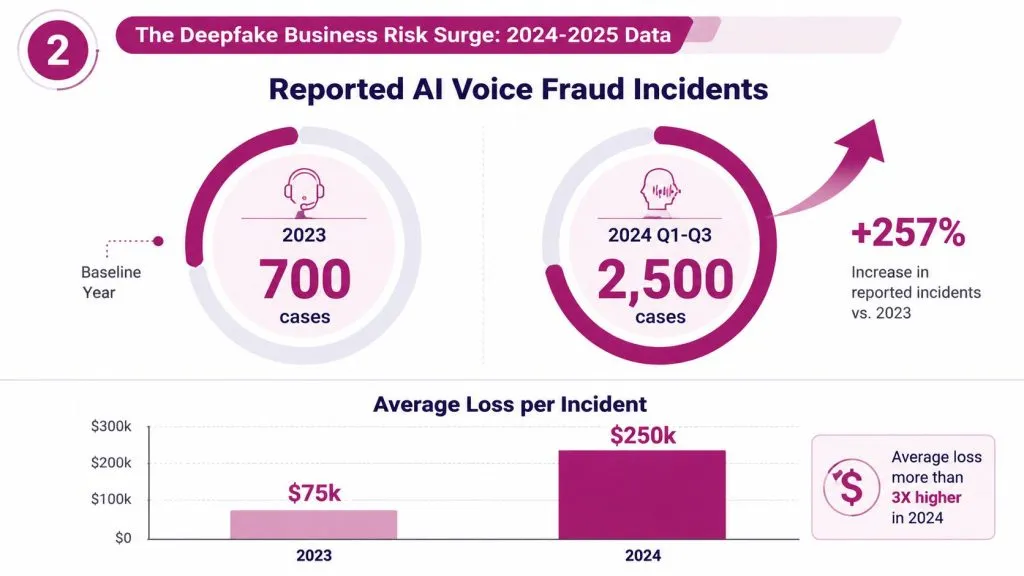
A deepfake is AI-generated or altered media that makes a person appear to say or do something they never did. In 2024, Entrust reported one deepfake identity attack every five minutes globally, while a Regula survey found that 49% of businesses had encountered video deepfake fraud.
Your client’s finance manager receives a video-call invitation from the CFO. The face looks familiar, the voice sounds right, and several “colleagues” appear on screen. The CFO asks for an urgent payment and says the normal approval process can follow later. For an MSP, this isn’t just a question of whether an employee can spot an artificial smile. It’s a failure of identity verification, payment controls, monitoring, and incident response.
What Is a Deepfake and How the Technology Works
A supplier’s finance contact joins a video call, with a familiar face and voice, then requests a payment outside the usual approval path. The media may be synthetic, but the business risk is operational: identity verification, payment controls, monitoring, and response all have to work together.
The word deepfake entered common use in 2017, after a Reddit moderator created a subreddit called “deepfakes” for sharing face-swapped videos using celebrities’ likenesses. That helped move synthetic media from an experimental technique into a recognized category of AI-generated manipulation, as documented by Britannica’s explanation of deepfakes.
A deepfake makes a real person appear to say or do something that never happened. Traditional editing might place a photograph in a different background. Deepfake systems alter or generate facial identity, expression, movement, voice, or the timing between audio and video. For an MSP, the same capability can affect executive calls, help-desk verification, onboarding, brand accounts, and payment instructions.
From source material to synthetic media
Deepfake production usually follows four stages:
- Data collection: An attacker gathers photographs, videos, interviews, public speeches, social posts, or recorded calls featuring the target. Varied material gives the system more information about appearance, voice, and behavior.
- Model training: An AI model learns facial structure, pronunciation, head movement, and expressions. Generative adversarial networks, or GANs, use one model to create synthetic content and another to judge whether it appears authentic. The generator improves in response to that criticism.
- Generation: The system produces a face, voice, or performance from an input such as another person’s video, a script, or an audio recording.
- Refinement: Software adjusts alignment, lighting, lip movement, timing, and edges. Compression and streaming may conceal remaining defects.
Facial reenactment shows why a basic filter is different from targeted impersonation. One person’s performance can drive another identity’s expressions, pose, or speech. That makes biometric identity relevant to businesses that treat a face as proof of access. Teams assessing how facial recognition affects safety should also consider whether the presented face is genuine.
MSPs can map these exposure points through attack surface analysis. Public executive videos, help-desk calls, onboarding recordings, social accounts, and payment workflows may provide training material or create an impersonation opportunity. Monitoring unusual login context, new payment instructions, account changes, and high-risk calls helps connect the synthetic-media problem to tools an MSP can configure and operate.
The technical category still matters. Entire face synthesis, identity swap, attribute manipulation, and expression swap change different evidence. An identity swap may retain the original lighting, pose, and background while replacing the person’s identity. Detection may therefore examine blending errors, warped geometry, lip timing, and movement across the recording, rather than relying on visible noise alone.
Consumer computing, large training datasets, and newer model architectures have made realistic synthetic content easier to produce. The pipeline used for entertainment filters and dubbing can also support a fraudulent call, fake executive announcement, or manipulated identity check. Detection helps, but independent verification and normal approval controls remain necessary.
The Four Families of Deepfake Manipulation
A useful way to answer what is deepfake is to separate the technology by what it changes. This helps an MSP decide which control should apply. A face-swap detector won’t necessarily identify a cloned voice, and a video verification process may miss a synthetic identity presented through an ordinary telephone call.
| Manipulation Type | Typical Inputs | Common Business Attack | Easiest Detection Gap |
|---|---|---|---|
| Entire face synthesis | Facial reference images, text or motion prompts, and model-generated features | A fabricated executive profile or social account promotes a fake investment or collects credentials | The reviewer trusts a convincing face and doesn’t verify the account through an independent channel |
| Identity swap | Source video, target photographs or video, facial landmarks, and lighting information | An attacker places a senior employee’s face on another person during a payment call | The meeting appears familiar, but the payment request bypasses the company’s normal approval path |
| Attribute manipulation | Existing image or video plus instructions to change age, hair, expression, clothing, or other traits | A fraudster alters an applicant’s appearance or changes an executive’s apparent condition in supporting media | Staff focus on the document or narrative and overlook changes in the underlying identity evidence |
| Expression or facial reenactment | Target face, driving performance video, audio track, and facial movement data | A fake CFO appears to speak naturally while an attacker supplies the script or request | Human reviewers accept synchronized speech and don’t challenge an unusual request |
| Voice cloning and audio-visual editing | Public speeches, calls, podcasts, text scripts, and background sound | A cloned CEO voice asks finance staff to send funds or disclose information | Telephone workflows provide no visual context, and urgency discourages a callback |
Why the input determines the control
Face swaps generally require a target identity and a source performance. In a business setting, the attack can slip through during a video meeting because staff recognize the face and assume the rest of the call is genuine.
Expression swaps alter how an existing face moves. A criminal may use an authentic-looking video feed while changing the spoken content or controlling the performance. The weak point is usually the request itself, especially when the speaker demands secrecy or a departure from established procedure.
Voice cloning targets the auditory assumption that a familiar voice equals a verified person. Public earnings calls, interviews, voicemail greetings, and customer recordings can provide useful material, but the defense doesn’t depend on identifying every synthetic waveform. A known-number callback and a second approver are stronger controls.
Full-body synthesis and broader audio-visual editing can create or alter posture, gestures, background participants, and environmental sound. These attacks are harder to evaluate when a meeting is busy, the connection is compressed, or employees are already expecting a fast decision.
Practical rule: Treat voice and video as signals, not authorization. Authorization should come from a separate, documented process.
Why Deepfakes Became a Business Risk Overnight
Deepfakes became a business problem when attackers started using synthetic identity as an operational layer across ordinary workflows. A fraudulent caller doesn’t need to compromise the accounting platform if a convincing voice persuades an employee to change a bank detail. A fake video doesn’t need to fool every person online if it convinces one employee during a pressured meeting.
The available incident data shows that this threat has moved beyond political misinformation. In 2024, Entrust reported one deepfake identity attack every five minutes globally, and its analysis found that deepfakes represented 40% of video biometric fraud attempts. Regula’s 2024 survey reported that 49% of businesses encountered video deepfake fraud, compared with 29% in 2022. These figures are summarized in FluxForce’s documented deepfake fraud incident data.
Three business surfaces deserve attention
Inbound calls are attractive because many help desks and finance teams still use conversational trust as an informal identity check. A familiar voice can pressure a technician into resetting access, changing a recovery address, or disclosing internal information.
Video identity workflows create a stronger impression of authenticity but can also create false confidence. A face that moves naturally may still be synthetic, and a successful liveness check doesn’t prove that the person has authority to perform a transaction.
Executive communications carry unusual weight. Employees may hesitate to challenge a senior leader who asks for confidentiality, speed, or an exception to the normal process. Attackers exploit hierarchy as much as they exploit AI.
The scale of reported harm is also difficult to measure. One 2025 threat report states that more than 80% of incidents did not disclose losses, while disclosed losses still exceeded $1.28 billion. The same report describes brand and reputation attacks, scams, and fraud as major real-world harms, not merely content-authenticity disputes, according to Resemble AI’s 2025 Deepfake Threat Report.
A separate global dataset reported $1.1 billion in deepfake-related fraud losses in 2025, while the FBI’s 2025 Internet Crime Report introduced an AI-related fraud category containing 22,364 complaints and $893 million in losses. The FBI warned that this figure is an undercount because investigators often can’t identify AI involvement when victims first report an incident, as described in the published 2025 Deepfake Threat Report.
For an MSP, the consequence is clear. A deepfake can trigger financial loss, customer confusion, reputational damage, and regulatory questions at the same time.
Real-World Deepfake Incidents MSPs Should Know
The most useful incident examples aren’t spectacular videos circulating online. They’re ordinary business interactions where a synthetic identity gains trust long enough to move money or information.
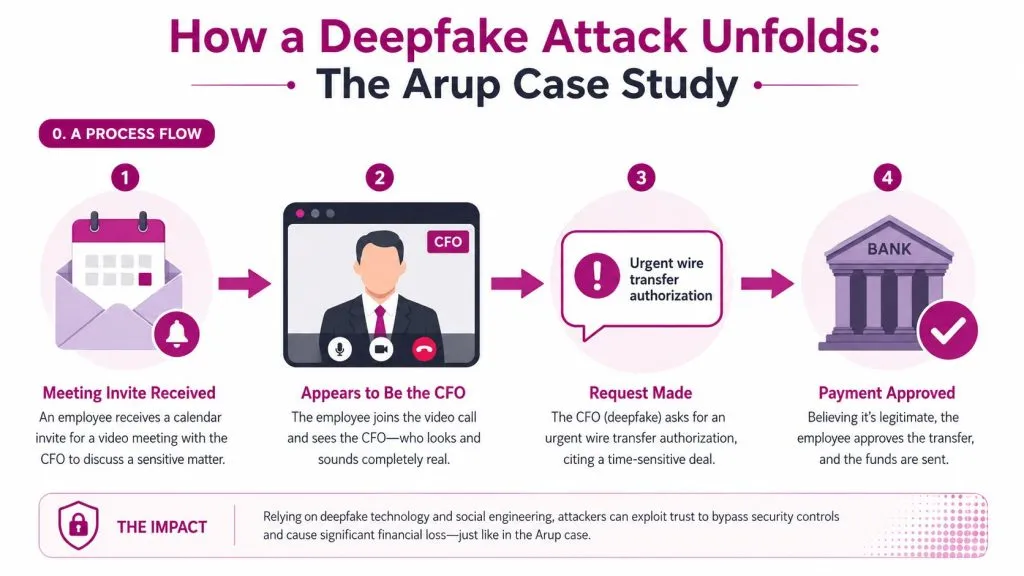
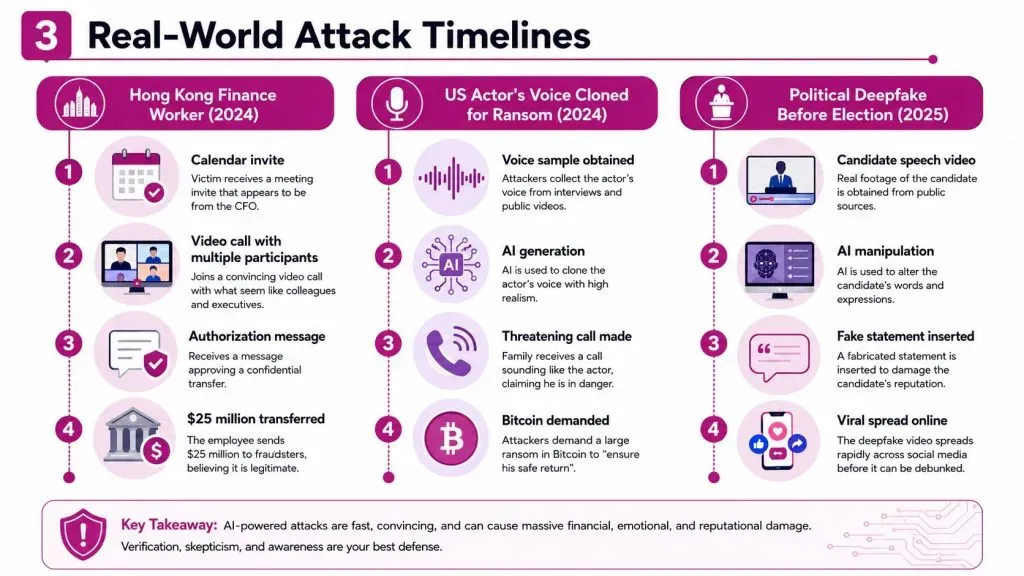
In the 2024 Arup Hong Kong incident, a finance worker joined what appeared to be a video meeting with the company’s chief financial officer and other participants. The meeting created a familiar corporate setting, then moved toward a payment authorization request. The reported loss was approximately $25 million. The failure wasn’t that the employee missed an AI artifact. The organization treated a video meeting as sufficient proof of identity and authority.
Controls that could have interrupted the sequence include an independent callback to a known number, dual approval for an unusual transfer, and a policy that forbids payment authorization based only on voice or video.
The voice-clone pattern
A voice-clone attack may start with public audio from an earnings call, conference appearance, podcast, or interview. The attacker creates a synthetic voice, contacts a finance employee, establishes urgency, and asks for a transfer or sensitive action. The employee may never see a suspicious attachment, malicious domain, or unusual login.
The failure point is often procedural. If the company has no requirement to call the executive back through a trusted number, the employee must make a judgment based on audio alone. A shared phrase, second approver, and separation between request and execution can reduce that dependence.
Brand and customer impersonation
A synthetic executive video can also appear on a social platform, claiming to offer an investment, product promotion, or customer support process. The attacker’s goal may be to move a stock price, collect credentials, redirect customers to a fraudulent site, or damage the company’s reputation.
MSPs should monitor these incidents as external threats, not only as content moderation problems. Dark-web monitoring for managed service providers can complement social and domain monitoring when stolen recordings, credentials, or attack planning appear outside the client’s normal channels.
This video provides additional context on how deepfake-enabled attacks can unfold:

How Deepfake Detection Works and Where It Falls Short
A detection system is closer to a fraud analyst comparing several clues than to a simple authenticity stamp. It may look for synthetic artifacts, including uneven edges, unnatural blinking, lip-sync errors, facial warping, and generation-related noise. These clues work best when the original recording is clear and compression has not erased the evidence.
Another layer examines biometric and physiological behavior. A system can compare gaze, facial geometry, ear shape, blink timing, skin-tone changes linked to pulse, and remote photoplethysmography signals. A convincing face may still move or change in ways that do not match a live person. Image quality, camera angle, and health conditions can make these signals unreliable.
Multimodal machine learning combines evidence instead of judging a single frame. A model may compare visual embeddings, audio spectrograms, timing, metadata, and physiological cues. Research surveys describe these methods and note that input quality and real-world conditions affect performance, as explained in the survey of deepfake detection methods.
| Detection Method | What It Analyzes | Strengths | Known Weaknesses |
|---|---|---|---|
| Artifact analysis | Pixels, edges, blending, compression noise, facial geometry, and temporal inconsistencies | Fast and useful for visible manipulation clues | Compression, resizing, poor lighting, and new generation methods can remove or hide artifacts |
| Biometric analysis | Blinking, gaze, pulse-related skin changes, ear shape, and movement | Adds signals that are harder to reproduce consistently | It needs suitable image quality and can create false positives with unusual camera angles or health conditions |
| Audio analysis | Spectrograms, pronunciation, cadence, breath patterns, and background sound | Helps identify cloned or altered speech | Telephone compression and short samples reduce available evidence |
| Multimodal models | Audio, video, timing, metadata, and context together | More resilient than relying on one signal | Scores can vary by dataset and manipulation family, and attackers can adapt to published detectors |
Why benchmark confidence can mislead
Deepfake detection is still heavily shaped by benchmark testing. DeepfakeBench brought together 15 state-of-the-art detection methods, 9 datasets, and standardized evaluation metrics to address reproducibility problems, according to the DeepfakeBench research paper. These resources help researchers compare systems. They do not guarantee accurate results on a compressed video call, a noisy phone recording, or a manipulation absent from the training data.
Technical research separates deepfakes into several manipulation families because each one leaves different traces and calls for different detection features. The technical classification of facial manipulation methods explains why a detector trained on one category may miss another.
A detector can also produce a useful warning without proving fraud. Attackers can adapt to public models, while streaming compression may strip away artifacts. A real-time call may expose little spatial detail and limited metadata, leaving the system with weaker evidence.
A detector score should change the level of scrutiny. It shouldn’t decide whether money moves.
For MSPs, detection belongs in the monitoring and response stack as a risk-reduction layer. Route high-risk alerts into the ticketing or security workflow, preserve the original recording and related metadata, and correlate the event with account, endpoint, domain, and transaction activity. The tool can prioritize investigation. Identity proofing, approval controls, and human escalation must determine the business response.
A Practical Defense Playbook for MSPs and SMB Teams
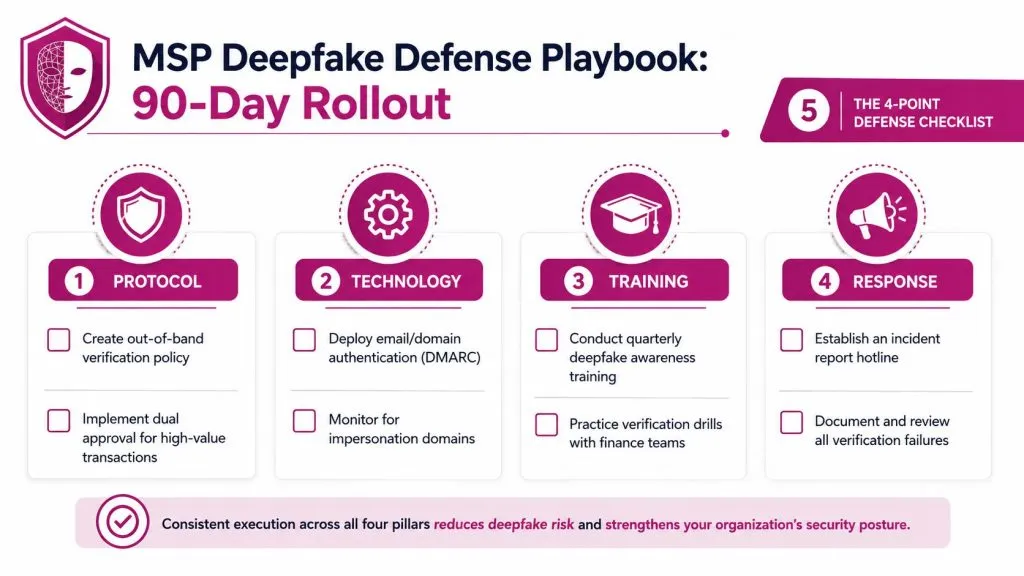
The most effective defense starts before an employee receives a suspicious call. An MSP can turn deepfake risk into a managed control by defining which actions require independent verification, monitoring external impersonation, and rehearsing the response.
Establish a verification protocol
Write a short rule that applies to voice, video, chat, and email. Any request to move money, change payment details, reset credentials, hire someone, or disclose sensitive information must be verified through a separate channel.
A workable protocol should require:
- Known-number callbacks: Call the requester using a number already stored in the company directory, not a number supplied during the suspicious interaction.
- Dual approval: Require a second authorized person for unusual or high-impact requests.
- Shared phrases: Use a pre-established phrase for sensitive conversations, while remembering that a phrase alone doesn’t replace independent confirmation.
- Documented exceptions: Record who approved the exception, how identity was verified, and why normal controls were bypassed.
Train finance, help-desk, executive-assistant, and HR teams together. Employees should practice ending a suspicious call without confrontation, reporting the event, and preserving the original message, meeting invitation, phone number, account handle, and payment instructions.
Monitor the external attack surface
A synthetic impersonation often appears first on a social account, lookalike domain, messaging profile, or leaked-data marketplace. Use brand monitoring to identify fake executive accounts and fraudulent content. Use dark-web monitoring to find exposed credentials or recordings that could support cloning. Keep domain and account alerts connected to an escalation process, so an analyst knows who can request a takedown and who must notify the client.
InsecureWeb provides deepfake and reputation monitoring alongside dark-web monitoring, fake-site and fake-account detection, threat intelligence, vulnerability scanning, and AI-guided penetration testing. Its dark-web scanning capability can fit into an MSP workflow that already tracks exposed client data.
Respond as a fraud and security incident
When an alert arrives, triage the request and preserve evidence before contacting the suspected account. Capture the original media, URL, timestamps, account identifiers, email headers where available, payment instructions, and internal approval records.
Then:
- Stop the transaction: Contact the bank or payment provider through an established fraud channel.
- Contain access: Reset credentials and review help-desk changes if the attacker requested account or recovery modifications.
- Report and remove: Report fake accounts, domains, and media to the relevant platform, registrar, hosting provider, or law-enforcement contact.
- Review the workflow: Identify where an employee relied on voice or video as authorization.
- Update controls: Turn the failure into a new verification drill and an amended procedure.
A detector may help prioritize the response, but the playbook must still work when no detector can reach a confident conclusion.
Legal, Ethical, and Compliance Considerations
Deepfake law remains a patchwork. Different jurisdictions may focus on election deception, non-consensual intimate imagery, impersonation, consumer fraud, or transparency for AI-generated content. The EU AI Act, for example, includes disclosure duties for certain artificially generated or manipulated image, audio, and video content that qualifies as a deepfake, subject to exceptions, as summarized in the Debevoise Data Blog discussion of AI-generated content and deepfakes.
The practical compliance question isn’t only whether a clip is technically synthetic. Ask whether it deceptively portrays an identifiable person, whether that person consented to the use of their likeness or voice, and whether the content could cause harm. A company using an approved synthetic avatar for accessibility or training still needs clear limits on reuse, disclosure, storage, and access.
Security teams should also clarify:
- Identity assurance: What evidence is required before a payment, credential change, or onboarding decision?
- Disclosure: How will the business label authorized synthetic marketing, training, or support content?
- Incident handling: Who evaluates legal, privacy, fraud, communications, and regulatory consequences when an impersonation succeeds?
- Vendor governance: Does a voice, video, KYC, or communications vendor document consent, provenance, retention, and abuse controls?
- Evidence preservation: Can the business retain the original media and relevant logs without altering the evidence?
Ethically, the same tools can support legitimate dubbing, accessibility, education, and controlled fraud simulations. The risk begins when a person’s identity is reused deceptively, without consent, or outside the purpose for which it was approved. A mature policy protects both innovation and the right of employees, customers, and executives not to have their likeness weaponized.
This week, assign an owner for deepfake incidents, draft an out-of-band verification policy, train finance and help-desk staff, review executive media exposure, check vendor safeguards, and enroll high-risk brands and leaders in impersonation monitoring. Those steps create practical resistance without requiring employees to become forensic video analysts.
InsecureWeb helps MSPs monitor deepfake and reputation threats, fake sites and accounts, dark-web exposure, and other external indicators that can support impersonation attacks. Visit InsecureWeb to evaluate how its monitoring and threat-intelligence capabilities can fit into a managed defense service for your clients.