Data Breach News14 min read
Cybersecurity Threat Detection for Modern Security Teams
By InsecureWeb Team
This report reflects observations of dark web activity. InsecureWeb makes no representations regarding the accuracy of this data.

CrowdStrike said the average eCrime breakout time fell to 29 minutes, and the fastest-ever breakout time reached 27 seconds in its 2026 threat report cycle. That is the backdrop for cybersecurity threat detection today. If attackers can move that fast, MSPs and security teams cannot treat detection as a monthly review task, they need layered monitoring that catches small signals before they turn into client-wide incidents.
The hard part is that the signals are getting quieter, not louder. In the same threat-report cycle, CrowdStrike said 82% of detections in 2025 were malware-free, which means many intrusions used legitimate tools, credentials, or hands-on activity instead of an obvious malicious file. That is why detection now has to look for behavior, exposure, and identity misuse, not just bad binaries. A practical guide for leaders who need a broader security baseline is the CEFCore guide to cyber security for CEFs, which fits well with the operational mindset MSP teams need.
The Modern Case for Cybersecurity Threat Detection
A client doesn’t usually call because a threat was “in progress.” They call after email accounts get used for fraud, after a remote desktop session appears at the wrong hour, or after a cloud login comes from a device nobody recognizes. That’s why cybersecurity threat detection is no longer a background control, it’s the part of security that decides whether the rest of the stack gets a chance to work.
The scale problem is just as important as the speed problem. Fortinet reported that active scanning in cyberspace rose 16.7% worldwide in 2024, and its labs saw billions of scan attempts each month, equal to about 36,000 scans per second Fortinet threat landscape report. That means exposed services and weak points are being probed constantly, long before a client’s staff notices anything unusual. Security teams are not waiting for a single dramatic breach event anymore, they’re filtering a constant stream of suspicious activity.
For MSPs, that changes the job. Detection is less like checking locks at the close of business and more like watching a building’s sensors while people move in and out all day. The team that wins is the team that can tell noise from real danger quickly enough to act.
Practical rule: if a client environment has no clear way to triage alerts, it doesn’t really have detection, it has accumulation.
That is the shift modern teams need to make. Detection has to be layered, automated, and tuned for real operations, because a system that only works after a breach report is just a record-keeping tool. For teams building out that mindset, the operating model behind attack surface analysis matters because exposed services and misconfigurations are often the first things attackers test.
What Cybersecurity Threat Detection Really Means
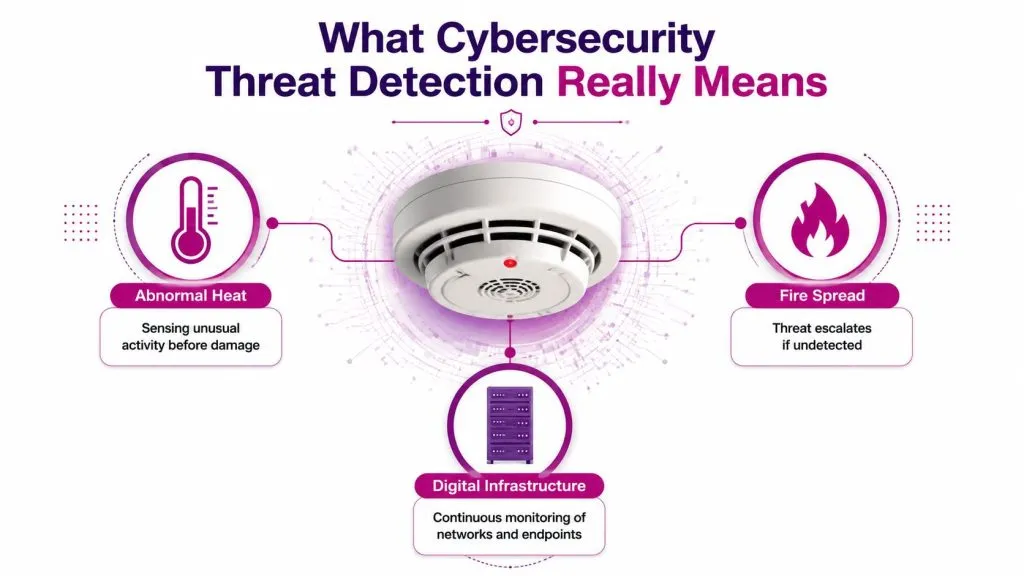
Cybersecurity threat detection works like a smoke alarm for digital infrastructure. A smoke alarm does not wait for a room to burn down. It senses abnormal heat or particles, then warns people before the damage spreads. Good detection follows the same logic, it watches for unusual behavior, risky exposure, and odd combinations of events that suggest trouble is starting.
From signatures to behavior
Older antivirus thinking depended on signatures, which is like identifying a known burglar by face alone. That still catches some threats, but it misses a lot of modern activity because many attacks do not look like malware at all. CrowdStrike said 82% of detections in 2025 were malware-free, so defenders often have to identify suspicious behavior instead of a bad file CrowdStrike global threat report.
That matters because attackers usually try to blend in. If someone uses legitimate tools, stolen credentials, or normal admin channels, file-based detection may stay quiet. Behavior-based monitoring asks different questions, such as whether a login, process, or device pattern fits what is normal for that user and that environment.
What the alarm is watching
A clear way to explain detection to nontechnical stakeholders is to break it into three parts.
- Signals: logs, endpoint events, cloud activity, identity events, and network flows.
- Analysis: rules, correlations, baselines, and anomaly logic that turn raw data into meaning.
- Response: alerts, escalation, containment, and follow-up investigation.
The alarm is only useful if someone can trust it. If it screams too often, people ignore it. If it stays silent too long, the fire spreads. Modern detection sits in the middle, trying to catch the right abnormal patterns early enough to matter.
Blind spots are where this gets harder. Encrypted traffic, cloud services, shadow IT, scattered identities, and multihomed devices can hide the very signals teams expect to see. In those environments, the question is not whether telemetry exists. The question is whether the team can still see enough of the path to spot abnormal behavior and decide what to do next.
Why speed changes the meaning of detection
CrowdStrike also reported a fastest-ever breakout time of 27 seconds in the same 2026 report cycle CrowdStrike global threat report. That is a hard reminder that detection cannot depend on long analyst delays or once-a-day review windows. For MSP teams, the useful question is no longer “Did we get an alert?” It is “Did we detect meaningful behavior early enough to contain it?”
Real detection value shows up here. Marketing coverage claims may say a platform watches everything, but operators need to know whether it can surface activity inside encrypted sessions, across cloud accounts, and on devices that move between networks. If those blind spots stay hidden, the alert count goes up while actual awareness stays low.
Comparing Cybersecurity Detection Approaches
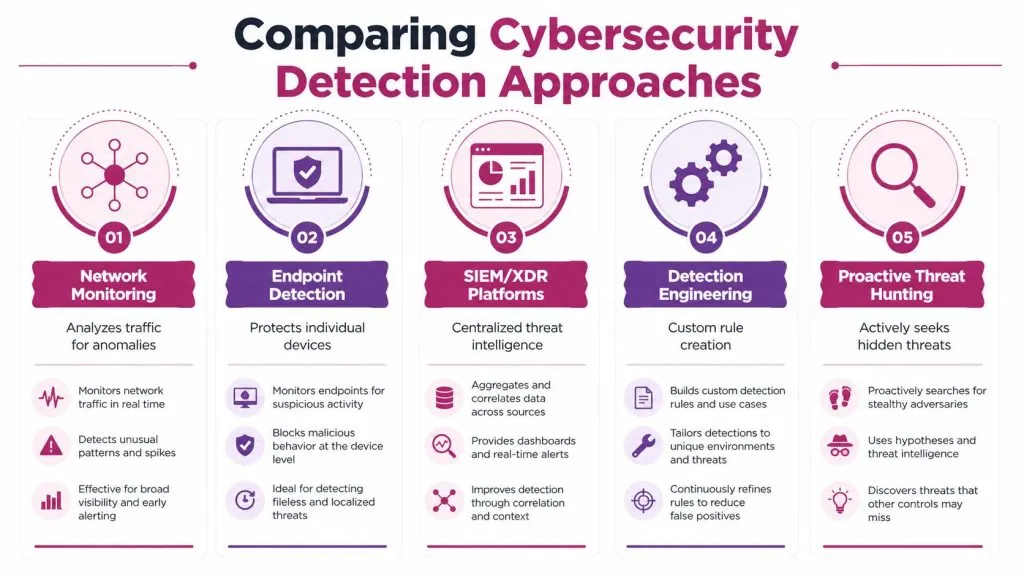
Different detection approaches solve different parts of the problem, and MSPs usually need more than one. Network monitoring sees traffic patterns, endpoint detection watches device behavior, SIEM and XDR platforms centralize telemetry, detection engineering creates custom logic, and proactive threat hunting looks for what automated systems missed. None of these gives a complete answer on its own, because each one sees a different slice of the same incident.
Where each approach helps
Network monitoring is strongest when you need to spot unusual movement across a client’s infrastructure, especially lateral movement or odd outbound connections. It works best when the network path is visible enough to study. Endpoint detection is better for seeing what happens on laptops, servers, and workstations, which matters when an attack stays local or never creates a clear network signal. SIEM and XDR platforms bring evidence together, which helps when one event looks harmless until it is correlated with other activity.
Detection engineering and threat hunting do a different job. Detection engineering builds the logic, while threat hunting tests the environment by actively looking for hidden activity. That makes both approaches useful in hybrid environments where blind spots are part of normal operations, not rare exceptions.
Where the blind spots show up
A 2022 enterprise monitoring study identified seven major blind spots, including encryption, cloud services, shadow IT, scattered identities, multihomed devices, and nonenterprise IT enterprise monitoring study. Those are the places where a simple “we monitor network and endpoint” story breaks down. If traffic is encrypted, the network layer may see very little. If work happens in cloud services or on unmanaged devices, the endpoint view can also be incomplete. For MSP teams, the practical question is whether the monitoring stack still exposes enough of the path to show abnormal behavior and guide the next action.
Detection quality drops fast when the environment is uneven. A strong tool in a blind spot is still a blind spot.
That is why checklist thinking causes problems. Buyers often ask whether a product “covers ATT&CK,” but coverage by itself can be misleading. A 2024 USENIX study found that ATT&CK coverage across four widely deployed endpoint detection products was inflated by low-risk rules and that vendors classified the same underlying behavior inconsistently USENIX security study. MSPs should ask a better question. Which techniques matter most, how noisy are the detections, and does the product catch high-impact activity in the client’s real environment? The answer matters more than a broad coverage claim.
A simple decision rule
Use network monitoring when traffic visibility is strong. Use endpoint detection when device control is strong. Use SIEM or XDR when you need correlation across sources. Use detection engineering when the client has repeatable risks that need custom logic. Use threat hunting when you suspect the telemetry is not telling the whole story.
For most MSPs, the goal is not choosing one approach and stopping there. It is building a mix that reduces blind spots without flooding the team with alerts. That mix should also account for the parts of the environment that are hard to see, including cloud services, encrypted traffic, and devices that move between networks.
Attack surface analysis helps here because it shows where those blind spots are most likely to matter, and where detection work should start. Attack surface analysis for MSPs gives teams a practical way to decide which assets, identities, and connections deserve closer watching.
Building Detection Architecture and Measuring Success
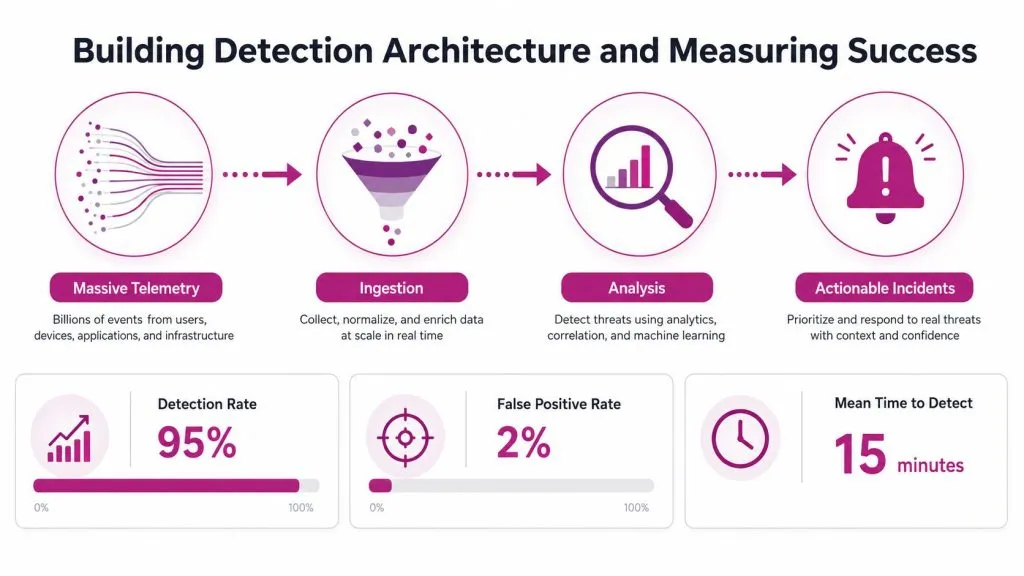
Detection architecture has one job, turn a flood of telemetry into a small number of actions a human can trust. A security team can have logs from endpoints, cloud services, identity platforms, and network devices, yet still miss what matters if the signals are not organized well. The challenge is not a lack of data, it is finding the few events that point to a real incident.
A useful way to judge that problem is to ask whether the stack can surface what operators cannot see directly. Encrypted traffic can hide payloads, cloud services can spread activity across accounts, and multihomed systems can split context across several paths. MSP teams need a design that still exposes suspicious behavior in those blind spots, because marketing coverage claims do not tell you whether a compromise would be found.
The architecture has to do four things well. It has to collect telemetry from the right places, normalize it enough to compare events, prioritize what looks risky, and hand off only the meaningful items for response. If any step is weak, analysts either miss threats or waste time on noise. That is why detection design should match the client’s attack surface, not just the tool vendor’s dashboard. The attack surface analysis resource is useful here because it helps teams decide which exposed assets, identities, and connections deserve the closest watch.
What good measurement looks like
Teams often talk about MTTD and MTTR, but those metrics only help if everyone uses them the same way. Mean time to detect measures how long it takes to notice suspicious activity. Mean time to respond measures how long it takes to contain or resolve it. If those numbers stay high, the problem may be telemetry quality, alert triage speed, or response workflow, not the detection rule itself.
False positives matter too. A detection stack that fires constantly trains people to ignore it, which is how real incidents hide in plain sight. The goal is not just more alerts, it is better incidents, the kind that point clearly to a host, account, or process that needs action. The Fortinet threat report reinforces that point by showing how much activity a monitoring program can be forced to sift through before a useful lead appears.
How to think about pipeline health
A useful architecture review can be framed in three questions.
- Are we collecting enough? If the client uses cloud services, identity platforms, remote endpoints, and encrypted traffic, the answer must account for those sources.
- Are we prioritizing well? A small number of high-confidence leads is better than a giant queue of uncertain warnings.
- Are we closing the loop? Every confirmed incident should improve tuning, triage, or response playbooks.
Operational insight: if analysts keep reopening the same alert patterns, the pipeline is teaching itself the wrong lesson.
The practical takeaway is simple. Detection should behave like a funnel, not a bucket. Everything enters as telemetry, but only a few items should come out as actionable incidents. That is also where measurement becomes operational, because the team can ask whether the funnel is finding the right events, not just producing activity. For MSPs that need to connect these review steps to obligations after a breach, the compliance guide for data breaches is a useful reference point.

Integrating Threat Intelligence and Dark Web Monitoring
Internal detection only sees what lands inside the environment. External threat intelligence fills in the missing context by watching for signs that an attack may start outside the perimeter, such as leaked credentials, impersonation attempts, or discussion of a target on hidden services. That outside-in view matters because many incidents begin long before the first internal alert.
Dark web monitoring is especially useful when the threat isn’t a payload yet, but an access path. InsecureWeb’s dark web scan capability is designed to look for stolen data and indicators that could feed future attacks, which gives MSPs a way to connect external exposure with internal monitoring and response. The dark web scan service fits that model because it extends detection into places your endpoint tools will never see.
The information loop that matters
The best integration pattern is simple. External intelligence produces an alert, the alert gets enriched with account or brand context, and the security team checks whether internal telemetry shows follow-on activity. That can happen through API-driven workflows, ticketing, or SIEM enrichment.
A good external signal can do more than warn about compromise. It can also tell the team where to look next. If credentials surface in a hidden forum, the response isn’t just a password reset. It’s a focused check for logins, mailbox rules, and account takeover behavior.
Why notification timing matters
When exposure becomes public, legal and communications teams may need to act quickly as well. A practical overview of those obligations is covered in the compliance guide for data breaches, which is useful context for teams that have to coordinate technical and reporting response under pressure.
InsecureWeb also offers a dark web monitoring capability built for MSP workflows, which can be used as one source of external intelligence among others. The point isn’t to replace internal tooling. It’s to make sure the first clue about an incident doesn’t arrive after the client has already been abused.
Operational Guidance for MSPs and MSSPs
MSPs rarely inherit clean telemetry. One client may have solid endpoint coverage, another may depend heavily on cloud apps, a third may use unmanaged devices, and a fourth may already have shadow IT that nobody documented. That makes blind-spot-aware monitoring the practical starting point. ENISA noted that many respondents lacked at least one proactive detection capability, including DNS request monitoring, flow monitoring, cloud monitoring, X.509 certificate monitoring, and logging with enough retention and correlation. If that is the baseline, MSPs need a method that assumes gaps instead of pretending they do not exist.

Standardize the baseline first
Every client needs a minimum detection profile. That profile should include identity events, endpoint activity, cloud logs where available, and whatever network visibility the environment can realistically support. Consistency matters because MSPs cannot tune every customer from scratch without spending time on avoidable variation.
White-label threat intelligence can help here, but only if it is tied to clear triage rules. An alert about leaked credentials is useful when the team knows which client owns the identity, which systems matter, and what escalation path applies. Without that context, the signal just becomes another ticket.
Focus on the blind spots that matter most
The biggest gaps usually sit where people move fastest. Encrypted traffic can hide content, cloud services can bypass older perimeter assumptions, and shadow IT can create entire workflows outside approved controls. Multihomed devices and scattered identities make correlation harder, which means the team needs stronger enrichment, not just more alerts.
MSP rule of thumb: do not promise complete visibility, promise known visibility with documented blind spots and a plan to cover them.
That position is easier to defend with clients than a vague “we monitor everything” claim. It also makes reporting more honest. When a client asks what value they are getting, show them where detection coverage is strong, where it is partial, and what changed because of tuning or new intelligence.
One practical source of external signals is dark web monitoring for managed service providers. InsecureWeb can sit in the stack for dark web monitoring, fake site and account detection, and vulnerability scanning, all of which support outside-in detection workflows. The point is not to replace core SOC tools. It is to fill the places they cannot see cleanly.
Real World Examples and Key Takeaways
An MSP notices a pattern that doesn’t fit the client’s normal noise. A user’s credentials appear in an external intelligence feed, then a few hours later the client’s mailbox shows unusual forwarding rules and a login from a device nobody recognizes. The endpoint tool doesn’t flag malware, because there isn’t any. The network monitor shows nothing dramatic, because the attacker is using legitimate access and cloud services.
The MSP escalates because the signals line up across sources. That’s the whole point of layered detection, one tool may stay quiet, but the combination of outside-in intelligence and internal telemetry turns a weak clue into a real incident. The response team resets credentials, removes the mailbox rules, checks for other account activity, and documents the indicators for future tuning.
The lesson is not that every alert becomes a breach. It’s that good detection narrows uncertainty early. That matters even more in hybrid environments where encryption, cloud apps, and scattered identities make complete visibility unrealistic.
Key takeaways for security teams
- Assume blind spots exist. Encryption, cloud services, shadow IT, and mixed device ownership will hide some activity unless you plan for them.
- Measure quality, not just coverage. ATT&CK coverage can look impressive while still overemphasizing low-risk rules.
- Use external intelligence as a trigger. Dark web alerts and impersonation monitoring help you look before internal tools have a clue.
- Treat detection as a funnel. Massive telemetry is normal, actionable incidents are the primary output.
- Report what changed. Clients care about reduced noise, faster triage, and clearer risk decisions more than tool counts.
The strongest programs don’t try to see everything equally. They focus on the places attackers use most often, then prove value by showing which alerts became incidents and which blind spots got smaller over time.
If you’re building or tightening a managed detection practice, start with the blind spots, not the dashboard. InsecureWeb gives MSPs and security teams dark web monitoring, fake site detection, threat intelligence, and external exposure checks that can feed your detection workflow where internal tools fall short.