Data Breach News11 min read
Incident Response Best Practices for Modern Security Teams
By InsecureWeb Team
This report reflects observations of dark web activity. InsecureWeb makes no representations regarding the accuracy of this data.
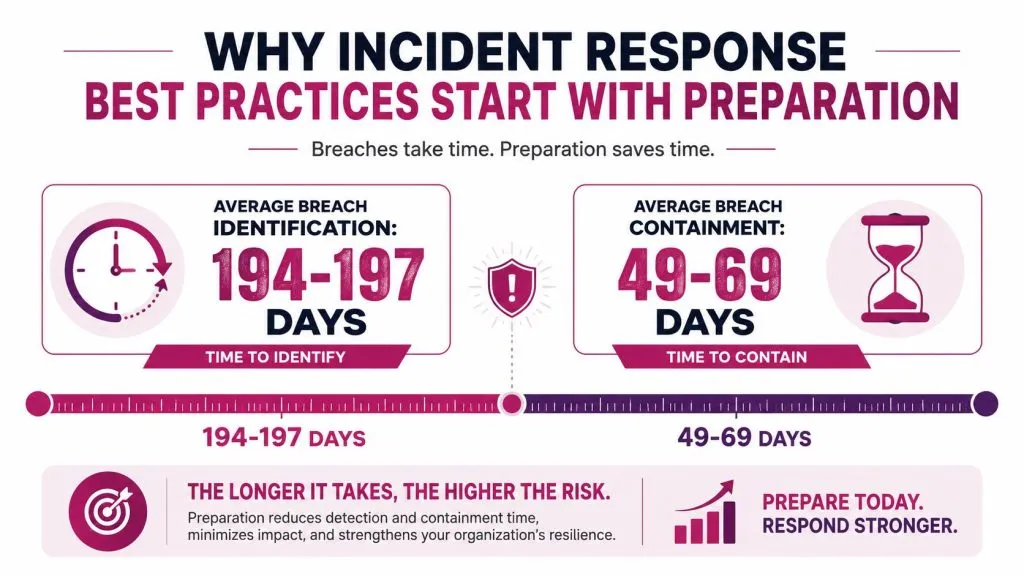
194 to 197 days is the average time to identify a breach, and 49 to 69 days is the average time to contain it. That’s why incident response best practices have to be engineered to compress every minute between compromise, detection, containment, and recovery, and why preparation is the most critical phase when minutes matter most.
If a team waits to decide who owns an alert, which logs to preserve, or when to notify a vendor, the response is already slipping. The programs that hold up under pressure are the ones that remove decision latency before the incident starts, with documented policy, named owners, pre-approved communications, and tested escalation paths.
Why Incident Response Best Practices Start With Preparation
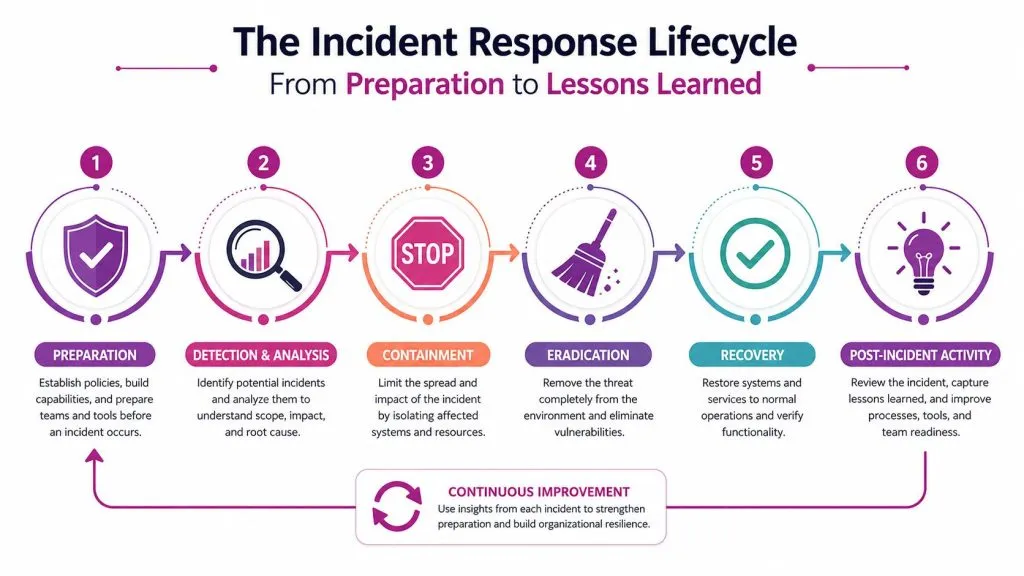
The first mistake many teams make is treating preparation like paperwork. In practice, it’s the part of the program that determines whether responders can act cleanly when the clock is running and the evidence is still fresh. NIST defines incident response as a lifecycle that includes preparation, detection and analysis, containment, eradication, recovery, and post-incident activity, and the structure makes sense because the work you do before an incident shapes every decision that follows (NIST SP 800-61r2).
Practical rule: if a decision needs debate during an active incident, it should have been pre-decided in preparation.
Preparation matters because it removes friction, not because it looks impressive on a maturity slide. That means incident classification criteria, named backups for critical roles, tested communication channels, and a response plan that people can follow under stress. It also means you don’t leave teams guessing about who can isolate systems, who can talk to customers, and who can approve containment actions.
A breach that takes months to identify and contain is usually not suffering from a lack of alarms. It’s suffering from a lack of response discipline. The teams that shorten dwell time usually start by documenting what an incident is, who declares it, what each severity level triggers, and where evidence gets preserved before anyone starts changing systems.
The opening statistic also changes how you think about tools. Detection tooling matters, but it’s not the starting point. The starting point is a repeatable operating model that lets analysts, incident commanders, legal counsel, and vendors move fast without stepping on each other.
For a practical way to think about early exposure, it helps to pair preparation with external visibility. A dark web scan is useful only if the findings feed a response process that already knows who acts, how fast, and with what authority.
The Incident Response Lifecycle From Preparation to Lessons Learned
The incident response lifecycle only works when each stage has a clear job and a clear handoff. Preparation sets the rules, detection and analysis confirm what is happening, containment limits spread, eradication removes attacker access, recovery restores services, and post-incident activity turns the event into a stronger program. The middle stages matter most under pressure, but they are much easier to execute when preparation has already removed guesswork.
Preparation and detection
Preparation is where the response muscle gets built. Detection and analysis are where that muscle is tested under real conditions. Microsoft’s guidance is direct about the scoping discipline that keeps incidents from dragging on, teams should identify the attack’s scope and objective, avoid unnecessary investigation, and focus forensic work only on endpoints attackers used or modified (Microsoft incident response overview). That discipline matters because chasing every device burns time, increases noise, and can interrupt operations without helping the investigation.
Containment, eradication, and recovery
Containment is about limiting spread while preserving evidence. Eradication is about removing access, persistence, and any path the attacker can still use. Recovery is about restoring trust in the environment, not just bringing systems back online. Teams that rush into cleanup often miss a persistence mechanism, then see the same access path used again during recovery because it never fully closed.
These stages also create different client-facing metrics for MSPs and MSSPs. Containment can be reported as time to isolate impacted systems, eradication as time to remove attacker-controlled accounts or tools, and recovery as time to return validated services to normal operations. That reporting is only useful if the team can tie each action back to what was touched across identity, endpoint, network, cloud, and third-party systems.
Post-incident activity
Post-incident activity is the stage many leaders underfund, even though it compounds value over time. A useful review does not ask whether the team was busy. It asks what was detected late, what was contained slowly, what was communicated poorly, which vendor handoff caused delay, and what control would have shortened the next event.
The best runbooks do not try to memorize every attacker move. They make the next decision obvious at every phase.

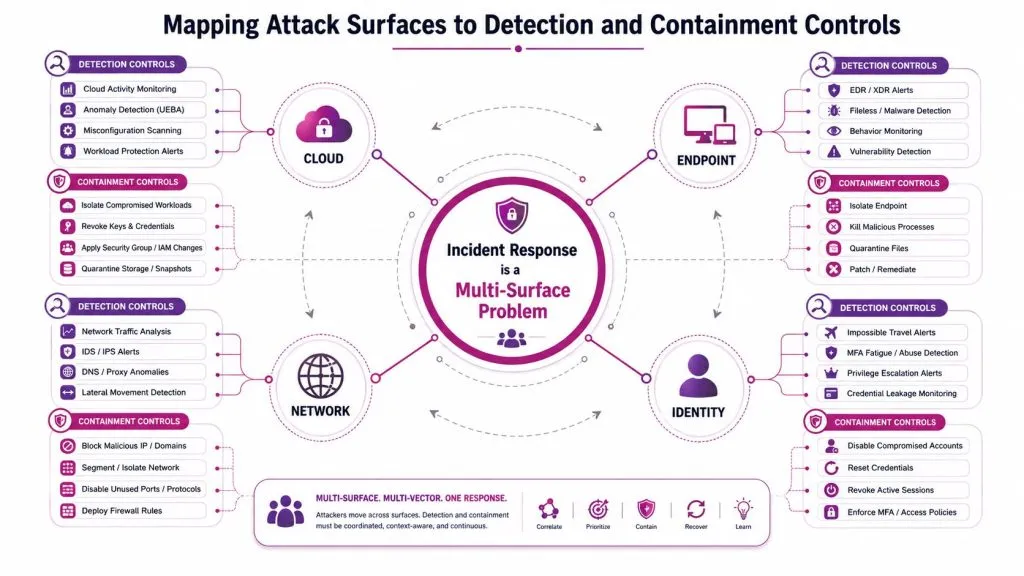
Mapping Attack Surfaces to Detection and Containment Controls
Modern incident response is a multi-surface problem, not a single-vector one. In Palo Alto Networks Unit 42’s 2026 Global Incident Response Report, analysts examined more than 750 incident response engagements and found that 87% of intrusions involved activity across multiple attack surfaces. Identity was involved in 89% of cases, endpoints in 61%, networks in 50%, and human factors in 45%, while phishing and vulnerabilities tied as the leading initial access vectors at 22% each (Unit 42 Global Incident Response Report).
What that means operationally
That pattern changes what effective containment looks like. If identity shows up in almost every investigation, then identity monitoring can’t be a side project. If endpoints and networks are both common surfaces, then EDR alone isn’t enough, and netflow alone isn’t enough either. The response model has to assume attackers move across identity, endpoint, network, and people in the same incident.
Control mapping by surface
- Identity: continuous log review, conditional access, rapid credential revocation, and tight privileged access handling.
- Endpoint: EDR visibility, rapid isolation, and focused forensic collection on systems the attacker touched.
- Network: segmentation awareness, east-west visibility, and fast blocking of suspicious traffic paths.
- Human layer: phishing-resistant authentication where possible, plus reporting paths for social engineering and suspicious prompts.
The reason this map matters is simple. If you only watch for one surface, the attacker uses another one to stay alive. Cross-surface coordination is what closes that gap.
For teams building out their own attack-surface workflow, an attack surface analysis process gives responders a better way to prioritize where compromise is most likely to spread and where containment will stick.
Role-Specific Checklists for the First 60 Minutes
The first hour is where most programs expose whether their roles are real or just labels in a document. Security analysts need authority to validate alerts and preserve volatile evidence. Incident commanders need the power to declare severity and stand up the war room. Communications leads need a draft path for executives and customers. Legal and compliance need a trigger for notification clocks and outside counsel involvement.
Security analyst
The analyst’s job is to verify, scope, and preserve. Confirm the alert is credible, identify the affected assets, collect the logs and evidence that might disappear, and stop any unnecessary changes from touching the scene. If the incident touches multiple systems, the analyst should narrow investigation to the endpoints and identities the attacker used, not every machine in the environment.
Incident commander
The commander’s job is decision flow. Declare severity, assign owners, lock the response rhythm, and keep the team from splitting into competing theories. If there’s no single person controlling status and priorities, the response becomes a set of parallel activities that never quite converge.
Communications and legal
The communications lead drafts the holding statement and keeps internal messaging consistent. Legal and compliance decide whether breach-notification obligations may be triggered, whether outside counsel needs to be looped in, and what needs to stay privileged. Those decisions should be pre-authorized in the plan so nobody has to ask permission while the clock is already moving.
If a responder has to wait for approval to do the obvious thing, the plan is too slow.
Teams that want a cleaner operational handoff often pair the runbook with an integrated Kanban for Google Tasks so assignments, owners, and timing stay visible during the first push.
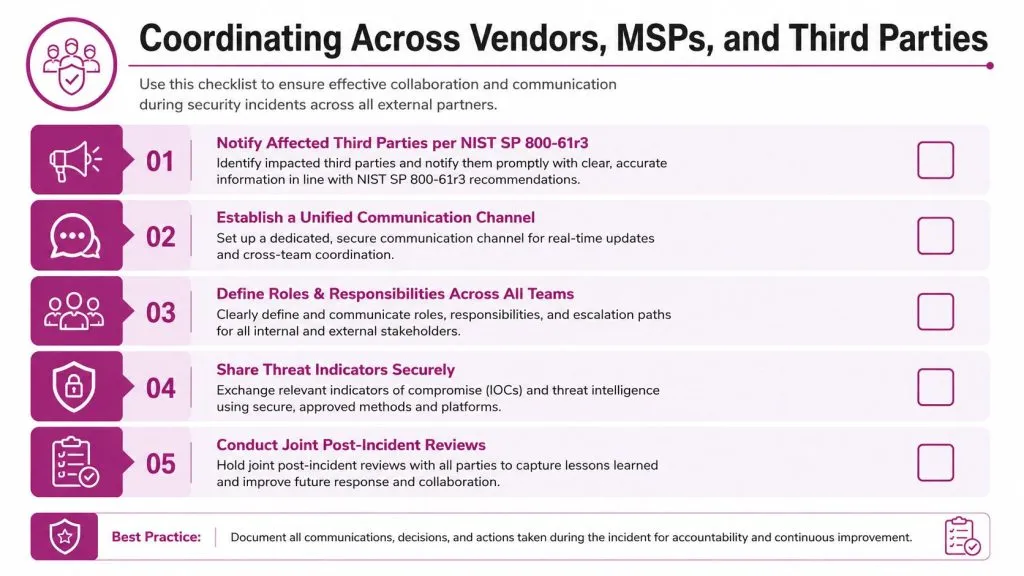
Coordinating Across Vendors, MSPs, and Third Parties
A lot of incident response guidance goes vague here, and real engagements get messy. NIST SP 800-61r3 explicitly expands the guidance to include notifying affected third parties and accounting for contractual requirements, which is a much more practical view than the usual “have a plan” advice (NIST SP 800-61r3). For MSPs and MSSPs, response quality often depends on whether the vendor ecosystem can move in sync.
A common scenario starts with one alert, then quickly becomes a coordination problem. The MSP has the logs, the SaaS vendor controls the application, outside counsel wants the facts preserved, the insurer wants timely notice, and the customer wants a clear answer about scope. If those parties aren’t already connected by a shared workflow, responders lose time just figuring out who can revoke what, who can share which evidence, and who needs to be notified first.
What the workflow has to cover
- Notification triggers: define when a third party gets looped in, not after hours of debate, but at the point a contractual or operational threshold is crossed.
- Shared communications: establish one approved channel for the incident team, vendor contacts, and counsel so instructions don’t fragment across email threads and chats.
- Evidence sharing: decide in advance what logs can be shared, in what format, and through which party, so nobody improvises under pressure.
- Containment authority: spell out who can disable accounts, revoke tokens, pause integrations, or isolate environments when multiple companies are involved.
That’s the difference between a cross-company incident that stays organized and one that turns into a blame loop. The best vendor workflows don’t eliminate friction, they reduce the number of decisions responders have to invent in the moment.
In practice, a coordinated third-party response often pairs incident handling with external exposure monitoring, and that’s where tools such as dark web monitoring for managed service providers become operationally relevant because they surface credential and brand exposure before a compromise grows wider.
Matching Detection and Response Tools to Each Lifecycle Stage
Not every tool belongs everywhere. The useful question is where a capability shortens dwell time. Dark web monitoring belongs in preparation and early detection because it can surface stolen credentials before they’re used. Vulnerability scanning belongs in preparation because it lowers the number of doors responders will later have to close. Fake site and account detection belong in detection and eradication because they expand the response beyond the internal network into the open internet.
| Capability | Lifecycle Stage | Dwell-Time Impact | InsecureWeb Feature |
|---|---|---|---|
| Dark web monitoring | Preparation, early detection | Surfaces exposed credentials before reuse | Dark web monitoring |
| Threat intelligence | Preparation, detection | Helps prioritize likely activity and suspicious infrastructure | Threat intelligence |
| Vulnerability scanning | Preparation | Reduces exploitable weaknesses that can lengthen an incident | Vulnerability scanning |
| AI-guided penetration testing | Preparation | Reveals reachable gaps before an attacker does | AI-guided penetration testing |
| Fake site detection | Detection, eradication | Helps remove impersonation assets and limit user exposure | Fake site detection |
| Reputation monitoring | Detection, post-incident activity | Helps track brand abuse and residual exposure after containment | Reputation monitoring |
| Deepfake monitoring | Detection, response coordination | Flags content that can distort incident communications | Deepfake & reputation monitoring |
InsecureWeb fits this lifecycle view because it covers external exposure, fake assets, and reputation-layer activity that many internal tools miss. That matters for MSPs and MSSPs that need one view across the open internet, the dark web, and social platforms, especially when a response isn’t just about endpoints or servers anymore.
The trade-off is simple. A narrow tool can be great at one layer, but if it doesn’t help you reduce time to see, time to scope, or time to contain, it won’t move the response curve much. The right stack supports the stages where incidents slow teams down.
Metrics and KPIs That Actually Improve Response
The metrics that matter are the ones that show whether response time is shrinking. MTTD, MTTR, MTTC, and dwell time tell you where the program is leaking time, while raw alert counts and ticket volume mostly tell you how noisy the environment is. The opening breach-duration numbers also explain why teams should care about speed, because breaches identified and contained within 200 days cost 23% less to resolve than slower incidents (incident response statistics summary).
What to measure
MTTD should tell you how long it takes to notice a compromise. MTTC should tell you how long it takes to stop spread. MTTR should tell you how long it takes to restore normal operations. Dwell time should tell you how long an attacker was active before discovery.
Where the data should come from
SIEM data shows alert and correlation timing. EDR records isolation and response actions. Ticketing tools show ownership and handoff delays. Post-incident reviews show the qualitative reasons the timeline stretched, like missing logs, slow vendor access, or unclear declaration criteria.
The best program uses those metrics by attack surface and by initial access path, not just as a single average. That’s how an MSP can tell a client whether identity incidents close faster than endpoint incidents, or whether containment is slowing down because legal review keeps getting inserted too late.
A dashboard that doesn’t change decisions is just a scoreboard.
Turning Post-Incident Reviews Into Durable Program Changes
A post-incident review should be short on drama and long on specificity. The useful output is a record of what happened, what was deferred, what detection gap mattered, what containment gap hurt, and which vendor or internal handoff added delay. That review becomes valuable only when every finding turns into a tracked change with an owner and a deadline.
For a practical starting point, it helps to browse our postmortem template and adapt the fields to match your own response model, especially if you need to capture timeline, decisions, and follow-up work in one place.
What durable improvement looks like
A strong review cadence doesn’t stop at documenting lessons. It converts them into playbook updates, tabletop scenarios, communications templates, and vendor workflow changes. The maturity progression is straightforward, ad hoc, documented, exercised, measured, and continuously improved, and the point of the model is to show clients that response quality is being built, not just claimed.
The most effective MSPs and MSSPs treat post-incident work as program design. One incident should improve the next one’s scope definition, the next one’s escalation path, and the next one’s third-party coordination. If those changes don’t show up in the runbook, they won’t show up under pressure.
If you need a response process that goes beyond generic playbooks, InsecureWeb helps teams watch the open internet, dark web, and social layer for the kinds of exposure that turn into incidents. Visit InsecureWeb to see how its monitoring, scanning, and brand protection capabilities can fit into a practical incident response workflow for MSPs, MSSPs, and internal security teams.