80% of modern security breaches involve compromised or stolen credentials, and 82% of breaches involve a human element, often tied to weak or reused credentials, according to Clutch Security’s overview of identity-first security. For an MSP or MSSP, that should change the way you package security services.
Most clients still think in terms of firewalls, endpoints, email filtering, and backup. Those still matter. But attackers keep finding the fastest path to access, and that path is usually identity. If your client’s user, admin, service account, or API token is trusted too easily, the rest of the stack becomes much easier to bypass.
That’s why identity-first security isn’t just another control category. It’s a shift in operating model. It changes how you assess risk, how you phase projects, how you structure recurring services, and how you prove value over time. It also pairs naturally with exposure discovery work such as dark web monitoring for stolen credentials and related risks, because credential exposure is often the earliest visible signal that an identity problem already exists.
Why Identity Is the New Security Perimeter
For years, MSP security strategy started at the edge. Harden the firewall. Lock down remote access. Segment the network. Push endpoint controls. That model still has value, but it no longer reflects how clients work.
Users sign in from home networks, unmanaged locations, cloud apps, personal mobile devices, and third-party portals. Workloads communicate through APIs instead of fixed internal paths. Admins move between SaaS consoles, remote management tools, and cloud platforms. The “inside” of the network isn’t a dependable trust boundary anymore.
Identity has become the control point that follows the user, the admin, the device, the workload, and the session. That matters because an attacker who gets valid access rarely needs to break in the old-fashioned way. They log in, inherit trust, and move laterally through whatever that identity can reach.
The business implication for service providers
Here, MSPs and MSSPs can raise the maturity of their offering. If you still sell security as a stack of disconnected tools, you’ll keep solving symptoms. If you build around identity, you can deliver a service that ties policy, access, privilege, monitoring, and remediation together.
Practical rule: If a client can’t tell you who has access, why they have it, and how that access is reviewed, they don’t have an identity program. They have accumulated permissions.
Identity-first security also gives you a cleaner business conversation. Instead of pitching another alert feed, you’re solving client problems they already recognize:
- Remote access risk that no longer fits a perimeter model
- Admin account exposure that makes every inherited privilege dangerous
- Audit friction caused by inconsistent access and poor lifecycle control
- Service sprawl across Microsoft 365, Google Workspace, Azure, AWS, line-of-business apps, and legacy systems
The MSPs that do this well don’t frame identity as an add-on. They make it the backbone of managed security.
Defining Identity-First Security
Identity-first security means access decisions start with verified identity, not assumed network trust. The simplest analogy is physical security.
A network-first model is a castle moat. Keep outsiders away, and everything inside gets more trust. An identity-first model is internal keycard control. Every person, contractor, admin, app, and service needs the right credential, the right clearance, and the right context at each door.
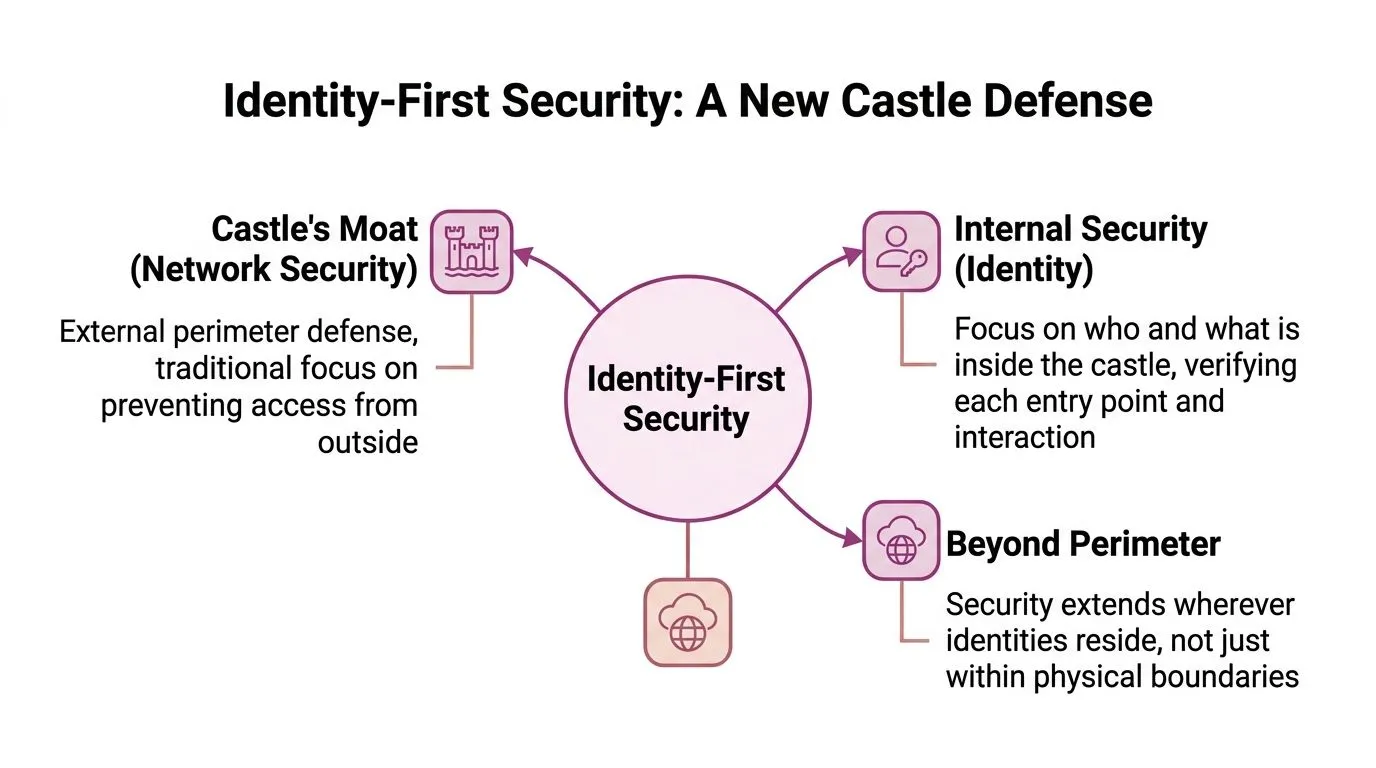
From moat thinking to keycard thinking
In practice, this means a user’s location is only one signal. Being on VPN doesn’t automatically make access safe. Being in the office doesn’t automatically make access appropriate. The system should evaluate who is requesting access, what they’re trying to reach, what device they’re using, whether the session looks normal, and whether the privilege level fits the task.
That’s also where people often confuse identity-first security with Zero Trust. They’re related, but they aren’t identical. Identity-first security is the philosophy that puts identity at the center of access decisions. Zero Trust is the broader operating model that enforces continuous verification, explicit authentication, and least privilege across the environment.
If you support SMB clients that are trying to move from ad hoc account administration toward something more structured, a practical local reference point is identity management for DFW SMBs. The value isn’t geography. It’s the reminder that identity work has to connect policy, provisioning, and day-to-day operations.
Network-First vs. Identity-First Security Comparison
| Aspect | Network-First Security (Traditional) | Identity-First Security (Modern) |
|---|---|---|
| Trust assumption | Internal location gets more trust | Every request must earn trust |
| Primary control point | Firewall, VPN, segmentation | Identity, authentication, authorization |
| Access decision basis | Where traffic comes from | Who or what is requesting access, plus context |
| Lateral movement risk | Higher if a trusted account is compromised | Lower when access is segmented by identity and privilege |
| Remote work fit | Often awkward and bolt-on | Native to distributed access patterns |
| SaaS and cloud fit | Frequently inconsistent | Better aligned to app-centric environments |
| Privileged access | Often persistent and broad | Scoped, reviewed, and reduced where possible |
| User experience | Multiple logins and inconsistent access paths | Can improve with strong SSO and well-designed policy |
A lot of failed identity projects come from overcomplicating the definition. Keep it simple. Verify the identity. Limit the access. Recheck trust during the session. Apply the same rigor to people and systems.
Core Architecture and Key Components
A workable identity-first architecture needs more than a directory and an MFA toggle. It has to enforce policy at access time, reduce standing privilege, detect misuse, and clean up identity sprawl before it becomes an incident.
NIST SP 800-207 is the right mental model here. The Aembit analysis of identity over network in Zero Trust notes that implementation requires a Zero Trust Architecture with continuous verification, explicit authentication, and least privilege. It also highlights core controls such as MFA, SSO, PAM, and role-based or attribute-based policy. In the same source, Microsoft benchmark data is cited showing that passwordless MFA plus blocking legacy authentication can reduce user session risk by 94%, and that Microsoft Entra ID Protection with Defender for Identity can improve threat detection accuracy by 40% through real-time behavior analysis.
Here’s the architecture view most MSPs need to standardize.
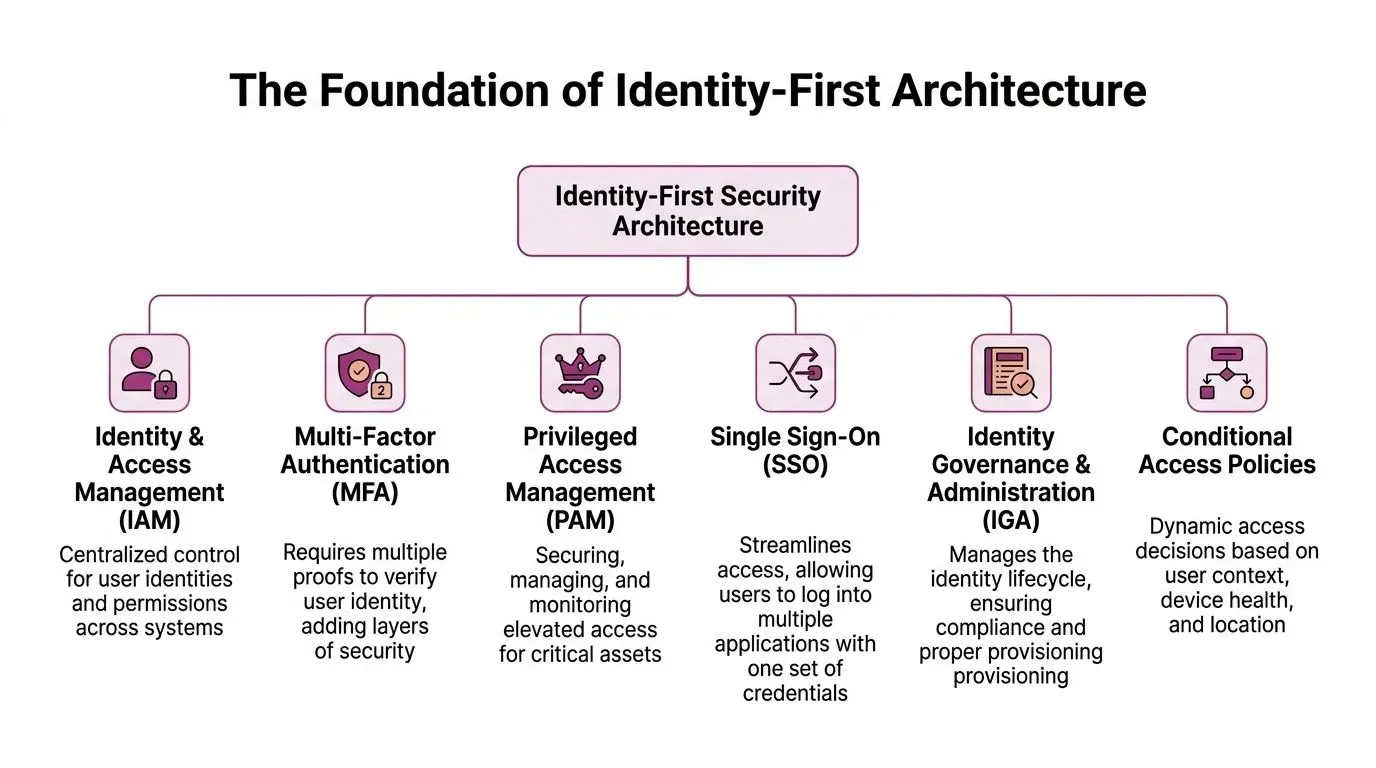
What the architecture must do
At minimum, the stack should answer five operational questions:
- Who is this entity? Human user, admin, contractor, service account, workload, or application.
- How sure are we? Strong authentication, phishing resistance where possible, and risk-aware validation.
- What should they reach? Access determined by role, attribute, or approved task.
- For how long? Standing access should shrink. Privileged access should expire.
- What happens if behavior changes? The system should detect anomalies and trigger review, challenge, or revocation.
A lot of teams buy tools that answer only the first two questions. That’s not enough.
For a quick operational primer on reducing exposure before policy enforcement even starts, it helps to understand what attack surface analysis covers in real environments. Identity-first work is stronger when it’s informed by where access paths, exposed services, and external risks exist.
A short explainer is useful before getting into implementation details:
The components that matter in practice
IAM and directory control sit at the center. This is your source for identities, groups, app assignments, and basic lifecycle events. If the directory is messy, every downstream control inherits that mess.
MFA is still essential, but not all MFA is equal. Push prompts alone create avoidable risk and user fatigue. Phishing-resistant methods such as hardware-backed approaches or platform biometrics are stronger. If your team needs a practical refresher on where authentication strategy, SSO, and user flow intersect, MFA and SSO best practices are worth reviewing.
SSO matters for security and operations. It reduces password sprawl, centralizes access decisions, and gives you one place to enforce authentication policy. It also lowers support friction if it’s implemented cleanly.
The best SSO rollout isn’t the one with the most app tiles. It’s the one that removes unmanaged logins and gives you reliable policy enforcement.
PAM is where many MSP offerings become differentiated. Admin access shouldn’t be broad, permanent, and invisible. You want vaulting where needed, session control where justified, approval for sensitive workflows, and clear ownership of privileged roles.
IGA and lifecycle management turn identity from a login problem into a governance discipline. Joiners, movers, leavers, contractor expiration, group cleanup, and periodic access reviews all belong here. This is what keeps permissions from accumulating unnoticed over time.
ITDR and behavioral detection close the loop. You need signals that tell you when an account, session, or privilege pattern doesn’t make sense. Entra ID Protection, Defender for Identity, and similar telemetry-driven controls become useful in this context. They don’t replace policy. They tell you when policy is being abused.
An Implementation Roadmap for MSPs and MSSPs
Most MSPs make identity projects too technical too early. Clients don’t buy “an identity transformation.” They buy lower risk, smoother access, cleaner audits, and fewer emergencies. The service has to be phased that way.
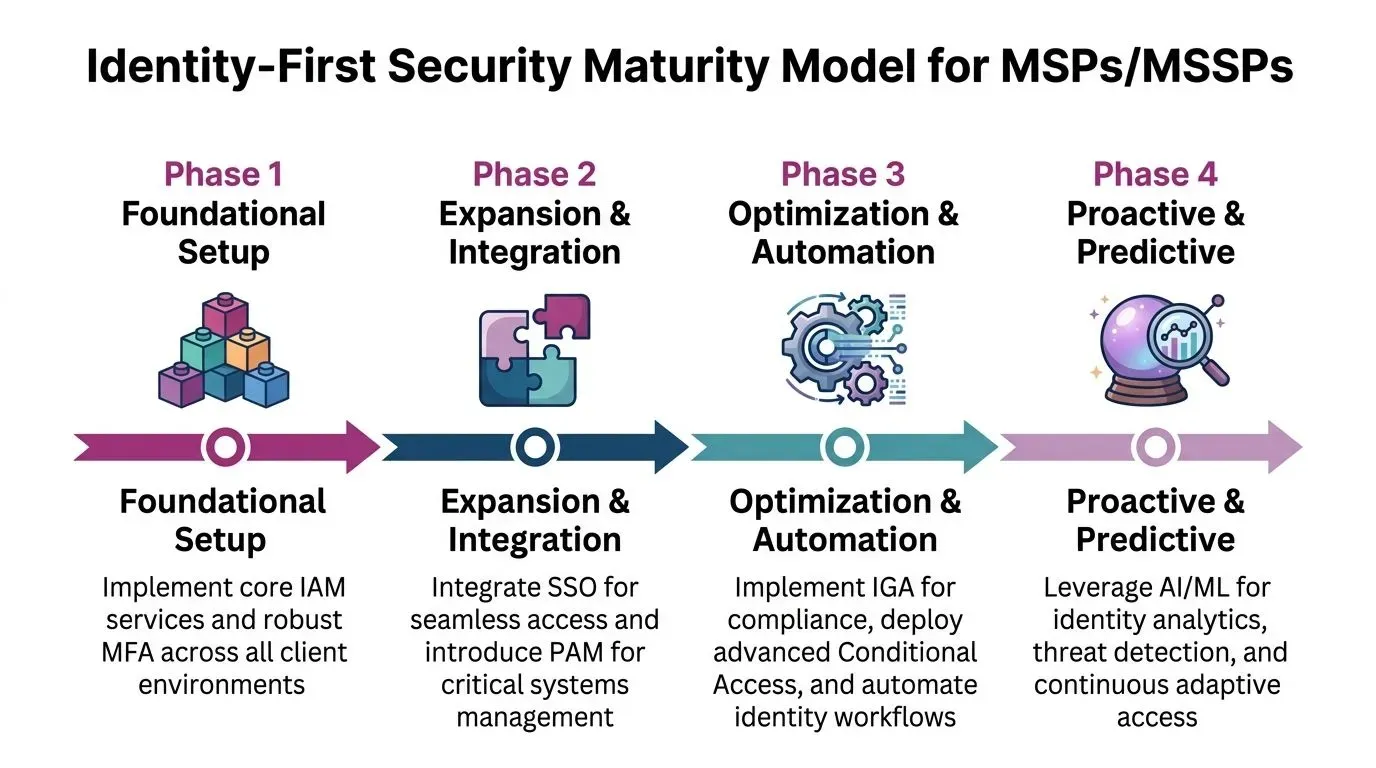
The most effective rollout model is tiered. Start with a service clients can adopt quickly. Expand into controls that improve visibility and governance. Then move mature clients into automation and tighter privilege design.
A useful companion service for early discovery is dark web monitoring for managed service providers. It helps open the conversation around exposed credentials, impersonation risk, and why identity hygiene deserves board-level attention.
Phase 1 foundational service
This phase should be standardized and easy to quote.
Offer a baseline package built around:
- Directory cleanup: Resolve stale users, duplicate identities, shared admin use, and obvious group sprawl.
- MFA rollout: Enforce MFA broadly, prioritize admin accounts first, then high-risk users and critical applications.
- SSO onboarding: Pull major SaaS applications behind central authentication wherever practical.
- Conditional access basics: Set policies around device posture, impossible travel signals where supported, risky sign-ins, and legacy protocol restrictions.
- Access inventory: Establish a first-pass map of who has access to what.
This phase is where you create immediate risk reduction and recurring service anchors. It’s also where weak providers fail by trying to customize too much. Standardization matters. Build a repeatable package, define supported app patterns, and make exceptions expensive.
Phase 2 advanced service
Once the client has reliable authentication and central visibility, start reducing blast radius.
This tier should focus on privileged and sensitive access:
- PAM for admins and critical systems
- Role redesign for least privilege
- Access reviews for finance, HR, executive, and infrastructure roles
- Contractor and third-party access controls
- Session and sign-in monitoring tied to escalation playbooks
At this point, you’re no longer just authenticating users. You’re controlling how privilege is granted, used, and reviewed. That’s a much stronger managed service story.
A practical sales mistake to avoid is bundling this as “advanced security hygiene.” Clients pay more readily when you tie it to operational outcomes. Examples include reducing shared admin exposure, tightening audit evidence, and shortening response time when an account is suspected to be compromised.
Phase 3 mature service
An MSSP-style offer begins to take shape.
The mature tier usually includes:
- JIT and time-bound elevation for administrative actions
- IGA workflows for joiners, movers, leavers, approvals, and recertification
- Behavior-based identity monitoring with investigation workflows
- Application and API identity controls beyond human users
- Policy tuning based on business process, not one-size-fits-all templates
Clients in this tier expect more than enforcement. They expect operational discipline. Your team needs runbooks, ownership models, exception handling, evidence collection, and board-facing reporting.
Operator advice: Don’t wait for perfect data before starting governance. Start with high-impact roles, privileged groups, and critical apps. Improve data quality as the service matures.
How to package it profitably
Profitable identity-first security services usually share a few traits.
| Service design choice | What works | What doesn’t |
|---|---|---|
| Packaging | Tiered offerings with clear scope | Custom projects for every client |
| Pricing logic | Charge for users, privileged roles, apps under management, and governance complexity | Charge only for tool resale |
| Delivery model | Standard policies, defined onboarding steps, and documented exceptions | One-off engineering every time |
| Reporting | Access review outcomes, risky identities, stale accounts, privileged changes | Generic monthly ticket summaries |
| Expansion path | Foundational to advanced to mature | Selling the largest bundle on day one |
The business upside is real because identity sits across security, productivity, compliance, and support. But only if you treat it as a managed service, not a software deployment.
Tooling and Integration Considerations
The tooling conversation gets messy because client environments are messy. Some run Entra ID and Microsoft 365 cleanly. Others still depend on on-prem Active Directory, old SSO patterns, line-of-business applications, and a handful of cloud services bolted on over time.
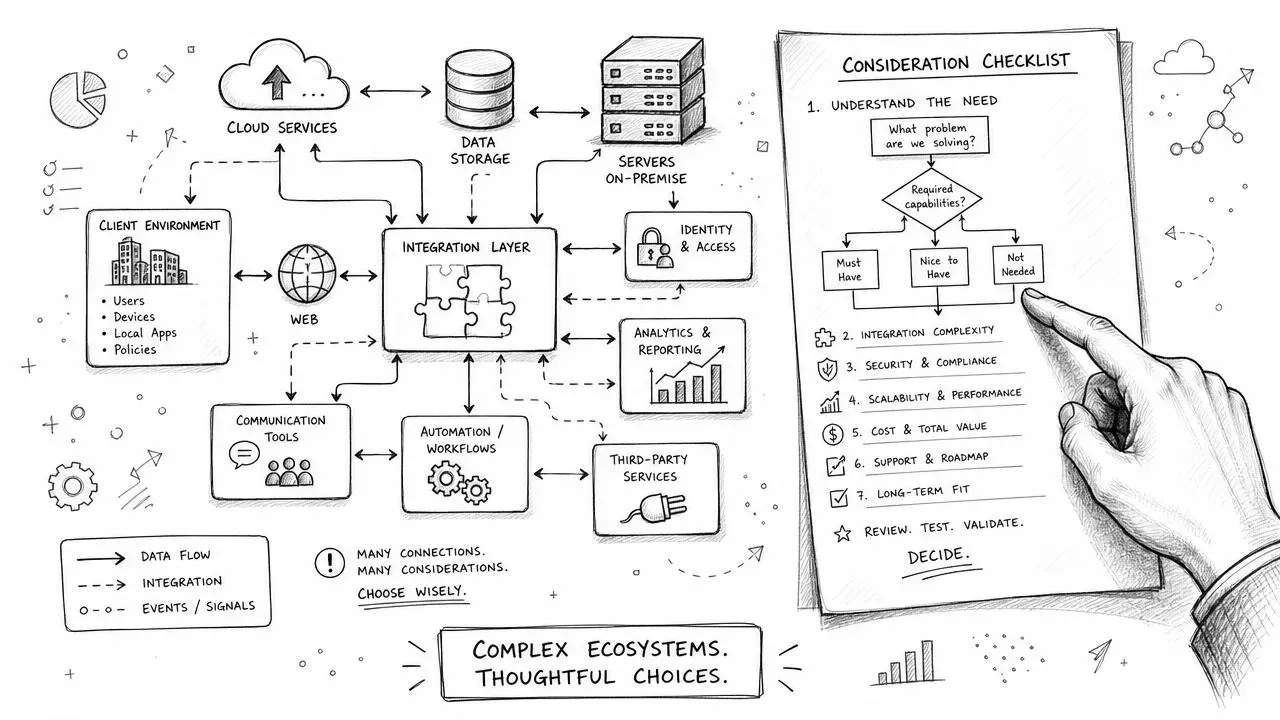
The Cloud Security Alliance discussion of identity-first security as the new perimeter calls out a critical reality: 82% of mid-sized businesses still rely on legacy IAM, and 64% of vendors don’t provide clear migration paths. The same source notes that identity propagation across legacy and modern services can reduce integration costs by 40% compared to full IAM migration.
Single platform vs best-of-breed
A consolidated platform has obvious appeal. Fewer consoles. Fewer contracts. Cleaner vendor alignment. If a client is strongly standardized on Microsoft, Okta, Google, or another core ecosystem, a platform-first approach often gets you to value faster.
Best-of-breed starts to win when requirements get sharper. That’s common in MSSP environments where one client needs stronger PAM, another needs deeper IGA, and a third has edge-case application integration that the platform vendor handles poorly.
The trade-off usually comes down to three questions:
- Operational overhead: Can your team support multiple control planes without creating inconsistency?
- Integration depth: Does the platform really cover the legacy apps and admin paths the client still uses?
- Service margin: Are you building a scalable service or a fragile collection of exceptions?
Working with legacy IAM instead of pretending it is gone
The wrong approach is telling clients they must rip and replace everything before improving security. That stalls projects and burns trust.
The better approach is staged interoperability:
- Use federation and SSO where the app supports it
- Bridge identity signals into legacy environments through supported connectors and proxies
- Apply strong policy at the front door even if the back-end app is older
- Propagate identity context across services so logs, sessions, and access decisions stay attributable
- Retire legacy authentication paths gradually, starting with the riskiest ones
A practical integration plan should identify which systems can modernize quickly, which need wrappers, and which are too risky to keep untouched. That’s architecture work, not just product selection.
If a vendor can demo a beautiful cloud-native flow but can’t explain how it handles your client’s old finance app, that vendor hasn’t solved your real problem.
For MSPs, margins are thereby protected. Good integration planning avoids expensive rework and gives clients a credible path that fits their actual environment.
Real-World Use Cases and Success Metrics
Clients rarely ask for identity-first security by name. They show up with pain. The strongest sales and delivery teams translate that pain into concrete identity controls.
Three client scenarios MSPs see constantly
A distributed workforce is the obvious one. Users sign in from many locations, use multiple devices, and move across Microsoft 365, file-sharing tools, CRM platforms, and remote support systems. A network-centric model turns that into a maze of exceptions. An identity-first model centralizes authentication, reduces unmanaged access paths, and applies stronger requirements when the session looks risky.
The second scenario is cloud administration. A client may have a small internal team, outsourced developers, and a few MSP admins touching Azure, AWS, backup consoles, and business applications. If those accounts keep broad standing privilege, one mistake or one compromised login can expose far more than intended. Identity controls make that access narrower, more visible, and easier to review.
The third is audit pressure. Clients in regulated sectors often aren’t failing because they have no controls. They’re failing because access evidence is scattered, approvals are inconsistent, and nobody can confidently explain why a user still has a sensitive role. Identity-first governance turns that into a managed process.
Metrics clients will actually understand
You don’t need invented ROI math to prove progress. Track a small set of operational metrics that show risk reduction and control maturity.
- Privileged account exposure: Count persistent admin assignments, shared admin use, and high-risk roles without formal review.
- Lifecycle discipline: Track stale accounts, orphaned accounts, and how quickly leaver access is removed.
- Access review completion: Report whether critical apps and privileged groups are being reviewed on schedule.
- Authentication strength coverage: Show which applications and admin paths are protected by strong MFA and centralized sign-in.
- Detection and response quality: Measure how quickly suspicious sign-in activity is reviewed and what actions were taken.
Clients understand trends when they tie to business risk. “We reduced stale privileged access and tightened admin review” lands better than “we tuned policy objects.”
Common Pitfalls and How to Avoid Them
Most identity programs don’t fail because MFA was missing. They fail because teams stop at MFA and assume they’re done.
The blind spots that break otherwise good programs
The biggest blind spot is non-human identity. The Apiiro glossary on identity-first security notes that non-human identities such as service accounts and API keys outnumber human identities by 5–15x, while 73% of organizations lack formal processes to manage them. The same source says 68% of cloud breaches stem from compromised or misconfigured non-human identities.
That should reshape your service design. If your managed identity program covers only employees and admins, it misses a major attack path.
The second pitfall is MFA fatigue. Teams deploy push-based MFA widely, then ignore repeated prompts, poor enrollment hygiene, and weak exception handling. Stronger factors and smarter policy reduce that risk.
The third is privilege creep. Users change roles, projects end, vendors rotate staff, and nobody removes old access. Over time, the environment becomes full of accidental privilege.
To avoid these failures:
- Inventory machine access: Identify service accounts, tokens, certificates, and automation identities with owners and intended use.
- Review exceptions tightly: Temporary bypasses have a way of becoming permanent unless they expire automatically.
- Run recurring access reviews: Start with privileged groups and sensitive apps if full coverage isn’t realistic yet.
- Treat shared accounts as technical debt: Replace them or contain them until they can be removed.
Mature identity-first security isn’t just about stronger logins. It’s about controlling every identity that can reach something important.
Making Identity Your Strongest Defense
The perimeter hasn’t disappeared. It just isn’t where trust should begin anymore. For MSPs and MSSPs, that changes both the security model and the business model.
Identity-first security gives you a service that maps directly to the way clients operate now. It supports remote work, cloud adoption, hybrid environments, privileged administration, and audit demands without pretending every client can start over from scratch. More importantly, it gives you a scalable way to move from reactive support into policy-driven security operations.
The strongest first step is simple. Audit identity posture before you propose a major transformation. Look at authentication strength, privileged access, stale accounts, third-party access, service accounts, and exposed credentials. That baseline will tell you where to start, what to standardize, and which clients are ready for a mature managed identity service.
InsecureWeb gives MSPs and MSSPs a practical way to start that conversation with clients. Use InsecureWeb to uncover exposed credentials, monitor dark web activity, detect impersonation, and expand your visibility into external threats that often lead back to identity risk. It’s a strong entry point for client identity posture audits, and it fits naturally into a broader managed security offering you can deliver under your own brand.