Data Security, updated 16 min read
Brand Protection Services: Your Complete 2026 Guide
By InsecureWeb Team

A client calls because customers are landing on a fake login page that looks close enough to pass. Support is getting angry emails. Sales wants it gone immediately. Legal asks who owns the domain. The security team wants indicators, screenshots, registrar details, and a takedown path. If you’re the MSP, hosting provider, or security firm in the middle, that call usually exposes the same problem: the client’s risk doesn’t stop at their firewall.
That’s where brand protection services stop being a marketing concern and become an operational security function. You’re not just protecting a logo. You’re watching for fake sites, impersonation accounts, scam ads, leaked credentials, abuse on marketplaces, and cloned content that attackers use to borrow trust and turn it into fraud.
The market reflects that shift. The global brand protection services market reached USD 1.48 billion in 2024, according to Dataintelo’s brand protection services market research. For service providers, that matters for two reasons. Buyers already understand the pain, and they increasingly expect someone to handle it as an ongoing managed service.
Your Client’s Brand Is Under Attack
The pattern is familiar. A client notices a phishing email using a lookalike domain. Then someone finds a fake social profile replying to customers. A week later, there’s a cloned landing page collecting credentials or payments. None of these incidents starts inside the client environment, but all of them end up on your desk because customers, prospects, and staff can’t tell the difference fast enough.
That’s why brand protection services work best when you treat them as an external threat monitoring discipline. The goal isn’t only to identify infringement. The goal is to identify abuse that turns brand trust into account takeover, payment fraud, support overload, and reputational damage.
For service providers, the practical issue is response coordination. The client wants one team to investigate, validate, escalate, preserve evidence, and push for removal. If your current answer is “send it to legal” or “open a ticket with the platform,” you’re already behind the attacker’s timeline.
Practical rule: If a fake domain or impersonation account can hurt customers today, it belongs in security operations today.
Strong brand protection also improves your role after an incident. When a breach, leak, or phishing event has already happened, you need to watch for the downstream abuse that follows. Clients often focus on internal cleanup first, then miss the impersonation wave that comes next. A post-incident checklist should include external monitoring alongside the core steps after a data breach.
The older legal foundations still matter. The establishment of the U.S. National Intellectual Property Rights Coordination Center marked a shift from fragmented enforcement toward a more unified approach, and government guidance continues to stress trademark registration and registration strategy as core groundwork. But in day-to-day service delivery, clients rarely buy “groundwork.” They buy faster discovery, cleaner evidence, and fewer customers getting trapped by scams in their name.
The Core Components of Modern Brand Protection
Most MSPs first hear “brand protection” and think counterfeit monitoring or trademark disputes. That’s too narrow for current operations. A usable service has to cover the places attackers exploit: domains, social platforms, app stores, marketplaces, public web content, breach data, and executive identity.
This visual captures the service model at a high level.
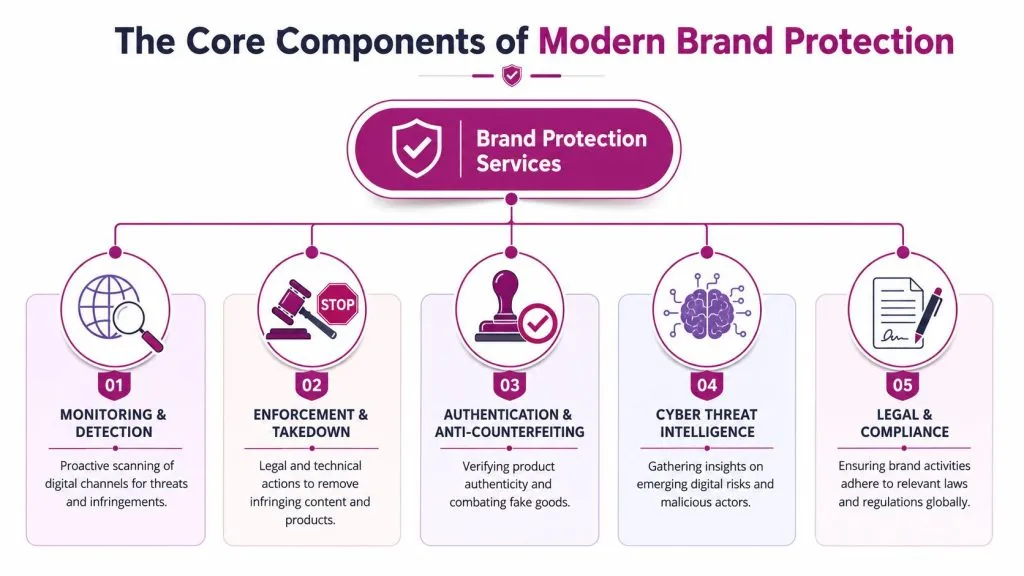
The strongest implementations combine AI/ML, image recognition, NLP, and behavioral analytics with human validation so teams can separate real infringement from unrelated entities or legitimate resellers, as described by BrandShield’s explanation of brand protection services. That last part matters more than most buyers realize. Detection without validation creates noisy queues, unnecessary takedown requests, and credibility problems with clients.
A useful outside reference is this guide for online brand security, which gives a good cross-channel view of how abuse shows up across public web properties. The service-provider job is to convert that view into repeatable monitoring and response.
Dark Web Monitoring
Dark web monitoring is usually the first easy win because clients understand stolen credentials, leaked emails, and exposed account data immediately. It helps you spot when a brand’s identity is being discussed, sold, or abused in places most internal tools never reach.
The actual value isn’t the alert by itself. It’s the correlation. If dark web chatter lines up with a phishing wave, credential reuse risk, or executive impersonation attempt, you can brief the client with context instead of dumping raw indicators. For MSPs building this service line, dark web monitoring capabilities often become the entry point that leads into broader brand monitoring.
Fake Site and Account Detection
This is the part clients notice first because it’s visible and embarrassing. Fake websites, spoofed support portals, social impersonation, and fraudulent seller profiles all use the same tactic: look real enough to hijack trust before anyone verifies.
What works:
- Brand term watchlists: Track priority names, product terms, executive names, and known visual assets.
- Image and content matching: Useful for catching cloned logos, copied site layouts, and reused product images.
- Triage before escalation: Teams need a review step so they don’t confuse fan pages, commentary, or authorized partners with abuse.
What doesn’t:
- Periodic scans: One-off sweeps miss fast-moving impersonation.
- Platform-only reporting: Native abuse forms help, but they don’t replace evidence handling or case management.
- Overly broad keyword alerts: These swamp analysts and make clients distrust the feed.
Threat Intelligence
Threat intelligence turns disconnected findings into an attack picture. A fake domain may be part of a broader cluster. A social impersonation profile may connect to scam ads, affiliate abuse, or a known lure pattern. Good intelligence helps your team decide which assets deserve urgent action and which ones can be watched.
Many providers underdeliver. They collect sightings but don’t produce prioritization. Clients don’t need a scrapbook of abuse. They need to know which threats affect customers, executives, payments, or credentials right now.
Mature teams don’t ask only “Did we find abuse?” They ask “Which abuse matters first, and what evidence do we already have to remove it?”
Vulnerability Scanning
Vulnerability scanning belongs in this stack because brand abuse often rides on visible weaknesses. If a client exposes outdated web assets, stale subdomains, or neglected internet-facing properties, attackers can use those gaps to create convincing impersonation narratives or compromise legitimate infrastructure tied to the brand.
This doesn’t replace traditional vulnerability management. It complements it by connecting external exposure to brand misuse. For service providers, that’s commercially useful because it links two budgets that are often separated: security hygiene and reputation protection.
A short comparison helps frame it:
| Component | Primary question | Operational output |
|---|---|---|
| Dark web monitoring | Has brand-linked data appeared in criminal spaces? | Exposure alerts with context |
| Fake site and account detection | Is someone pretending to be the client publicly? | Verified impersonation cases |
| Threat intelligence | Which findings are part of a bigger campaign? | Prioritized response queue |
| Vulnerability scanning | Is the client exposing weak public assets? | Remediation tasks |
| Deepfake and reputation monitoring | Is manipulated content targeting trust in people or brand? | Escalation for PR, legal, and security |
Deepfake and Reputation Monitoring
This area is moving fast. Executive impersonation, manipulated audio or video, and coordinated reputational attacks can trigger customer confusion well before a legal team can react. Monitoring public channels for fake media, executive name abuse, and suspicious viral narratives gives clients earlier warning.
For providers, this is also where brand protection stops looking like a niche add-on and starts looking like a board-level advisory service. You’re protecting not just the company’s public marks, but the people and trust relationships that hold revenue together.
From IP Protection to Cyber Risk Management
A client calls because customers are entering card details on a fake checkout page that went live that morning. Legal can help with trademark enforcement and formal complaints, but the first hours belong to operations. Someone has to confirm the domain, capture evidence, identify the host or registrar, submit abuse reports, alert the client’s support team, and decide whether customer communication needs to go out the same day.
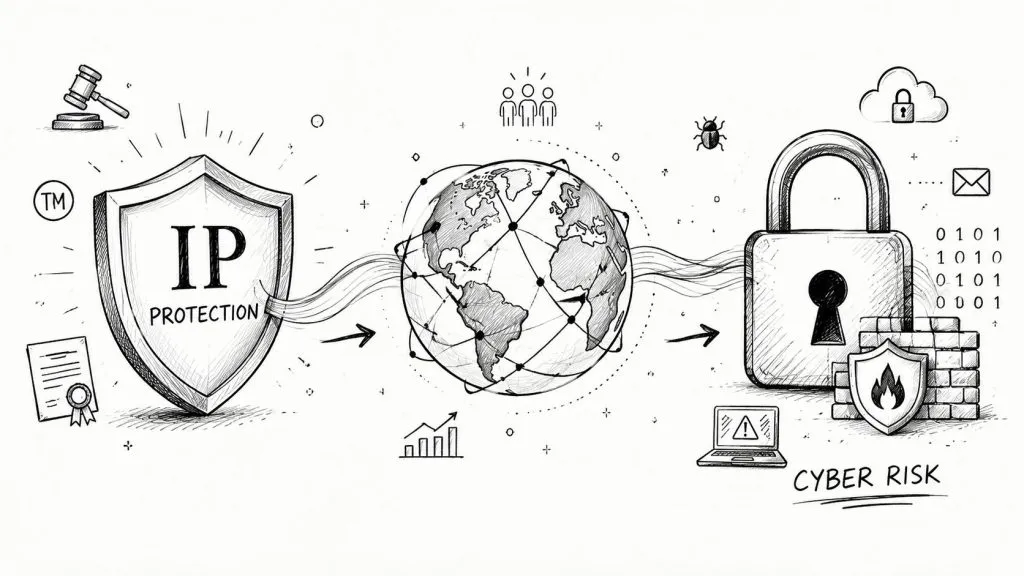
That is why brand protection has shifted beyond trademark watching and counterfeit enforcement. As Doppel explains in its overview of modern brand protection, current programs cover phishing, fake login pages, executive impersonation, and scam ads alongside traditional IP concerns. For MSPs, MSSPs, and hosting providers, that changes the service model. The work starts to look like security operations with legal and communications support, not a legal process with occasional technical help.
Why legal-only workflows break down
Legal teams are designed for rights assertion, documentation, and defensible action. They are rarely staffed for continuous monitoring across domains, social platforms, marketplaces, messaging apps, and ad networks. Security teams and abuse desks already run time-sensitive triage, escalation, and evidence handling. Brand abuse fits that operating model much better.
The handoff point is usually obvious. If an attacker registers a lookalike domain and clones a client portal, the practical questions are immediate:
- Is the page active and collecting credentials, payments, or support requests?
- What evidence needs to be preserved before the content changes or disappears?
- Which provider, registrar, platform, or marketplace has the fastest enforcement path?
- Who owns customer notification, fraud review, and internal escalation on the client side?
This is also where brand protection connects cleanly to external exposure work. Providers that already map public assets and risk paths through attack surface analysis can extend that process into impersonation monitoring, takedown handling, and abuse reporting. The commercial upside matters. Clients stop seeing brand protection as a niche legal add-on and start buying it as an operational security service with visible outcomes.
What security teams need instead
The workable model is continuous monitoring tied to response playbooks. Periodic reviews still have a place for trend reporting and stakeholder updates, but they do not catch fast-moving abuse in time to limit fraud. Attackers can register domains, launch social accounts, and rotate content quickly. Service providers need tooling that surfaces likely abuse early, plus analysts who can validate findings and move them into action.
That action usually includes evidence capture, severity scoring, complaint routing, takedown submission, and coordination with legal, PR, or fraud teams when the case affects customers or executives. The trade-off is straightforward. A low-cost monitoring package creates visibility, but it also creates client frustration if nobody owns enforcement. A higher-value managed service costs more to deliver, yet it is easier to retain because clients can see the difference between alerts and actual case resolution.
If a provider can package detection, validation, takedown support, and reporting into one service, brand protection stops being a loose set of scans and becomes part of cyber risk management. That is the version clients renew.
Why Brand Protection Is a Goldmine for Service Providers
A client calls after support tickets spike overnight. Customers are sending screenshots of a fake login page, a cloned social profile, and emails that look close enough to the authentic brand to win trust. The client is worried about fraud, but the service provider has a second question to answer. Who is going to monitor this exposure, confirm what is real, and push the response through to resolution every week after the first incident?
That ownership gap is where brand protection becomes commercially strong for MSPs, hosting providers, and security firms. Clients already understand the business impact. Lost transactions, support volume, reputational damage, and executive pressure are easy to see. What many of them lack is an external security function that can detect abuse early and manage the response across technical, operational, and customer-facing teams.
It fits recurring revenue without forcing a hard sell
Brand protection is easier to package than many security services because the outcome is visible. Providers can describe it in plain terms: monitor for fake websites, impersonation accounts, scam campaigns, leaked credentials, and abuse of branded assets, then validate findings and help drive takedowns or escalation. Buyers understand that quickly.
The revenue model is also attractive. External abuse does not stop after a one-time assessment, so the service lends itself to monthly monitoring, incident-based response fees, premium executive coverage, and higher-touch enforcement retainers. Providers often enter through adjacent offers such as a white label dark web scanning service, then expand into impersonation monitoring, domain abuse review, marketplace fraud, and social account enforcement as the client matures.
That gives account teams a practical upsell path instead of a one-off project.
It increases retention because clients see operational value
Clients rarely switch away from the provider that can take a messy public incident and turn it into a managed process. Brand abuse cases often involve security, support, legal, marketing, fraud, and leadership at the same time. A provider that can coordinate those parties becomes harder to replace than one that only forwards alerts.
The stickiness comes from execution. Strong providers usually standardize a few things early:
- Case-ready evidence: screenshots, timestamps, asset details, hosting data, and severity notes that a client can act on immediately
- Clear ownership rules: defined thresholds for when the provider handles outreach, when legal reviews language, and when executives need a briefing
- Status reporting: open cases, takedown progress, repeat offenders, and trends the client can show to leadership
There is a trade-off here. A low-cost alerting package is simple to launch, but it often disappoints clients when no one owns remediation. A managed service with analyst review and takedown handling costs more to deliver, yet it is easier to renew because the client sees outcomes, not just noise.
It gives sales teams a better entry point
Brand protection works well in early sales conversations because it is externally observable. Providers can often show a prospect suspicious domains, fake profiles, copied content, or exposed credentials without touching internal systems or starting a long technical assessment. That shortens the path to a meaningful discussion.
It also broadens the provider’s position in the account. Internal controls still matter, but they do not answer the customer complaint that says, “I paid the wrong site because it looked legitimate.” Brand protection speaks directly to that problem. For hosting providers, it also supports a stronger security story around the infrastructure, domains, and digital presence they already help manage.
A simple commercial framing helps:
| Standard MSP pitch | Brand protection pitch |
|---|---|
| We secure your internal environment | We monitor external abuse of your brand and help stop it |
| We respond to issues inside your stack | We also track the public channels attackers use to reach customers |
| We protect systems | We protect systems, customer trust, and revenue |
This is why the category sells well across regulated businesses, consumer-facing brands, multi-location firms, and companies with visible executives. It gives service providers a service that is easier to explain than many security products, easier to prove than many awareness programs, and easier to expand once the client sees real cases closed.
Evaluating and Choosing a Brand Protection Platform
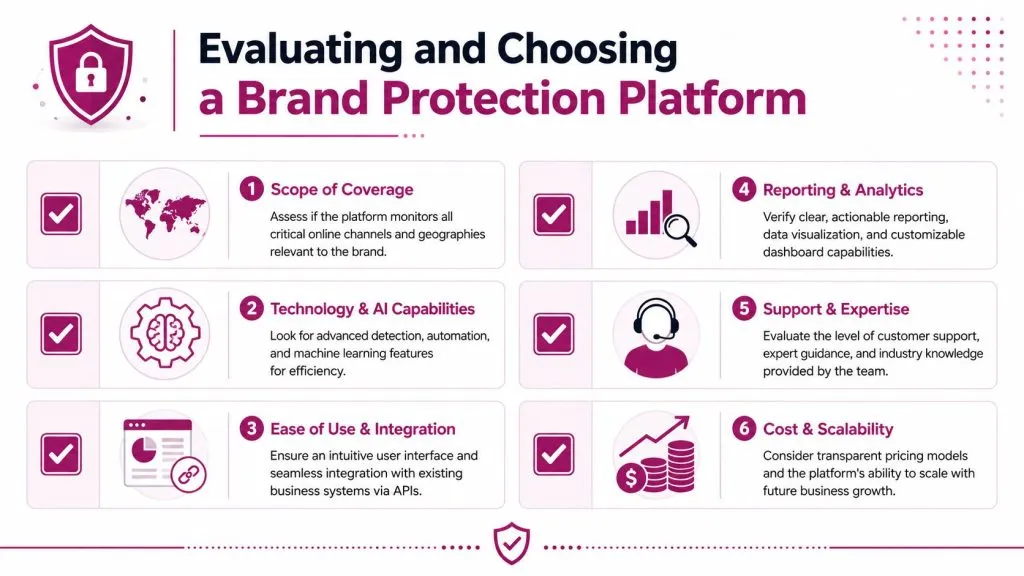
The wrong platform will give you a lot of alerts and very little service you can deliver. The right one will let you monitor broadly, validate quickly, act on findings, and report cleanly to clients under your own operating model.
This checklist is a useful way to structure vendor review.
Coverage matters more than feature lists
Start with monitoring scope. If the platform only watches domains, it won’t cover the channels where many client incidents now surface. You need visibility across websites, social platforms, app stores, marketplaces, and other public properties relevant to the client’s risk profile.
Ask vendors to show you:
- Where they monitor: Domains, social, apps, marketplaces, public web, and other abuse channels.
- How they detect: Pattern matching, visual similarity, language analysis, behavior signals, or combinations of these.
- How they reduce noise: Human review, confidence scoring, and rules for excluding legitimate use cases.
A broad dashboard is not enough. You want evidence that the system can distinguish true abuse from harmless mentions or authorized partners.
Ask how the vendor handles enforcement
Detection is only half the service. The more important question is what happens after a finding is validated. Strong platforms support evidence packaging and practical enforcement paths, including registrar complaints, platform abuse queues, and other removal workflows. Weak platforms leave your analysts to copy screenshots into email and hope for the best.
Use this short buyer checklist in demos:
- Evidence quality: Are screenshots, asset details, and contextual artifacts gathered automatically?
- Workflow control: Can your team assign, track, and escalate cases cleanly?
- Response flexibility: Does the platform support both urgent abuse cases and slower-moving disputes?
- Client reporting: Can you generate reports that make sense to non-technical stakeholders?
Check reseller fit early
Many technically capable platforms fail the channel test. They work for direct enterprise buyers but not for MSPs, hosting providers, or MSSPs who need multi-tenant visibility, white-label reporting, API access, and pricing that supports recurring resale.
Comparing products by their operating model, rather than solely by detection logic, is a reasonable approach. For example, InsecureWeb is built for MSPs, hosting providers, and security firms, and includes API access plus services such as dark web monitoring, fake site and account detection, threat intelligence, vulnerability scanning, and deepfake or reputation monitoring. That’s useful if you need a platform you can plug into existing service delivery instead of building custom glue around single-purpose tools.
Buy for workflow first. If your team can’t operationalize the output, the feature set won’t save the service.
A final screening question helps: can the vendor support how you sell, onboard, report, and escalate today, or will your team have to redesign its operating model around the tool?
Measuring Success and Demonstrating ROI to Clients
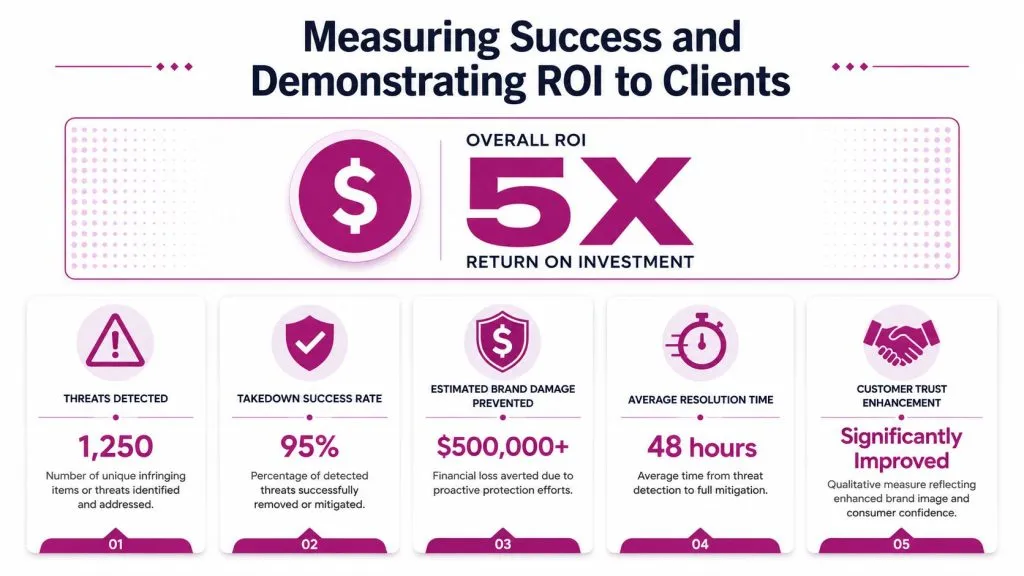
At this point, many providers lose momentum. They find abuse, send alert emails, and assume the client understands the value. Most clients don’t. They need proof that the service reduces exposure, resolves threats faster, and supports business outcomes they care about.
This visual shows the kind of KPI framing clients expect, even if your actual numbers will vary by account and threat mix.
Use operational KPIs first
Recorded Future explicitly recommends tracking time-to-detection, time-to-takedown, and related operational measures to prove whether brand protection is working, not just whether it can find abuse, as covered in its guidance on real-time intelligence for brand protection. That recommendation is important because detection-only reporting often sounds impressive while hiding a weak response function.
The most useful KPI set is usually simple:
| KPI | What it tells the client | Why it matters |
|---|---|---|
| Time-to-detection | How quickly abuse was found after appearing | Shorter exposure window |
| Time-to-takedown | How quickly validated abuse was removed | Faster disruption of scams |
| Takedown success rate | How often removal efforts worked | Quality of enforcement process |
| Case backlog | How much validated abuse is still pending | Operational load and bottlenecks |
| Repeat offender tracking | Which actors or channels keep recurring | Where to focus next controls |
Don’t overload monthly reports with vanity counts. “We found a lot” is weaker than “we found critical items quickly, validated them, and moved them through removal.”
Translate metrics into client outcomes
The client doesn’t buy time-to-detection as an abstract number. They buy fewer customers reaching fake pages, fewer support escalations, less confusion around executive identity, and less brand damage from public scams.
A good report connects each metric to an outcome:
- Fast detection: Reduced the period during which customers could encounter a fake asset.
- Fast takedown: Limited the spread and lifespan of active scams.
- Strong success rate: Showed the service can move from visibility to action.
- Trend analysis: Identified which channels or themes keep getting abused, so the client can adjust controls and messaging.
This is also where qualitative reporting helps. If a fake support account was removed before it gained traction, say that plainly. If a phishing page was discovered early and escalated quickly, show the timeline. If a client had multiple unresolved assets because a platform moved slowly, call that out too. Honest reporting builds trust faster than padded dashboards.
The cleanest ROI story is operational. We found the threat, verified it, removed it, and reduced the time it could harm customers.
For MSPs, this reporting discipline also protects renewal conversations. Clients may forget individual incidents, but they remember a provider who can show what was prevented, what was resolved, and where risk is shifting.
The Next Step in Your Security Portfolio
The perimeter problem has changed. Clients still need endpoint protection, email security, backups, patching, and access control. They also need someone watching the internet for abuse of their identity, their executives, their domains, and the trust they’ve spent years building.
That’s why brand protection services fit so well in a modern provider portfolio. They connect external monitoring, security operations, reputation defense, and practical incident response in a form clients can understand. They also create recurring revenue around work that is visible, urgent, and difficult for clients to run alone.
The providers that do this well don’t sell it as a legal extra or a marketing nice-to-have. They package it as managed external risk reduction. That framing is more accurate, and it makes delivery easier because your team can anchor the service in detection, validation, enforcement, and reporting.
If you already help clients reduce cyber risk, this is a natural extension of the same mission. You’re just widening the field of view to include the places attackers abuse brand trust before they ever touch a protected endpoint.
If you want to add brand protection services to your portfolio without building the monitoring and workflow stack from scratch, InsecureWeb is one option to evaluate. It’s designed for MSPs, hosting providers, and security firms that need external threat visibility, white-label delivery, and API-based integration into existing service operations.