Data Breach News14 min read
Zero Trust Security Solutions: A Practical Guide for MSPs
By InsecureWeb Team
This report reflects observations of dark web activity. InsecureWeb makes no representations regarding the accuracy of this data.
You’re probably already living this problem. A technician gets phished, a reused admin credential leaks into a password dump, and suddenly the same remote access stack that supports one client now becomes the shortest path into several. For an MSP or MSSP, that’s the primary reason zero trust security solutions matter, they’re not a trendy architecture, they’re the difference between one compromised account and a cross-tenant incident.
The old perimeter model breaks fast in managed services because trust gets reused everywhere. Shared tools, delegated admin rights, contractors, remote endpoints, SaaS sprawl, and third-party access all collapse into the same question, who gets in, from where, and under what conditions? Zero trust answers that with continuous verification, least-privilege access, and session-level control, which is exactly the posture an MSP needs when it’s responsible for many clients at once.
The MSP Wake-Up Call
A single stolen credential is rarely just one client’s problem in an MSP shop. If that login reaches shared RMM, PSA, cloud admin, or password vault tooling, the blast radius can jump across tenants in minutes. Perimeter thinking fails here, because the perimeter is not one network anymore, it is a mesh of delegated access paths.
The hard lesson is that multi-tenant operations need tenant-specific trust decisions. If an endpoint looks healthy for Client A, that does not mean the same user or device should get the same access to Client B’s systems, especially when third-party admins, after-hours support, and break-glass accounts are in play. Outside threat visibility matters too, because stolen credentials and impersonation campaigns often surface first in places you are not watching closely, like the open internet and credential marketplaces, which is why services like dark web monitoring for managed service providers belong in the stack.
Practical rule: if one admin credential can touch multiple client environments, your access model is already too flat.
CISA’s zero trust guidance treats the model as granular least-privilege access decisions enforced continuously, not as a one-time login gate, as noted in the earlier CISA zero trust guidance reference. That distinction matters for MSPs because the business model depends on delegated access, and delegated access is where traditional trust assumptions rot. Zero trust is the architecture that keeps a compromised session from turning into a multi-client cleanup project.
What Zero Trust Actually Means
A zero trust stack only works when you stop handing out broad access after login. An MSP can package that idea into a service clients understand, but the service has to be built around narrow, revocable access paths, not around a fancier VPN story. Every access request should be judged on identity, device state, and context, then allowed only where the request fits.
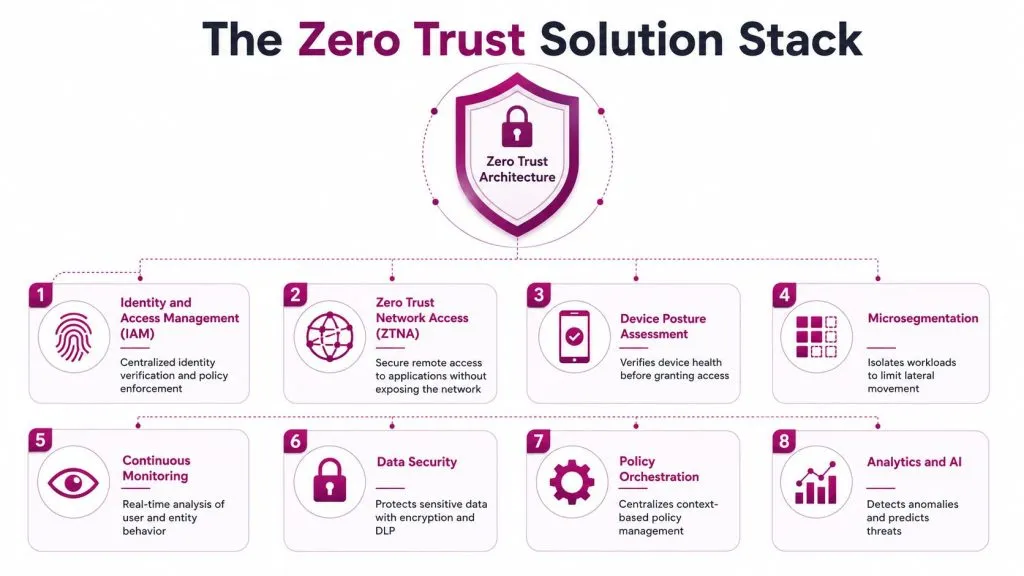
The Zero Trust Solution Stack
The three principles that matter are continuous verification, least privilege, and assume breach. Continuous verification means the system keeps checking identity, device posture, and context every time access is requested. Least privilege means users and service accounts only get what they need. Assume breach means you design as if something will fail, so you limit the damage before it spreads.

For an MSP, those principles change the business mechanics. Onboarding gets tighter because access is scoped to role, tenant, and device state instead of blanket VPN access. Third-party access becomes controllable because sessions can be time-bound and app-specific. And the blast radius shrinks because a stolen token does not automatically grant access to every internal hop.
CISA describes zero trust as enforcing precise access decisions at granular levels, while NIST-oriented guidance treats trust as something that is never implicit and must be continuously evaluated. In practice, that means a policy decision point evaluates the request and a policy enforcement point allows or blocks it, then the system can re-check if posture or risk changes mid-session. That is why zero trust is an architecture, not a product box. You do not buy it off the shelf, you assemble it across identity, device, network, workload, telemetry, and attack surface analysis controls. See attack surface analysis for MSPs if you want a clear example of how exposure mapping supports the policy layer.
The right question is not “Do we have zero trust?” It is “Which access path still trusts too much?”
The Zero Trust Solution Stack
The stack only works when the components reinforce each other. IAM verifies the person or service account, ZTNA limits the path to the application, device posture checks whether the endpoint is safe, microsegmentation stops lateral movement, monitoring catches anomalous behavior, and policy orchestration keeps the rules consistent. Without that layering, you have just renamed old perimeter tools.
The Core Solution Categories
A workable zero trust stack for an MSP is not one vendor and not one control. It’s a set of categories that interlock, and if one of them is missing, the whole resale story gets weaker. The point is to package a service clients can understand, then deliver it with enough integration depth that your team can operate it without drowning in exceptions.
Identity, access, and application entry
ZTNA is the front door most clients will feel. It replaces broad network reach with application-level access, so users get to the app they need without being dropped into the whole network. Microsoft’s zero trust guidance emphasizes least privilege, just-in-time or just-enough access, and continuous validation, which fits the MSP model because it gives you tighter control over third-party support paths (Microsoft zero trust guidance).
IAM is the policy engine behind that front door. If identity isn’t clean, everything downstream gets noisy. Multi-factor auth, role design, and conditional access are the foundation, not the add-ons. If you’re still treating identity as a login tool instead of a security boundary, your zero trust pitch won’t hold up.
Device, network, and segmentation controls
Device posture assessment is what keeps a trusted user from becoming a trusted problem. A credential on a managed, compliant laptop is one thing. The same credential on a jailbroken, unpatched, or unknown endpoint is another. The system should know the difference before access starts.
Microsegmentation matters when the attacker gets past the first gate. It limits lateral movement inside the client environment and inside your own management plane. That’s especially important for shared admin tools, service accounts, and workloads that shouldn’t talk freely just because they sit in the same cloud account.
Monitoring, threat intelligence, and validation
Continuous monitoring and analytics closes the loop. You need session telemetry, behavior signals, and policy logs if you want to prove the model is working. Without that visibility, zero trust turns into another policy deck no one can defend.
Threat intelligence belongs in the stack because identity abuse starts before the login screen. Dark web monitoring, fake site detection, and brand impersonation alerts help you catch credential exposure and fraud attempts earlier than internal logs alone. External visibility is where a service like attack surface analysis for managed environments fits naturally, because your clients’ real exposure isn’t just inside their own network map.
Vulnerability scanning and AI-guided penetration testing make the stack honest. Scanning tells you where the weak points are. Pen testing tells you whether the controls fail the way an attacker expects them to fail. If you resell zero trust without validation, you’re selling confidence, not security.
| Zero Trust Solution Evaluation Criteria for MSPs | Multi-Tenancy | API Access | White-Label Ready | MSP Margin Model |
|---|---|---|---|---|
| ZTNA | Strong when tenant boundaries are native | Strong if policy and session APIs exist | Sometimes | Seat or tenant based |
| IAM | Varies by directory and federation depth | Usually strong | Rarely | Often per user or bundle |
| Device posture assessment | Moderate | Strong if endpoint data is exposed | Sometimes | Per endpoint or managed tier |
| Microsegmentation | Strong in mature platforms | Moderate to strong | Rarely | Project plus subscription |
| Continuous monitoring and analytics | Strong if logs are tenant-aware | Strong | Sometimes | Seat, log volume, or bundle |
| Threat intelligence | Strong if feeds are contextualized | Strong | Often | Bundle or add-on |
| Vulnerability scanning | Strong if scopes are separated | Strong | Often | Asset or subscription based |
| AI-guided penetration testing | Moderate | Strong | Sometimes | Per test or retainer |
If you want to white-label a real service instead of stitching together disconnected point tools, API-driven offerings are the cleanest path. InsecureWeb is one example in this category, because it combines dark web monitoring, fake-site detection, vulnerability scanning, and AI-guided penetration testing into a branded service model for MSPs. That keeps the customer experience under your name while letting your team keep the operating surface narrower.
How to Evaluate Zero Trust Vendors
Don’t buy by feature count. Buy by how well the platform survives a multi-tenant reseller model. If a vendor can’t isolate tenants, expose clean APIs, and fit into your PSA and RMM workflows, it’s going to cost you more in ops time than it earns in margin.
Score the platform like an operator
Use a short scorecard before you sign anything. The questions that matter are blunt.
- Multi-tenancy depth: Can you separate clients cleanly, or do you end up faking it with tags and spreadsheets?
- API access: Can your team automate provisioning, reporting, and alert routing without manual console work?
- White-label flexibility: Can you deliver the service under your own brand, or does the vendor remain visible everywhere?
- Pricing model: Does the vendor charge per seat, per tenant, per asset, or in a way that matches how you bill?
- Operational fit: Does it integrate with the tools your techs already use, or does it create another swivel-chair workflow?
Rule of thumb: if the vendor’s dashboard becomes your technicians’ daily bottleneck, the platform is too expensive even when the license looks cheap.
Compare categories before you compare products
| Solution Category | What to Ask First | Good MSP Fit | Weak MSP Fit |
|---|---|---|---|
| ZTNA | Can I scope access by tenant and app? | Tenant-specific application access | Broad tunnel-style access |
| IAM | Can I automate joiner, mover, leaver workflows? | Strong identity automation | Manual admin and custom exceptions |
| Device posture | Can I pull endpoint state into policy? | Clean health checks and compliance signals | Static device allowlists |
| Monitoring and analytics | Can I separate client telemetry and alerting? | Per-tenant dashboards and exports | Shared logs with poor filtering |
| Threat intelligence | Can I turn alerts into client actions? | API-based enrichment and branded reporting | Generic feed dumps |
| Vulnerability scanning | Can I run scoped scans safely? | Clear tenant boundaries and reporting | Flat scans with noisy output |
| Pen testing | Can I trigger tests on demand? | Controlled, repeatable test plans | One-off manual engagements |
If you’re evaluating API-driven services, treat the API as a product feature, not a checkbox. Ask whether alerts, findings, and reports can land in your portal, your tickets, and your client-facing workflows. If the answer is yes, you can package it. If the answer is no, you’ll end up reselling someone else’s interface.
A 12-Month Zero Trust Deployment Roadmap
MSPs fail zero trust projects when they try to roll out everything at once. The right move is phased, because you need working identity and visibility before you tighten enforcement. That sequencing also makes the service easier to sell, because each quarter can produce something the client can see and audit.
Quarter 1 and Quarter 2
Start with discovery, identity, and scope. Inventory every privileged identity, every managed endpoint, every service account, and every third-party access path. Define tenant boundaries and map the workflows that matter, then lock in your baseline metrics for detection and containment.
After that, roll out ZTNA to the highest-risk access paths first. Focus on remote admin access, contractors, and shared support workflows. The goal is to replace broad VPN-style reach with application-level control without breaking daily operations. Keep the rollout narrow enough that your technicians can support it.
Quarter 3 and Quarter 4
Bring in device posture assessment and microsegmentation once identity and entry are stable. You start limiting risky endpoints and shrinking internal movement paths. You don’t need to re-architect every client network in one pass, but you do need to cut off the easy lateral movement routes that attackers love.
Then fold in continuous monitoring and threat intelligence. This is the place to add API-driven external visibility, including dark web monitoring, fake-site detection, vulnerability scans, and AI-guided pen testing under your own brand. Those services give clients proof that zero trust isn’t just blocking access, it’s also watching for the credential exposure and impersonation that usually come first.
- Q1 deliverables: identity inventory, tenant map, access policy draft, baseline metrics.
- Q2 deliverables: ZTNA pilot, privileged access scoping, remote support redesign.
- Q3 deliverables: endpoint posture gating, segmentation for high-risk systems, policy tuning.
- Q4 deliverables: alerting workflow, threat-intel integration, client reporting, quarterly maturity review.
A roadmap like this gives your sales team something concrete and gives operations a realistic sequence. It also keeps you from promising a “complete” zero trust program before the client has the plumbing to support it.
Compliance Alignment and ROI
Compliance is where zero trust becomes easy to defend in front of finance. Auditors do not care about slogans, they care about whether access control, logging, segmentation, and identity governance are visible, repeatable, and tied to a documented process. If you can map those controls cleanly to frameworks like SOC 2, ISO 27001, HIPAA, PCI DSS, and NIST CSF, you have a service clients can justify and renew.
Why CFOs pay attention
The strongest business case is breach cost. Industry reporting on IBM’s 2025 Cost of a Data Breach findings shows that organizations with a zero-trust architecture saved an average of $1.76 million per breach compared with organizations without it. That is the number to use when a CFO asks why an MSP is pushing identity controls and segmentation instead of another point product, and it comes from the industry summary of IBM 2025 breach-cost findings.
That same reporting also noted a global average breach cost of $4.44 million in 2025. Verizon’s 2025 DBIR found that 22% of breaches began with credential abuse, which is the attack path zero trust is built to compress. Microsoft’s 2025 security reporting added that phishing-resistant MFA can block over 99% of identity-based attacks, which is exactly why identity hardening pays back quickly, see the industry summary of IBM 2025 breach-cost findings, the Verizon DBIR data above, and the Microsoft security reporting above.
What to present in the client proposal
Put the control, the framework, and the business outcome on the same page.
Use a simple structure. Show how IAM supports access control, how monitoring supports logging and evidence, how segmentation supports network protection, and how threat intelligence strengthens detection and response. Then connect those controls to fewer audit surprises, faster evidence collection, and lower breach exposure.
For MSPs and MSSPs, the sales angle should be sharper than a generic compliance pitch. Package zero trust as an evidence-producing security layer that you can white-label, report on, and tie back to recurring compliance tasks the client already has to complete. That framing helps the buyer, because it turns an architecture discussion into something the finance team can price, and it gives your team a cleaner way to sell managed identity, managed monitoring, and API-driven external threat intelligence without sounding like you are bolting on random tools.
Common Pitfalls and Honest Limitations
Zero trust is not magic, and MSPs get into trouble when they sell it that way. The biggest failure mode is the execution gap, where a company buys too many tools, never converges the policy layer, and ends up with inconsistent enforcement across environments. Gartner’s guidance is blunt here, define scope, risks, budget, business processes, and gaps before implementation, because the hard part is alignment, not the label (Gartner zero trust architecture guidance).
Where the model still struggles
IoT, OT, and constrained-device environments are harder. The research shows that orchestration, lightweight cryptography, and environmental perception are still underexplored in those settings, which means you can’t promise a neat, universal rollout there. In practical terms, legacy plants, building systems, and specialized devices often need segmentation-first designs, not a clean identity-only approach (systematic review of zero trust in constrained environments).
The other problem is friction. If you over-tighten every policy on day one, users start looking for shortcuts. They’ll push for exceptions, shadow IT, or alternate collaboration paths if the approved path becomes unusable. MSPs need to be honest about that trade-off and tune policies so the business can still move.
Zero trust should reduce risk without turning every ticket into a permission escalation.
The right pitch is controlled access, not blocked work. If the client can’t operate, the architecture failed even if the dashboard looks clean.
Pre-Deployment Checklist and Key Questions
Before you sign anything, run the same checklist every time. Inventory identities, devices, service accounts, and third-party access paths. Map the data flows. Define tenant boundaries. Confirm API access, white-label options, and reporting exports. Set your baseline metrics for detection and containment, then schedule quarterly maturity reviews from day one.
For credential exposure monitoring, a dedicated dark web scan is a good operational checkpoint before and after rollout. It gives you a concrete way to look for leaked identities and impersonation signals that belong in the access decision layer, not just in incident response.
Three questions MSPs hear all the time, answered plainly. How do you measure whether zero trust is reducing risk without slowing the business? Track access exceptions, endpoint compliance, and how often policy changes are needed, then compare that against the client’s baseline operations. Can zero trust work in OT and legacy environments? Yes, but usually through segmentation and scoped access rather than full replacement. How do you package external threat intelligence as a billable service? Bundle it into monitoring, reporting, and alert-driven response so the client gets a managed outcome, not just raw data.
If you’re building or reselling a zero trust stack, stop trying to assemble it from disconnected point tools. Visit InsecureWeb and use its API-driven dark web monitoring, fake-site detection, vulnerability scanning, and AI-guided penetration testing to package a branded service that fits your MSP model and scales across clients.