Data Breach News12 min read
Zero Trust Architecture Implementation: A Practical Playbook
By InsecureWeb Team
This report reflects observations of dark web activity. InsecureWeb makes no representations regarding the accuracy of this data.
Most zero trust projects fail for a simple reason, teams buy tools before they know what they’re protecting. That shortcut feels productive, but it usually produces exceptions, overlapping policies, and a false sense of control. A zero trust architecture implementation starts with governance, visibility, and disciplined sequencing, because the model only works when identity, devices, applications, infrastructure, and network controls are all being governed together.
The market has moved past the “is this real?” debate. Gartner reported that 63% of organizations worldwide had implemented a zero-trust strategy by April 2024, which shows that zero trust has become mainstream, even if maturity still varies widely across organizations and regions (Gartner press release). The harder question is whether the strategy is enforced across the environment, or just attached to a roadmap slide.
Why Zero Trust Is a Program and Not a Product
A zero trust architecture implementation fails fast when leaders treat it like a software purchase. No single vendor can give you verified identity, device posture, segmentation, policy orchestration, logging, and access governance all by itself. Those capabilities have to be coordinated, and coordination is a program problem first, a tooling problem second.
The real unit of work is governance
Zero trust is built on verify explicitly, least privilege, and assume breach. Those principles sound simple until someone has to define who gets access, under what conditions, to which data, from which device, and with what logging requirements. That’s where most brownfield environments stall, because the work exposes missing inventories, undocumented business processes, and old exceptions that no one wants to own.
NIST’s implementation guidance frames this as a phased effort, beginning with discovering the environment, defining mission-based access policy, identifying existing capabilities, closing gaps, and then implementing and verifying the components (NIST SP 1800-35). That sequencing matters because zero trust is measured by how broadly those principles are enforced, not by whether the organization has adopted the label.
Practical rule: if your team can’t name the protected surface, the policy owners, and the exception process, you’re not ready to choose products yet.
Why the program view survives brownfield reality
Brownfield environments are messy by design. They already contain legacy apps, fragile authentication paths, shadow IT, and business units that depend on exceptions to keep things moving. A product-first rollout usually creates a stack of compensating controls that look secure on paper but don’t align with how people work.
CISA’s 2025 implementation guidance shows how zero trust matured into a concrete control model, including strong MFA throughout the enterprise, phishing-resistant MFA for agency staff, contractors, and partners, and MFA enforced at the application layer rather than the network layer (CISA implementation guidance). That’s not a product purchase. It’s a policy decision that has to be carried through identity, application access, and auditability.
In practice, timeline and budget are driven less by the tool contract and more by governance readiness. If the catalog is incomplete, the identity model is fragmented, or the logging estate can’t support validation, the program will slow down no matter how strong the vendor demo looked.
Discovery and Inventory Before Any Technology Selection
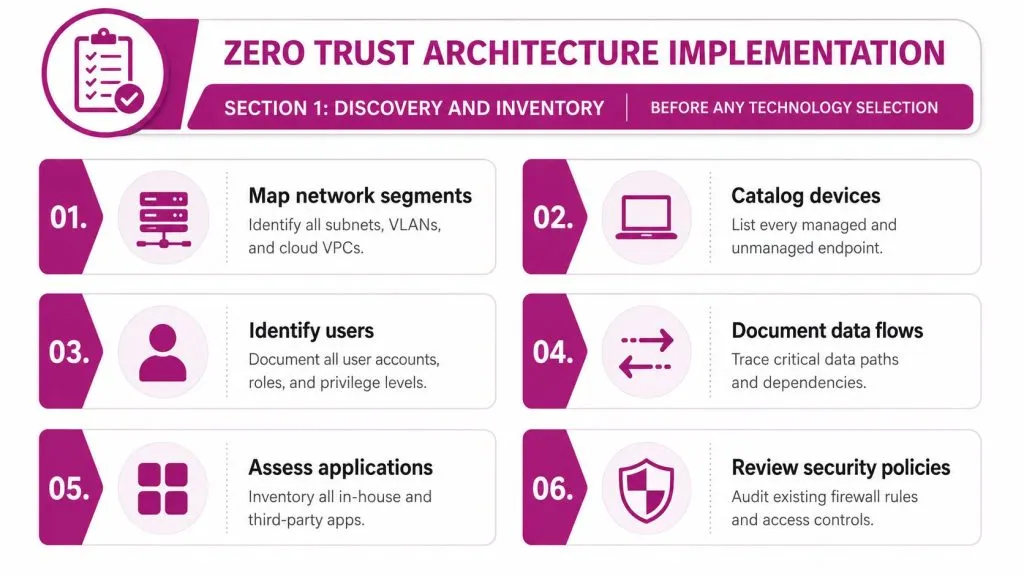
The first mistake I see in zero trust programs is jumping to a tool shortlist before the organization knows what it owns. That usually leads to controls being bolted onto a partial asset list, which means the biggest risks stay outside the design. NIST and Gartner both point toward the same front-end work, inventory, policy definition, identity governance, application cataloging, logging, and scope decisions, before enforcement starts (NCCOE draft guidance).
What needs to be cataloged
Start with the things that create access risk. That includes privileged accounts, service accounts, contractor access, sensitive applications, exposed data paths, unmanaged endpoints, legacy authentication dependencies, and the current policy gaps around them.
A useful inventory doesn’t just list assets, it connects them. If a finance application depends on an old app server, a shared database account, and a manually approved VPN exception, that’s one control problem, not three unrelated ones. The same goes for shadow IT, because a tool no one formally manages still expands the attack surface.
Use the inventory to map transaction flows, not just asset names. Ask where the request originates, what authenticates the user or service, where authorization happens, what logs are created, and where the session can move next. That reveals which systems need early attention because they combine high value with weak visibility.
How to prioritize the first pilot
The best first targets are usually privileged accounts and sensitive applications, because they give you high security value with a narrower scope than an enterprise-wide rollout. That aligns with NIST’s incremental approach and avoids the business disruption that comes with a rip-and-replace mindset (NIST SP 1800-35).
A strong pilot scope usually includes three filters.
- Highest business value, lowest chaos: choose a system the business cares about but can tolerate in observation mode while policies are tuned.
- Clear transaction paths: select workflows where you can trace access from user to application to data and validate what happened.
- Existing IAM foundation: prioritize places where your current identity and access controls can be extended instead of rebuilt from scratch.
For brownfield environments, the key question isn’t “what’s the perfect zero trust product?” It’s “where can we prove policy decisions with the least operational friction?” That’s why a mature inventory process often does more to unblock implementation than any technology evaluation cycle.
Internal mapping also matters here, especially if your team is already doing attack surface work. The practical overlap with attack surface analysis is real, because both disciplines depend on seeing the environment clearly before controls are tightened.
Inventory work feels slow until you compare it with the cost of fixing exception sprawl after rollout.
Core Design Patterns for Zero Trust Controls
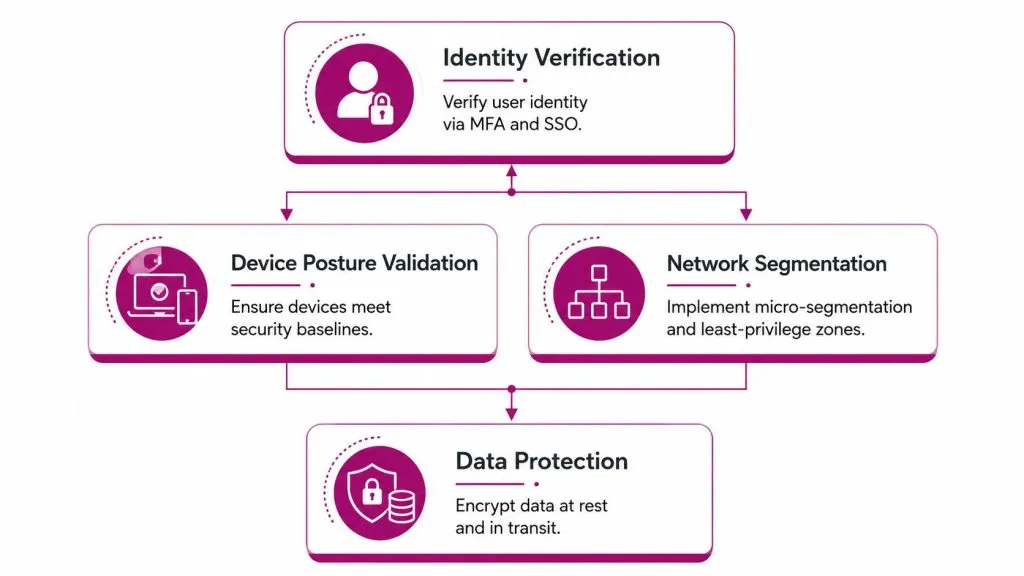
Teams often overemphasize one control family while underbuilding the others. Identity teams want stronger authentication, network teams want segmentation, and security teams want better data protection, but zero trust only works when those pieces reinforce each other. Microsoft’s model frames the architecture around identity, endpoints, apps, infrastructure, and network, tied together by verify explicitly, least privileged access, and assume breach (Microsoft Zero Trust guidance).
Identity and device signals have to travel together
Strong identity alone doesn’t solve the problem if the device is unmanaged or unhealthy. CISA’s guidance makes that clear by emphasizing phishing-resistant MFA and enterprise-wide MFA enforcement at the application layer, not just at the perimeter (CISA implementation guidance). In practice, the access decision should use identity plus device posture, not one or the other.
That’s where conditional access earns its keep. A clean design checks who the user is, what device they’re using, whether the device meets baseline posture, and whether the request matches policy for that application and that data tier. If any of those pieces are missing, the request should degrade gracefully, not fail in a way that forces people back to a broad exception.
Segmentation contains damage, it doesn’t replace identity
Micro-segmentation is useful because it limits lateral movement, but it’s not a substitute for access governance. If you only segment the network and leave overbroad identity permissions in place, an attacker who gets valid credentials can still move through approved paths that were never intended for that user.
The better pattern is to combine least privilege, segmentation, and continuous authorization. That means a service account can reach one application tier, a contractor can reach one support portal, and a privileged admin can be granted access only for the task and window that policy allows. The point isn’t to make access impossible, it’s to make it specific.
Data protection closes the loop
Data controls are the part many programs postpone because they’re harder to standardize. Encryption, access policy, and logging need to line up with the sensitivity of the data, or segmentation just becomes a prettier version of the old perimeter.
The strongest zero trust designs don’t ask, “Can this user get in?” They ask, “Can this user get only what they need, from a trusted device, for a specific purpose, with an auditable trail?”
That trade-off matters for user experience too. If policy is too rigid, users route around it. If it’s too loose, security gets a false win. The balanced design is one that uses layered signals to keep normal work smooth while making risky access expensive, visible, and revocable.
Phased Migration Plan Starting with High-Value Targets
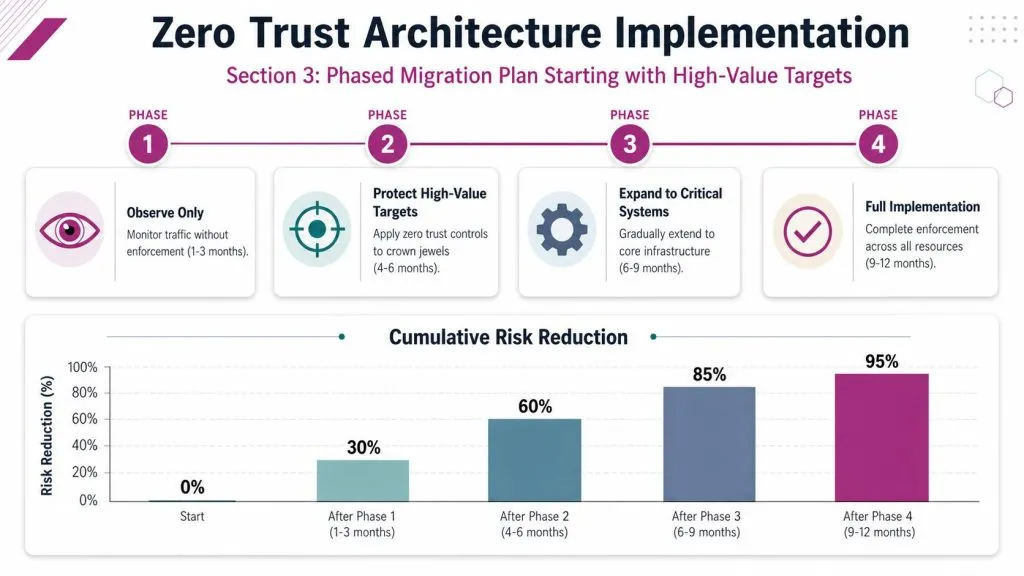
Big-bang zero trust programs usually fail because production teams won’t accept a blind cutover on critical systems. NIST’s guidance explicitly recommends incremental rollout, starting with high-value targets and validating controls before broad expansion (NIST SP 1800-35). That’s the only sane way to move in a brownfield estate.

Start in observation mode
Begin by monitoring access without enforcing every policy on day one. Observation mode gives you the raw material to tune policies, find false positives, and uncover dependencies that weren’t documented during inventory.
The point of this phase is not to delay security. It’s to make the first enforcement decision credible. If you can’t explain why a request was allowed or denied in the pilot, you’re not ready to expand it.
Protect the crown jewels first
Privileged accounts and sensitive applications should be the first enforcement targets because they create the highest risk if they’re misused. Once those are under control, extend the same model to adjacent systems that share identity paths, data flows, or administrative functions.
A useful pilot definition includes the access boundary, the business owner, the exception process, and the rollback plan. If any of those are fuzzy, the pilot will drift and every defect will be argued as an edge case.
For environments with legacy systems, the answer is usually not a wholesale replacement. A lot of teams need intermediary layers, compensating controls, or stricter access paths while older systems are gradually isolated. The goal is to reduce exposure while keeping the business running.
If you’re evaluating adjacent detection work, there’s a practical tie-in with dark web monitoring use cases, because credential exposure often becomes visible outside the enterprise before an access event is logged inside it.
Move from pilot to production with evidence
A pilot should only expand when the logs show the policy is enforceable, the business process still works, and the exception volume is manageable. That verification step is not optional. It’s the difference between a controlled migration and a collection of temporary workarounds that become permanent.
Organizations often ask how long this takes. The right answer is not a fixed schedule, because the timeline depends on scope, legacy constraints, and how much governance cleanup is needed before enforcement. A quarterly cadence usually works better than a one-shot program plan because it gives teams room to validate, adjust, and then broaden the perimeter of trust.
Policy Enforcement and Continuous Validation
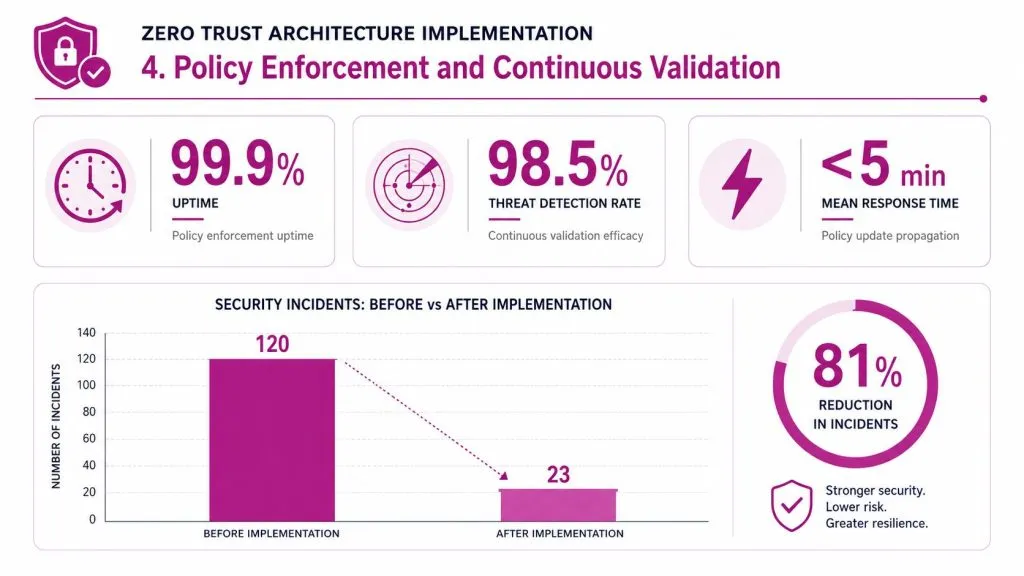
Policy is where zero trust becomes measurable. Authentication, authorization, access control, orchestration, and auditing all need to line up, or the architecture becomes a set of disconnected controls with no reliable feedback loop. NIST’s implementation model depends on verifying the deployment and then continuously improving it as threats and regulations change (NIST SP 1800-35).
Enforcement needs a policy owner, not just a platform
The hardest operational gap is usually orchestration and auditing. Authentication tools are relatively easy to deploy compared with policy consistency across business units, exception handling, and post-decision review. That’s why the policy owner matters, because someone has to decide when a request is blocked, when it’s allowed, and when it must be escalated.
A good governance model ties policy to business use cases, not abstract rules. If finance, engineering, and third-party support all have different access patterns, the controls should reflect that reality while still preserving a shared standard for identity proofing, logging, and revocation.
Validation is the control that proves the control works
Continuous validation should answer a few practical questions.
- Are policies covering the intended resources?
- Are exceptions shrinking, or are they becoming the primary access model?
- Can access be revoked quickly when a role changes or a credential is exposed?
- Can the team detect lateral movement attempts inside the protected surface?
Those questions matter more than vanity metrics because they expose whether the model is changing risk. If users are still relying on manual approvals, stale entitlements, or undocumented bypasses, the program isn’t mature enough to claim real enforcement.
Logging is part of enforcement, not a separate function. Gartner’s early-task guidance explicitly includes logging, identity governance, application cataloging, and business process alignment, which is a good clue that visibility problems are often the true bottleneck, not the controls themselves (NCCOE draft guidance).
Policy has to evolve with the environment
Threats change, business workflows change, and regulations change. If your policy engine isn’t being reviewed on a schedule, exceptions will pile up and the zero trust model will slowly drift back toward implicit trust.
The right test is simple, can you show that access was deliberate, limited, logged, and revocable for the whole path, not just the login event?
That’s the difference between policy as a document and policy as an operating control. The first can be approved in a meeting. The second has to survive every real request your users make.
Common Pitfalls and How to Avoid Them
I’ve seen the same failure pattern enough times to trust it. A team starts with a promising architecture, buys a few controls, and then discovers that no one owns the app catalog, the exception process, or the logging standard needed to prove the rollout works. The project doesn’t usually fail in a dramatic way. It turns into an exception factory.
Brownfield reality breaks clean-slide assumptions
Greenfield diagrams make zero trust look orderly. Brownfield environments are full of legacy authentication, undocumented dependencies, and systems that can’t tolerate aggressive policy changes. If you don’t account for those constraints early, users get blocked and the business starts asking for carve-outs.
The fastest recovery is to shrink the scope, restore visibility, and rebuild policy around the actual workflow instead of the ideal one. That often means revisiting identity governance, cleaning up the application catalog, and tightening the pilot to a smaller set of systems that can be validated properly.
Segmentation without identity is a half-measure
Some teams treat network segmentation as if it completes the model. It doesn’t. Without strong identity controls, a valid credential can still open the wrong door, and the firewall will happily allow the traffic if policy says the subject is trusted.
The fix is to align segmentation with authenticated identity and device posture. That combination is harder to manage, but it closes the gap that pure network design leaves behind.
The quiet killer is governance fatigue
The most dangerous warning sign is not a tool failure, it’s exception creep. If local teams keep requesting special cases because the policy is too broad, too rigid, or too hard to support, the architecture starts to erode from the inside.
Logging gaps are another early signal. If you can’t confirm what happened after a request was allowed or denied, you can’t validate the model, and if you can’t validate it, you’re guessing. When that happens, step back, restore the inventory, and re-baseline the policy before expanding again.
InsecureWeb helps teams spot exposed credentials, weak points, and impersonation risks before they turn into access problems. If you’re building a zero trust program and want better visibility into the threats that live outside your perimeter, visit InsecureWeb to see how its monitoring and scanning services can support your security workflow.