Data Breach News12 min read
Vulnerability Scanning vs Penetration Testing: Explained
By InsecureWeb Team
This report reflects observations of dark web activity. InsecureWeb makes no representations regarding the accuracy of this data.
Most advice on vulnerability scanning vs penetration testing starts with the wrong question. It treats the two as rivals, then tries to force a budget decision before the team has even defined what each method is supposed to prove. That’s how organizations end up with a scanner that produces noise, a pentest that arrives too late, or both tools running in parallel without a workflow that turns findings into action.
The practical distinction is simpler. Vulnerability scanning is an automated sweep for known issues, while penetration testing is a human-led attempt to exploit weaknesses and chain them into real impact, a distinction grounded in automation versus adversarial validation (DeepStrike). Mature programs use both because they answer different questions. Scanning asks what exposures exist across the environment. Penetration testing asks whether an attacker can get in and do damage.
| Attribute | Vulnerability Scanning | Penetration Testing |
|---|---|---|
| Primary purpose | Find known weaknesses across many assets | Prove exploitability and business impact |
| Method | Automated | Human-led |
| Strength | Broad coverage and repeatability | Deep validation and attack chaining |
| Weak spot | Surface-level by design | Less continuous and more expensive |
| Best use | Continuous hygiene and prioritization | Targeted validation after discovery or remediation |
Why the Either-Or Debate Misses the Point
The loudest argument around vulnerability scanning vs penetration testing is usually framed as a choice. Pick the cheaper one. Pick the deeper one. Pick whichever one your auditor asks for. That framing misses the operational reality inside MSPs, MSSPs, and internal security teams, because the two methods don’t compete for the same job.
They answer different questions
Scanning asks, what known exposures exist across our assets right now? It is broad, automated, and built for repeatability. Penetration testing asks, can an attacker turn any of those weaknesses into actual access or meaningful damage? That second question needs human judgment, chained actions, and context around what matters to the business (Picus Security).
That difference matters because a clean scan report doesn’t mean the environment is resilient, and a clever pentest doesn’t replace the coverage of routine discovery. A mature security program uses the scan to identify and rank known weakness, then uses the pentest to validate whether the riskiest paths are exploitable. In other words, the scan is the map, the pentest is the field exercise.
Practical rule: if the team can only answer one question with the tool, it’s not a substitute for the other tool.
Why the substitute mindset wastes budget
The substitute mindset causes duplicate work. Teams pay for a pentest that rediscovered obvious patched issues, or they buy a scanner and assume they’ve covered adversarial validation. Neither outcome is efficient, and both create a false sense of coverage.
A better model is layered assurance. Continuous scanning keeps the asset base under observation, while periodic pentesting validates the paths that matter most. That pattern aligns with how major security guidance treats the two methods, broad discovery first, then targeted validation (Picus Security). It also matches the way real remediation programs work. Findings need to be triaged, fixed, and checked again, not just reported once.
For MSPs, that framing changes the sales conversation too. Don’t pitch pentesting as “better” scanning. Pitch it as the proof layer that makes the scan data operationally useful. For internal teams, the same logic applies. Scanning is the continuous control. Pentesting is the verification.
Definitions and Core Objectives Compared
The cleanest way to separate vulnerability scanning vs penetration testing is to define each by what it does in practice, not by the generic labels people attach to them. Scanning is an automated process that inventories assets, compares them to known CVEs, exposed services, weak configurations, missing patches, and unsafe defaults, then produces a prioritized findings list for remediation (MSP Corp). Pentesting is a hands-on exercise that attempts to exploit weaknesses and chain them together to prove real-world impact (DeepStrike).
Side by side in operational terms
Vulnerability scanning is built for coverage. It can run across networks, apps, clouds, and other IT systems, and it is usually used to keep hygiene current and help teams decide what to fix first. Penetration testing is built for proof. It is a manual or human-led simulation of real attack behavior, intended to show whether a vulnerability leads to access, privilege escalation, or data exposure.
The difference shows up in daily operations. A scanner is the better fit when you need to track the full asset base, keep watch on drift, and support ongoing triage. A pentest is the better fit when you need to test whether a likely path is exploitable, especially after you have already narrowed the risk set through attack surface analysis.
| Attribute | Vulnerability Scanning | Penetration Testing |
|---|---|---|
| Scope | Broad and repeatable | Narrower and targeted |
| Method | Automated sweep | Human-led exploitation |
| Output | Prioritized list of findings | Evidence of exploitability and impact |
| Frequency | Continuous or scheduled | Periodic |
| Best at | Inventory, known issues, prioritization | Validation, chaining, business logic |
That difference matters in the field. If you need to know whether every endpoint, cloud asset, or public-facing app has a missing patch or risky configuration, scanning is the right first pass. If you need to know whether a chain of smaller issues becomes a breach path, pentesting is the right validation step.
Scanning tells you where the doors are unlocked. Pentesting tells you whether someone can get through the hallways, open the right rooms, and leave with something valuable.
Why confusion creates gaps
Confusing the two creates blind spots. A scan can tell you that something is exposed, but it does not prove the security impact of that exposure. A pentest can prove impact, but it will not naturally give you the same broad, repeatable view of the whole environment. The distinction between automated coverage and adversarial validation is the main reason the two methods should be sequenced, not collapsed into one.
For teams running a mature program, the right question is never “Which one is real security?” It is “Which one gives us the right signal at this stage of the control cycle?” That is the operational mindset that keeps budgets focused and remediation credible. For MSPs and MSSPs, it also avoids paying twice for the same discovery work, then missing the handoff from findings to validation.
Depth Versus Breadth in Security Testing
Security teams often want one tool to do two jobs. That rarely works in practice. Vulnerability scanning gives breadth, speed, and repeatability. Penetration testing gives depth, context, and proof. Those strengths pull in different directions, and the better programs accept that trade-off instead of pretending it can be removed.
Breadth is fast, depth is earned
Automated scanners are built for scale. They inventory assets, compare them against known issues, and flag likely weaknesses across large environments. That makes them useful for continuous hygiene, especially when the environment changes often or the team needs a consistent baseline before deeper validation. For MSPs, they are also easier to standardize across tenants in a multi-client stack.
Pentests work differently. They are manual or human-led, so they take more time and usually more effort to run. That extra effort pays off in places scanners struggle, especially business-logic flaws, unusual trust relationships, and chained attack paths that do not fit a signature-based model, as discussed by Cyber Defense Magazine.
Industry writeups on manual testing consistently point to far more unique findings than an automated-only pass, and the reason is straightforward. A scanner can confirm exposure, but it does not reason through attacker intent, sequence, or misuse of a trusted workflow. A pentest can.
The key point is that test depth matters when risk is hidden in sequence, context, or attacker creativity.
What scanners miss and why that matters
Scanners are strongest where the issue is known and patternable. They are weaker where the weakness depends on application behavior, trust boundaries, or the way multiple small findings combine into a real attack path. That is why a scan often becomes the starting point for remediation work, not the end of it, as noted by MSP Corp.
A practical rule helps here.
- Use scanning for asset coverage, known CVEs, misconfigurations, and recurring hygiene.
- Use pentesting for exploitability, chained access, and checking whether a weakness is operationally dangerous.
- Use both when the risk is tied to business impact, not just technical exposure.
The mistake many teams make is expecting a pentest to behave like a broad scanner with better branding. It will not. The better workflow is to let the scanner find the likely weak points, then send a pentest at the few places where proof matters most. That is where the budget buys security value, especially in environments where controls overlap and findings can be repeated unless the handoff is planned. For example, if a physical or logical access layer is already being validated elsewhere, such as cellular vs NFC gate access, do not pay a pentest team to rediscover the same control weakness from a different angle unless the business question specifically requires it.
When to Use Each Method and When to Combine Them
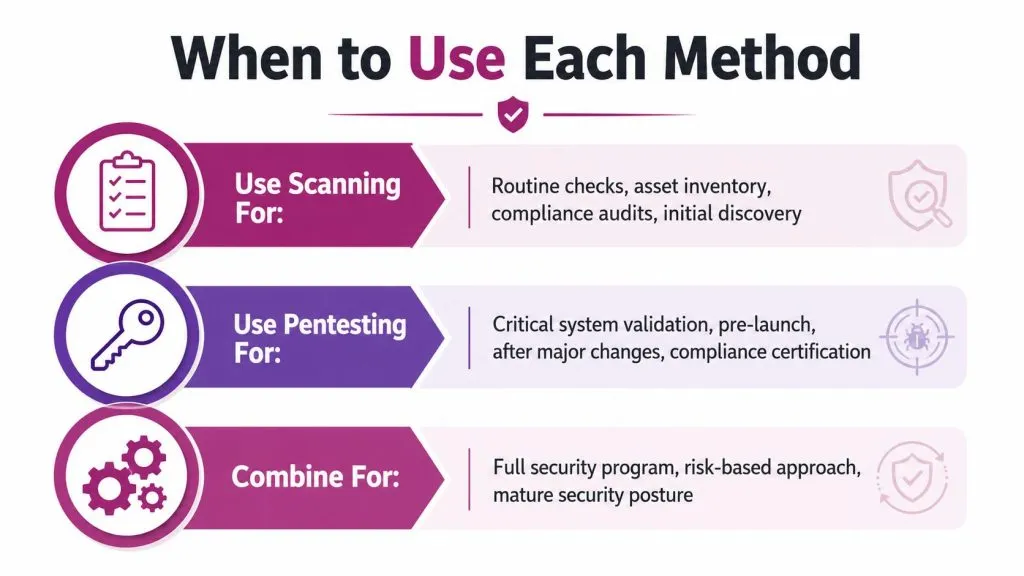
The right choice depends on the decision you need to make, not the tool you already own. If you need continuous visibility, start with scanning. If you need proof of exploitability, use pentesting. If you need both hygiene and assurance, combine them deliberately so the second activity doesn’t repeat the first.
A practical decision matrix
For continuous compliance monitoring, scanning should lead. It fits the need for repeatable checks across infrastructure, cloud services, and apps, and it helps teams track known issues over time. For pre-deployment validation or post-remediation verification, a targeted pentest can confirm that the fix changes the attack outcome. That’s the point where manual judgment adds value.
For post-incident investigation, scanning can help map what else is exposed, while a pentest can test whether the incident path is still open elsewhere. For client-facing assessments in an MSP or MSSP environment, the best response is usually a layered package, because different customers care about different proof points and different reporting styles.
If the question is “what might be weak?”, scan first. If the question is “can this weakness be abused?”, pentest. If the question is “how do we avoid paying twice for the same answer?”, sequence them.
Avoid duplicate findings
The common budget waste comes from running a pentest without a clean scan baseline. That forces the tester to rediscover obvious exposures instead of spending time on attack chains and control validation. The fix is simple. Use the scan to narrow the field, then scope the pentest around the highest-value assets, the riskiest changes, and the most important business processes.
That orchestration mindset also shows up in physical access security. A resource like cellular vs NFC gate access is useful because it shows how different control layers solve different problems, rather than replacing one another. The same logic applies here. Discovery and validation are separate layers.
The best combined model is not “scan and pentest everything all the time.” It’s “scan continuously, then pentest the parts of the environment where exploitability would change the business conversation.” That keeps the program lean and defensible.

Building a Layered Security Testing Workflow
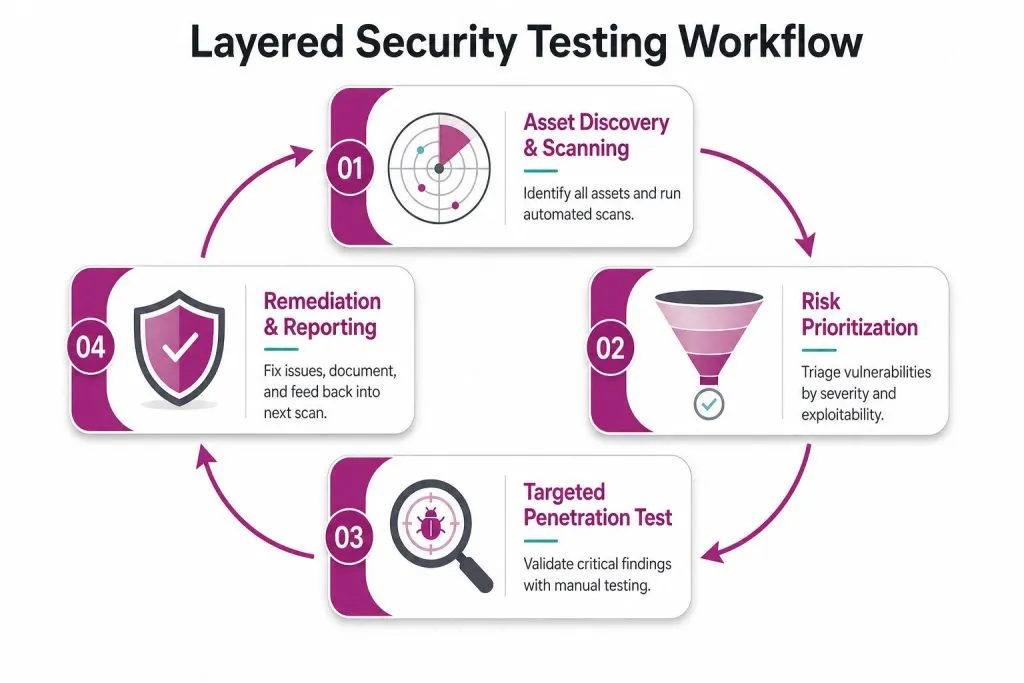
A workable program starts with scanning data, not with a pentest calendar. Scans create the broad inventory, the severity ranking, and the shortlist of areas that deserve human attention. Pentesting then validates whether the most important exposures really translate into attack paths, and that validation feeds the next round of remediation.
A sequence that doesn’t waste effort
The cleanest workflow is discovery, prioritization, validation, remediation. Asset discovery and automated scanning catch the known issues. Prioritization uses severity models such as CVSS and EPSS to sort what matters first, because not every finding needs the same response (Picus Security). Targeted pentesting then focuses only on the critical areas that still need proof.
That order matters because it prevents redundant testing. A pentest team shouldn’t spend half the engagement confirming commodity issues that a scanner already flagged and the operations team already fixed. The better use of human time is to test whether control gaps, chaining opportunities, or risky business processes still survive after remediation.
How the outputs should feed each other
The scan report should influence pentest scope. If the environment contains a cluster of externally exposed systems, weak configurations, or a new application path, those areas become candidates for manual validation. If the pentest confirms a path to impact, the remediation team gets a much clearer change list than it would from a raw vulnerability list alone.
For teams who want a deeper framing of layered controls, understand multilayered protection is a useful companion concept. The same idea applies here, one control layer finds exposure, another proves whether it can be used.
The key is to treat the workflow as a loop, not a one-time event. Scan, rank, test the riskiest paths, fix, then rescan. That loop is what turns point-in-time testing into an operating model.
Implementation Guidance for MSPs and Security Teams
MSPs and internal teams get better results when they package security testing as a chain of services, not as isolated deliverables. The workflow should start with automated scanning, feed into targeted validation, and end with remediation guidance that the client can act on. If the report doesn’t drive a change ticket, the engagement is incomplete.
What to operationalize first
Start with a repeatable scan baseline across client environments. That gives you a shared vocabulary for risk, a way to compare tenants, and a clean intake for deeper tests. Then decide which assets justify manual validation. Public-facing systems, critical apps, and environments with recent changes are usually better candidates than stable internal segments.
The reporting layer matters as much as the testing layer. Use clear remediation ownership, separate what’s exploitable from what’s present, and keep the outputs aligned to a fix workflow. If you need a practical model for follow-up discipline, mastering vulnerability remediation is worth reviewing because the hardest part is usually not detection, it’s getting the issue closed.
How to package it for clients
For MSPs and MSSPs, the strongest offer is usually a layered bundle, not a single test. Pair continuous scanning with periodic pentesting, then add threat context where it helps the client understand priority. If you also monitor for exposure outside the perimeter, a service like dark web scan can fit naturally into the same program because it broadens the picture beyond internal assets.
A good service package should answer three client questions:
- What changed? Show new exposures and risky modifications.
- Can it be abused? Use pentesting to prove or disprove impact.
- What gets fixed next? Tie each critical finding to an owner and a deadline.
That structure works because it respects how teams buy security. They don’t want more alerts. They want fewer unknowns and fewer surprises.
Real-World Scenarios and Expected Outcomes
A mid-sized business with a small IT team usually gets the best return from continuous scanning plus periodic validation. Scanning gives them an ongoing view of patch gaps and misconfigurations, while a scheduled pentest confirms whether the most important paths are exploitable. If an incident does happen, the team can use a post-breach review to understand what else was exposed and what still needs hardening, which is why steps after data breach belongs in the playbook.
What this looks like in practice
An MSP serving multiple clients can standardize the scan layer, then reserve pentesting for higher-risk tenants, critical systems, or pre-change reviews. That keeps costs predictable and makes the deeper work more meaningful. Internal security teams can do the same by using scan output to narrow pentest scope, then focusing manual testing on the areas where a business process would be affected.
The outcome is usually better prioritization, less duplicate effort, and reports that map more cleanly to remediation. The organizations that do this well don’t ask which method is superior. They ask how each method fits into the control cycle.
If you want a practical way to turn scan results into action and add targeted validation where it matters, InsecureWeb offers the layered approach MSPs and IT teams usually need. It’s built for continuous discovery, deeper testing, and client-ready reporting, so you can spend less time chasing duplicate findings and more time fixing the risks that actually matter.