Data Breach News13 min read
What Is Exposure Management and Why It Matters in 2026
By InsecureWeb Team
This report reflects observations of dark web activity. InsecureWeb makes no representations regarding the accuracy of this data.

Exposure management is the continuous process of identifying, prioritizing, and reducing internet-reachable security weaknesses across assets, identities, and configurations, not just running periodic vulnerability scans. The global exposure management market was estimated at USD 3.3 billion in 2024 and projected to reach USD 10.91 billion by 2030.
An MSP discovers the problem during a routine client review. A forgotten test server is still reachable from the internet, a cloud storage permission is broader than intended, and an old administrator account still has access to a production application. None of these issues necessarily appears as a neat, urgent item in a traditional vulnerability report.
That situation is common because modern exposure is larger than a list of software flaws. Cloud workloads, APIs, SaaS platforms, identities, third-party integrations, and unmanaged services all create possible routes into a business. Exposure management asks a more practical question than “Which vulnerabilities exist?” It asks, “Which reachable conditions could an attacker combine to affect something important, and what will remove that path?”
The Reality of Modern Cyber Exposure
The first finding looks harmless. The test server runs an old application, contains no obvious customer records, and belongs to a development team that assumed it was protected behind the corporate network. The MSP’s external review tells a different story. The server has a public route, an administrative interface, and a connection to another environment that contains more valuable systems.
A periodic vulnerability scan might identify the outdated application. It might not explain that the server is internet-reachable, who owns it, whether authentication is required, or whether its privileges create a route to a higher-value asset. Those details determine practical exposure.
Exposure management is a continuous, structured process for discovering what an attacker can reach, evaluating how separate weaknesses could connect, assigning ownership, and reducing the reachable risk. The discipline grew from vulnerability management, but it covers a broader environment that includes cloud workloads, APIs, SaaS, identities, and third-party integrations. Industry history traces the category through Gartner’s introduction of Continuous Threat Exposure Management, or CTEM, in 2022. Tenable says it pioneered the exposure management category in October 2017 and introduced its first exposure management platform in 2018, while Gartner had expanded the taxonomy again by 2025 with exposure assessment platforms. These milestones are summarized in this background on exposure management.
Why periodic scans miss the operational problem
A scan gives you a point-in-time view. Exposure management gives you an operating process.
That distinction matters when teams add a SaaS application without security review, publish an API during a product release, change a cloud firewall rule, or grant a service account more privileges than it needs. The weakness may not be a conventional CVE. It may be an exposed identity, a permissive configuration, an unknown asset, or a chain of individually modest issues.
For an MSP, the challenge is multiplied across clients. Each client has different asset inventories, owners, contracts, risk tolerances, and remediation capabilities. A repeatable exposure process helps the provider build authority in a defensible niche by turning scattered external findings into a clear service model, rather than presenting another undifferentiated scan report.
Practical rule: If you can’t identify the asset, its owner, its reachable paths, and the action that will reduce exposure, you don’t yet have an operational finding.
The goal isn’t to find every theoretical weakness and overwhelm a small IT team. The goal is to identify the exposures that matter most, verify the fix, and keep looking as the environment changes.
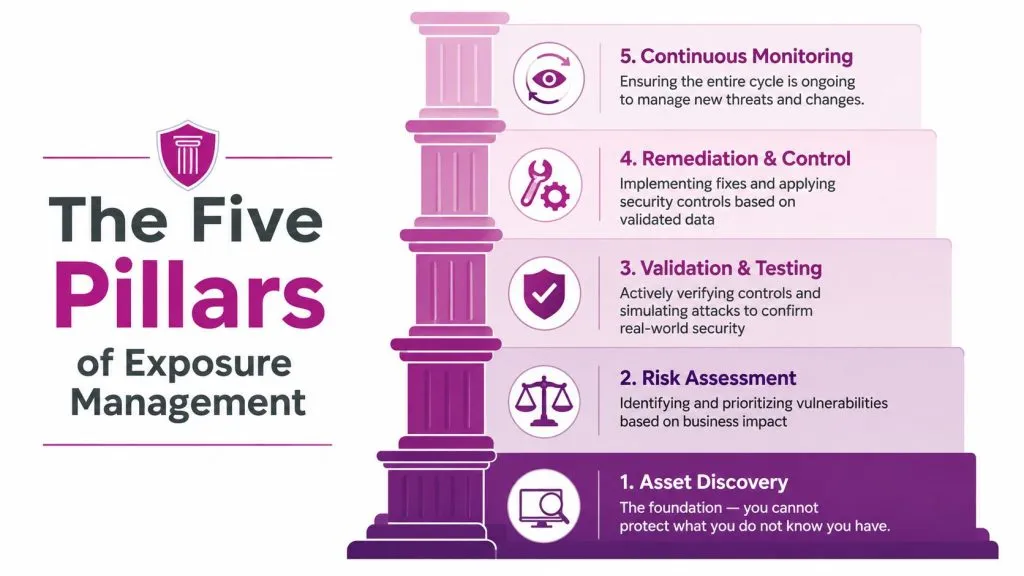
The Five Pillars of Exposure Management
Exposure management works as a connected discipline. Discovery without ownership produces an inventory nobody can act on. Prioritization without reachability creates another severity-ranked queue. Remediation without validation creates confidence without proof.
Asset discovery
Asset discovery is the foundation because you can’t protect what you don’t know you have. Build a working inventory of internet-facing hosts, cloud resources, applications, APIs, domains, identities, certificates, and important third-party connections.
Think of it as creating a map of every door and service entrance around a building. An internal asset register may show the doors your facilities team installed. External discovery shows the door a contractor added, the temporary entrance nobody removed, and the service window that was left open after a project ended.
Ownership belongs in the inventory. An asset without a named technical and business owner will usually wait in a queue, even when the security team has correctly identified the problem.
External attack surface management
External attack surface management shows the organization from the outside. It helps identify assets that respond to internet traffic, exposed services, forgotten subdomains, public applications, and third-party dependencies that may not appear in internal records.
This pillar complements internal vulnerability scanning. A scanner may assess known systems well, but it can’t protect an asset that never entered its scope. Attack surface analysis helps teams understand how an adversary might enumerate and connect those external assets. For a deeper explanation of that perspective, see this guide to attack surface analysis.
Vulnerability and configuration assessment
Vulnerabilities remain important, but exposure management places them beside misconfigurations, weak authentication, excessive permissions, and insecure defaults. The same software flaw has different practical significance depending on whether the affected system is isolated, internet-facing, authenticated, privileged, or connected to a critical business service.
The assessment should therefore connect each finding to reachability, ownership, authentication dependence, and privilege reach, rather than treating the scanner’s severity label as the final decision.
Threat-informed risk assessment
Threat intelligence adds attacker perspective. It can help a team decide whether an exposed service, identity, or vulnerability deserves immediate attention, especially when attackers are known to target that technology or access pattern.
This doesn’t mean an SMB needs a large intelligence department. An MSP can establish a small set of decision signals, such as whether the asset is public, whether exploit activity is relevant, whether sensitive data is reachable, and whether the account has unnecessary privilege. Those signals provide more useful direction than a flat list.
Remediation orchestration and monitoring
The final pillar turns findings into assigned work. A useful ticket should identify the asset, owner, exposure path, business consequence, recommended action, and deadline. After remediation, the team should reassess the original path, not merely mark the ticket complete.
That creates a loop:
- Discover the asset and exposure.
- Prioritize the route according to reachability and impact.
- Assign the action to the responsible team.
- Validate that the route is closed.
- Monitor for reappearance or new exposure.
Each pillar strengthens the others. Remove an unnecessary public service, harden the services that must remain exposed, and continue checking whether changes have restored the path.
How Exposure Management Differs from Vulnerability Management
Traditional vulnerability management still has a place. It identifies known software weaknesses, supports structured patching, and provides useful evidence for audits. The operational gap appears when teams treat that list as a complete representation of cyber exposure.
| Dimension | Vulnerability Management | Exposure Management |
|---|---|---|
| Primary question | Which known software flaws exist? | Which reachable conditions create meaningful attack paths? |
| Scope | Usually scanned systems and known vulnerabilities | Assets, identities, configurations, APIs, cloud services, and connected paths |
| Timing | Periodic assessments and remediation cycles | Continuous discovery, reassessment, and risk reduction |
| Prioritization | Scanner severity and technical impact | Reachability, exploitability, authentication, privilege, ownership, and business importance |
| Ownership | Often centered in security and patch teams | Shared across security, IT, application owners, cloud teams, and business stakeholders |
| Completion | Patch or configuration change is recorded | The original exposure is rechecked and shown to be reduced or closed |
| Budgeting | Tool and labor for scanning, triage, and patching | A broader operating model covering discovery, validation, workflows, and monitoring |
| Outcome | A managed vulnerability backlog | A smaller and better-understood set of reachable business risks |
The difference is easiest to see in daily work. A vulnerability manager may sort findings by severity and send a remediation queue to IT. An exposure management team starts with the externally reachable asset, maps ownership and access, determines whether an attacker can use the condition, and assigns the fix according to the path’s business consequence.
That shift also changes accountability. Security can’t generate tickets and assume the job is finished. IT can’t close a ticket because a patch tool reported success if the service remains reachable through another route. Business owners need to help define which applications, identities, and data stores deserve priority.
The useful test: If your team measures only how many findings it discovered or closed, it may be measuring activity rather than reduced exposure.
You don’t need a full exposure program merely because you run vulnerability scans. The transition becomes necessary when your inventory is unreliable, findings lack owners, external assets appear unexpectedly, cloud and SaaS changes outpace review, or patched systems remain difficult to validate. At that point, buying another scanner won’t solve the central problem. The operating model needs better context and follow-through.
Why MSPs and SMBs Need Exposure Management Now
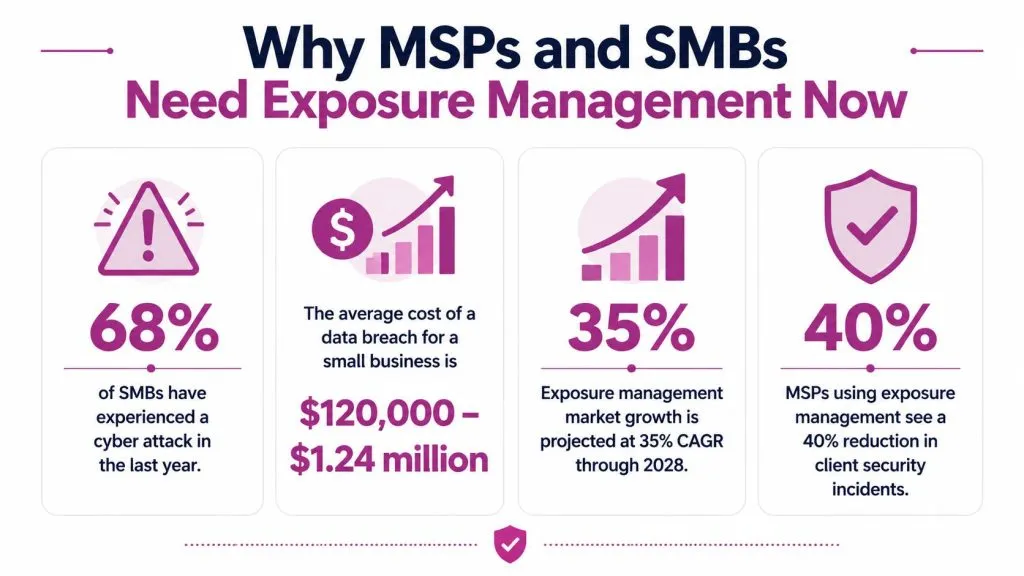
Small organizations rarely have spare staff to investigate every alert, reconcile every scanner, and chase every owner. That makes prioritization more important, not less. An SMB can start with a narrow question, which internet-facing assets and identities could give an attacker the most useful route into the business?
The category’s commercial momentum reflects that need. One market estimate placed exposure management at USD 3.3 billion in 2024 and projected USD 10.91 billion by 2030, with a 22.9% CAGR from 2025 to 2030, while another snapshot in the same report estimated USD 3.27 billion in 2024 and USD 3.89 billion in 2025. These are market projections, not a guarantee of security outcomes, but they show that organizations are budgeting for a broader approach to continuous, risk-based defense. The figures come from Grand View Research’s exposure management market analysis.
The MSP opportunity
For an MSP, exposure management can become a recurring operational service rather than a once-a-year assessment. The provider can standardize discovery, review internet-facing changes, route findings to the right client contact, validate remediation, and present a concise risk report during service reviews.
That model creates practical differentiation. Many providers can offer antivirus, patching, and scheduled scans. Fewer can answer which exposed paths matter most, why a finding belongs to a particular owner, and whether the agreed fix changed the external view.
It can also reduce avoidable ambiguity in client relationships. A report that says “critical vulnerability found” invites an argument about severity. A report that says “publicly reachable service, authenticated administrative path, owner identified, remediation verified” gives both sides a concrete decision.
The SMB reality
An SMB doesn’t need to copy an enterprise security architecture. It needs a manageable sequence. Start with the perimeter, identities with privileged access, cloud storage permissions, remote administration, and externally accessible applications. Remove what shouldn’t be public, harden what must remain public, and validate the result.
The business case is straightforward. A forgotten service can provide initial access, a weak identity can provide escalation, and a poorly monitored connection can let an attacker move without early detection. Exposure management helps teams interrupt that chain before they spend scarce resources investigating a much larger incident.
For organizations assessing adjacent external signals, resources such as this overview of dark web monitoring benefits can help connect exposed credentials and impersonation risks to the wider exposure picture.

The strongest approach is proportional. A small IT team can use existing scanners, cloud inventories, identity data, ticketing, and carefully chosen external monitoring rather than purchasing every category of enterprise tooling at once. The discipline matters more than the size of the platform.
Implementing Exposure Management in Your Organization
Implementation should begin with reachability, not procurement. A team that buys a platform before deciding what it needs to know, who owns each asset, and how it will validate fixes may create a more polished backlog.
Step one, remove unnecessary exposure
List public services, administrative interfaces, remote access points, APIs, cloud resources, and externally visible applications. For each item, ask whether it needs to be accessible from the internet at all.
If the answer is no, remove the route. Decommission the service, restrict access, close the unnecessary path, or place the resource behind an approved access mechanism. This is usually the clearest first action because eliminating reachability removes an attack opportunity rather than merely reducing its severity.
Step two, harden what must remain reachable
Some services have to be public. Web applications, customer portals, email services, and selected APIs may be business requirements. Protect them with a focused baseline:
- Patch exposed software: Apply relevant security updates and confirm the running service changed.
- Replace default passwords: Remove factory credentials and review stored secrets.
- Require MFA: Add multi-factor authentication to administrative and remote access.
- Use jump-host access: Keep privileged management away from direct public exposure.
- Monitor ingress and egress: Review unexpected connections and outbound activity.
- Limit privileges: Remove unnecessary access from users, service accounts, and integrations.
CISA’s exposure reduction guidance supports the practical sequence of removing unnecessary internet exposure, hardening assets that must remain exposed, and reassessing controls routinely.
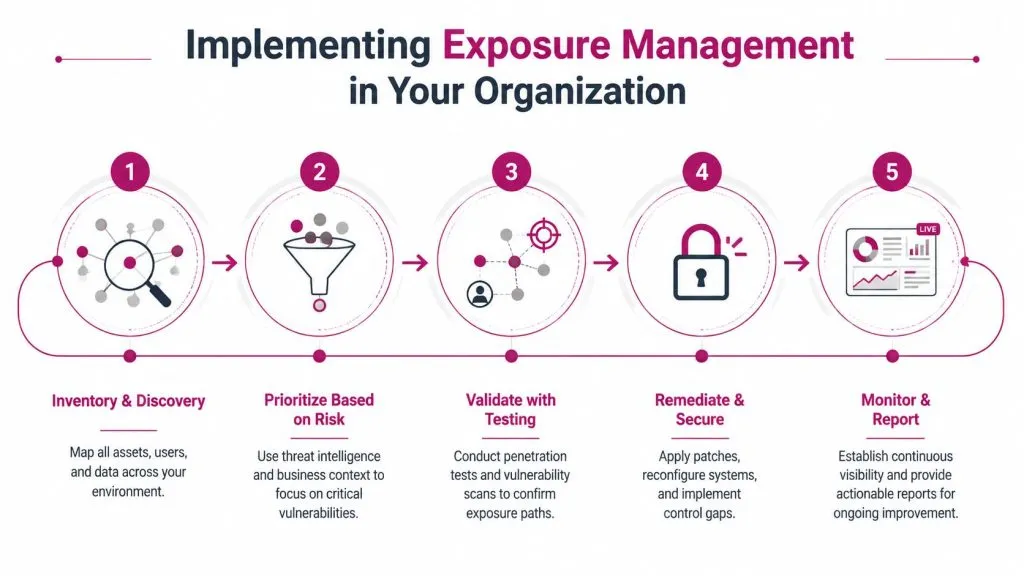
Step three, connect findings to owners
Create an owner field that people maintain. The owner may be an application manager, infrastructure lead, cloud administrator, vendor manager, or business sponsor. Include the asset’s business function, data sensitivity, access dependencies, and approved remediation route.
For an MSP, this information belongs in the client runbook and ticket workflow. A finding that arrives without an accountable person is not ready for remediation.
Step four, validate the fix
Do not stop when the patching system reports success. Recheck the original external exposure, confirm the service no longer accepts the unwanted access, and inspect related permissions or routes that could preserve the attack path.
Validation can be lightweight. An external reassessment, authenticated configuration review, targeted test, or controlled penetration test may be appropriate depending on the asset and risk. The method should answer one question: did the attacker’s route become harder or impossible to use?
Step five, repeat and improve
Set reassessment routines for the assets that matter most, then expand coverage as the process becomes reliable. Teams considering broader governance can use an enterprise security solutions guide to compare how exposure work fits alongside existing controls, but the implementation should remain proportionate to the organization.
External credential exposure can also inform identity reviews. A dark web scan is one possible input, but it shouldn’t replace asset ownership, access control, MFA, and validation.
Measuring Success with KPIs and Automation
A busy security team can still leave the business exposed. Scan counts, ticket volume, and the number of findings closed describe workload, but they don’t prove that attackers have fewer usable routes.
Use KPIs that connect activity to outcome:
- Internet-facing visibility: Track whether every known public asset has an owner, business context, and current assessment data.
- Validated remediation time: Measure the time from identifying a priority exposure to confirming that the original path is closed.
- Exposure window: Record how long important reachable weaknesses remain open.
- Attack-path reduction: Track whether remediation removes routes to sensitive systems, not merely whether individual findings disappear.
- Exception age: Review how long accepted risks remain in place and whether their compensating controls still work.
- Data freshness: Mark inventory and assessment results as current, stale, or awaiting revalidation.
The most useful dashboard separates discovery, action, and proof. A leadership report might show newly discovered public assets, high-priority exposures assigned to owners, fixes awaiting validation, and paths confirmed closed. That language is more meaningful than a large total of vulnerabilities because it describes what changed in business risk.
Automation supports scale, but it needs boundaries. Use APIs and integrations to synchronize asset data, normalize findings, create tickets, assign owners, enforce SLAs, and trigger reassessments after changes. Keep human judgment for questions such as whether a service is business-critical, whether an exception is acceptable, and whether a proposed control introduces operational risk.
Measure the loop, not the queue. A smaller backlog is useful only when the organization can show that reachability and attack paths have actually been reduced.
An MSP can automate the repeatable parts across clients while preserving client-specific approvals. A small business can start with scheduled exports and ticket rules, then add deeper integrations when ownership and prioritization are stable. The progression should follow operational readiness, not a desire to imitate a large enterprise stack.
The Future of Exposure Management and Next Steps
Exposure management will expand as organizations add AI systems, cloud services, supply chain dependencies, and identity-centric architectures. AI-assisted attack simulation, automated testing, and predictive modeling may improve how teams validate paths, but the core discipline won’t change: discover, prioritize, reduce, verify, and monitor.
Start with an external inventory and named owners. Then remove unnecessary exposure, harden essential services, connect findings to remediation workflows, and establish proof that fixes work. Over time, turn those routines into a documented program with KPIs leadership can understand.
InsecureWeb helps MSPs, hosting providers, and security firms combine external threat monitoring, vulnerability scanning, AI-guided penetration testing, fake-site and account detection, and dark web monitoring under their own brand, with API access for connecting existing workflows. Visit InsecureWeb to evaluate how those capabilities can support a practical exposure management program for your organization or clients.