Data Breach News13 min read
Security Posture Management: A Practical Guide for MSPs
By InsecureWeb Team
This report reflects observations of dark web activity. InsecureWeb makes no representations regarding the accuracy of this data.
Security posture management has moved from a specialist topic to a budgeted enterprise category, with one forecast putting the market at USD 26.64 billion in 2025 and USD 53.31 billion by 2030, a 14.9% CAGR over the period, while North America accounted for 38.1% of revenue in 2025 according to the same forecast (MarketsandMarkets). That scale matters to MSPs because buyers are no longer asking for another dashboard, they’re asking for a way to prove they’re harder to breach right now, and to keep proving it as cloud, identity, and SaaS sprawl keeps growing.
For MSPs, the practical question isn’t whether posture management sounds strategic. It’s whether it can be turned into a service that finds real exposure, drives remediation, and shows whether the client is improving.
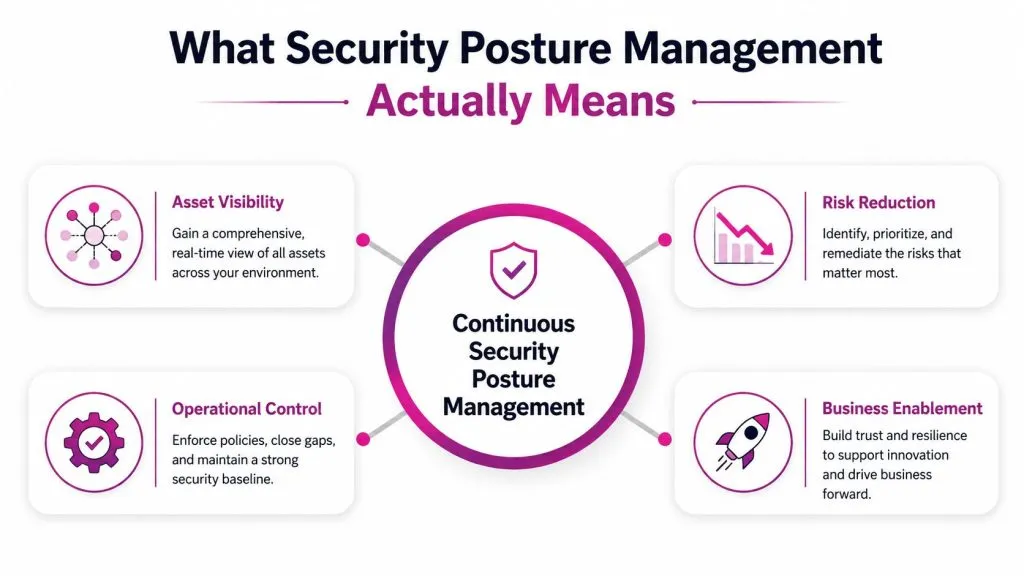
What Security Posture Management Means
Security posture management is the discipline of answering a simple operational question, how hard are we to breach right now. NIST defines security posture as the current security status of an enterprise’s networks, information, and systems, based on the resources and capabilities in place to manage defense and react as conditions change (NIST glossary). That definition matters because it moves the conversation away from static compliance and toward current defensive reality.
For an MSP, posture management is not a single tool category. It is a loop, discover assets, assess exposure, prioritize what matters, remediate gaps, then verify that the fix still holds after the next change. The market projection cited above shows why this approach keeps getting budget, since clients want continuous visibility and remediation rather than another point-in-time report (MarketsandMarkets).
What makes it different in practice
The difference from older security work is cadence. Periodic audits tell you what was true at a point in time, while posture management asks what changed since then and whether controls still work after new assets, new privileges, and new configurations appear. That is why posture programs have to include cloud, on-premises, identity, and data exposure, not just one control domain.
Practical rule: if a client cannot tell you what changed since the last review, they do not have posture management yet, they have reporting.
The best way to explain this to clients is to treat posture as an operating state. A strong program produces evidence such as control coverage, misconfiguration counts, vulnerable asset counts, and mean time to remediate, then uses those signals to drive ownership and follow-up. It is a management loop, not a scan result.
Why MSPs should package it as a service
MSPs sell posture management well when they stop presenting it as more security tooling and start presenting it as an outcome. Clients usually do not want another alert stream, they want fewer unknowns, faster fixes, and a defensible answer when leadership asks whether risk is going down.
That framing matters because posture management cuts across tools the client already owns. It connects discovery, prioritization, and validation across those tools, which means the service has to sit above point products rather than compete with them. The MSP’s value is in coordinating the loop and proving it is still working after the environment changes.
For many clients, that includes tracking gaps in non-human identity. Service accounts, API keys, application tokens, and orphaned automation often outlive the humans who created them, and they rarely show up in a standard review unless the process is built to look for them. That is where posture work becomes operational, because the fix is not just finding the issue, it is keeping the issue from coming back after the next sync, the next handoff, or the next vendor change.
A good way to scope the work is to start with attack surface analysis and then use posture data to keep the exposed set under control. Attack surface analysis gives the MSP a repeatable way to identify what is reachable and what is newly exposed, while posture management turns that discovery into a continuous validation loop. That combination is what turns a security program into something a client can run and measure.
The Five Core Components of a Strong Posture Program
A useful posture program rests on five components, and each one catches something the others miss. If one of them is weak, the whole program can look healthier on paper than it is in practice.
The most common failure I see in the field is overreliance on scanners without a clean inventory. The tools look busy, the reports look polished, and the client still has blind spots in forgotten systems, old permissions, and shadow assets.
Start with inventory, then make it continuous
Asset inventory is the base layer because you cannot fix what you do not know exists. A forgotten staging server, an orphaned SaaS tenant, or a retired application still reachable from the internet will break the rest of the workflow if it never enters the assessment pipeline.
Vulnerability scanning comes next, but it only becomes useful when it is tied to context. Raw vulnerability lists are easy to create and hard to operationalize, so the MSP has to sort findings by exploitability, business impact, and whether the asset matters to the client’s operations.
Use context, not noise
Threat intelligence adds the attacker’s view. It helps teams avoid treating every issue as equally urgent, which is where many programs waste time. A misconfiguration on a production identity system matters more than the same issue on a forgotten lab box, and threat context helps make that judgment defensible.
Configuration management is where posture drift usually starts. A permissive policy, an exception that never expires, or a cloud setting left at a default value can undo weeks of clean-up work. Continuous monitoring, misconfiguration detection, risk prioritization, and remediation need to be separate operational steps, because each one fails in a different way if the process is vague.
A good posture program does not just flag what is broken. It shows which fixes should be made in templates, which should be made in policy, and which should be retired because the asset itself should not exist.
Incident response closes the loop. It proves that posture data can move into action when a finding is urgent, not just sit in a report. If the MSP cannot hand off a critical exposure into a response path, then the posture program is still only an assessment product.
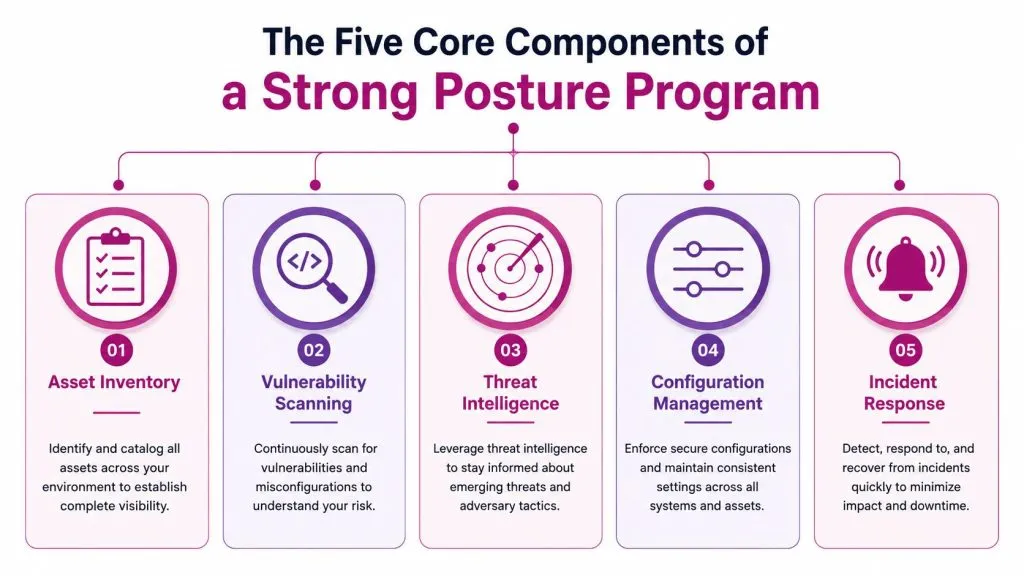
The practical test is simple, each component should reduce work for the next one. Inventory should shrink uncertainty, scanning should narrow the field, threat intelligence should sharpen priority, configuration management should reduce recurrence, and incident response should shorten the time between discovery and action. If any layer only produces more tickets, the program is still immature.
A useful shortcut for MSPs is to map each component to a deliverable the client recognizes. Inventory becomes coverage, scanning becomes exposure, configuration management becomes drift, and incident response becomes accountable remediation. That makes the service easier to explain and much harder to fake.

For a deeper look at how inventory and exposure mapping affect posture, this internal resource is a useful companion, attack surface analysis for MSPs.
How SPM Differs from VM, CSPM, and XDR
MSPs often group security terms together because the tools overlap in practice. That works until the client asks why one platform found a cloud misconfiguration, another surfaced a vulnerability, and a third filled the queue with alerts without reducing exposure.
The boundaries matter
Vulnerability management focuses on finding and patching weaknesses in software. It is strongest when the question is, what should we patch now, and weakest when the question is, what matters most to the business at this moment? CSPM is narrower, it concentrates on cloud configuration issues and drift. The NCSC’s guidance on CSPM describes that scope clearly, continuous monitoring of cloud environments, evaluation of resources and configurations against policy, and identification of misconfigurations and remediation paths.
XDR sits in a different part of the stack. It correlates threat signals and helps detection and response teams see patterns across endpoints, identities, email, and other telemetry. That is useful for active threat handling, but it does not answer the broader question of whether the environment is becoming harder or easier to attack over time.
| Practice | Primary Scope | Key Output | Best For |
|---|---|---|---|
| SPM | Continuous exposure, control, and remediation posture across the environment | Prioritized risk reduction and validation of fixes | MSPs that need one operational view across assets, identity, cloud, and reporting |
| VM | Software vulnerabilities and patchable weaknesses | Vulnerability findings and patch queues | Patch-centric programs and technical remediation teams |
| CSPM | Cloud resource and configuration risk | Cloud misconfiguration findings and policy checks | Multi-cloud and cloud-native control enforcement |
| XDR | Cross-domain threat detection and response | Correlated alerts and incident workflows | SOC operations and active threat containment |
The overlap is real, but the service promise is different. SPM is the umbrella view that asks whether those tools are making the client harder to breach over time. VM, CSPM, and XDR are inputs into that answer, not substitutes for it.
How to position it in a service catalog
MSPs should avoid selling SPM as a replacement for the tools underneath it. The better pitch is that SPM organizes the output of those tools into a continuous program the client can act on. That matters in SMB environments, where nobody has time to reconcile four dashboards by hand.
The easiest mistake is to promise “full coverage” because a platform touches several domains. Coverage only means something if the program keeps finding new assets, catches drift, and verifies remediation after the change lands. That is the difference between a tool stack and a posture service.
The Non-Human Identity Blind Spot in Posture Assessments
Most posture assessments still overfocus on human users because user accounts are easy to count and easy to report. The problem is that many of the highest-risk access paths aren’t human at all.
Why inventories look complete when they aren’t
Service accounts, API keys, tokens, certificates, and third-party integrations often sit outside standard reviews. They’re frequently misclassified, orphaned, or left with stale ownership, which makes the posture score look cleaner than the environment really is. The discovery problem is compounded when those identities are spread across SaaS, automation workflows, and cloud services that weren’t designed for the same ownership model as employee accounts.
The source material behind this issue recommends measuring privilege, secret age, rotation frequency, and third-party reach, which is the right way to think about it operationally. Those metrics tell you whether a non-human identity is healthy, not just whether it exists (NHIM Group FAQ).
What MSPs should measure first
A practical review doesn’t need to start with everything at once. It should begin by finding the identities that can reach sensitive systems, then checking whether they are still needed, who owns them, and how often the credentials are refreshed.
A posture score that ignores service accounts is a comfort metric, not a control metric.
OWASP’s Non-Human Identity Top 10 is useful here because it frames discovery and classification as the core problem, not an edge case. That matters for MSPs serving SaaS-heavy clients, because automation tends to create access paths faster than teams can track them.
Once those identities are in scope, posture work becomes much more honest. You’ll still see gaps, but they’ll be real gaps, not artifacts of incomplete inventory. That changes both the quality of the remediation queue and the confidence level of any report sent to leadership.
The field lesson is straightforward. If a client’s automation stack is growing and the posture program isn’t tracking non-human identities, the service is incomplete. The client may still be compliant, but they’re not fully understood.
Building an SPM Program for MSPs and SMB Clients
The strongest way to launch posture management for SMB clients is to start narrow, make the assessment continuous, and keep remediation tied to the people who already own the systems. The common mistake is opening the scope too fast, then flooding the client with findings they cannot route, approve, or verify.
Use a rollout that matches SMB reality
Start with a baseline review of the client’s critical systems, then keep discovery running so the inventory does not decay after onboarding. From there, rank issues by exploitability and business impact, not by whichever alert is loudest. That keeps the service tied to real risk instead of sheer volume.
For MSPs, the operational target is repeatability. Fixes should be easy to apply, easy to hand off, and easy to check after the change window closes. If the same issue keeps reappearing, the program needs a better control point, not more findings.
Build the workflow around ownership
A workable MSP program needs clear answers to three questions for every finding, who owns it, what change closes it, and how it will be verified after the change. Without that, posture data turns into reporting with no operational weight.
Use a short escalation path for high-risk items and a slower, batched path for lower-risk drift. SMB clients rarely have dedicated security staff, so the MSP has to carry more of the coordination work and make the output easy for non-specialists to act on.
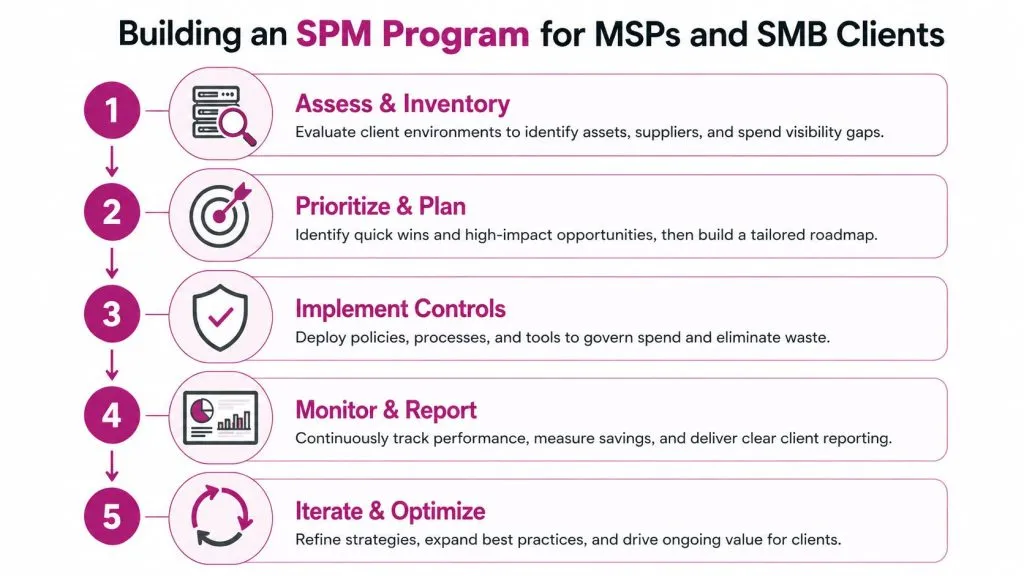
A workable implementation sequence looks like this.
- Assess and Inventory: identify the full asset set, including internet-facing systems and high-value identities.
- Prioritize and Plan: rank the findings by business impact and likely abuse path.
- Implement Controls: close gaps through policy, configuration, or remediation work.
- Monitor and Report: confirm the environment still matches the intended state after changes land.
- Iterate and Optimize: remove recurring causes of drift and improve the workflow over time.
That loop should include outside-in signals, too. Dark web monitoring for MSPs can add early warning around exposed credentials and brand abuse, which often changes remediation priority before an internal scan ever does. It does not replace posture management, but it gives the program more context for what to fix first.
The hardest part of onboarding is scope discipline. Clients want everything assessed, but they can only fix a limited number of issues at a time. Strong posture programs respect that limit, focus on the exposure that matters most, and keep checking whether the fixes stick.
Metrics That Prove Posture Is Improving
Posture management earns trust only when the client can see improvement, not just activity. Compliance checklists can show whether a control existed at a point in time, but they do not show whether the environment is getting easier to defend.
Measure outcomes, not noise
The most useful metrics are the ones tied directly to work getting done. Patch latency shows how quickly the team turns findings into change. MFA coverage shows how much of the identity surface is protected. Mean time to remediate shows whether assignments are moving.
Control coverage percentage, misconfiguration counts, and a practical indicator of user-side resilience such as phishing resilience also belong in the report. Those metrics only matter if they are tied to owners and follow-up dates, otherwise they become another dashboard that nobody opens or acts on.
Report progress in business terms
For SMB clients, the report should not read like a scanner export. It should answer whether the organization is becoming harder to breach, where the remaining exposure sits, and what is slowing remediation. That keeps the conversation on business risk instead of tool output.
The Reach Security guidance is useful because it pushes posture tracking toward resilience metrics like patch latency, MFA coverage, phishing resilience, mean time to detect, and mean time to contain. That is a healthier frame than checklist completion.
If a metric does not change a decision, it belongs in a dashboard appendix, not in the client review.
The reporting habit that works best in the field is trend plus action. Show what changed, show what was fixed, and show what still needs ownership. That creates a feedback loop the client can use, and it gives the MSP a clear way to show the value of the service over time.
Integrating InsecureWeb into Your MSP Security Offering
A platform like InsecureWeb fits best as an input layer for posture programs that need external visibility without rebuilding everything from scratch. It offers dark web monitoring, vulnerability scanning, AI-guided penetration testing, fake site and account detection, and deepfake and reputation monitoring, which map cleanly into discovery, validation, and threat-awareness work. For MSPs, the practical value is that these functions can be delivered under the MSP’s own brand, with API access included free for integration into existing workflows.
If you want a more direct external exposure check, the dark web scan capability is a straightforward way to pull exposed credentials and related findings into the same operational loop as the rest of the posture program. That’s most useful when the MSP wants to enrich remediation priority, not replace existing inventory or cloud controls.
The strongest use case is as a white-labeled service layer that complements the core posture loop. Dark web findings can feed into identity review, fake site alerts can feed into brand protection, and vulnerability results can support prioritization of the highest-risk assets. Used that way, the platform helps turn posture management into a continuous service instead of a quarterly cleanup exercise.
If you’re building or tightening a posture management offer for clients, InsecureWeb gives MSPs a white-label way to add dark web monitoring, vulnerability scanning, fake site detection, and related external threat checks into the same operational model. Use it to enrich remediation priorities, keep visibility continuous, and show clients that posture is improving in practice, not just in a report.