Data Breach News13 min read
What Is White Label Solution: A Complete Guide for MSPs
By InsecureWeb Team
This report reflects observations of dark web activity. InsecureWeb makes no representations regarding the accuracy of this data.
A white label solution is a product or service built by one company and rebranded by another as its own. In banking, the model is already mainstream, the European Banking Authority reported in 2025 that 35% of banks responding to its Spring RAQ were using it.
For MSPs, that matters because white labeling is no longer a side-channel tactic. It’s a proven distribution model for packaging cybersecurity services under your own brand while someone else runs the underlying platform.
Understanding White Label Solutions in Cybersecurity
A white label solution in cybersecurity is a packaged product or service that one company builds, then another company sells under its own brand. The core idea is simple, but the business impact is bigger than many MSPs expect. In practice, it lets a provider launch monitoring, scanning, or intelligence services without engineering the entire stack from scratch.
That model is already normalized in regulated markets. The European Banking Authority reported in 2025 that 35% of banks responding to its Spring RAQ were using white labelling, which shows the pattern isn’t limited to agencies or fast-moving SaaS firms, it’s embedded in heavily governed industries too, according to the EBA white labelling report.
Why MSPs care
For MSPs and MSSPs, the appeal is speed with brand control. You can offer dark web monitoring, vulnerability scanning, threat intelligence, or reputation monitoring under your own identity, while the vendor handles the underlying engine, updates, and infrastructure. That’s especially useful when clients want one accountable partner, not a vendor roster.
The catch is that white label doesn’t mean “you own the technology.” It means you own the customer relationship and the presentation layer, while the provider owns the stack underneath. That distinction matters when clients ask about roadmap changes, incident timelines, or where their data lives.
Practical rule: If you can’t clearly explain which parts you control and which parts the vendor controls, you’re not ready to resell the service.
In cybersecurity, that boundary is the difference between a clean expansion play and an operational mess. MSPs that understand it can add revenue lines without overbuilding internal teams. MSPs that ignore it often end up with support surprises, compliance gaps, and weak positioning in front of clients.
How White Label Architecture Functions
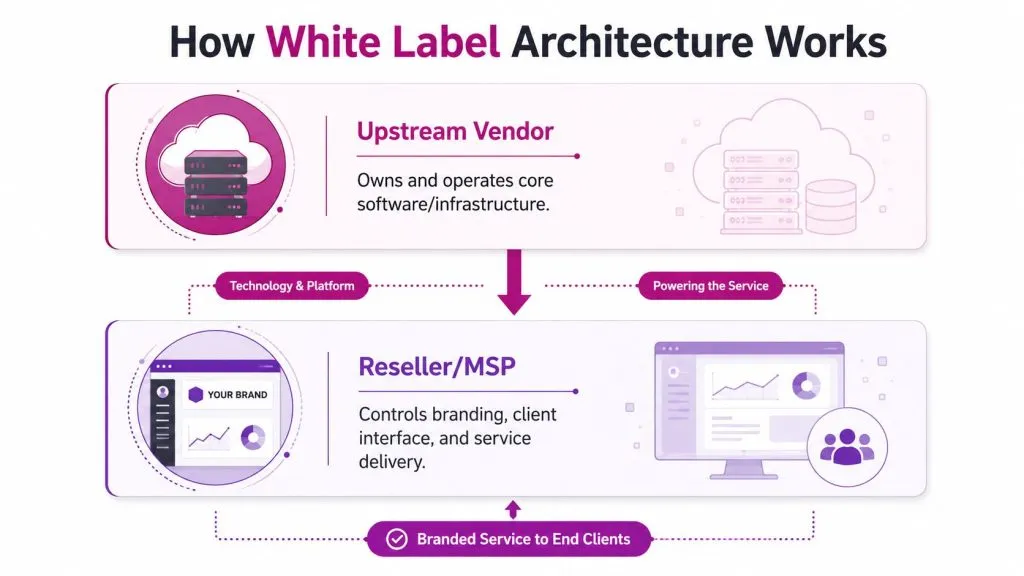
A white-label cybersecurity platform usually runs as a two-layer system. The upstream vendor owns and operates the core software or infrastructure, while the reseller controls the customer-facing layer, including brand, UI, pricing, and distribution. End users see the MSP’s identity, not the original producer’s identity, as described in the Tagada white-label glossary.
The operating model matters because it separates control from ownership. In practice, that split can make a service faster to launch, but it also creates blind spots if the MSP does not map responsibilities before the first client goes live. For a practical example of how that split affects scope, see attack surface analysis guidance.
What the vendor owns
The vendor is usually responsible for backend maintenance, core feature development, hosting, patching, scanning engines, and threat feed ingestion. That means the vendor is the part of the relationship that determines whether the service stays stable, current, and defensible. If that backend slips, your brand absorbs the client frustration.
For MSPs, that creates a hard reality. You are not buying a blank canvas, you are renting a controlled operating environment. Your differentiation comes from packaging, integrations, onboarding quality, reporting, and response discipline, not from writing the core code yourself.
The hidden risk is compliance drift. If the vendor changes logging retention, data residency, access controls, or subprocessors without giving you clear notice, your own customer commitments can fall out of alignment even though your logo is on the portal. That is where service reviews and contract language matter, because the technical stack and the legal promise rarely move at the same speed.
What the reseller controls
The reseller controls the visible layer, usually logos, color scheme, domain presentation, pricing tiers, service bundles, and client communications. In SaaS delivery, that usually makes deployment faster because you are adjusting the interface rather than changing application logic, which is one reason white-label software is often delivered as SaaS ReviewTrackers on white label software.
That architecture works well when you need to move quickly. It works poorly when you expect deep product changes on demand, or when your sales team promises features the vendor roadmap does not support. The operational risk is straightforward, if the vendor does not expose the right integrations, your branded service can feel thin.
This is also where support boundaries get tested. A client may open a ticket through your help desk, but the actual fix can sit with the upstream vendor, and every handoff adds delay unless escalation paths are defined in advance. If you do not set those paths early, you end up explaining gaps you did not create.
You are buying leverage, not sovereignty.
An MSP should map the vendor’s responsibilities against client expectations before launch. That includes support escalation, uptime commitments, logging access, and how much visibility you get when a client asks a hard question after an alert or incident. If those pieces are vague, the service may still look polished, but it will be difficult to defend when a client wants a clear answer.
White Label vs Private Label vs OEM vs Managed Services
White label, private label, OEM, and managed services get lumped together all the time, but they behave differently in real delivery work. For MSPs, the useful question isn’t terminology, it’s how much control you need over the product, the brand, and the operating risk.
The managed services for SMBs resource from ARPHost is a helpful reference point here because it highlights the service-delivery mindset that’s different from pure resale. A managed service is about ongoing execution. White label is about reselling a vendor-built service under your brand.
Comparison table for MSPs
| Model | Brand Control | Customization Depth | Time to Market | Margin Structure | Best For |
|---|---|---|---|---|---|
| White Label | High | Moderate | Fast | Branding and packaging can protect margin | MSPs that need branded services quickly |
| Private Label | High | Deeper than white label | Slower | More room for product-specific differentiation | Firms that want more product uniqueness |
| OEM | Limited to embedded component branding | Varies by integration depth | Moderate | Often tied to component licensing | Vendors building larger proprietary platforms |
| Managed Services | Brand is service-led, not product-led | Operational, not product-level | Depends on the delivery model | Margin comes from labor, process, and recurring contracts | MSPs delivering ongoing support and operations |
The practical difference
White label is usually the fastest path when you want to add a cybersecurity service without hiring a new engineering team. Private label generally implies deeper product tailoring, while OEM is about embedding a component into something bigger. Managed services are different again, because the value is in your people, processes, and accountability rather than a rebranded platform.
That’s why white label works best when the vendor’s product is already close to what you need. If you require custom workflows, unusual reporting, or unique compliance logic, the model can become restrictive fast. At that point, you’re often better off with a more customizable arrangement or a service model that lets you own the operational layer directly.
The Business Case for White Label Cybersecurity Services
The business case starts with capacity. An MSP can add a cybersecurity line without carrying the full engineering, product, and support build itself. In 2025 and 2026 roundups, 73% of agencies were using white label services, 60% were outsourcing PPC campaigns, and agencies outsourcing 40%–60% of delivery work were growing 2.3× faster while earning 20% higher margins, according to industry white label marketing statistics. Those figures come from agency and marketing markets, but the operating logic carries over to cybersecurity services.
White label also sits in a market that is clearly large enough to support real channel demand. The same source projects the white label marketing market to reach $99.19 billion by 2026, with digital marketing growing at a 13.1% CAGR, and estimates the global white-label SaaS market at $235.9 billion in 2025 and $278 billion in 2026, implying a 16.2% CAGR over that period, from the same market roundup. Those projections help explain why resellers keep adopting the model. They can widen the service catalog without building every capability in-house, but the trade-off is that the vendor’s roadmap and support quality shape what you can safely sell.

Why the model works for cybersecurity
Cybersecurity buyers usually care about outcomes, not product trivia. If an MSP can package monitoring, scanning, reporting, and response coordination under one contract, the client gets a simpler buying decision and a clearer accountability chain. The MSP gets a cleaner revenue story and a faster path to expansion, which matters when clients want one provider to own more of the stack.
The hidden cost is operational discipline. Shared platforms can blur service boundaries, and that creates trouble fast when a client expects your team to fix a vendor-side issue you do not control. If several competitors resell the same platform, differentiation shifts to packaging, onboarding, incident handling, and how well your support team can explain what the service does and does not cover. If the vendor’s uptime slips, your margin gets hit by support noise before the client ever sees a technical root cause.
Operational truth: White label becomes a growth engine only when the MSP can support, explain, and defend the service better than the vendor’s generic support motion.
That is why white label cybersecurity should be treated as a go-to-market decision, not a procurement shortcut. You are gaining strategic advantage, not sovereignty. The upside is real, but only if your team can absorb vendor dependency without losing control of the client experience, the escalation path, or the compliance posture.
Learn more about dark web monitoring here: dark web monitoring for managed service providers.
Implementing and Integrating a White Label Platform
White-label software is often delivered as SaaS, which makes branding and rollout relatively straightforward. Resellers can usually customize logos, colors, domain presentation, and other visible elements without touching the underlying application logic.
The interface is the easy part. The actual work is making the service dependable in day-to-day operations.
What a clean rollout looks like
Start by connecting the platform to the client workflow. That usually means API integration, alert routing, account provisioning, and a clear rule for who gets notified when something triggers. Then align the customer-facing layer so the service looks like part of your own portfolio, not an added-on tool.
Build the support model before you sell the first seat. If the vendor owns backend operations, your team still needs escalation paths, response expectations, and a documented handoff process. Without that, the help desk becomes the middle layer for every issue, including the ones your technicians cannot fix directly.
Implementation rule: Never sell the service until your escalation path is written down and tested.
Questions that matter before launch
- Branding scope: Can you change the domain, login experience, reports, and client-facing notifications?
- Service boundaries: Which alerts, tickets, and tasks are your team responsible for, and which ones go straight to the vendor?
- Commercial structure: Does the pricing model leave room for support time, onboarding work, and incident overhead?
- Control points: Can you export data, review logs, and track activity in a way that supports client conversations?
Treat integration as a business process, not just a technical setup. That is usually the difference between a platform that supports margin and one that eats it through onboarding friction and support load. One option for teams that want external threat monitoring under their own brand is InsecureWeb, which offers dark web monitoring, vulnerability scanning, threat intelligence, and API access for white-label delivery. That fit matters because the product has to match both the operational workflow and the resale model.
If the vendor cannot support your operational standards, the service will look polished on the surface and fragile underneath. The better integrations give clients a simple branded experience while your technicians work from a predictable support path behind it.
Security and Compliance Risks You Cannot Outsource
A white-label arrangement does not transfer accountability. The vendor may run the backend, but your MSP still has to answer for data protection, client trust, and incident handling. That pressure is higher when you serve regulated customers, because the legal and reputational consequences land on the brand the client hired, not the company behind the engine.
The least visible risk is data handling. If the provider stores or processes data in a jurisdiction that conflicts with a client requirement, you can create a compliance issue before the first alert ever fires. For MSPs working in sensitive environments, the Captapi data handling rules are a useful reminder that handling, retention, and access controls need to be documented before the service goes live.

Where MSPs get caught
The first trap is shared liability during an incident. Clients rarely care whether the vendor failed. They care whether your team caught it, explained it, and responded properly. The second trap is auditability. If you cannot show clear logs, timestamps, and handling procedures, you will struggle to defend the service in a compliance review.
The third trap is assuming the vendor’s security posture is acceptable because the product is branded. It is not. You still need to vet certifications, access controls, data retention practices, escalation handling, and who can see what when an alert fires. Those are operational questions, and they affect whether the service holds up under scrutiny.
A clean logo will not save a weak control structure.
What to verify before you sign
- Data location and retention: Where is information stored, how long is it kept, and can it be removed on request?
- Access boundaries: Who can view client data, and what controls limit internal vendor access?
- Audit trail quality: Can you reconstruct what happened during an alert or incident?
- Breach workflow: If something goes wrong, who notifies whom, and how quickly does the process start?
See our step-by-step guide after a breach here: https://insecureweb.com/steps-after-data-breach/
For MSPs serving regulated clients, the right vendor is the one that strengthens your compliance story, not just your branding. If you cannot defend the data flow, the service may look commercially attractive but remain operationally unsafe. White label should widen your capabilities, not blur your obligations.
Taking Your White Label Cybersecurity Service to Market
A white-label cybersecurity service sells best when the MSP sells the outcome, not the platform. Clients don’t want a tool dump. They want a clear story about risk reduction, visibility, and response ownership. That means your positioning has to emphasize your process, your reporting, and your service wrapper, even if the engine underneath is shared with other resellers.
Pricing usually works better when it reflects the way clients buy security. Bundling can make the offer easier to understand, especially when you’re pairing monitoring with scanning or intelligence. À la carte can still work, but only if your sales team can explain why one service is enough for a given client and how the service evolves over time.
A simple market play
A practical rollout often starts with one niche package. An MSP sells the service to existing clients first, uses onboarding to prove the workflow, then folds the service into renewal conversations and higher-tier contracts. That gives the team real client language instead of a generic vendor pitch deck.
The strongest sales materials don’t brag about the underlying platform. They show what the client gets, who responds, how reports are delivered, and what happens if suspicious activity appears. That’s the advantage of white label, the technology stays in the background while your service story stays front and center.
Sales rule: If the brochure sounds like a software spec sheet, it’s not ready for a client meeting.
What keeps clients engaged
Reporting is the simplest retention lever. Regular visibility creates a reason to keep talking to the client, and threat intelligence gives your team something concrete to explain between incidents. Onboarding also matters because it sets trust early, especially when the client is handing over access, expectations, or sensitive data.
The service wins when it feels like a continuation of your MSP relationship, not a separate product line. That’s what turns white label from a branding exercise into a real revenue channel.
If you’re building a white-label cybersecurity offer and want a cleaner way to monitor external threats under your own brand, visit InsecureWeb and see how its dark web monitoring, vulnerability scanning, and API access can fit into an MSP delivery model. It’s a practical place to start if you want branded security services without building the whole stack yourself.