Data Breach News10 min read
How to Prevent Supply Chain Attacks: A 2026 Guide
By InsecureWeb Team
This report reflects observations of dark web activity. InsecureWeb makes no representations regarding the accuracy of this data.

Most advice on how to prevent supply chain attacks still starts in the wrong place. It focuses on questionnaires, annual reviews, and compliance scores, then acts surprised when attackers slip through OAuth consent grants, browser extensions, low-code connectors, and delegated identities that never show up in the vendor register.
That gap matters because supply-chain risk isn’t rare anymore, it’s routine. CrowdStrike’s survey found 84% of respondents believed software supply-chain attacks could become one of the biggest cyber threats within three years, while only 36% had vetted all new and existing suppliers for security in the prior 12 months. The same survey found 45% had experienced at least one software supply-chain attack in the past year, and 59% of organizations hit by their first such attack had no response strategy, which is exactly why vendor trust by itself is a bad control CrowdStrike.
The practical lesson is simple. Vendor count is not the main risk driver, access depth is. A small set of highly privileged integrations can create far more exposure than a long list of low-impact suppliers.
Why Traditional Vendor Management Fails Against Modern Threats
Annual questionnaires assume the problem is static. It isn’t. Attackers don’t need every supplier, they need the supplier, app, or delegated identity that can reach sensitive systems without being noticed.
The control gap starts outside the procurement queue
Classic vendor management was built for contracts, renewals, and periodic attestations. That model breaks when a finance team authorizes a low-code connector, a developer approves an OAuth app, or a helpdesk technician installs a browser extension that inherits broad access. Those paths often bypass the review process completely, even though they can touch email, files, source code, and administrative consoles.
Practical rule: if an integration can read data, move data, or act as a user, treat it like a supplier with privileged access, not a convenience tool.
This is why attack surface analysis has to include more than hostnames and SaaS subscriptions. It has to map identities, tokens, delegated scopes, and automation paths too. If you’re missing that layer, the inventory looks neat while the exposure stays open, which is exactly the kind of blind spot that attack surface analysis is meant to uncover.
Trust relationships are what attackers weaponize
Modern supply-chain compromise usually rides on trust. Valid credentials, legitimate software updates, and sanctioned integrations all lower suspicion, which makes detection harder once an attacker is inside. The more privilege a third party can exercise, the fewer steps the attacker needs after compromise.
That’s why the right question isn’t “How many vendors do we have?” It’s “Which identities can reach the most valuable systems with the least friction?” A browser extension with read access to webmail may be more dangerous than a large but low-trust contractor list. A delegated OAuth grant with broad file permissions can matter more than a dozen routine service providers.
The mistake most checklists make is treating all suppliers as equal. They aren’t. Access depth, data sensitivity, and ability to act on behalf of users are the features that shape real risk.
Building a Risk-Tiered Supplier Governance Model
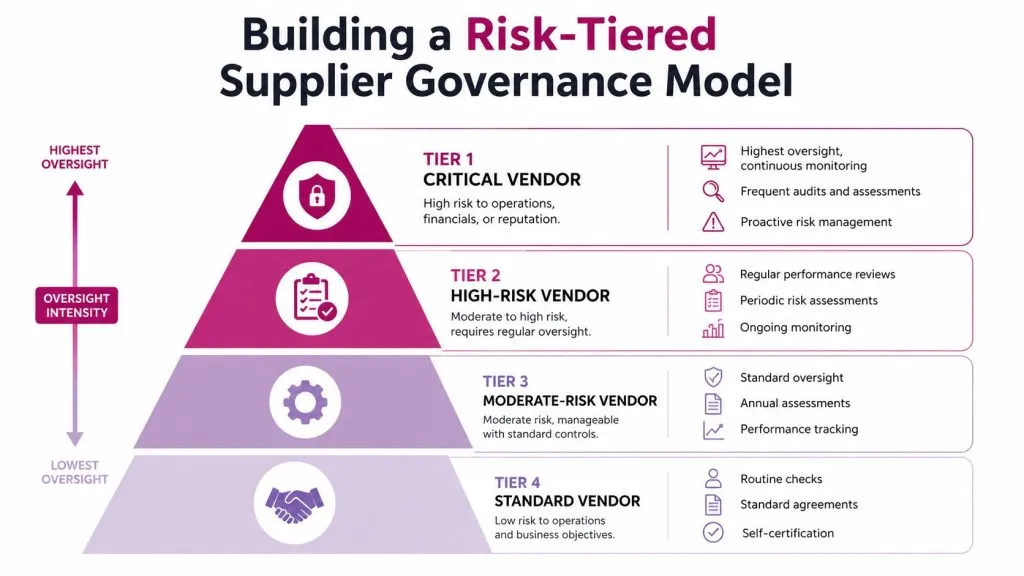
A useful governance model starts by ranking suppliers by blast radius, not by procurement category. That means giving the most scrutiny to the vendor or integration that can disrupt operations, expose sensitive data, or alter privileged workflows, then easing off only where the damage potential is low.
Build the inventory with the right people in the room
NCC Group recommends a formal discovery exercise across procurement, finance, legal, business continuity, IT, and cyber to identify critical assets and the suppliers tied to them NCC Group. That cross-functional step matters because no single team sees the whole dependency chain.
Use those workshops to answer four questions for each supplier or integration.
- What can it touch? Identify data sets, systems, and administrative surfaces.
- How much is it integrated? Look at auth scopes, API rights, persistence, and automation.
- What happens if it fails or turns hostile? Map operational and security blast radius.
- Can we remove or narrow it without breaking business flow? A workaround that buys time is often better than blind acceptance.
Tier by impact, not by volume
Once the inventory exists, separate suppliers into tiers. Critical vendors get continuous oversight, tighter contract language, and stronger access boundaries. Standard vendors get routine checks and conventional terms. The point isn’t paperwork for its own sake, it’s to spend attention where compromise would hurt most.
Security requirements belong in RFIs, RFPs, and contracts, not just in a one-time onboarding form. If a supplier can reach production data or admin tooling, the agreement should state what logging, notification, and access controls are required. If it can’t tolerate a heavier process, that’s a sign the relationship needs redesign.
The trade-off is friction. Tighter oversight slows some onboarding, and that’s fine for high-impact relationships. What doesn’t work is making every supplier go through the same review path, because that creates fatigue and encourages people to route around the process.
Hardening Build Pipelines with Provenance Controls
A lot of software supply-chain damage lands in the build and release process itself. Developers pull in dependencies, CI jobs package them, and release systems sign off on artifacts that nobody has verified. If the pipeline trusts inputs by default, attackers only need one weak dependency or one stolen token to poison the output.
Treat provenance as a release gate
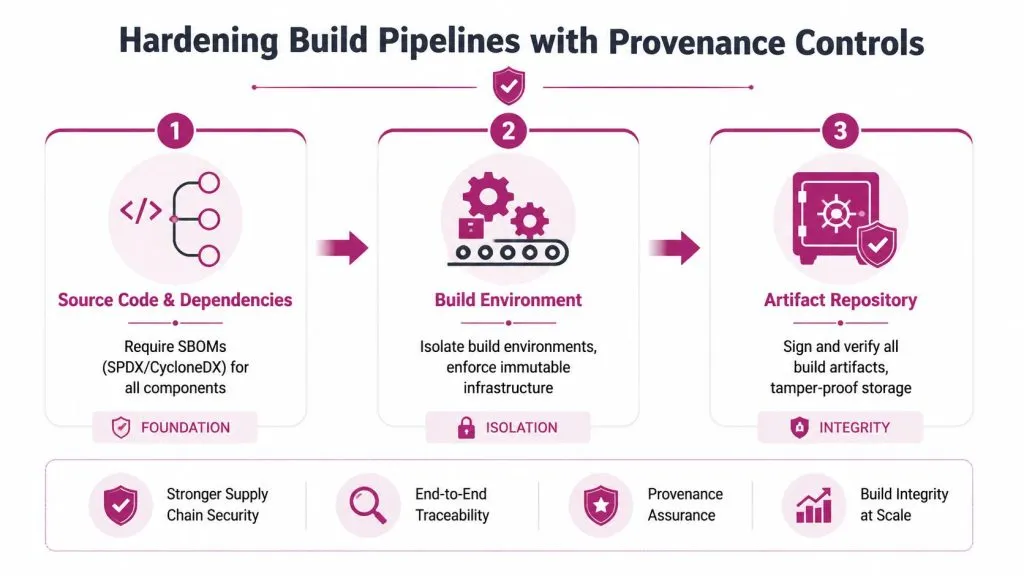
CISA’s guidance on defending against software supply-chain attacks emphasizes continuous assessment, least-privilege access for vendors, and pre-built response playbooks, not annual review cycles CISA. In practice, that means using a three-layer software provenance control.
- Require SBOMs in SPDX or CycloneDX for build inputs.
- Verify code signing and provenance before deployment.
- Combine both with least-privilege vendor access so third-party tools can’t freely publish or modify what they shouldn’t.
That stack works because it separates visibility, integrity, and authority. SBOMs tell you what is present. Signing and provenance validation tell you what you’re willing to trust. Least privilege limits who can change the answer.
Keep build security strong without making teams bypass it
The mistake is to make verification so heavy that engineers disable it. Instead, put checks where they’re hard to bypass and easy to automate. Validate artifact signatures during deployment, keep signing keys in tightly controlled stores, and isolate build environments so developer convenience doesn’t bleed into production trust.
A useful rule is to fail closed on release, but fail fast in feedback. Developers should learn about malformed artifacts, unsigned packages, and unexpected dependency changes early, before the release train is blocked. That keeps the security gate meaningful without turning every deploy into a manual exception process.
The pipeline should trust what it can prove, not what it hopes is clean.

Securing the Hidden Third-Party Access Surface
The least visible part of the supply chain is often the most dangerous. OAuth apps can read mail or files, browser extensions can inspect sessions, low-code connectors can move records across systems, and MSP tooling can sit on top of admin privileges that ordinary procurement reviews never examine.
Build an inventory of delegated access
Start with identity and access records, not just the approved vendor list. Pull every connected app, extension, service account, delegated grant, and automation credential into one register. Then ask a basic question for each one, what would an attacker be able to do if this were hijacked tomorrow?
That question exposes the difference between a low-risk convenience and a high-risk control path. Some integrations only touch non-sensitive workflow data. Others can relay mail, create files, or call APIs as a user with broad permissions. Those second-class paths deserve the same scrutiny you’d give an externally managed admin account.
Prioritize by blast radius
Panorays recommends ranking vendors and integrations by blast radius, data sensitivity, privileged access, and dependency depth Panorays. That’s a better triage method than a generic compliance score because it reflects how compromise spreads.
Use that model to sort hidden access paths into three bins.
- Immediate review: anything that can act on behalf of admins, move data across trust boundaries, or reach sensitive mailboxes.
- Scheduled remediation: tools that have broad read access but limited write power.
- Routine monitoring: low-impact add-ons with narrow, revocable scope.
If you need a fast way to spot abuse, a dark web scan can help identify leaked credentials or exposed data tied to those delegated identities before they become a larger problem.
The trade-off here is ownership. These assets often live in shadow IT, so security can’t fix them alone. Application owners, helpdesk teams, and platform admins all need to know who can approve, revoke, and review each integration. Otherwise, the register becomes stale the moment someone adds a new connector to solve a business problem.
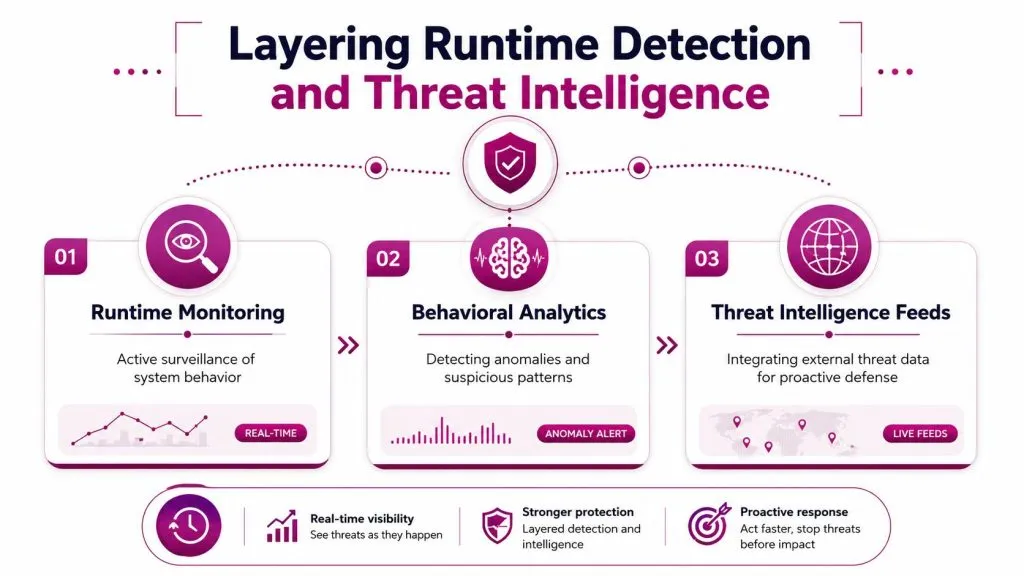
Layering Runtime Detection and Threat Intelligence
Prevention buys time. It doesn’t catch everything. Once a trusted package, integration, or vendor account is abused, you need runtime signals that show something is off before the compromise turns into a larger incident.
Watch behavior, not just alerts
Runtime monitoring should focus on the behaviors that matter. Unexpected process execution, unusual outbound connections, privilege changes, and access from service accounts that don’t match normal patterns are better signals than raw event volume. Behavioral analytics help reduce noise by correlating small anomalies into a pattern that deserves attention.
That’s especially important for MSPs, because one noisy tenant can bury a real compromise in alert fatigue. Triage gets easier when the detections are tied to known trust relationships, like vendor tools appearing in places they’ve never been used, or third-party processes trying to reach systems outside their normal scope.
Add external intelligence to close the gap
The value of external threat intelligence is simple. It shows you what’s happening outside your perimeter before that activity lands inside it. Credentials offered for sale, fake brand accounts, or indicators tied to compromised suppliers can all sharpen your response posture.
Operational rule: treat intelligence as a filter for action, not as a pile of indicators to admire.
A practical deployment pattern is to push external feeds into the same workflow as your detection stack, then let correlation decide what gets escalated. That’s where platforms like InsecureWeb fit for teams that need dark web monitoring, fake site and account detection, and threat intelligence tied to external exposure. Used properly, those signals complement internal monitoring instead of replacing it.
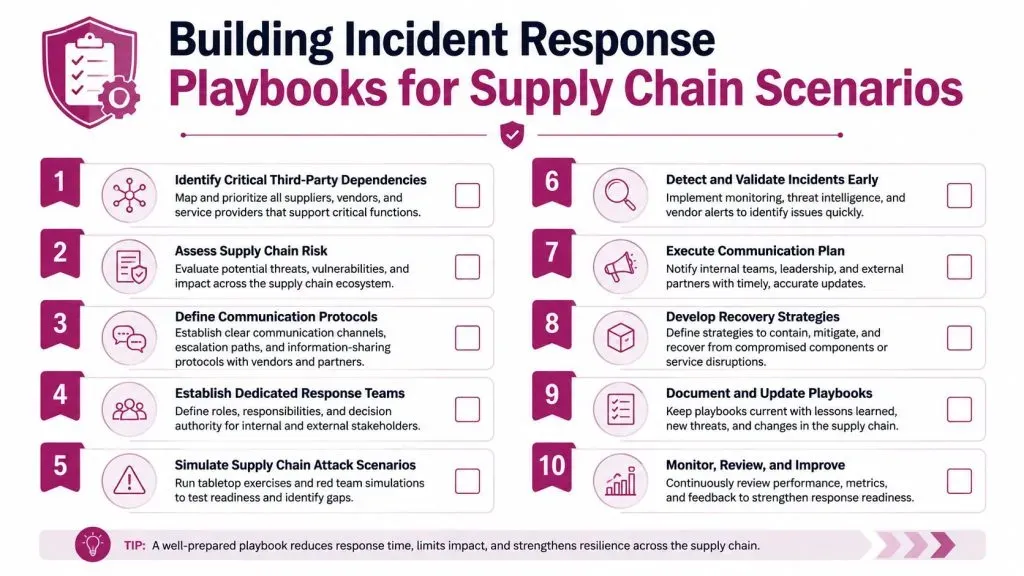
Building Incident Response Playbooks for Supply Chain Scenarios
When a trusted supplier is compromised, generic incident response often stalls. Teams spend too long figuring out whether the alert is “really” a vendor issue, who owns the relationship, and whether they’re allowed to shut off the connection that just became dangerous.
Rehearse the parts that normal playbooks miss
A supply-chain playbook should start with dependency mapping, not ticket routing. Identify which suppliers, integrations, and delegated identities can affect production or sensitive data, then pre-assign who can isolate them and who needs to be notified. If you wait until the incident to sort out authority, you’ve already lost time.
Regular tabletop exercises matter here because they expose the ugly edge cases. What happens when the vendor is legitimate but its software channel is weaponized? Who handles legal notice, customer messaging, and technical containment at the same time? Those are separate jobs, and they shouldn’t be invented during the breach.
For a deeper checklist on response structure, the practical guidance in Technovation LLC’s incident response playbook resources is a useful companion to internal planning.
Measure response readiness, not just response speed
The wrong metric is how quickly someone clicked “acknowledge.” The useful metric is whether the team can identify impacted dependencies, contain the affected path, and communicate clearly without guessing. That’s why the earlier guidance on layered controls matters. Good prevention shrinks the event, good detection spots it, and good response keeps it from spreading.
If you need a post-incident reference point for the first actions after compromise, steps after a data breach is the right checklist to keep close to the playbook.
Integrating External Threat Intelligence as a Force Multiplier
Internal controls stop a lot of trouble, but they don’t show you every signal that matters. External threat intelligence adds context from the open web, the dark web, and impersonation activity that often appears before a compromise reaches your environment.
Use outside signals to sharpen inside controls
The most useful outside signals are the ones that map back to your actual exposure. Stolen credentials, leaked files, typosquatting, and fake accounts can all indicate that a supplier, user, or brand is being targeted. When those alerts feed into your internal workflows, security teams can prioritize resets, takedowns, or access reviews before the issue grows.
For MSPs, that matters even more because you’re usually defending multiple environments at once. A single intelligence layer can support tenant-specific monitoring, client branding, and automated workflows if the platform exposes API access cleanly. That makes it easier to turn external findings into tickets, alerts, or customer reports without manual cleanup.
Keep the boundary clear
Threat intelligence should never replace ownership, access control, or response discipline. It only works when the team already knows which identities, suppliers, and services matter most. Use it to raise confidence, shorten time to awareness, and catch what the preventive layers miss.
If your goal is to get better at how to prevent supply chain attacks without bloating the stack, start with the controls that narrow access depth, then add an external monitoring layer that watches for leaks, impersonation, and emerging threat activity. InsecureWeb provides dark web monitoring, fake site and account detection, vulnerability scanning, and API access that can slot into MSP workflows, so you can track outside threats alongside the vendor and identity controls you already run. Visit InsecureWeb to see how those signals can support supply-chain prevention and response in one place.