Sales, updated 13 min read
Threat Intelligence Automation: A Practical Guide for MSPs
By InsecureWeb Team
Threat intelligence automation stopped being a nice-to-have when security teams lost the ability to keep up manually. The market itself makes that clear. The global threat intelligence automation market is projected to grow from USD 14.29 billion in 2024 to USD 26.31 billion by 2032 according to Data Bridge Market Research. That kind of growth doesn’t happen because buyers want another dashboard. It happens because too many teams are still trying to fight machine-speed attacks with analyst-speed workflows.
For MSPs and MSSPs, the problem is sharper. You’re not protecting one environment. You’re protecting many. Every weak feed, noisy alert, or brittle playbook gets multiplied across clients. The result is familiar: alert fatigue, inconsistent triage, and analysts spending time gathering context instead of making decisions.
The teams that get value from threat intelligence automation don’t just connect feeds to a SIEM and call it done. They do two things most guides skip. First, they enrich intelligence before action, so low-confidence indicators don’t trigger useless noise. Second, they adopt the attacker’s perspective, so automation helps predict what’s likely to be targeted instead of only reacting after an alert fires.
The Unstoppable Rise of Security Automation
Attack volume is climbing, but headcount and analyst time are not keeping pace. That gap is why security automation has moved from a nice-to-have efficiency project to a requirement for running a stable SOC.
For MSPs and MSSPs, the failure mode is easy to spot. One low-quality feed can contaminate queues across multiple tenants. One analyst stuck doing repetitive enrichment can slow every escalation behind them. One manual triage step repeated hundreds of times per day creates backlog, inconsistency, and missed service targets.
The core shift is operational.
Why this matters for managed security teams
An MSP can sometimes absorb inefficiency with tighter process control. An MSSP usually cannot. Multi-tenant operations break down fast when analysts are still copying indicators between tools, checking basic context by hand, and making high-volume decisions without standardized enrichment.
That is why the best automation programs do more than connect feeds. They enrich intelligence before any action is taken. Raw indicators rarely justify blocking, escalating, or waking an on-call engineer. Teams need source confidence, asset relevance, exposure context, and some view of attacker behavior before the workflow touches production. Without that step, automation scales noise faster than it scales judgment.
A useful comparison comes from operational engineering. In complex environments, teams combine telemetry with modeling to reduce risk before small issues spread into system-wide problems. The same logic applies in security, especially when you’re optimizing operations with IoT and simulation. Good automation does not just move data faster. It adds the context needed to make the next action defensible.
Practical rule: If an analyst must manually copy an indicator into three tools before deciding whether it deserves investigation, the workflow is already too slow.
The second step many teams miss is perspective. Automation becomes far more effective when it is built around how attackers chain activity, test controls, and reuse infrastructure. That outside-in view helps teams predict likely next moves instead of waiting for another alert to confirm the problem. The result is a SOC that spends less time reacting to isolated signals and more time reducing client risk with consistent, repeatable decisions.
What Is Threat Intelligence Automation Really
Threat intelligence automation works best when you think of it as your network’s autonomous immune system. A manual team behaves like a librarian who has to fetch one book at a time, compare notes, then decide whether the problem is real. An automated system behaves more like a biological defense mechanism. It recognizes suspicious signals, compares them against known patterns, adds context, and reacts before the issue spreads.
Think of it as an autonomous immune system
In practice, the goal isn’t just collecting external feeds. It’s turning raw intelligence into operational decisions. That means the system has to absorb signals from many places, compare them with internal events, and determine whether something should be ignored, investigated, or contained.
That speed is where automation changes outcomes. Automated threat intelligence systems can reduce the response timeline from hours or days to mere minutes by correlating internal logs with external intelligence feeds in real time, enabling machine-speed detection and response that can isolate compromised hosts seconds after an exploit is observed, as described by Recorded Future.
The four stages that matter
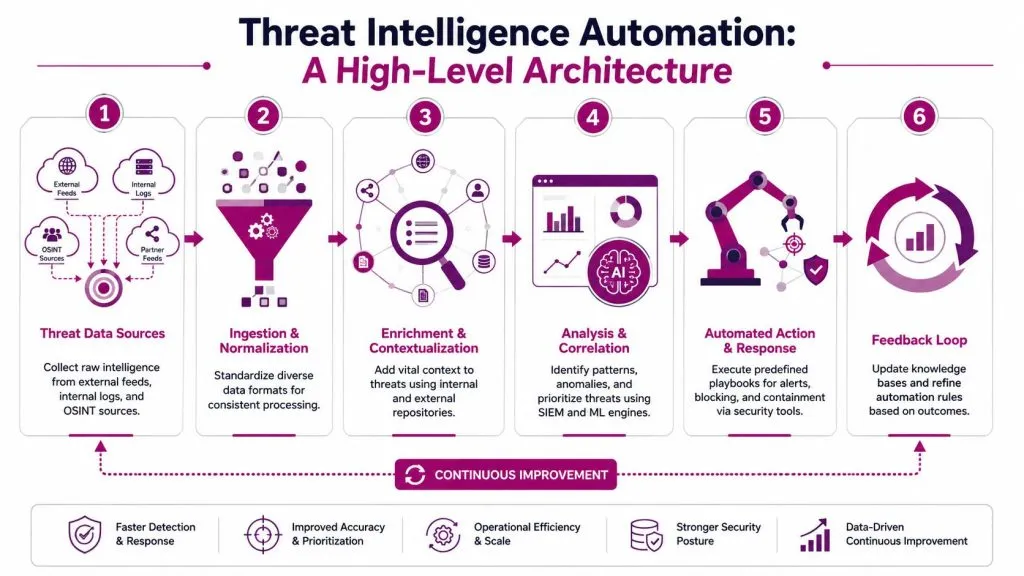
Most stacks vary by vendor, but the workflow is usually built from four core stages:
- Ingestion
Pull in technical feeds, open web findings, dark web signals, internal telemetry, email events, EDR alerts, and cloud logs. If this layer is weak, everything upstream is weak too. - Processing and enrichment
Normalize formats, deduplicate indicators, attach reputation, historical sightings, related malware families, and affected assets. These steps transform raw data into valuable intelligence. - Analysis and correlation
Compare external intelligence with internal evidence. A suspicious domain by itself may mean little. The same domain tied to an endpoint alert, a risky user, and a known campaign becomes actionable. - Action
Trigger a SOAR workflow, create a ticket, notify an analyst, quarantine an endpoint, block a connection, or hold an email for review. The right action depends on confidence and blast radius.
Here’s a useful sanity check. If your “automation” only ingests feeds and creates more alerts, you haven’t automated intelligence. You’ve automated noise generation.
A short walkthrough helps:
| Stage | What good looks like | What fails in practice |
|---|---|---|
| Ingestion | Multiple relevant sources flow into one normalized pipeline | Every feed creates its own silo |
| Enrichment | Alerts include context before analysts see them | Raw IOCs arrive with no priority |
| Correlation | Internal and external evidence are matched automatically | Analysts pivot manually between tools |
| Action | Response depends on confidence and policy | Every alert is treated the same |
A quick explainer is worth watching if you need to align technical and non-technical managers around the concept.

Key Benefits and Measurable KPIs for Your SOC
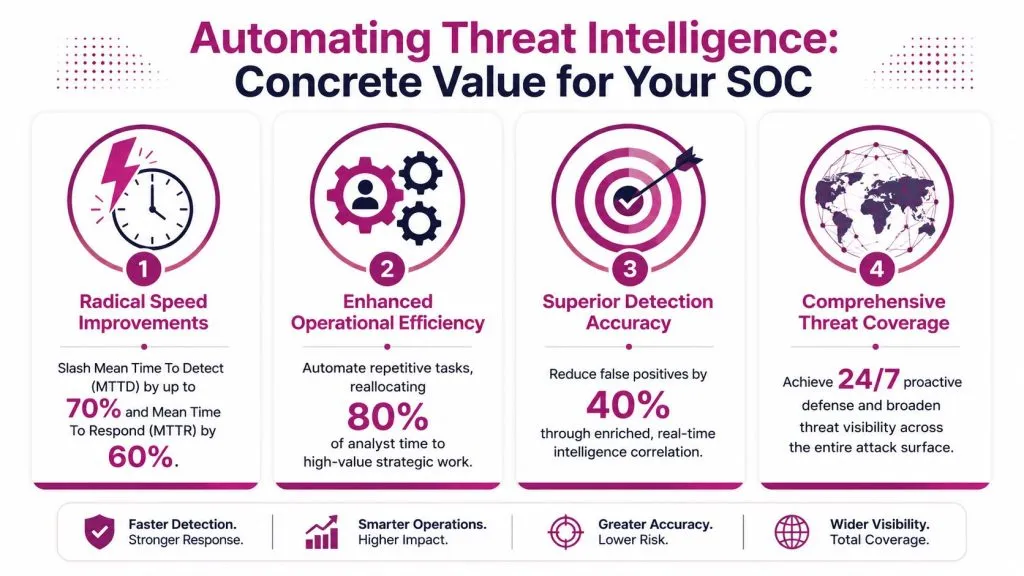
Threat intelligence automation only wins budget when it produces outcomes a manager can defend. Faster response sounds good, but clients buy what they can see in service quality, staffing efficiency, and reduction in operational drag.
The adoption story is already settled. 97% of industry respondents said automation is essential for effective defense, and machine learning models have achieved detection accuracy rates of up to 99%, with some deep learning architectures reaching 99.6% accuracy with a 0% false positive rate, according to Securonix. That doesn’t mean every SOC will hit those results. It does mean automation is no longer experimental.
What you can actually measure
The strongest benefits usually show up in four places.
- Speed of triage: Analysts spend less time gathering context and more time deciding.
- Alert quality: Better enrichment means fewer low-value cases rise to human review.
- Analyst utilization: Repetitive lookups, tagging, and first-pass sorting move to machines.
- Coverage: Teams can monitor more sources and more client environments without linear staffing growth.
A mature SOC doesn’t measure automation by how many playbooks exist. It measures automation by how many analyst minutes never had to be spent.
Which KPIs matter to clients
MSPs and MSSPs should track a small set of KPIs that connect security operations to business value.
| KPI | Why it matters | What to watch |
|---|---|---|
| Alerts automatically enriched | Shows reduction in manual context gathering | Are analysts seeing complete context at first touch |
| Alerts closed without human intervention | Shows where automation is trustworthy | Which rules are accurate enough to leave unattended |
| Escalations by severity tier | Shows whether prioritization improved | Are high-risk items reaching humans faster |
| Analyst time reclaimed | Shows operational efficiency | Which tasks still consume manual effort |
| False positive trend | Shows signal quality | Which feeds or rules create noise |
Client-facing reporting should also include intelligence-led services beyond the SOC. For example, teams that offer dark web monitoring benefits for early threat visibility can connect external exposure findings to internal alert prioritization. That helps clients understand why some indicators deserve immediate action while others don’t.
What doesn’t work is vanity reporting. “We processed more intelligence” means little. “We reduced manual triage and improved escalation quality” is something a client can understand and renew against.
Common Automation Patterns and Architecture
A practical architecture for threat intelligence automation doesn’t need to be exotic. It needs to be dependable. In most managed environments, that means external and internal sources feeding a normalization layer, then a threat intelligence platform or data pipeline, then SIEM and SOAR, then response tooling such as EDR, email security, firewall controls, and ticketing.
The backbone of a workable design
The backbone usually includes these components:
- Collection layer: Commercial feeds, OSINT, dark web sources, internal telemetry, cloud events, identity logs.
- Normalization layer: Parsing and schema standardization so one source doesn’t require custom logic everywhere else.
- Enrichment services: Reputation checks, asset context, historical sightings, campaign mapping, MITRE ATT&CK mapping.
- Decision layer: SIEM detections, TIP scoring, SOAR playbooks, analyst review queues.
- Response layer: Tickets, blocks, endpoint isolation, mailbox action, vulnerability workflow, client notification.
One of the more useful advances here is automated CTI reporting. AI-driven cyber threat intelligence automation can generate CTI reports that map attack behaviors to the MITRE framework, cover IOCs and TTPs, improve detection accuracy, and reduce manual intelligence analysis effort by up to 40%, according to the arXiv paper on CTI automation. That’s valuable because analysts don’t just need alerts. They need structured interpretation.
For providers trying to align threat intelligence with external exposure, attack surface analysis for security teams is a useful parallel discipline. It forces you to think beyond what the SIEM already sees and toward what an attacker can reach first.
Four patterns that usually deliver value fast
Indicator enrichment is the best first project in most SOCs. Take every suspicious IP, domain, hash, or URL and automatically attach context before it lands in an analyst queue. If you only do one thing, do this.
Automated threat hunting works when new intelligence can be searched across historical and live telemetry without analyst copy-paste. Good hunting workflows launch queries across EDR, email, identity, and cloud logs together.
Phishing triage is another strong candidate because email volume is high and the decision tree is repetitive. Automation can extract URLs, compare them with current intelligence, check sender patterns, and either suppress noise or escalate fast.
Vulnerability prioritization is where many teams finally tie security operations to remediation. The point isn’t to automate patching blindly. The point is to rank flaws based on exploit relevance, asset criticality, and whether related intelligence suggests active abuse.
Architect’s note: Don’t automate the final action until you trust the enrichment and scoring layers. Blocking bad data faster just creates outages at machine speed.
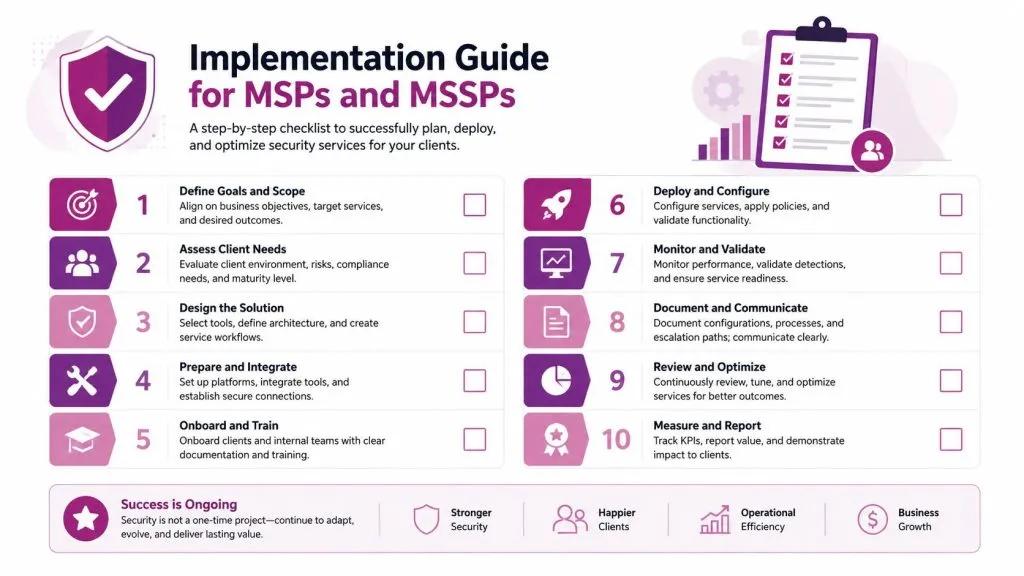
Implementation Guide for MSPs and MSSPs
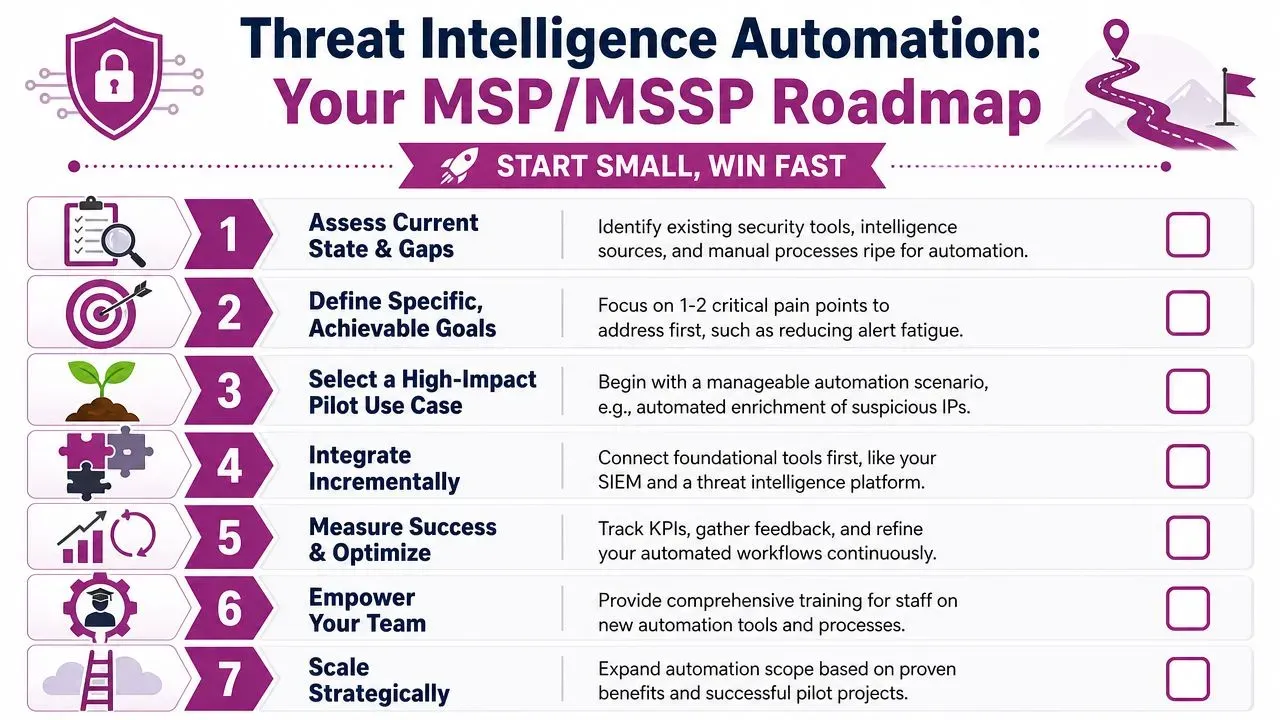
Most failed automation projects share the same flaw. The team started with a platform purchase instead of a workflow problem. If you want threat intelligence automation to stick, begin with one painful, repetitive process that your analysts already hate doing by hand.
Start small and pick one painful workflow
Good first candidates have three traits. They happen often, they follow a repeatable decision path, and they don’t require deep case-by-case judgment.
Examples include:
- Suspicious IP enrichment: Pull reputation, sightings, related alerts, and asset context automatically.
- Phishing intake triage: Extract observables, enrich them, and route based on confidence.
- External exposure review: Match outside-in findings against client asset inventories and open tickets only when ownership is clear.
- Credential exposure checking: Correlate leaked identity data with tenant context before escalation.
Teams outside security have learned the same lesson in business process design. The useful pattern is narrow automation with clear handoffs, not giant transformation programs. That’s why guides on practical AI business automation are relevant here. The mechanics differ, but the implementation discipline is the same.
Where projects usually fail
The biggest mistake is trusting raw indicators too early. A critical gap in many playbooks is the failure to enrich and validate raw IOCs in real time. Threat intelligence enrichment is described by Torq’s analysis of threat intelligence tools as the critical bridge that adds context like reputation and history, preventing automation from overwhelming analysts with low-confidence alerts and false positives.
That lesson matters even more in multi-tenant operations. One unvalidated IOC can create duplicate cases, client confusion, unnecessary blocks, and after-hours escalations nobody needed.
Common failure modes look like this:
| Failure mode | What it causes | Better approach |
|---|---|---|
| Raw IOC ingestion with direct action | Noise, false positives, bad blocks | Enrich and score before any response |
| Too many feeds, no curation | Analyst overload | Keep only sources that improve decisions |
| One giant rollout | Long delays, weak adoption | Pilot one use case and expand |
| No API depth | Manual glue work | Choose tools with strong integrations |
| No feedback loop | Stale playbooks | Review outcomes and tune rules regularly |
Tool selection rules that save time later
When evaluating tools, I’d insist on a few basics:
- API quality matters more than UI polish: If it can’t integrate cleanly with your SIEM, SOAR, EDR, and ticketing stack, you’ll end up rebuilding the workflow manually.
- Normalization must be native or easy to build: If every source needs custom handling forever, maintenance becomes the hidden cost.
- Analyst override is mandatory: Humans need a simple way to correct, suppress, or approve automated actions.
- Tenant separation must be clean: MSP and MSSP environments can’t tolerate sloppy client data boundaries.
For service providers offering external intelligence services, dark web monitoring for managed service providers fits well when it’s integrated into the same prioritization model as endpoint, identity, and email alerts. Treat it as context for decision-making, not as a disconnected feed.
Advanced Practices to Master Your Automation Strategy
Basic automation helps you react faster. Mature automation helps you predict where pressure will appear next. That shift happens when teams stop viewing security only from the inside out.
Shift from inside-out to outside-in
Most automated systems focus on an inside-out defensive view. Modernizing threat intelligence requires embracing the attacker’s viewpoint to understand their needs and predict their targets, a point raised by Ansh Patnaik of CyCognito in this discussion on the attacker perspective.
That idea changes how you build automation. Instead of only asking, “What alerts fired in our tools?” you also ask:
- Which exposed assets would an attacker notice first
- Which brands, domains, or identities are easiest to impersonate
- Which client weaknesses line up with current adversary behavior
- Which external signals suggest preparation before exploitation
Threat intelligence automation becomes predictive when a mature pipeline monitors the conditions an attacker needs, not just the evidence left after the first move.
Teams that only automate internal alerts stay efficient but reactive. Teams that automate around attacker opportunity start closing windows before the incident begins.
Build feedback loops into every playbook
Strong playbooks learn. Weak playbooks calcify.
Analyst decisions should feed back into scoring, suppression lists, enrichment rules, and escalation thresholds. If analysts repeatedly dismiss a certain class of enriched alerts, the pipeline should adapt. If a particular signal repeatedly appears in high-quality cases, prioritize it.
The same is true across the wider stack. Threat intelligence, attack surface visibility, email controls, endpoint telemetry, vulnerability operations, and identity signals should all influence one another. When those systems stay isolated, automation turns into a set of scripts. When they share context, automation becomes an operating model.
Frequently Asked Questions
What is the difference between automation and orchestration
Automation handles a specific task without human effort, such as enriching an IOC or opening a ticket. Orchestration coordinates multiple automated tasks into a workflow, such as enriching an IOC, checking endpoint telemetry, updating the SIEM case, and routing the result to the right client queue.
Will AI replace analysts
No. It should remove repetitive work, not replace judgment. Analysts are still needed to validate edge cases, investigate unusual behavior, tune playbooks, and decide when business context outweighs technical scoring.
How should MSPs think about ROI
Start with labor and risk. Measure how much manual triage time disappeared, how much alert quality improved, and how consistently high-risk issues reached the right responder. The strongest ROI cases usually come from reclaimed analyst capacity, fewer noisy escalations, and faster movement from detection to containment.
If you want to turn external threat signals into managed services your clients will value, InsecureWeb is worth a look. It helps MSPs, MSSPs, and security teams monitor dark web exposure, detect fake sites and accounts, identify vulnerabilities, and watch for threats across the open internet, dark web, and social media, with white-label delivery and API access that fits into an existing security stack.