Data Breach News14 min read
Reputation Management Software White Label: Boost MSP Growth
By InsecureWeb Team
This report reflects observations of dark web activity. InsecureWeb makes no representations regarding the accuracy of this data.
You’re probably already selling dark-web monitoring, fake site detection, vulnerability scanning, or some mix of those, and then a prospect asks the one thing your stack still doesn’t cover cleanly, “Can you also handle reviews and Google stuff?” That’s the gap. Reputation management software white label gives an MSP a branded way to answer yes without building a separate platform, hiring a product team, or sending clients to a third-party dashboard with someone else’s name on it.
The smart move is not to treat reputation as a random add-on. It sits naturally beside brand-protection and threat-monitoring services, because clients don’t separate “security” from “trust” when they search your name, read reviews, or see an impersonation attack. If you already own the conversation around dark web exposure and fake accounts, white-label reputation tooling lets you extend that same relationship into review monitoring, response workflows, and client-facing reporting under your own brand.
What White-Label Reputation Management Software Actually Is
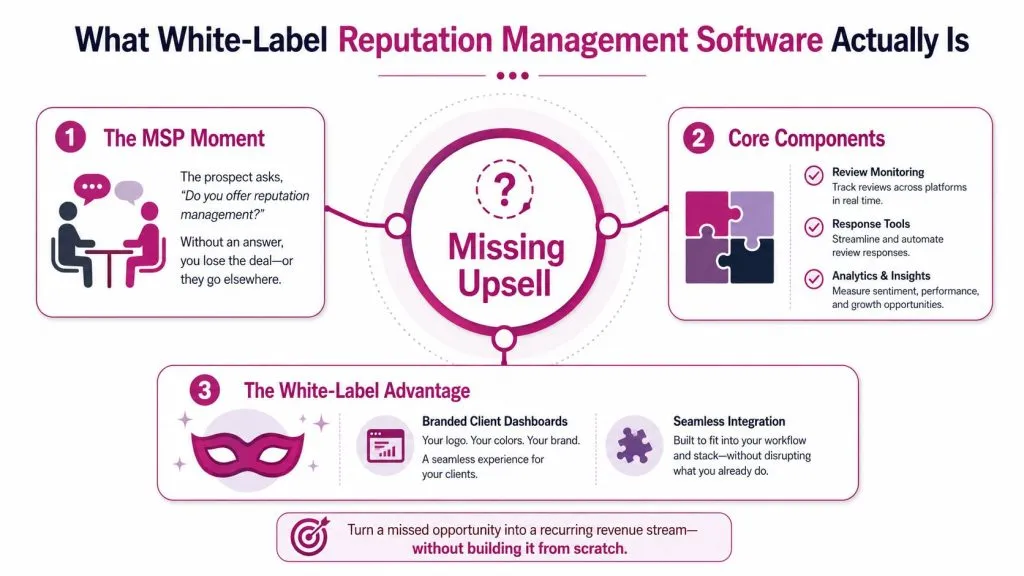
A common MSP moment looks like this. You are in a security renewal, the client likes your dark-web monitoring pitch, and then someone on their side asks whether you can also handle the reviews and Google results. That is not a random ask. It is the opening for a stacked service, especially for local and multi-location businesses that live or die by search results and review pages.
White-label reputation management software is a third-party platform that your agency or MSP presents as its own. The client sees your logo, your domain, your emails, your dashboards, and your reports, while the vendor stays behind the curtain. In practice, the software pulls in reviews from major sources such as Google, Yelp, Facebook, BBB, and TripAdvisor and gives you one place to monitor, respond, and report under your brand, not the vendor’s.
Why the timing matters
This category did not appear out of nowhere. It grew out of the broader online reputation management market, which was measured at USD 5.2 billion in 2022 and is projected to reach USD 14.0 billion by 2030, implying a 13.5% CAGR from 2023 to 2030 Reviewly. That growth matters because it shows reputation management has moved from a side task into a recurring software category that agencies can resell at scale.
For an MSP owner, the takeaway is simple. Do not build a review shop or a custom software product unless that is your core business. Use a branded service layer that sits on top of a mature reputation stack and fits beside the services you already sell. If you can explain dark-web monitoring as “we watch for your data where you can’t easily see it,” you can explain white-label reputation management as “we watch and manage what customers see about your business online, under our own portal,” and the two services sit well together. For a deeper example of that adjacent trust layer, see dark-web monitoring for MSPs.
Practical rule: if the client can log in and immediately see your branding, your support path, and your reporting, you have a service. If they keep hitting vendor branding, you have a reseller account pretending to be a service.
The strength here is not the software itself, it is the commercial wrapper. Agencies and MSPs can package review monitoring, response workflows, reporting, and branded delivery on top of existing ORM infrastructure. That is why the white-label layer gets more valuable as the parent market expands, and why it fits cleanly next to dark-web and brand-protection services you already sell.
Why MSPs and MSSPs Should Add It to the Stack
A client searches their own name before they call your team. If the results are messy, your security stack already has a trust problem that reputation management can help fix. For MSPs and MSSPs, this is not a side offer. It is a practical add-on to the brand-protection and dark-web monitoring services you already sell, and it gives you another recurring line item in the same account.
The revenue logic is obvious
White-label reputation gives you a recurring service line without forcing you to build software from scratch. The platform handles review generation, monitoring, response workflows, and reporting, while your team keeps control of the relationship, packaging, and support. That model works because the client sees your brand, not the vendor’s, and the service feels like part of your stack rather than a pass-through tool EmbedMyReviews.
Build-versus-resell math should settle the argument fast. Independent implementation guidance puts a custom AI-enabled reputation platform at roughly 8 to 12 weeks and $13,000 to $25,000, rising to $18,000 to $28,000 when multiple platform APIs are integrated Rapid Developers. That is real engineering time and real cash just to recreate features a vendor already packages.
Build vs White-Label at a Glance
| Factor | Custom Build | White-Label License |
|---|---|---|
| Time to launch | Longer, with product and QA overhead | Faster, because the platform already exists |
| Upfront cost | Roughly $13,000 to $25,000, or $18,000 to $28,000 with multiple APIs Rapid Developers | Lower, because you’re licensing and branding |
| Brand control | Full, but you own maintenance | High at the client layer, vendor hidden |
| Operational load | Heavy, with support and roadmap burden | Lighter, with vendor handling core platform work |
| Best fit | Rare, product-led MSPs with engineering depth | Most MSPs and MSSPs |
If you serve multi-location clients, the fit gets stronger. Reputation issues repeat across branches, franchises, and local service lines, so one service can roll across multiple locations without redesigning the workflow each time. That makes it easier to standardize reporting, sell a common playbook, and keep your delivery team out of one-off chaos.
The trade-off is vendor dependency. You are tying a revenue line to someone else’s platform, so exit terms, data portability, compliance posture, and branding control need to be checked up front. If you cannot export client histories, response templates, and reporting cleanly, you are renting an advantage instead of owning a service. That same discipline should already guide your dark-web monitoring service stack, because reputation and brand-protection work best when the data stays portable and the client relationship stays yours.
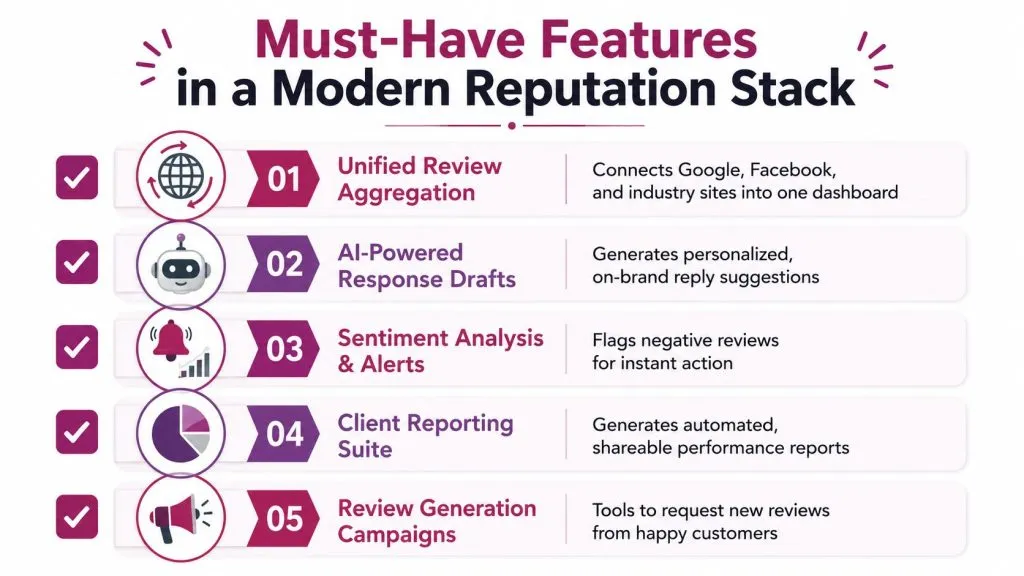
Must-Have Features in a Modern Reputation Stack
A good reputation stack does more than collect reviews. It fits into the rest of your service line, supports client work without extra handholding, and gives you a clean path to package reputation with dark-web and brand-protection offers you already sell. Skip pretty demos and focus on what your team will run every day.
Core capabilities you should insist on
Unified review aggregation comes first. If the platform only pulls from a couple of major networks, you are missing a chunk of the client’s reputation surface. You want one dashboard that pulls review activity into a single workflow so your team can respond without jumping between portals.
AI-drafted responses with human approval should save time without letting the platform speak for the client. The right setup drafts replies, sends them into an approval step, and keeps the client’s tone intact. If the vendor talks about AI responses but cannot show a review-by-review approval path, skip it.
Sentiment and trend reporting matter because clients pay for interpretation, not a wall of star ratings. A useful dashboard shows patterns across locations and makes it easy to explain what changed, where it changed, and who needs to act. That matters even more when you are managing reputation as part of a broader dark web scan and brand-protection service line.
Where security-adjacent value fits
Reputation work already overlaps with the services MSPs sell around impersonation, fraud, and brand abuse. Fake-account detection and impersonation monitoring belong in the stack because clients often find out about abuse after it has already spread. InsecureWeb’s platform focuses on dark web monitoring, fake site and account detection, threat intelligence, vulnerability scanning, and deepfake and reputation monitoring, which shows how reputation can sit inside a broader protection workflow for the open internet, not just review pages.
Use this standard: if the vendor cannot show how monitoring, alerts, and reporting support both trust and security workflows, the platform is too narrow for an MSP portfolio.
Open API and webhook coverage should also be on your checklist. If you cannot connect the platform into PSA, RMM, or CRM tools, you end up with another island of data and another manual handoff. That hurts scale and makes renewals harder to manage.
Role-based access is another filter. Multi-tenant delivery only works when your internal team, client admins, and end users see exactly what they should see, and nothing else. For managed services, that access model is operational hygiene.
How to Evaluate and Select the Right Platform
Buy for operational depth, portability, and the white-label layer. A vendor can look strong in a demo and still fail the first time your team tries to launch a branded portal, route approvals, or export client data. That is the true test. If the platform cannot survive day-one use, it is the wrong platform.
The criteria that actually matter
Integration depth comes first. Good enough means the major networks. Better means the platform also covers niche and local directories, because local businesses rarely live on one review site alone. If source coverage is shallow, clients will see the gaps fast.
White-label realism is the second filter. Logo and colors are not enough. You want custom domains, branded emails, client-facing exports, and a portal that does not leak vendor names in the footer or browser path. That is the line between a reseller account and a true white-label product, especially when login friction affects adoption ProfilePilot.
Data ownership and portability should be explicit in the contract. Most white-label content talks about branding and workflows, but the bigger risk is what happens when you leave the platform. That includes client histories, response templates, reporting, and any multi-location records your service has accumulated Internet Zone.
Build the portfolio around stackability, not just resale. If your MSP already sells dark web scan and brand-protection services, the reputation platform should fit that motion instead of forcing a separate process for every client. That is where data portability and clean client ownership matter most, because clients do not stay loyal to a vendor they cannot leave cleanly.
What should disqualify a vendor
If the vendor cannot answer security and compliance questions clearly, walk away. That matters for healthcare, legal, and other sensitive verticals, where review requests, moderation boundaries, and evidence retention can intersect with privacy or legal concerns. The category gets marketed like simple marketing software, but real deployments can touch regulated workflows and audit expectations Reviewly.
The commercial model should be clean too. If every useful feature is a hidden add-on, your margin gets messy fast. If the roadmap is vague, your team inherits product risk without any control over the next release cycle.
Use the same discipline you would use for security tooling. Clear monitoring, clear alerts, clear ownership, and clear client-facing output are the standard. If a platform cannot explain those basics without hand-waving, it will create friction in your service delivery.
A shortlist scoring method
Use a simple scorecard in the demo meeting.
- Integration depth: Does it cover the review sources your clients use?
- White-label depth: Can you replace the vendor identity everywhere clients touch the product?
- Portability: Can you export client history and templates without a fight?
- Compliance posture: Does the vendor speak clearly about logs, consent, and regulated workflows?
- Commercial fit: Does the pricing let you package the service profitably?
If a vendor scores weakly on portability or white-label realism, do not negotiate around it. Move on.
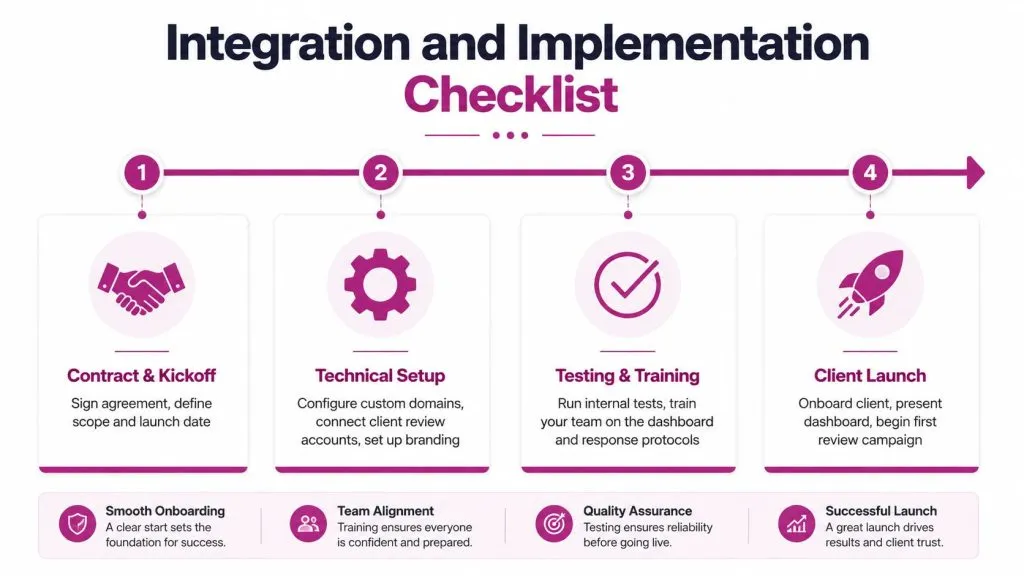
Integration and Implementation Checklist
A clean launch starts before the client ever logs in. Most implementation pain comes from the basics teams skip because they look operational instead of strategic. They are strategic the moment they break.
Get the branding and trust layer right
Start with the client-facing identity. Custom domains, dedicated SSL certificates, and branded email setup belong in place before launch, not after. If the portal looks shared or generic, trust drops the moment the client hits the login screen.
SPF and DKIM should be configured so review requests, alerts, and reports come from your identity, not an obvious vendor sender. That lowers deliverability risk and keeps the communication thread consistent across your service desk and client inboxes.
Lock down the operational side
Role-based access should be set for your internal team, client admins, and any approval users. Give everyone the same view because it is easier on day one, and you create permission sprawl and cleanup work later.
Launch with a pilot location first. Pick one branch, one brand, or one smaller account, then test review imports, response approval, reporting exports, and client notifications before you scale. That catches workflow issues without turning the whole rollout into a live fire drill.
Don’t skip governance
Audit logs matter, especially for sensitive verticals. If a negative review triggers a legal or privacy issue, you need to know who saw it, who replied, and when it moved through the workflow. Consent capture for review outreach belongs in the same bucket, because you need a defensible process when asking customers to leave feedback.
If your implementation plan has a launch date but no approval path, no audit trail, and no rollback step, it is not a launch plan. It is a hope.
API integration into PSA and CRM tools should come after the core brand and access setup, not before. Once the branded service is stable, connect it into the systems your team already uses. That sequence keeps the first deployment simple enough for a project manager to run without guesswork.
Pricing and Packaging Models That Actually Work
Pricing reputation as a feature is a mistake. Price it as a service line with an outcome, a workflow, and a support burden. Then pick the packaging model that matches how your clients buy.
Choose the model that matches the account
Per-location pricing works when you sell to franchises, clinics, or service groups with clearly separated branches. It’s simple for the buyer and easy for you to forecast. The downside is that it can get awkward if some locations generate a lot more review traffic than others.
Per-seat pricing is usually the weakest fit for reputation management. Your client doesn’t care how many internal users can click around, they care about how many locations are protected and how the service is run. If a vendor pushes per-seat as the main model, be careful.
Tiered bundles are the most practical. You can anchor the service around monitoring and reporting, then add response workflows, review generation, and stronger support at higher tiers. That keeps the sales conversation tied to business value instead of feature clutter.
Bundle it with adjacent security services
MSPs should be aggressive. Reputation should sit beside dark-web monitoring, fake-account detection, vulnerability scanning, and brand-impersonation alerts. That gives your account team a story about trust protection, not a random menu of disconnected tools.
A clean bundle also reduces churn. The client is less likely to drop a service when it’s positioned as part of a broader protection stack than when it’s sold as a standalone widget. That is especially true for organizations already buying security, compliance, or brand protection from you.
Keep the contract clean
If your vendor bills monthly, you still need annual commitments on your side. Otherwise, you inherit the vendor’s flexibility without capturing any of the renewal value. Put exit clauses, data export rights, and transition support in writing before you sign.
Use your package name, not the vendor’s plan name. Clients should buy something like a trust, reviews, or reputation protection bundle, not a software SKU they can’t interpret. If your pricing page reads like a vendor reseller sheet, you’ve already lost margin.
Go-to-Market and White-Label Branding Tips
A logo swap is not branding. If clients can tell which vendor powers your portal, the illusion breaks and so does the service experience. You need the service to feel native from first touch to quarterly review.
Position the service as trust protection
Name the offer around outcomes, not features. Words like trust, visibility, protection, and presence work better than “review software.” You’re not selling star ratings, you’re selling control over what buyers see when they search.
Sales conversations should lead with business impact. Talk about renewal risk, local credibility, and consistency across locations before you talk about dashboards. That framing lands better with owners and operators than a discussion of widgets or review feeds.
Make the service feel owned
Every touchpoint matters. Footer text, sender names, support email domains, and report headers should all match your brand. If the client has to ask who really runs the service, the white-label model is already slipping.
Support escalation paths need to be clear too. Your team should know what gets handled internally, what goes to the vendor, and what the client sees. That keeps response times sane and prevents awkward handoffs.
Use the service in renewals and expansions
Review reports can do more than show progress. They can anchor the next conversation about multi-location rollout, branch-level consistency, or pairing reputation with your existing security services. The report becomes a sales asset, not just an update email.
If you already use dark-web monitoring in your portfolio, that story gets stronger when reputation joins the stack. The benefits of dark web monitoring are easier to explain when you position reputation as the public-facing side of the same trust equation.
Avoid the usual branding mistakes.
- Vendor names in dashboards: Remove them or don’t launch.
- Generic support inboxes: Use your own domain.
- Mixed visual identity: Pick one brand system and keep it consistent.
- Feature-first messaging: Lead with business outcomes instead.
Key Takeaways and Frequently Asked Questions
Pick a vendor whose white-label layer is real, not cosmetic. Negotiate data portability before the contract is signed. Package reputation with your existing security and brand-protection services, then treat branding as part of the product, not a design exercise.
FAQ
How is white-label reputation management different from generic ORM tools?
White-label software is built to appear as your service, with your branding, your login experience, and your reporting. Generic ORM tools may have the features, but they usually don’t hide the vendor or support a real reseller motion.
What compliance issues matter for healthcare and legal clients?
Consent for review outreach, moderation boundaries, audit logs, and evidence retention matter most. If a platform can’t speak clearly to those workflows, don’t put sensitive clients on it.
What happens to client data if I change vendors?
That depends on your contract and the platform’s export options. Demand clear data portability terms up front, including client histories, templates, and reporting.
How fast can an MSP launch this service line?
Fast enough to matter if the platform is already built, branded, and integrated cleanly. The actual speed depends on your domain setup, approval flow, and whether you start with a pilot location or try to roll out everywhere at once.
If you’re already selling dark-web monitoring, brand protection, or vulnerability services, reputation belongs in the same bundle. The stack gets stronger when you own both the hidden threats and the public trust layer.
If you want to turn reputation into a branded service line without building the stack yourself, InsecureWeb gives MSPs a white-label way to monitor threats, fake sites, impersonation, and reputation signals under their own brand. Visit InsecureWeb if you want to package that protection into the portfolio you already sell.