Data Breach News16 min read
10 Reputation Management Best Practices for MSPs & IT Teams
By InsecureWeb Team
This report reflects observations of dark web activity. InsecureWeb makes no representations regarding the accuracy of this data.
In reputation management, the shift is already visible in how people decide whom to trust. A well-cited industry survey found that 91% of consumers read online reviews regularly or occasionally, and 84% trust them as much as personal recommendations (ReviewTrackers reputation management statistics). For MSPs and IT teams, that means your reputation lives in search results, review sites, social feeds, and threat communities at the same time.
That’s why old-school PR isn’t enough anymore. Modern best practice is a continuous operating model, with monitoring, response, search visibility, and regular audits handled as part of daily security work, not as a side project. Industry guidance now treats reputation as a set of observable signals, including review volume, star ratings, sentiment, response speed, and search visibility, which makes it a management function rather than a one-time campaign.
The risk surface has also expanded. MSPs now have to watch for stolen credentials on the dark web, fake support sites, impersonation accounts, coordinated smear campaigns, and deepfake content that can spread faster than a human team can manually contain it. The good news is that the playbook is clear enough to operationalize, especially if you connect the right monitoring, escalation, legal, and metrics workflows.
1. Continuous Dark Web and Deep Web Monitoring
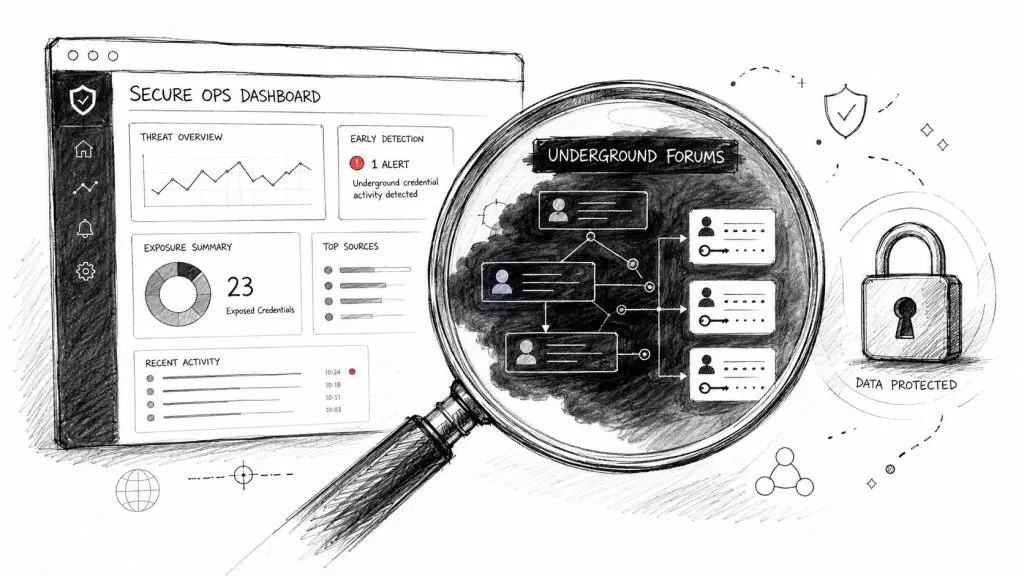
Dark web monitoring should be treated like an early-warning control, not a forensic afterthought. If an employee password, reseller login, or client credential package appears in a forum dump, the team that sees it first gets the best chance to contain the blast radius before fraud, lateral movement, or public disclosure. For MSPs, this is also a service differentiator because clients buy speed as much as they buy coverage.
Build the watchlist like an attacker would
The useful queries go beyond your exact company name. Track domain variations, executive names, product names, common misspellings, and homograph-style lookalikes, then connect those hits to your incident response playbook. If a credential set appears alongside a client domain, cross-reference it with VPN, email, and identity logs before deciding whether it’s noise or a live issue.
Practical rule: if a lead lands in a dark web feed, it is not a lead until you verify it against internal telemetry and preserve evidence.
The operational trade-off is simple. Broader monitoring catches more threats, but it also creates more false positives, so assign one person to triage weekly and keep escalation criteria written down. InsecureWeb’s dark web scan fits well here because it gives MSPs a way to fold outside exposure checks into an existing response process instead of scattering them across one-off tools.
A mature program also checks languages and source diversity. Underground activity rarely stays in one language or one forum, so coverage gaps become blind spots fast. Treat dark web hits as the start of investigation, not the end of it.
2. Fake Site and Brand Impersonation Detection
Impersonation is one of the easiest ways to turn trust into a liability. A convincing fake login page, counterfeit support portal, or spoofed executive account can collect credentials, redirect payments, or push a client into a malicious workflow before anyone notices the typo in the URL.
Monitor domains, accounts, and lookalikes together
The most effective programs register obvious domain variations, then monitor new registrations containing the brand name every day. That matters because attackers often build their credibility from small details, like a close-match domain, a cloned logo, or a social profile that borrows the right title and photo. You’ll catch more than phishing pages if you treat impersonation as part of your broader attack surface, which is why the thinking behind attack surface analysis maps neatly to brand protection.
For MSPs and security teams, the work is not just detection. It’s ownership, proof, and takedown readiness. Keep a record of official social handles, certificate details, WHOIS data, screenshots, and timestamps so you can move quickly when platform support asks for verification.
- Register common variants early: Secure the most obvious .co, .net, and .io versions before someone else uses them against you.
- Watch executive identity risk: Track names and titles of founders, account managers, and service leads because impersonation often targets people, not only brands.
- Use platform relationships: Faster takedowns usually happen when you already know the right contact or escalation path.
The trade-off here is cost versus coverage. You won’t block every fake site by pre-registering domains, but you can reduce the number of easy wins for attackers and shorten the time between detection and removal.
3. Proactive Social Media Reputation Monitoring
Social channels are where small issues become public narratives. A complaint about service delays, a screenshot of a failed login, or a deepfake video of an executive can reach a broader audience long before your support queue catches up, so social listening needs to sit inside the security process, not just the marketing calendar.
Track sentiment and malicious content in the same view
Industry guidance recommends watching the major platforms your audience uses and routing alerts for brand names, product names, and executive names into shared dashboards. That works because sentiment shifts often appear before a full crisis, especially when customers start repeating the same complaint or when a fake post starts getting amplified by coordinated accounts. The practical point is to treat social mentions as both service feedback and threat telemetry.
For B2B teams, LinkedIn deserves the same discipline as X or Facebook, because executive impersonation and fake partnership announcements can do real damage in a business context. Consumer-facing brands need tighter coverage on TikTok and Instagram, where visual manipulation spreads easily and deepfakes can look legitimate at a glance. If you’re building broader identity safeguards, the logic in digital identity protection strategies fits naturally with reputation monitoring.
A useful operating standard is simple. Critical issues should be triaged fast, documented, and, when appropriate, moved to a private channel without sounding defensive. If the post is legitimate, reply like a human, acknowledge the concern, and close the loop with a concrete next step.
Fast response is valuable, but speed without coordination creates mixed messaging. Make sure one team owns the public reply and one person owns the internal escalation.
The win here is not perfect silence. It’s credibility, because a calm, timely response reduces the odds that a routine complaint becomes a reputational incident.
4. Rapid Response and Crisis Communication Protocols
A reputation problem gets harder to control every minute it sits unaddressed. That’s why written response protocols matter, especially for MSPs that support multiple clients, multiple time zones, and multiple escalation paths at once.
Pre-write the first move
The best crisis teams don’t start from a blank page. They keep templates for likely scenarios, define who approves messaging, and rehearse the handoff between support, legal, leadership, and public-facing staff. If a breach notification, impersonation attack, or public misinformation event breaks before business hours, your team should already know who gets paged, who posts, and who documents decisions.
The cleanest playbook is usually the one that limits improvisation. Pre-approved language prevents accidental admissions, legal review keeps you inside disclosure obligations, and a named spokesperson keeps the story consistent. Use steps after a data breach as a reminder that containment, evidence handling, and communication all need to move together.
Practical rule: write for the first hour, not the first day. If your team can’t issue an informed holding statement quickly, the internet will write one for you.
A strong protocol also includes after-hours coverage and multi-language communication where needed. That matters because a slow overnight response can create avoidable confusion, especially when a rumor starts in one region and reaches another before your team is awake. Good crisis communication doesn’t eliminate bad news, it makes the organization look disciplined while the facts are still moving.
For deeper message discipline, it helps to align with crisis communication best practices before you ever need them in anger.
5. Vulnerability Disclosure, Transparency, and Customer Communication
Transparency is hard when the news is ugly, but silence is usually worse. Customers generally handle bad news better when they get a clear timeline, a direct description of impact, and a realistic remediation path instead of vague reassurance that “we take security seriously.”
Tell the truth early, then keep updating it
A responsible disclosure policy gives researchers and customers one obvious route to report issues before those issues become public. That should include a security.txt file, an internal triage workflow, notification templates, and a legal review path that can decide quickly what must be disclosed and to whom. The point is not oversharing, it’s making sure the facts are correct and the communication is timely.
Different teams need different levels of detail. Customers need to know what was accessed, what they should do next, and how you’re reducing repeat risk. Legal and compliance teams need records, scope decisions, and notification history. Security teams need the technical root cause and the remediation plan.
A transparent response also depends on consistency. If you publish a status page, keep it current. If you send customer security updates, send them at regular intervals, not only when the issue gets worse. If a post-incident summary is appropriate, explain what changed without exposing sensitive internal details.
Customers usually don’t expect perfection. They expect honesty, specificity, and follow-through.
That’s the balance worth protecting. Overly cautious language can sound evasive, while too much detail can create new risk, so legal, compliance, and security need to draft the same message together.
6. Automated Threat Intelligence and Reporting
Threat intelligence only helps when it reaches people in time to act. Manual feed review is too slow for most MSP environments, especially when the goal is to protect many clients from the same exploit chain, phishing kit, or impersonation tactic.
Filter for relevance, not volume
The right system collects, analyzes, and routes intelligence by business context. If a vulnerability affects your stack, your clients’ stack, or a service you resell, that should trigger a faster workflow than generic news about a threat actor with no overlap. Good intelligence doesn’t flood the team, it narrows decisions.
Executive reporting should reflect that. Weekly or monthly summaries work best when they separate noise from action items and connect the threat to an actual asset, control gap, or ticket. For MSPs, that’s where the value lives, because clients care less about raw intelligence than about what you prevented, patched, or isolated.
Automated reporting also helps standardize response. If the same intelligence repeatedly leads to a ticket, a scan, and a remediation task, your team spends less time translating threat news into work and more time doing the work. Correlate feeds with vulnerability management and asset inventories, or the reports will stay interesting but operationally thin.
The practical trade-off is obvious. Broader feeds give you more context, but they also increase alert fatigue. Narrow feeds are cleaner, but they can miss adjacent risk, so the best setups start broad, then tune aggressively based on what produces action.
7. Regular Security Audit and Compliance Verification
Audits are not just about satisfying a checkbox. They show customers, insurers, and regulators that your controls work in practice, and they help you find weak points before an attacker or an auditor does.
Make the audit cycle visible
A good audit program has a cadence, a scope, and a remediation owner for every finding. Quarterly internal scans, annual penetration tests, and documentation that tracks what changed after each review are the minimum foundation for teams that want to prove diligence. If you support regulated customers, align the work with the frameworks that matter to them, then keep the evidence organized enough to pull quickly.
Value comes from trend lines. Year-over-year improvements in fewer repeat findings, faster closure, and cleaner control evidence help sales, legal, and customer success talk about trust with substance instead of slogans. Security and reputation overlap, because a tidy audit trail makes due diligence easier for buyers and less stressful for your own team.
Use the findings to change policy, not just to create a remediation queue. If the same issue keeps reappearing, the problem is probably process, ownership, or tooling, not the report itself.
An audit that doesn’t change behavior becomes an expensive archive.
That’s the bar. Document what was tested, what failed, what got fixed, and who signed off, then feed those lessons into the next review cycle.
8. Executive and Employee Training on Reputation Risks
Most reputation damage starts with a person making a small mistake under pressure. A rushed reply, a sloppy password reset, a phishing click, or a careless social post can create more trust damage than a lot of technical failures, because people remember the behavior behind the incident.
Train for role, not just attendance
Executive training should cover fraud, impersonation, account takeover, and public-facing communication risks. Staff training should cover phishing, secure handling of customer data, and what to do when they see something suspicious. The more the examples look like the work people do, the more likely they are to remember the right response when a real message lands.
Phishing simulations help, but only when they’re followed by feedback that teaches, not shames. A culture where people report mistakes quickly is better than one where they hide them, because secrecy stretches recovery time and makes the eventual problem bigger.
Use monthly simulations if you can sustain them, and keep the scenarios fresh. If the same lure repeats too often, staff start recognizing the drill instead of learning the habit. For executives, focus on high-trust abuse, including impostor calls and urgent approval requests, because senior roles are a favorite target for social engineering.
The broader goal is consistency. When every employee knows how to route a concern, the organization stops creating avoidable reputational risk from inside its own walls.
9. API and Workflow Integration for Seamless Security Operations
Tools that live outside the workflow tend to get ignored. Integration matters because reputation and threat alerts need to land where people already work, whether that’s a SIEM, a ticketing queue, a collaboration channel, or an automation platform.
Route alerts to action, not inbox clutter
A useful setup pushes high-priority alerts into the systems your team already trusts, then deduplicates repeat noise before it reaches humans. That means one event can create a ticket, notify the right channel, and log the evidence trail without forcing someone to retype the same information three times. InsecureWeb’s free API is built for exactly that kind of workflow, which makes it easier for MSPs to bundle monitoring into their own stack without adding another disconnected console.
Start with the integrations that remove friction fastest. SIEM, ticketing, and secure messaging usually beat fancy dashboards because they change how fast the team acts. Once that’s stable, add webhooks, role-based approvals, and runbooks for repeatable response patterns.
The trade-off is governance. Automation speeds response, but if you don’t define who can trigger it, what it can do, and how you review it, you can create new risk while trying to reduce old risk. Monitor the integrations themselves, too, because a broken connector can become a blind spot.
If alerts don’t create work, close the loop, or prove they were handled, they’re just expensive noise.
That’s the standard worth enforcing.
10. Metrics, Monitoring, and Continuous Improvement Program
What gets measured gets fixed more reliably. Reputation programs fail when they rely on vague confidence instead of visible indicators, so the team needs a small set of metrics that show whether detection, response, and customer perception are improving.
Measure the operational and business sides together
Keep the dashboard tight. Track review volume, sentiment trends, share of voice, response time, detection speed, remediation completion, and the number of repeat issues that come back after closure. For reputation management, industry guidance already points to sentiment scores, share of voice, brand mentions, review velocity, and response times as the kind of metrics that help teams spot patterns early and see whether interventions are working (Curogram online reputation management strategy).
The operational detail matters as much as the headline metric. Shared dashboards and standardized KPIs make it easier for security, marketing, and leadership to talk about the same problem without translation overhead. Best-practice guidance also recommends benchmarking against competitors and using AI-driven sentiment detection so teams can see whether the brand is drifting in the right direction (Reputation.com marketing strategy guidance).
Build the program around review cadence, too. A quarterly or biannual audit rhythm helps compare current results with the previous baseline, which is how you find real improvement instead of guessing at it (Reputation.com new rules of reputation management). Keep the reporting practical, because leadership usually needs a short trend view, not a raw alert dump.
The question is whether the metric changes behavior. If it doesn’t influence staffing, tools, response speed, or customer communication, it’s probably not the right metric.
10-Point Reputation Management Best Practices Comparison
| Item | Implementation complexity 🔄 | Resource requirements ⚡ | Expected outcomes 📊 | Ideal use cases 💡 | Key advantages ⭐ |
|---|---|---|---|---|---|
| Continuous Dark Web and Deep Web Monitoring | High, specialized tooling, multi‑language scraping, continuous tuning | High, automated crawlers, dedicated analysts, SIEM integration | Early detection of leaked credentials and data; reduced time‑to‑discovery | MSPs, financial, healthcare, incident response teams | Proactive threat detection; compliance and early remediation |
| Fake Site and Brand Impersonation Detection | Medium, domain/social scanning plus takedown workflows | Medium, domain monitoring tools, legal/takedown contacts, WHOIS monitoring | Reduced fraud and impersonation; faster removal of malicious sites/accounts | E‑commerce, SaaS, consumer brands, support portals | Protects reputation; prevents customer fraud and phishing |
| Proactive Social Media Reputation Monitoring | High, 24/7 multi‑platform monitoring and sentiment analysis | High, monitoring platforms, analysts, crisis comms capability | Early crisis detection; faster PR response; deepfake identification | Consumer brands, public companies, executive protection | Prevents viral damage; informs communications and marketing |
| Rapid Response and Crisis Communication Protocols | Medium, documented playbooks, approval workflows, tabletop testing | Medium, trained response team, templates, multi‑channel tools | Consistent, rapid responses; controlled narrative; regulatory notices | Any org facing public incidents; regulated industries | Reduces amplification; ensures legal/compliant notifications |
| Vulnerability Disclosure & Customer Communication | Medium, policy creation, legal coordination, disclosure timelines | Medium, legal, security, comms resources; transparency reporting tools | Builds trust; meets notification requirements; reduces long‑term damage | SaaS/cloud providers, regulated sectors, companies with public data | Demonstrates maturity and accountability; improves researcher relations |
| Automated Threat Intelligence and Reporting | Medium, feed aggregation, filtering, and integration work | Medium, threat feeds, SIEM/TP platform, analysts for tuning | Actionable, prioritized intelligence; faster, informed decisions | MSPs, finance, healthcare, critical infrastructure | Contextual insights; reduces analyst load; risk‑based prioritization |
| Regular Security Audit & Compliance Verification | High, formal audits, testing, and documentation demands | High, external auditors, pen testers, remediation resources | Verified controls and compliance evidence; reduced exploit risk | Regulated industries, enterprise customers, insurers | Proof of due diligence; supports certifications and customer trust |
| Executive & Employee Training on Reputation Risks | Low–Medium, program design, role‑specific curricula, simulations | Low–Medium, LMS, trainers, phishing simulation tools | Lower human‑error incidents; improved reporting and policy adherence | All organizations; roles with access to sensitive systems | Reduces phishing/social engineering success; builds security culture |
| API & Workflow Integration for Security Operations | Medium, development work, integration testing, maintenance | Medium, engineering time, API management, monitoring of integrations | Faster MTTR; automated ticketing and correlated alerts | SOCs, MSP platforms, organizations with multiple security tools | Scales response; reduces manual work and alert fatigue |
| Metrics, Monitoring & Continuous Improvement Program | Medium, KPI selection, dashboarding, data pipelines | Medium, analytics infrastructure, analysts, reporting cadence | Measurable improvements (MTTD/MTTR, sentiment); data‑driven decisions | Leadership reporting, continuous security programs, MSP client reporting | Demonstrates ROI; drives prioritized improvements and accountability |
Action Plan for Reputation Resilience
Reputation resilience starts with visibility and ends with discipline. The strongest MSP and IT teams treat dark web monitoring, impersonation detection, social listening, response playbooks, transparency, threat intelligence, audits, training, integrations, and metrics as one operating model instead of ten disconnected tasks. That’s the difference between reacting to incidents and managing risk before it becomes public.
Begin with the controls that expose hidden exposure fastest. Wire dark web monitoring into incident response, add fake site and account detection for your brand and executives, and make sure social alerts reach a real responder fast enough to matter. Then connect those signals to legal, compliance, and communications so the response stays consistent when pressure rises.
From there, focus on repeatability. A good reputation program can’t depend on memory or heroics, so formalize your escalations, document your notification logic, and keep your dashboards tied to business outcomes. The best teams review trends on a schedule, compare results to prior baselines, and use the findings to improve the next response cycle instead of waiting for a crisis to force the lesson.
If you’re ready to turn outside threat monitoring into a practical, client-ready workflow, InsecureWeb gives MSPs and security teams the API-driven tools to detect dark web exposure, fake sites, deepfake threats, and weak spots from one place. Visit it now if you want to fold reputation protection into the same operational stack you already use.