Data Breach News12 min read
Information Security vs Cyber Security: Key Differences
By InsecureWeb Team
This report reflects observations of dark web activity. InsecureWeb makes no representations regarding the accuracy of this data.
You’ve probably seen the same pattern on client calls. The firewall is current, endpoint protection is deployed, MFA is on for most users, and yet the breach review still ends with a miserable question, who owned the gap between the stolen credential, the exposed data, and the missed policy control? That’s where information security vs cyber security stops being a naming debate and starts affecting budgets, tooling, and accountability.
For MSPs and IT directors, the confusion shows up fast. Cyber tools get bought to solve what are really information governance problems, while policy work gets delayed because everyone assumes the security stack already covers it. The result is a program that looks busy, but leaves blind spots in physical records, human process, external exposure, and incident ownership.
| Dimension | Information Security | Cyber Security |
|---|---|---|
| Scope | Protects information in any form, digital, paper, physical, and procedural | Protects digital systems, networks, devices, and electronically stored data |
| Primary objective | Preserve confidentiality, integrity, and availability across the whole information lifecycle | Defend digital attack surfaces from unauthorized access and cyberattacks |
| Common threats | Theft, misuse, policy failure, insider risk, physical loss, process gaps | Malware, ransomware, phishing, credential theft, network intrusion |
| Typical controls | Classification, access policy, physical safeguards, retention, awareness, governance | MFA, patching, EDR, monitoring, vulnerability scanning, incident response |
| Ownership | Security leadership, compliance, business process owners | Security operations, IT, SOC, incident responders |
Why the Distinction Matters for Modern Security Programs
A common failure pattern begins after a credential theft incident. A client’s employee password appears in a breach dump, the SOC flags the account, the firewall and EDR are fine, and leadership assumes the issue was “cyber” and therefore handled by the tech stack. Then the post-incident review exposes the problem: nobody owned the broader information protection gap, including data classification, credential reuse, and who should have been monitoring for exposed identity data from the start.
That’s the practical reason the information security vs cyber security distinction matters. Information security is the broader governance umbrella, it protects information in any form, digital, paper, verbal, or physical. Cybersecurity is the narrower action layer, focused on computers, networks, and internet-connected assets. When teams blur those scopes, they usually overbuy tools for one side and underfund controls on the other.
Practical rule: if the risk exists even when the laptop is off, it’s information security. If the risk depends on a system, network, or device being reachable, it’s cybersecurity.
This matters for budgeting because the line between the two disciplines determines who pays for what. Cybersecurity budgets usually go toward monitoring, endpoint defense, patching, scanning, and incident response. Information security budgets need room for policy, data handling, employee training, records protection, and business process controls that don’t live inside a console. If you force every problem into the “cyber” bucket, physical and procedural risk gets underfunded.
The scale of cyber risk also explains why the split is no longer theoretical. By 2023, the FBI’s IC3 recorded 880,418 complaints of cybercrime, a 10% increase from 2022, with losses above $12.5 billion (Augusta University on cybersecurity vs. information security). At enterprise level, the global average cost of a data breach was about $4.5 million in 2023 (same source). Those numbers are why the action layer gets constant attention, but they don’t remove the need for the broader governance model.
Defining Information Security and Cyber Security
Information security protects the confidentiality, integrity, and availability of information in any form. That means digital records, paper files, physical assets, and the processes that move information around the business. The discipline answers questions like, who should be allowed to see this data, how long should we keep it, where can it be stored, and what happens if a process leaks it without any malware involved.
Cybersecurity is narrower. It focuses on protecting digital systems, networks, devices, and electronically stored data from cyberattacks and unauthorized access. That makes it the technical specialization that deals with systems exploited through the internet, malicious code, identity abuse, and network-connected attack paths.
The cleanest way to explain the difference to clients is to anchor information security to the CIA triad, confidentiality, integrity, and availability, then position cybersecurity as the technical implementation layer that protects digital assets inside that framework. Information security governs the policy and control model. Cybersecurity enforces it on servers, endpoints, cloud services, identity systems, and network infrastructure.
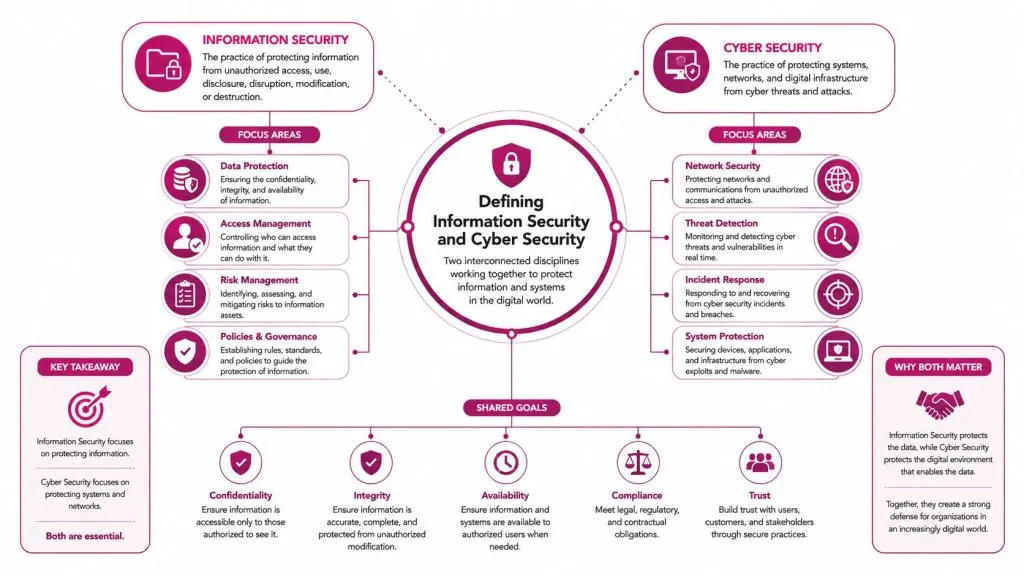
Historically, that ordering matters. Information security is the older, broader discipline, and cybersecurity emerged later as the digital-threat specialization layered inside it. That’s why the better question isn’t “which term is right?” It’s “which control domain is missing from the program?” A business can be strong on network defense and still be weak on data governance, just as it can have polished policies and still be exposed to ransomware, phishing, or credential theft.
For a useful practitioner framing, Accelerate IT Services Inc on cyber security is a decent complement because it places cyber defense in an evolution of digital risk rather than treating it like a standalone slogan. That perspective helps MSPs explain why a client can’t buy one tool and call the entire security program complete.
Comparing Scope Objectives and Threat Surfaces
The fastest way to reduce confusion is to compare the two disciplines by operational criteria, not by marketing language. Information security is the broader discipline, so it covers everything from document handling to visitor access, while cybersecurity is the specialization that protects digital systems and attack surfaces. The difference shows up in daily work, tool selection, and who gets paged during an incident.
The source of confusion is often the threat surface itself. Cybersecurity is concerned with connected assets, credentials, exposed services, malicious payloads, and internet-delivered attacks. Information security must also deal with paper records, internal process failures, employee behavior, vendor trust, and the way data moves across the business. If an MSP sells only a cyber stack, it can miss the control points that keep information safe outside the network.
Attack surface analysis is useful here because it forces teams to inventory what attackers can reach, not just what they can scan. That mindset belongs to cybersecurity, but the output often feeds broader information security governance too.
| Dimension | Information Security | Cyber Security |
|---|---|---|
| Scope of protection | Any information, any form, including physical and organizational context | Digital systems, networks, endpoints, cloud, and electronic data |
| Main objective | Reduce loss, misuse, corruption, and unauthorized disclosure across the business | Detect, block, and recover from digital attacks |
| Threat surfaces | Paper files, verbal disclosure, insider misuse, access policy, physical storage, digital data | Email, endpoints, servers, internet-facing apps, identity systems, cloud workloads |
| Typical controls | Classification, retention, access policy, physical safeguards, training, governance | MFA, EDR, SIEM, vulnerability scanning, patch management, threat hunting |
| Compliance implications | Data handling, privacy, records, audit readiness, process control | Technical safeguards, logging, incident response, secure configuration |
The compliance angle is where service packaging often goes wrong. Security frameworks like ISO 27001, NIST-based programs, and privacy obligations such as GDPR don’t ask teams to choose one discipline. They expect a working blend of governance and technical control. Cyber tools help you meet system-level requirements, but they don’t replace classification, ownership, process, or evidence. A client can have excellent monitoring and still fail an audit because the organization can’t show clear policy, retention, or data-handling discipline.
The budgeting implication is simple. If the conversation starts and ends with cyber tools, the business may buy more controls than it can operate. If the conversation is too broad and never becomes technical, it ends up with policy binders and no detection. A workable program needs both, and it needs the distinction to decide what belongs in the security platform, what belongs in governance, and what belongs in the service catalogue.
Real-World Scenarios Where the Overlap Matters
A stolen credential incident is the easiest place to see the overlap. Dark web monitoring surfaces an employee password, the help desk resets the account, and the SOC checks for suspicious logins. That’s cybersecurity in motion. But if nobody checks whether the account had access to sensitive records, whether the credential was reused elsewhere, or whether the business even had a policy for exposed identities, the information security failure remains untouched. What to do after a data breach becomes relevant here because containment is only one part of recovery.
A second scenario shows where narrow cyber language falls short. An executive’s likeness gets cloned into a deepfake impersonation on social media, and a finance employee receives a message that looks like a legitimate direction from leadership. There may be no malware, no exploit, and no firewall event at all. That still belongs inside information security because the organization’s reputation, trust model, and human decision process are being attacked, even though the delivery channel is digital.
A lot of “not our problem” decisions happen right before the invoice gets paid or the data gets handed over.
The third scenario shows the reverse problem, a cybersecurity stack that looks healthy on paper but fails an audit because governance is weak. Logs are retained, endpoints are patched, and access controls are in place, but policies are missing, responsibilities are unclear, and evidence for data handling is thin. In that case, the technical side is doing its job, but the broader information security program can’t prove control. That’s exactly where IT directors get caught between operational reality and compliance expectations.
In practice, the same incident can require both disciplines at once. Stolen credentials trigger cyber monitoring, but they also raise information security questions about data exposure, user training, and account lifecycle management. Impersonation fraud demands cyber visibility into external exposure, but it also needs information security controls around verification procedures, payment approval, and staff behavior. The overlap isn’t a corner case, it’s the normal operating environment.
Role and Responsibility Mapping for Security Teams
The ownership problem is where many MSPs lose control of the conversation. If every issue becomes “cyber,” then the team that owns tools ends up owning policy by accident. If everything becomes “information security,” then no one owns detection, response, or the daily work of keeping systems patched and monitored.
A better model is to split responsibility by control type, not by job title alone. MSPs and MSSPs usually own the operational cyber layer, things like monitoring, endpoint response, vulnerability scanning, and external attack-surface visibility. Internal IT owns the systems, access, and change management that make those controls effective. Compliance officers and business leaders own the information security governance layer, especially classification, policy, retention, and evidence. The security lead should connect those pieces with a RACI matrix so there’s no gap between who sees a threat and who acts on it.
| Role | Information Security Ownership | Cyber Security Ownership |
|---|---|---|
| MSP or MSSP | Advisory support for policy, reporting, and service boundaries | Monitoring, response, patch oversight, scanning, threat detection |
| Internal IT | Access governance, change control, records support, user lifecycle | Endpoint, server, identity, network, and cloud hardening |
| Compliance or Risk | Policy, evidence, audit readiness, privacy process | Control mapping and assurance review |
| Leadership | Funding, priorities, escalation decisions | Incident approval and risk acceptance |
The budget mistake is to fund the cyber stack and assume the rest appears automatically. It doesn’t. If a business underinvests in training, classification, or process ownership, the best tooling still gets undermined by human error and unclear workflows. If an MSP packages only detection and remediation, clients often assume that means their data is safe everywhere, which is not a defensible assumption.
Use this test: if a service can’t be assigned to a named owner, it isn’t ready for the client contract.
For packaging, the cleanest offer is a layered one. One layer covers the information security program, governance, data handling, roles, and audit readiness. Another layer covers cybersecurity operations, monitoring, response, and technical hardening. That makes scope easier to explain, keeps scope creep out of the agreement, and gives clients a realistic view of what they’re buying.
Bridging the Gap with Integrated Security Capabilities
A unified platform works when it supports both the information and cyber sides without forcing a false choice. Dark web monitoring serves the information security mandate because it watches for data and credentials wherever they appear outside the organization, including exposed forums and leaked marketplaces. Learn more about how dark web scanning works. Vulnerability scanning and AI-guided penetration testing serve the cybersecurity side by testing digital attack surfaces before attackers do. Fake site and account detection sits in the overlap, because it protects brand trust while also countering digital impersonation.
InsecureWeb fits that model because it covers external exposure rather than trying to replace the whole security program. Its dark web monitoring, fake site and account detection, threat intelligence, vulnerability scanning, AI-guided penetration testing, and deepfake and reputation monitoring map cleanly to the split between governance and technical defense. For MSPs, the practical value is packaging. These capabilities can be offered under their own brand with API access for integration into existing toolchains, which makes it easier to assign ownership and explain what sits in the base service versus an add-on.
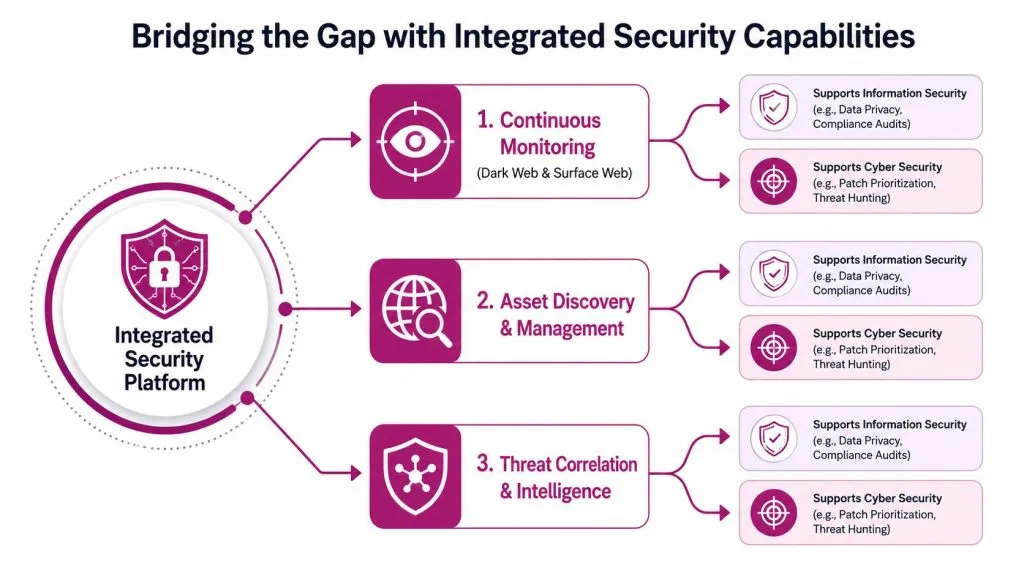
The strongest use case is connecting the missing pieces. Threat intelligence helps leadership prioritize governance changes, while the same feed can inform response priorities in the security operations workflow. Dark web findings can trigger account resets, client alerts, and data handling reviews at the same time. That is the kind of bridge MSPs need when they are trying to sell outcome-based services instead of tool sprawl.
For teams comparing options, the right question is whether a platform covers external exposure, identity risk, and attack-surface visibility in a way that supports both policy and operations. If it only watches the network, it misses broader information risk. If it only produces reports, it will not help with technical response.
Screenshot from https://insecureweb.com
Decision Checklist for Security Practitioners
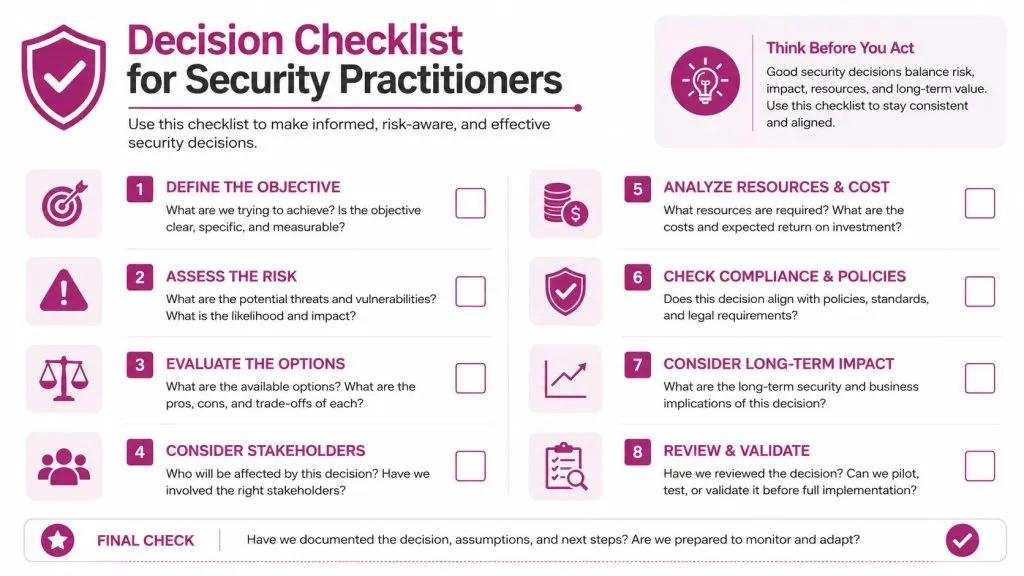
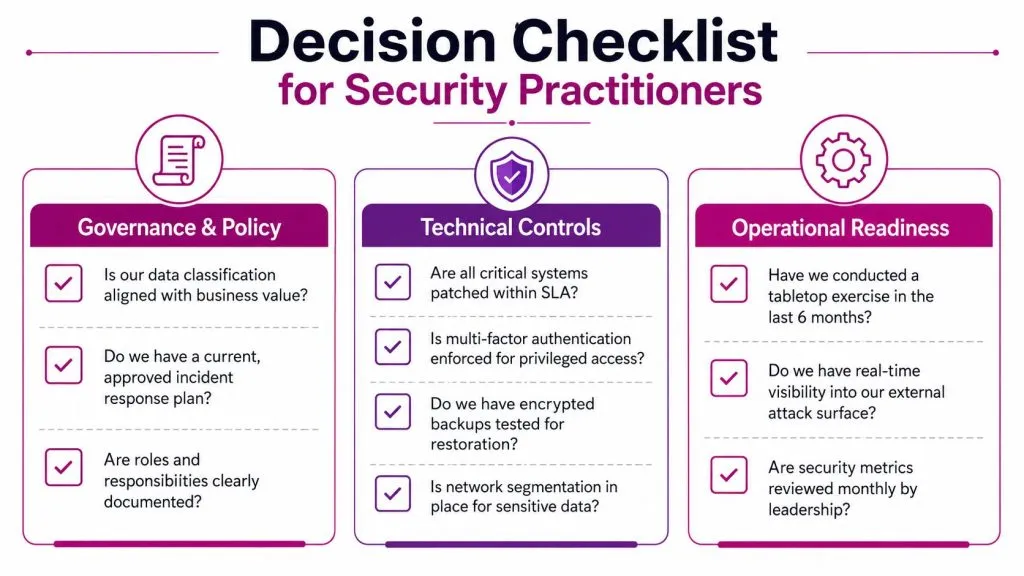
Start with governance. If your data classification is tied to business value, your incident response plan is current and approved, and roles are documented, the information security side is probably healthy enough to support the cyber program. If any of those answers is no, fix that before buying another tool.
Then check the technical layer. Critical systems should be patched within SLA, privileged access should require MFA, backups should be encrypted and restoration tested, and sensitive data should sit behind segmentation. If those controls are missing, the cyber side needs work before the next audit or incident.
Finally, test operational readiness. A tabletop exercise in the last six months, visibility into the external attack surface, and monthly leadership review of security metrics are strong signs of a functioning program. If leadership can’t see the state of the environment, the team is reacting instead of managing risk.
If your program is heavy on tools but light on policy, you’re over-indexed on cybersecurity. If it has solid policies but weak monitoring, you’re underbuilt on cyber operations. Rebalance both sides, then revisit vendor packaging, ownership, and reporting so the program matches the risk.
InsecureWeb gives MSPs and IT teams a practical way to cover dark web monitoring, fake site and account detection, threat intelligence, vulnerability scanning, AI-guided penetration testing, and reputation monitoring from one platform. If you’re trying to close the gap between information security governance and cyber security operations, visit InsecureWeb and see how those controls can fit into your service stack.