Data Breach News13 min read
IDN Homograph Attack: Detection & Mitigation Tips for MSPs
By InsecureWeb Team
This report reflects observations of dark web activity. InsecureWeb makes no representations regarding the accuracy of this data.
A security dashboard can show a clean perimeter while a fake version of a client’s login domain remains active in plain sight. The domain may contain Cyrillic, Greek, Arabic, or other Unicode characters that render almost exactly like the trusted brand name. Users see the familiar word. Your typosquatting feed sees a different string.
That gap is where an IDN homograph attack succeeds. Internationalized domain names make the web usable across scripts, but the same flexibility lets attackers register look-alike labels that can evade ASCII-focused discovery, reputation systems, email filters, and hurried human review. For MSPs managing several clients, especially organizations with multilingual brands, detection has to operate at the character, registration, certificate, DNS, and campaign levels.
Why Your Security Dashboard Misses Homograph Domains
An MSP notices a familiar pattern. The brand-monitoring console flags obvious look-alikes every morning, such as an extra character, a missing letter, or a swapped number. Analysts review the queue, close the harmless results, and investigate the few domains that host suspicious content.
A carefully built homograph domain doesn’t behave like those alerts. It may preserve the exact visual shape of the client’s brand while replacing one or more Latin characters with Cyrillic or Greek equivalents. To a person looking at an email preview or browser address bar, the malicious label appears correct. To an ASCII similarity engine, it can look unrelated because the underlying code points differ.
The problem isn’t that the monitoring platform is malfunctioning. It may be doing exactly what it was designed to do, comparing normalized ASCII strings and common typo variants. The blind spot appears when the tool doesn’t decode internationalized domain names, map Unicode confusables, or compare labels across scripts.
Practical rule: Treat visual similarity and string similarity as separate detection problems.
The historical record makes clear that this isn’t a theoretical browser curiosity. Evgeniy Gabrilovich and Alex Gontmakher formalized the attack in security literature in December 2001, describing how Unicode-enabled URLs could replace characters across scripts to spoof legitimate websites. By 2002, a registered example using Russian characters had demonstrated the technique as a real-world phishing vector, as documented in the history of IDN homograph attacks.
The filter gap
Automated filters often catch:
- Obvious typos: Extra, missing, or transposed ASCII characters.
- Basic brand variants: Hyphens, numbers, and common misspellings.
- Known malicious infrastructure: Domains already associated with a reported campaign.
They can miss:
- Cross-script substitutions: A Cyrillic character replacing a Latin character with a similar glyph.
- Mixed-script labels: A domain combining characters from several writing systems.
- Same-script confusables: Characters that look alike even without crossing script boundaries.
- New registrations: A domain with no reputation history and no prior malicious verdict.
For an MSP, the operational lesson is simple. A clean dashboard doesn’t prove that a client has no look-alike domains. It may only prove that the dashboard is searching the wrong representation of the name. Add Unicode-aware discovery to external attack surface analysis, and make the decoded, human-readable label part of every analyst workflow. A useful starting point is attack surface analysis for internet-facing assets, but the monitoring rule must explicitly include internationalized labels and confusable characters.
How Unicode and Punycode Enable Domain Impersonation
Unicode gives computers a common way to represent characters from many writing systems. That universal representation supports internationalized domain names, or IDNs, so a domain label can contain characters beyond the traditional ASCII set.
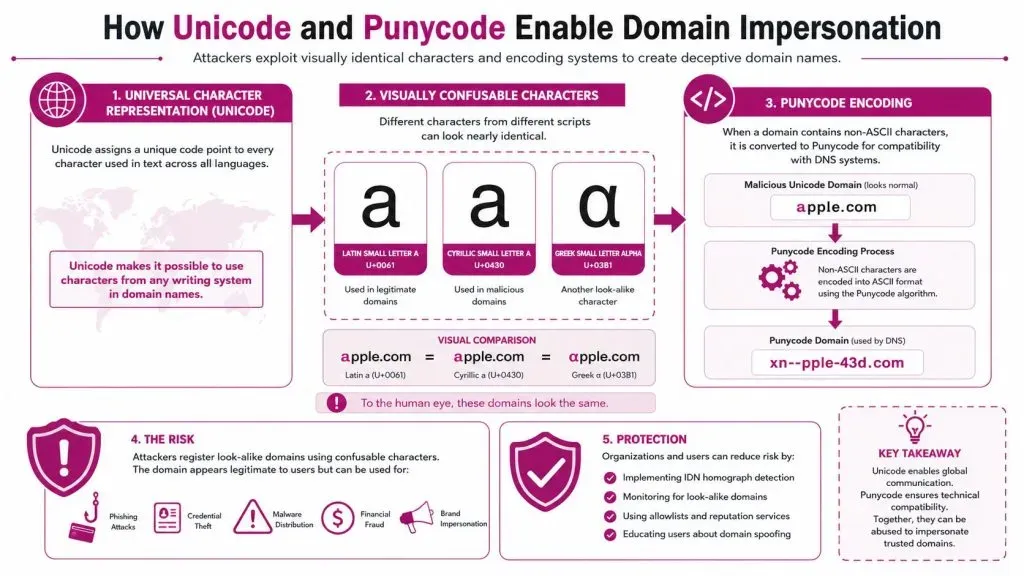
The security issue comes from appearance. A Latin a and a Cyrillic а have different Unicode code points, yet many fonts render them almost identically. The same visual ambiguity can occur among Latin, Cyrillic, and Greek characters. DNS treats the labels as different names, while a human reader may treat them as the same word.
The substitution mechanism
An attacker starts with a trusted domain and identifies characters that can be replaced without visibly changing the name.
- Select a target. The attacker chooses a bank, SaaS provider, retailer, or internal service that users already recognize.
- Choose confusables. One or more characters are replaced with visually similar characters from another script.
- Register the IDN. The resulting label is a legitimate domain registration in technical terms, even though it impersonates the trusted name visually.
- Attach infrastructure. The attacker publishes a website, configures mail or redirects, and sends a lure.
- Exploit trust. The victim judges the visible spelling instead of the underlying domain identity.
The classic example uses a domain that appears to read аррӏе.com, with Cyrillic characters standing in for letters in apple.com. A vulnerable presentation layer may render the Unicode label so convincingly that the user sees what looks like the trusted brand. The domain resolver, however, is handling a distinct name.
Where Punycode fits
Browsers and DNS systems need an ASCII-compatible representation for an IDN. Punycode provides that encoding. A Unicode label is converted into a form beginning with xn--, followed by an encoded sequence that represents the non-ASCII characters.
That means the same domain can have two operationally important views:
- Unicode form: Easier for people to read, but potentially deceptive.
- Punycode form: Harder to read, but exposes that the label contains encoded international characters.
For example, the deceptive label in the supplied example is represented as xn--80ak6aa92e.com. A browser that applies a cautious display policy may show the Punycode form rather than a visually ambiguous Unicode label. Other applications, previews, and security tools may display or process the name differently.
The distinction matters beyond browsers. Certificate transparency logs, WHOIS records, threat feeds, email gateways, and SIEM events may store the Punycode form. If analysts search only for the visible brand spelling, they can miss the event. If they search only for xn--, they’ll create noise from legitimate IDNs.
The control that works best is not asking users to become Unicode specialists. It’s making both representations available to the systems and people reviewing the event.
The Anatomy of a Homograph Phishing Campaign
A homograph campaign usually looks ordinary at the infrastructure level. The attacker registers a domain, serves a page, sends a lure, and collects submitted information. The unusual feature is the name, which hides in the gap between machine-readable identity and human-readable appearance.
The attack chain
Research comes first. The attacker identifies a trusted brand and studies its domain, login flow, email language, and customer support pages. High-value targets often include financial services, cloud platforms, identity providers, and brands whose customers act quickly when asked to verify an account.
Crafting follows. The attacker tests confusable characters against the target label. A one-character substitution may be enough, and the measurement literature shows how effective low-effort substitutions can be. One eight-month study detected 2,984 homograph domains targeting 819 reference domains, with 2,393 cases, about 80%, using a single-character replacement (CNS 2019 homograph research).
Registration creates the first monitoring opportunity. The attacker chooses an available IDN, sometimes through a registrar or registry with weaker validation controls. A domain can exist before it hosts a page, which is why waiting for web content leaves a visibility gap.
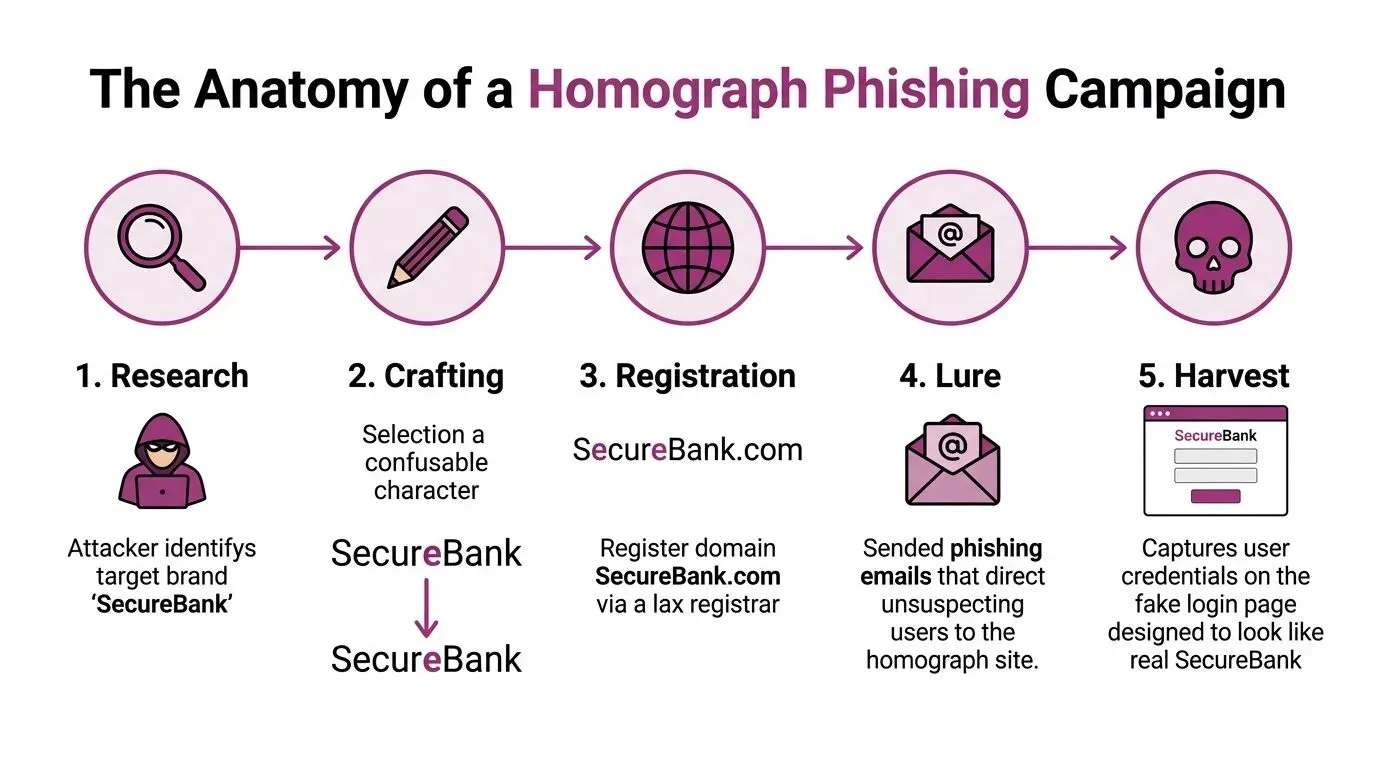
Certificates make the site look credible. Public certificate issuance doesn’t establish that the requester owns the legitimate brand. It can provide encrypted transport for the attacker’s domain, while the phishing page copies the target’s visual design. Analysts who treat HTTPS as a trust signal are especially vulnerable to this presentation.
Lures and harvesting complete the campaign. The attacker sends an email, message, advertisement, or support-themed notification that directs the victim to the look-alike site. The page may request credentials, payment information, or an authentication code, and the attacker can use the captured data in follow-on activity.
Where defenders lose the trail
Threat intelligence feeds commonly prioritize known malicious infrastructure, not every new IDN registration. Certificate transparency monitoring can help, but only if the collection pipeline decodes Punycode and compares the resulting label with client brands and confusable variants. DNS discovery adds another signal when a suspicious domain begins resolving to infrastructure associated with a campaign.
Attackers may also register a domain before using it. That creates a period when the name has little reputation history and no malicious page for scanners to inspect. A registration-time alert gives the MSP time to validate ownership, contact the client, and prepare a takedown or block before the lure reaches users.
When an incident affects public trust, technical containment is only part of the response. Teams also need coordinated messaging, approval paths, and social-channel monitoring. Guidance on SuperX crisis management tips can help structure that communications side without confusing it with the technical investigation.

Detection Techniques That Actually Work at Scale
No single control solves the IDN homograph problem. Browser policies protect the person at the point of display, registry rules prevent some dangerous registrations, and monitoring systems identify domains that have already entered the ecosystem. MSPs need all three, but they should understand what each layer can and cannot do.
| Control | Strongest use | Production limitation |
|---|---|---|
| Browser display policy | Warns users when a label is suspicious or mixed-script | Doesn’t protect users in every application or stop registration |
| Registry policy | Blocks or restricts dangerous labels before delegation | Coverage and strictness vary by registry |
| Brand monitoring | Finds registrations and infrastructure matching client names | Generates false positives without script and ownership context |
| Email and web filtering | Blocks known lures and malicious destinations | Can miss new domains and visually deceptive strings |
Browser-side defenses
Chrome and Firefox have both used display and warning strategies to reduce visual deception. A browser may show the Punycode form for suspicious combinations or warn about mixed scripts and known confusables. This is useful at the moment of navigation, especially when a user opens a link directly.
It isn’t enough for an MSP to say, “The browser will catch it.” Users may encounter the domain in an email client, collaboration platform, mobile application, PDF, or social post before the browser evaluates it. Browser policies also need to classify the label correctly, and a carefully selected same-script or less obvious substitution can reduce the value of a simple mixed-script warning.
Registry-side controls
Registry defenses operate earlier. ICANN-related guidance recommends conservative Label Generation Rules, inclusion-based code-point approval, and explicit homographic lookup checks before a label is delegated. Some TLD policies also require ownership of the Western variant before permitting a homoglyph registration, according to research on registry controls (survey of homograph mitigation approaches).
This approach reduces the number of attackable names before an attacker can obtain certificates or send lures. It won’t cover every TLD, and it may restrict legitimate multilingual naming, so registries must balance usability with abuse resistance.
Monitoring and false positives
Third-party tools can generate confusable candidates, decode Punycode, compare scripts, and enrich results with registration, DNS, certificate, and page evidence. Configure them to rank exact visual matches and active client-brand impersonation above broad similarity results. A legitimate internationalized domain shouldn’t receive the same priority as a newly registered label that copies a client’s login brand and presents a credential form.
For MSP operations, send high-confidence findings to the ticketing system and lower-confidence candidates to a review queue. Dark web scanning for exposed threats can complement domain monitoring when attackers discuss or trade related infrastructure, but it shouldn’t replace registration and certificate visibility.
Building a Monitoring Strategy for MSPs and Security Teams
Start with an inventory, not a vendor. For each client, record the authoritative domains, product names, login hosts, regional brand variants, registered trademarks, and known third-party services. Store both the normal Unicode form and its Punycode representation, then generate a controlled set of confusable candidates based on the scripts the client uses.
Four signals belong in the workflow
Certificate transparency logs provide an early warning when a certificate appears for a suspicious IDN. Your parser should decode every xn-- label, preserve the original value, normalize the Unicode value, identify scripts, and compare the result with each client’s protected names. Send the decoded candidate and the certificate details into the same case record so analysts don’t have to translate it manually.
WHOIS and registration monitoring catches the domain before a phishing page appears. Watch for new IDN registrations whose labels match a client name, a login service, or a high-value product. Registration privacy can limit ownership data, so treat the event itself as a lead rather than relying on registrant identity.
DNS and hosting enrichment tells you whether the domain is becoming operational. A newly registered look-alike with no resolution is different from one that points to active hosting, uses a certificate, and serves a page resembling the client’s authentication flow.
Dark web monitoring adds campaign context. Criminals may advertise credentials, phishing kits, or target lists separately from the domain itself. MSPs can use dark web monitoring guidance for managed service providers to place that signal within an escalation process.
Make triage thresholds explicit
Use a three-level queue:
- Immediate escalation: An exact visual match to a protected domain, especially when the domain has active DNS, a certificate, a login page, or evidence of delivery.
- Priority investigation: A close partial match involving a client brand, a regional variant, or a privileged service name.
- Watch and enrich: A broad confusable candidate with no active infrastructure or clear relationship to the client.
That classification keeps analysts from treating every Unicode domain as malicious. It also prevents the opposite failure, where alert fatigue makes a genuine impersonation look like another harmless typo.
Integrate with the MSP stack
Forward normalized findings to the SIEM with fields for client, Unicode label, Punycode label, script set, registration time, certificate subject, DNS status, hosting provider, page title, screenshot hash, and analyst verdict. Create a case automatically for the highest-confidence tier, attach the evidence, and assign ownership to the person responsible for client notification or takedown coordination.
Don’t try to enumerate every possible Unicode combination. Protect high-value names first, monitor scripts relevant to each client’s markets, and expand the candidate set when a campaign reveals a new substitution pattern. That keeps the system usable while preserving the data needed for retrospective hunting.
Policy Controls That Stop Homographs Before Registration
Post-registration monitoring is necessary, but it starts after an attacker has obtained a name. The stronger control is to prevent dangerous labels from being delegated in the first place.
Registry operators can apply conservative Label Generation Rules that define which code points are permitted and which combinations are considered confusable. Inclusion-based approval is more defensible than allowing every technically valid Unicode character and trying to detect abuse later. A registry can also perform an explicit homographic lookup before delegation, comparing the requested label with existing protected labels.
Some policies go further by requiring the registrant to own the corresponding Western variant before registering a homoglyph version. That requirement doesn’t eliminate every deception technique, and it needs careful treatment for legitimate multilingual businesses, but it removes a large class of opportunistic impersonations.
The operational advantage is clear. Registration-time controls reduce the available pool of malicious names before attackers can obtain certificates, publish pages, or distribute links. They also reduce downstream alert volume, which matters to MSPs whose analysts already manage thousands of external events.
The cheapest malicious domain is the one the attacker never gets to register.
MSPs should ask registrars and registry partners specific questions: Do they support Unicode confusable checks? Do they publish their Label Generation Rules? Do they restrict mixed-script labels? Do they require control of an existing Latin-domain variant? Can they provide registration events quickly enough for client protection workflows?
Offering this as a governance and brand-protection service can distinguish an MSP from competitors that only react after a phishing page appears. The value isn’t limited to takedown speed. A policy review can help a client decide which regional names to reserve, which variants to monitor, and which registration practices create unnecessary exposure.
Defending Multilingual Brand Footprints in IDN-Heavy Markets
ASCII-centric monitoring reflects an English-language assumption. It works reasonably well for a brand that operates under one Latin-script domain, but it becomes incomplete when a company uses Arabic, Chinese, Cyrillic, Greek, or other internationalized names across regional websites and customer journeys.
A 2024 study of Arabic domain names concluded that gaps in industrial tooling expose millions of users to domain-manipulation phishing, highlighting a risk profile that standard Latin and Cyrillic examples don’t capture. The broader adoption data also shows that this isn’t an edge case. One large-scale 2024 analysis examined 323,135 IDNs, and 12.32% of the 2,623,161 IDNs analyzed were affected by the homograph problem (USENIX research on IDN homographs).
Audit the real brand footprint
List every customer-facing name, not only the primary domain. Include translated brand names, local login portals, mobile-app links, campaign domains, distributor sites, and names used by regional support teams. For each market, document the scripts that appear in legitimate traffic and the confusable characters most likely to be mistaken for the brand.
Then work with local registrars and regional security teams. They can identify script-specific policies, registration practices, and visual conventions that a global tool may classify poorly. Ask monitoring vendors to demonstrate Arabic, Chinese, and Cyrillic detection with your actual brand names, not a generic English sample.
The business risk extends beyond stolen credentials. A fake Arabic brand domain can undermine trust during market expansion, confuse partners, and force customer-support teams to explain a fraud they didn’t detect. Treat multilingual identity protection as part of external attack surface management, with ownership, escalation paths, and evidence standards defined before an incident.
MSPs can use InsecureWeb to monitor fake sites, impersonating domains, dark web exposure, and other external threats affecting their clients. Visit InsecureWeb to connect brand protection and threat intelligence with the security tools your team already operates, including through its MSP-focused platform and API access.