Data Breach News14 min read
Automated Penetration Testing: A Practical Guide for MSPs
By InsecureWeb Team
This report reflects observations of dark web activity. InsecureWeb makes no representations regarding the accuracy of this data.
The most popular advice about automated penetration testing is also the most misleading: let an AI attack your environment continuously, then retire manual testing. That promise confuses repeatable execution with security judgment. A tool can move quickly through known weaknesses, but it still has to prove that a finding is exploitable, reproducible, in scope, and meaningful to the client.
For MSPs and MSSPs, that distinction matters operationally. An unverified finding creates ticket noise, while an unrepeatable result weakens audit evidence and makes remediation harder to defend. The practical model in 2026 is human-in-the-loop validation, automation for breadth and regression testing, and skilled testers for context, business logic, and unusual attack chains.
The field itself has matured. A 2018 cloud-security paper framed automated penetration testing as a methodology for continuous security assessment, while the peer-reviewed 2025 article “Automated penetration testing: Formalization and realization” reflects a move toward formal models, implementation, and case-study validation. The question is no longer whether the technology exists. It’s whether a platform can produce evidence your engineers, clients, auditors, and incident responders can trust.
Why Automated Penetration Testing Is Not a Silver Bullet
Automated penetration testing can’t fully replace a capable human tester. The reason isn’t that automation lacks speed. It’s that real compromise often depends on context, incomplete information, and decisions that weren’t anticipated when the platform’s attack logic was designed.
A mature platform can discover assets, identify known vulnerabilities, attempt controlled exploitation, and chain weaknesses into an attack path. It can repeat that work after a patch or infrastructure change, which makes it valuable as a continuous validation layer. It can’t reliably understand every business process, infer the intended authorization model of a custom application, or invent a novel route through an unfamiliar environment.
The central problem is the validation gap. A scanner may identify a vulnerable component, exposed service, or weak configuration. An automated testing platform may go further and attempt exploitation. But the output still needs to answer practical questions:
- Was the weakness reachable from the defined foothold?
- Did exploitation succeed, or did the tool infer success from a response?
- Can another operator reproduce the result safely?
- What evidence should the remediation ticket contain?
- Did the exploit create meaningful access, or only demonstrate a low-impact condition?
That gap is especially serious for providers. Guidance on penetration testing for small businesses is useful because smaller clients often need affordable, repeatable assurance, but affordability doesn’t remove the need to define scope and limitations clearly. An MSP that presents an automated report as equivalent to a manual engagement risks creating a false impression of coverage.
Practical rule: Treat every automated finding as a candidate for validation until the platform captures reproducible evidence and a human confirms the result is actionable.
Automation is strongest when the question is narrow and repeatable: did a known exposure remain reachable after a deployment, did a segmentation change close an attack path, or can a low-privilege account still reach a sensitive system? It’s weaker when the test requires creative reasoning or knowledge of how a client’s business works.
The same discipline applies after a security incident. Teams should connect findings to a defined response process, including the steps after a data breach, rather than treating a pentest report as a substitute for investigation. A validated attack path can inform containment and remediation, but it doesn’t establish the full scope of a breach.
Core Components of Automated Penetration Testing
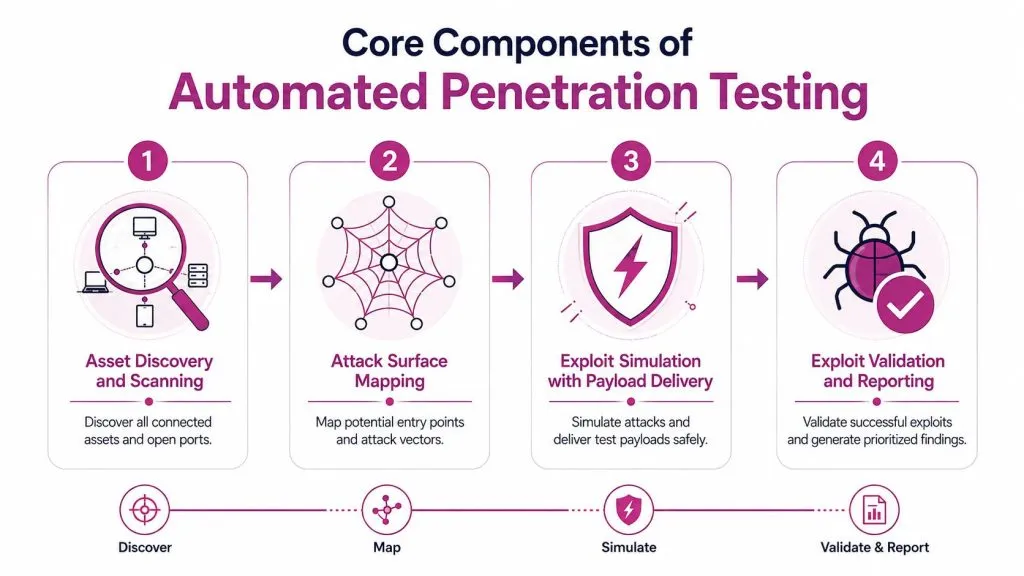
An automated penetration test should follow a defensible progression from discovery to evidence. The product may use different names for each module, but the operational sequence usually contains four connected components.
Asset discovery and scanning
The first layer identifies what exists. External discovery looks for domains, services, applications, and exposed interfaces. Internal discovery examines reachable hosts, identities, trust relationships, and configuration states from an authorized foothold.
Scanning engines commonly compare observed software and settings against known vulnerability information, including CVEs and configuration weaknesses. That creates an inventory of possible entry points, but it doesn’t prove that an attacker can use them. A scanner can tell you that a component appears vulnerable. It may not know whether network controls, authentication requirements, compensating controls, or application context prevent exploitation.
Discovery also has a governance requirement. Providers need written authorization, clear exclusions, client-specific credentials, and an agreed response plan before a tool touches production systems. Without those controls, technical capability becomes a liability.
Attack surface mapping
The second layer turns an inventory into relationships. Attack surface mapping connects exposed services, identities, trust paths, cloud resources, applications, and sensitive targets. A platform begins to answer a more useful question: which weaknesses can an attacker reach from a defined starting point?
A fixed asset list won’t capture the full problem. Cloud resources appear and disappear, SaaS permissions change, and new external services can bypass assumptions made during a quarterly assessment. The attack surface analysis guide provides useful context for understanding why discovery and relationship mapping must operate together.
Exploit simulation and payload delivery
The third layer performs controlled attack actions. Depending on the platform and scope, that may include exploiting a known weakness, testing authentication paths, attempting privilege escalation, harvesting limited credentials, or pivoting to another reachable system.
Safe execution is the dividing line between a production-capable platform and an unsafe script collection. Providers should confirm how the tool avoids destructive payloads, limits rate and concurrency, handles endpoint detection alerts, and stops when an action could affect availability. A successful simulation should produce a clear result, not merely a suspicious request or a matching banner.
Validation, evidence, and reporting
The final layer determines whether the result is useful. Mature tooling captures evidence at each material step, records the starting conditions, identifies the affected asset, and explains how the chain progressed. It should also distinguish a blocked attempt from a successful compromise, because a control that stops an attack is an operational result, not an empty test.
Reporting then translates technical output into remediation priorities. A useful finding includes the attack path, affected business asset, reproduction context, evidence, recommended fix, and retest status. The report shouldn’t bury the client in raw scanner output. It should show which choke points break the greatest number of paths and which fixes deserve immediate attention.
The accompanying workflow video offers another way to visualize how these stages fit together:

Advantages and Limitations You Must Understand
Automation earns its place by making security testing repeatable. It also creates risk when teams mistake repeatability for completeness.
| Advantage | Limitation |
|---|---|
| Continuous validation catches configuration and exposure changes between manual engagements. | It may miss novel attack chains that require reasoning outside encoded workflows. |
| Efficient scale lets a provider test multiple client environments without scheduling every action manually. | False-positive noise can erode analyst trust and consume scarce triage capacity. |
| Rapid regression testing checks whether a patch or control change closed a previously validated path. | Business-logic testing still needs someone who understands application intent and user workflows. |
| Consistent methodology reduces variation between operators and client environments. | Complex coverage gaps remain in segmented, multi-tenant, restricted, or poorly inventoried estates. |
Where automation delivers
A provider can run the same approved workflow across a portfolio, preserve evidence in a consistent structure, and trigger retesting after a remediation event. That’s valuable for vulnerability management because the team can separate an exposure that merely exists from one that remains reachable through a demonstrated path.
Automation also reduces the human effort spent on routine checks. Skilled testers can focus on threat modeling, application behavior, identity abuse, and unusual pivot opportunities instead of repeating the same baseline discovery on every client.
Where the model breaks
False positives are the biggest adoption barrier for MSPs. A single noisy platform can create hundreds of tickets across multiple tenants, forcing analysts to investigate results that don’t survive independent validation. Once engineers learn that reports frequently fail to reproduce, they start ignoring the queue, including the findings that matter.
Coverage creates a separate problem. Synack and Omdia research reported by PR Newswire found that enterprises prioritize penetration testing, yet only 32% of the global attack surface is tested on average, leaving 68% untested. That figure describes an exposure and scope problem, not proof that any particular platform performs poorly.
Automated testing also struggles with authorization logic, pricing rules, workflow abuse, and vulnerabilities that require an attacker to understand the client’s business. A tool may validate that an endpoint responds, but a human often has to determine whether a user can access another customer’s records or perform an unauthorized action.
Trust is an output requirement. A shorter report with reproducible evidence is more valuable than a larger report no one wants to investigate.
Integrating Automation Into Your Security Program
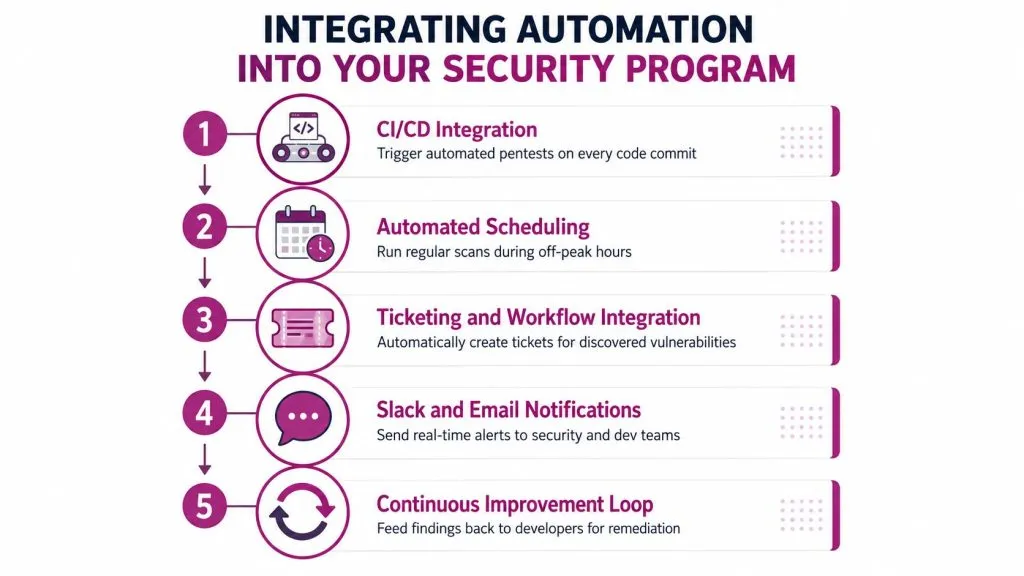
Automation works when it enters the workflow where teams already make decisions. Deploying a platform without ticket ownership, scope governance, and retest procedures moves noise from a scanner into another dashboard.
Start with a controlled integration
Connect the first test to a representative application or network segment, not the entire client portfolio. Establish the authorized targets, credentials, exclusions, safe payload settings, and escalation contacts before the first run.
For application teams, connect testing to CI/CD events that matter. A code commit, infrastructure change, or production release can trigger a targeted test. The gate should match the risk. Blocking every build for a low-confidence result will create resistance, while allowing a validated critical path into production defeats the purpose.
Connect findings to ownership
Send findings into the vulnerability management or service-management platform your team already uses. Standardized formats such as SARIF or STIX can help preserve technical context, but the important question is whether the destination retains evidence, severity rationale, affected asset, and retest state.
A useful workflow assigns each finding to a responsible owner:
- Security validates the result. Analysts confirm scope, evidence, and impact.
- The service owner accepts or remediates it. The ticket includes a specific action, not only a vulnerability identifier.
- The platform retests the path. Closure requires proof that the exploitable condition or chain is gone.
- The provider records exceptions. Risk acceptance needs an owner, rationale, and review date.
Set cadence by exposure
A fixed calendar is easy to administer but can miss changes between runs. Use a risk-based schedule instead. Internet-facing assets deserve more frequent attention than stable internal systems, while major migrations, segmentation changes, identity redesigns, and new integrations should trigger event-driven testing.
Authenticated testing requires careful credential management. Store service credentials in an approved secrets system, restrict their permissions, rotate them, and monitor their use. Also account for API rate limits, scan concurrency, maintenance windows, and client environments that share infrastructure.
Build a feedback loop
Manual testers should review representative findings and label them as confirmed, rejected, duplicate, out of scope, or requiring deeper investigation. Feed those decisions into custom rules, exclusions, and prioritization logic. This takes operational effort, but it’s how a multi-tenant service avoids repeating the same mistake across every client.
Escalation should reflect impact, not just severity labels. A validated route to a sensitive system deserves immediate human attention, while a low-confidence observation can wait for normal triage.
Evaluating Tools With Benchmarks and Market Data
Vendor demonstrations usually present a clean lab target and a successful compromise. That confirms the tool can complete one scenario. It does not show whether the workflow remains safe, reproducible, and useful across different client environments.
Independent benchmarks are more useful when they expose performance by task. AutoPenBench evaluates generative agents across 33 tasks in in-vitro and real-world scenarios. It measures progress through vulnerable containers instead of looking only at final compromise. Buyers can therefore see whether an agent fails during reconnaissance, exploitation, or post-exploitation planning. The benchmark is documented in the AutoPenBench technical paper.
PentestEval breaks the process down further. It divides penetration testing into six stages and evaluates LLM systems across 346 tasks and 12 realistic vulnerable scenarios. Its results place current models well below expert performance in Weakness Gathering, Attack Decision-Making, and Exploit Generation. That supports stage-specific controls rather than trust in a single end-to-end score. The PentestEval research is especially relevant when a vendor describes an AI system as autonomous.
Read the market without treating it as proof
The global penetration testing market was estimated at USD 2.72 billion in 2026 and projected to reach USD 5.54 billion by 2031, with a projected 15.29% CAGR over that period, according to Bright Defense’s penetration testing statistics. A separate report valued autonomous AI penetration testing at USD 2.8 billion in 2025 and projected USD 9.7 billion by 2034, with SaaS and cloud deployment holding 58.4% share in 2025. These figures indicate commercial momentum, not validated performance in your environment.
Bright Defense reported that only 29% of organizations had automated 70% or more of their security testing. Treat that figure as a maturity signal. Adoption is increasing, while broad automation remains incomplete.
| Evaluation Criteria | What to Measure | Red Flags |
|---|---|---|
| Exploit evidence | Reproducible steps, artifacts, timestamps, and safe retest results | A report provides only a severity score or screenshot |
| Stage performance | Discovery, decision-making, exploit generation, and post-exploitation separately | One end-to-end success claim hides stage failures |
| Scope coverage | External assets, cloud, identity, SaaS, internal segmentation, and authenticated paths | The vendor cannot explain excluded or unreachable assets |
| False-positive handling | Human review process, confidence labels, suppression controls, and feedback loops | Every observation becomes a ticket |
| Integration effort | APIs, ticketing, CI/CD, secrets management, and tenant isolation | Rate limits and credential requirements appear late |
| Commercial model | Per-scan, per-asset, or platform licensing against operational workload | Pricing ignores tuning, triage, and evidence review |
Run a proof of value against representative environments. Require vendors to show failed attempts, blocked paths, reruns after remediation, and findings rejected by a human reviewer. A useful evaluation also checks whether another operator can reproduce the result from the recorded evidence. That demonstration reveals more than a successful laboratory exploit, and it exposes where human review remains necessary.
Building a Hybrid Testing Strategy
Fully autonomous penetration testing remains an aspirational claim in many environments. A stronger operating model assigns repetitive validation to automation and reserves interpretation, adaptation, and risk judgment for human testers. The key advantage is not a higher scan count. It is evidence that another operator can reproduce and verify the result.
Automation is well suited to:
- Baseline coverage: recurring discovery, known weakness checks, and controlled exploit attempts.
- Regression testing: retesting after patches, configuration changes, and infrastructure deployments.
- Evidence collection: consistent artifacts, timelines, affected assets, and remediation status.
- Portfolio scale: repeatable workflows across client tenants with defined authorization boundaries.
Human testers should own questions that depend on context:
- Business logic: authorization, workflow abuse, tenant isolation, and application-specific assumptions.
- Threat modeling: selecting meaningful objectives and identifying how an attacker could combine separate systems.
- Creative exploitation: adapting when a known technique fails or the environment exposes an unusual path.
- Risk interpretation: translating technical findings into business impact for executives, owners, and auditors.
Recent reporting indicates that reliance on AI-only testing has declined significantly as buyers shift toward oversight and verification models. That change reflects a practical concern: an automated finding is useful only when its steps, artifacts, scope, and outcome can be checked. A result that cannot be rerun or explained creates review work rather than reducing it.
Use frequent automated validation for known controls and recurring changes. Schedule manual assessments after major architectural changes and at planned review points. Set timing according to asset criticality, regulatory obligations, change velocity, and the client’s tolerance for production testing.
Measure the partnership, not just the tool. Track validated coverage, reproducibility, remediation quality, and the depth of manual testing on high-value systems.
Automation can confirm that a user reaches an endpoint while missing that the same user can modify another customer’s account, bypass an approval step, or access a record through an unusual sequence. Hybrid programs spend automation capacity on repeatable proof and direct expert time toward paths that require business context and creative judgment. That division produces findings teams can validate, reproduce, and defend during remediation reviews.
Use Cases for MSPs and MSSPs
MSPs and MSSPs can use automated penetration testing to scale validation without scheduling a separate manual engagement for every routine change. The service becomes more useful when the provider treats it as a managed process, not as a report generator.
Consider a regulated client with an internet-facing application and a changing cloud estate. A quarterly manual assessment may satisfy a defined requirement, but it won’t automatically validate every configuration change between engagements. An automated workflow can check approved assets continuously or after material changes, while the provider retains manual testing for deeper application and business-risk questions.
Cloud migration creates another practical use case. Before a client moves a workload into production, an automated test can examine exposed services, identity paths, and misconfigurations within the approved scope. The provider can use the result as a release gate, but only after validating that the test is safe and that the evidence supports the decision.
A tiered service model can also work:
| Use Case | Service Tier | Client Profile | Key Consideration |
|---|---|---|---|
| Continuous compliance validation | Baseline managed service | Regulated or audit-focused organizations | Define what automation validates and what still requires manual assessment |
| Pre-deployment testing | Cloud or DevSecOps add-on | Clients changing infrastructure frequently | Integrate with release approvals and protect production stability |
| Attack-surface monitoring | Ongoing exposure package | Distributed mid-market environments | Reconcile discovered assets with authorization and ownership |
| Deep adversarial assessment | Premium manual service | High-value or high-risk clients | Reserve human testers for logic, chaining, and contextual analysis |
Multi-tenant orchestration needs strict separation. Each client requires its own scope, credentials, evidence store, notification path, and approval record. Critical findings should reach the named client stakeholder within the agreed service level, while lower-confidence items can enter a review queue until an analyst confirms them.
Providers should also explain limitations in service agreements. Automated results aren’t equivalent to a manual penetration test, and an untested asset shouldn’t be described as secure merely because no finding exists. A managed dark web scan can complement this work by identifying exposed credentials or organizational data outside the network, but it answers a different question from exploit validation inside an authorized environment.
InsecureWeb offers vulnerability scanning, AI-guided penetration testing, threat intelligence, dark web monitoring, impersonation detection, and API access for providers that want to connect these capabilities to existing workflows. Visit InsecureWeb to assess whether its provider-oriented tooling fits your validation process, then test it against a controlled client scope with explicit human review.