Data Breach News15 min read
Social Media Reputation Monitoring: A Guide for MSPs
By InsecureWeb Team
This report reflects observations of dark web activity. InsecureWeb makes no representations regarding the accuracy of this data.
A client calls before your team has even finished the morning handoff. Their branded Instagram account is being flooded with scam replies. A fake executive video is circulating on X. Support is seeing confused customers ask whether the company has been breached, even though nothing inside the environment has tripped an alert. From the client’s perspective, this is a security incident. From many MSPs’ perspective, it still sits in an awkward gap between marketing, PR, and cyber.
That gap is where attackers operate.
Social platforms now function like a public attack surface. They’re used to impersonate brands, redirect customers, seed false narratives, and make a company look compromised before any internal system is touched. If your clients already trust you with endpoint security, identity, email, and vulnerability management, they’ll eventually ask who is watching the open web and social channels for attacks against their name, people, and reputation.
Social media reputation monitoring becomes a practical managed service, not a soft add-on. Done well, it gives clients early warning, clear response paths, and a provider who can connect external signals to operational action. Done poorly, it becomes a noisy dashboard with no SLA, no triage logic, and no measurable value. Teams that want a broader playbook for managing social media crises effectively can use that as a companion resource, but the MSP opportunity is more specific: package monitoring, response coordination, and takedown support as a repeatable white-label service.
Introduction When Reputation Becomes a Liability
The client rarely describes the first alert as a reputation problem.
They say customers are getting scammed in comments. They say a fake page is running ads with their logo. They say a video of the founder is spreading and nobody knows if it’s real. The post might be false, but the business impact is immediate. Sales pauses. Support queues spike. Leadership wants answers now, not after the weekly social report.
That’s why MSPs need to stop treating social media reputation monitoring as somebody else’s department. In practice, these incidents behave like external security events. They involve impersonation, deception, abuse of trust, and public manipulation. They spread faster than ticket queues and often hit customer confidence before internal teams can verify what’s happening.
For MSPs and MSSPs, that changes the service model. The work isn’t limited to spotting negative sentiment. It includes identifying malicious accounts, routing urgent findings, preserving evidence, coordinating with client stakeholders, and helping decide whether the event belongs with support, PR, legal, or the security team. The providers that build this capability early will be easier to retain because they’re protecting something clients can see in real time: their public credibility.
Social media reputation monitoring works best when it’s treated like external threat detection with brand context, not like a marketing report with nicer charts.
Why Social Media Reputation Is a Security Issue
Social media has become a trust layer that businesses don’t control. That alone makes it a security concern.
According to Morning Consult’s reporting on social media and brand reputation, 67% of adults globally report that it is becoming increasingly harder to distinguish real content from manipulated or AI-generated material on social media, and 28% of adults believe social platforms are effectively preventing manipulated or fake content. For MSPs, the takeaway is simple. Clients can’t assume the platform will stop harmful content before customers, employees, or partners see it.
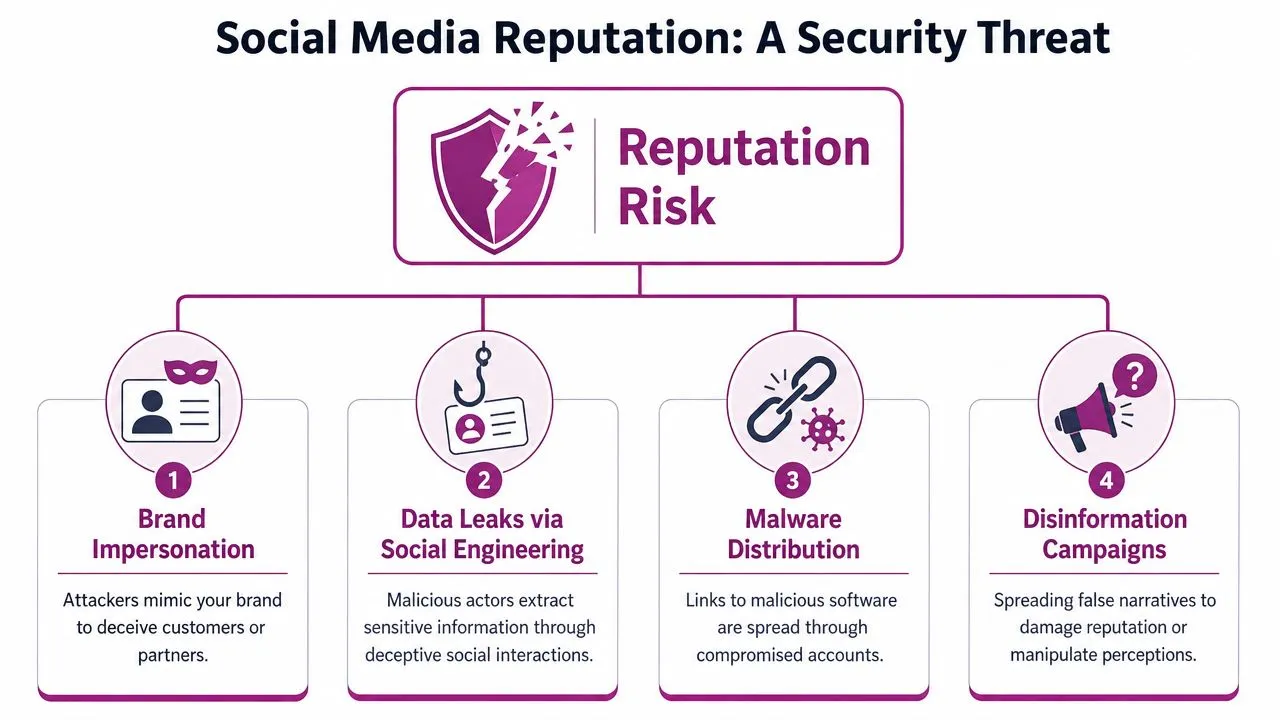
The attack paths are concrete
A reputation incident on social media usually maps to one of a few security patterns:
- Brand impersonation where an attacker clones the client’s profile, logo, and voice to phish customers or redirect payments.
- Executive impersonation where a fake statement, audio clip, or video is used to create urgency, panic, or confusion.
- Disinformation pressure where coordinated accounts push a false narrative around a launch, outage, or policy decision.
- Social engineering at scale where comment threads and DMs become a delivery system for scams, malicious links, or fake support interactions.
These aren’t abstract PR headaches. They affect fraud exposure, customer support load, and incident response workload.
Why MSPs should own the monitoring layer
MSPs already understand how to operationalize noisy external signals. You do it with email alerts, vulnerability findings, suspicious login telemetry, and dark web indicators. Social channels fit the same pattern. The difference is that the signal is public and reputational, not just technical.
An unmonitored brand presence acts like an unguarded side entrance. Attackers don’t need to break into infrastructure if they can mislead customers in public. In smaller client environments, social channels can be even less governed than email or M365. Credentials are shared. Agencies have partial access. Former staff sometimes remain connected to publishing tools. Nobody owns response after hours.
Practical rule: If an attacker can use a public platform to alter how customers, partners, or staff perceive the client, the issue belongs in the security conversation.
What not to do
Many providers make one of two mistakes.
The first is under-scoping the problem and offering simple mention tracking. That catches obvious brand tags but misses fake profiles, altered media, and coordinated narrative shifts.
The second is over-scoping the promise and acting like every negative post is malicious. Clients don’t want drama detection. They want risk classification. Your service has to separate routine dissatisfaction from incidents that can cause fraud, trust erosion, or legal exposure.
That distinction is what makes the offer credible and profitable.
Core Signals and Data Sources for Monitoring
Basic social listening starts with brand keywords. Professional social media reputation monitoring starts with a threat model.
Your data collection needs to span the channels where attackers, critics, customers, and opportunists all operate at once. That includes the obvious platforms, but it also includes review sites, discussion communities, and niche forums where false claims often gain traction before they reach mainstream channels.
Where the useful signals actually come from
Don’t limit monitoring to X, Facebook, LinkedIn, Instagram, and TikTok. Those matter, but they aren’t enough. MSPs should watch:
- Public social platforms for direct mentions, fake profiles, copied creative, and viral complaint threads.
- Reddit and community forums where narratives form before official media notices them.
- Review sites and local listings where fake complaint patterns or impersonation attempts can appear.
- Comments on creator and partner posts because attackers often target secondary surfaces with scam replies.
- Public video platforms where manipulated clips, stitched commentary, and reposts can spread without tagging the brand.
For high-comment environments, operational teams also need platform-specific collection habits. If a client depends heavily on Instagram, workflows for mastering Instagram comment search are useful because comment abuse often surfaces before a fake account is fully reported and removed.
What to detect beyond mentions
The most important signals aren’t always explicit brand mentions. Watch for:
- Velocity changes such as a sudden burst of complaints using similar language.
- Account anomalies including newly created profiles using the client’s naming pattern, logo, or executive photos.
- Security language clusters around words like scam, fraud, hacked, breached, fake, refund, or unauthorized.
- Cross-platform repetition where the same narrative jumps from one channel to another.
- Media reuse such as copied videos, modified graphics, or reposted statements presented as current.
A single complaint is rarely the problem. A repeating pattern is.
The sarcasm problem is real
Many mainstream tools frequently fall short. Lucidya’s analysis of media monitoring blind spots notes that mainstream monitoring often fails to detect sarcastic or culturally nuanced negative sentiment that standard sentiment analysis tools misclassify. For MSPs serving clients across regions or industries, that matters because subtle mockery often appears before open hostility.
A tool that only counts positive and negative keywords will miss early-stage reputational shifts. It may classify a sarcastic wave as neutral. It may miss meme-based criticism entirely. It may overlook a culturally specific phrase that signals distrust in one market and means nothing in another.
If your monitoring stack can’t recognize irony, coded language, or meme reuse, you don’t have early warning. You have delayed confirmation.
A workable collection model for MSPs
Use a simple collection hierarchy:
| Monitoring layer | Primary purpose | Typical sources |
|---|---|---|
| Brand surface | Catch direct abuse fast | Official platforms, comments, mentions |
| Narrative surface | Spot emerging criticism | Reddit, forums, public threads |
| Fraud surface | Find impersonation and scams | Fake profiles, replies, review sites |
| Executive surface | Detect targeted abuse | Leader names, headshots, fake media |
That model helps analysts collect with intent instead of dumping every mention into one queue.
Building Your Monitoring and Response Workflow
The workflow matters more than the dashboard. Most failed services don’t fail because the tool is weak. They fail because nobody defined what happens after the alert.
Start the section below as if you were writing an incident runbook. That’s the right mindset.
A visual workflow helps when you’re training analysts and setting expectations with clients.
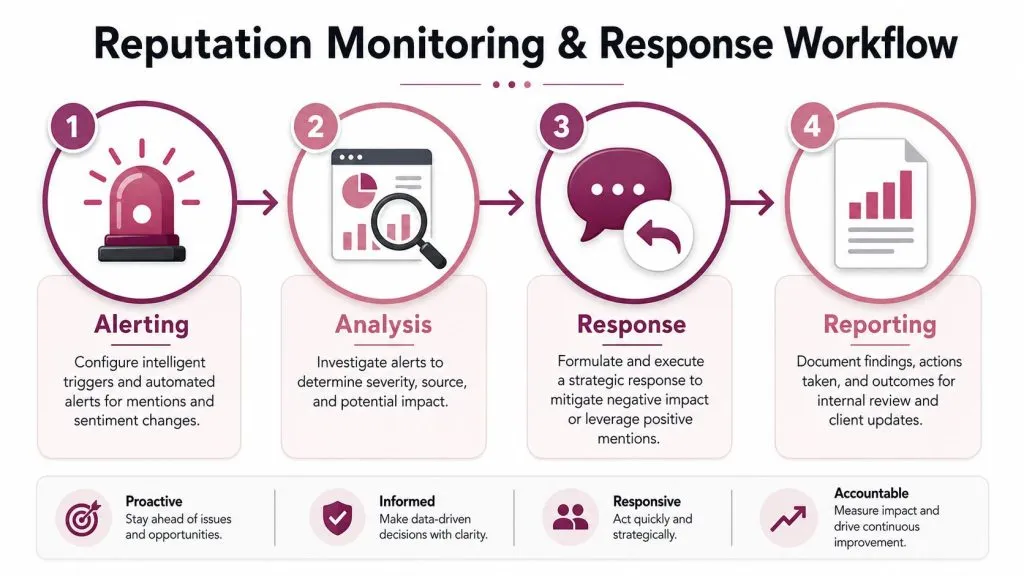
Alerting
Your first job is reducing noise without blinding the team. Talkwalker’s guidance on social media reputation management states that effective monitoring requires defined response SLAs, specifically responding to negative feedback within 1 hour during business hours, and that crisis identification should use engagement metrics, topic sensitivity, and the reach of critics with a cross-functional assessment team.
For MSP use, that means alerts should be threshold-based, not mention-based. Good triggers include:
- High-risk identity misuse such as a new account using the client’s brand name or executive likeness
- Sensitive topic clusters tied to safety, fraud, data exposure, or legal claims
- Unusual engagement acceleration on a negative thread
- Repeat scam indicators in comments or replies across multiple posts
Don’t page the analyst for every unhappy customer. Page them when the pattern suggests escalation risk.
Triage
Triage decides whether the event is operational noise, customer service friction, or a real security issue.
A practical triage matrix uses three questions:
- Who is speaking? A random account, a known customer, a journalist, an influencer, or a lookalike profile.
- What is the claim? Dissatisfaction, fraud allegation, impersonation, manipulated media, or disclosure of sensitive information.
- How fast is it moving? Limited visibility, cross-posted, or rapidly amplifying.
That gives analysts a defensible way to classify severity. It also helps avoid overreacting to criticism that should go to support.
For teams that already correlate external intelligence with investigative workflows, methods used in dark web monitoring for OSINT and investigations are useful here. The discipline is similar. Preserve evidence, assess credibility, connect related indicators, and route action based on risk.
Escalation
The handoff path must be written before the first incident arrives.
Use role-based escalation, not personality-based escalation. If the service depends on “whoever usually handles social stuff,” it won’t scale. A strong model looks like this:
- Support-owned issues for ordinary complaints, refund questions, and service problems
- Marketing or communications-owned issues for public clarification and brand messaging
- Security-owned issues for impersonation, scam campaigns, account compromise suspicion, and manipulated media
- Legal or leadership review for defamation, regulated claims, executive targeting, or content removal disputes
The cross-functional assessment team matters because social incidents can change category quickly. A complaint can become a fraud vector. A fake profile can trigger payment scams. A meme can turn into a coordinated false narrative.
This training clip is worth using with analysts and client stakeholders who need a shared mental model for social response:

Remediation and takedown
Remediation usually includes more than one stream of work at once:
- Public response when silence would create more confusion
- Platform reporting for impersonation, malicious content, or account abuse
- Client-side action such as notifying support, legal, or leadership
- Evidence retention through screenshots, URLs, timestamps, and account details
- Post-incident review to update watchlists, templates, and thresholds
The public reply and the security action aren’t the same thing. One addresses audience perception. The other removes or contains the threat.
The MSP that can run both tracks cleanly becomes much harder for clients to replace.
The Technology Stack for Reputation Monitoring
A workable service stack needs to do three things well. Collect broadly, classify intelligently, and integrate cleanly.
That sounds obvious, but many MSPs still evaluate tools like standalone marketing platforms. For a managed security context, the better question is whether the system can feed downstream operations without forcing analysts to swivel between disconnected consoles.
The pipeline you actually need
Cision’s overview of online reputation monitoring tools describes the core model well: a professional platform requires data aggregation from diverse sources, segmentation by risk, and an analytical engine using semantic analysis, text mining, and NLP to generate real-time alerts for critical threats.
For MSP delivery, map that into a practical stack:
| Stack layer | What it should do | Why it matters to MSPs |
|---|---|---|
| Collection | Pull from social platforms, blogs, forums, and review sites | Broad visibility reduces blind spots |
| Classification | Group by sentiment, topic, source, and risk | Analysts need priority, not raw volume |
| Alerting | Trigger fast on critical events | Supports SLAs and after-hours workflows |
| Case management | Turn alerts into tickets or incidents | Keeps the service operationally accountable |
| Reporting | Show trends and outcomes | Proves value to clients and renewals |
API access matters more than another dashboard
If the tool can’t push data into your SIEM, SOAR, PSA, or ticketing system, it becomes a side project. Analysts miss alerts. Response timing drifts. Evidence gets trapped in the vendor portal.
API access lets you normalize social risk alongside other external intelligence. An impersonation account can become a ticket. A deepfake mention can trigger a case. A cluster of scam comments can be correlated with phishing reports or dark web exposure. That’s also why MSPs expanding external monitoring should look at adjacent service models such as dark web monitoring for managed service providers. The strongest offers don’t isolate brand abuse from the rest of the external threat picture.
What to look for during vendor evaluation
Don’t get distracted by polished sentiment charts. Ask harder questions:
- Can the platform detect image, account, and narrative abuse, not just text mentions?
- Can it separate urgent alerts from report-only events?
- Can analysts annotate, classify, and export evidence easily?
- Can you white-label reports, portals, or notifications?
- Can it support nuanced sentiment work?
For teams refining sentiment analysis maturity, practical ideas in BeyondComments on brand sentiment can help frame what good interpretation looks like beyond crude positive-versus-negative scoring.
A good stack doesn’t replace analyst judgment. It makes judgment scalable.
Packaging and Reporting the Service for Clients
Many MSPs leave money on the table. They sell monitoring hours instead of selling outcomes.
Clients don’t buy social media reputation monitoring because they want another monthly chart pack. They buy it because they want somebody accountable for watching public channels, classifying risk, and helping stop visible damage before it hardens into customer distrust.
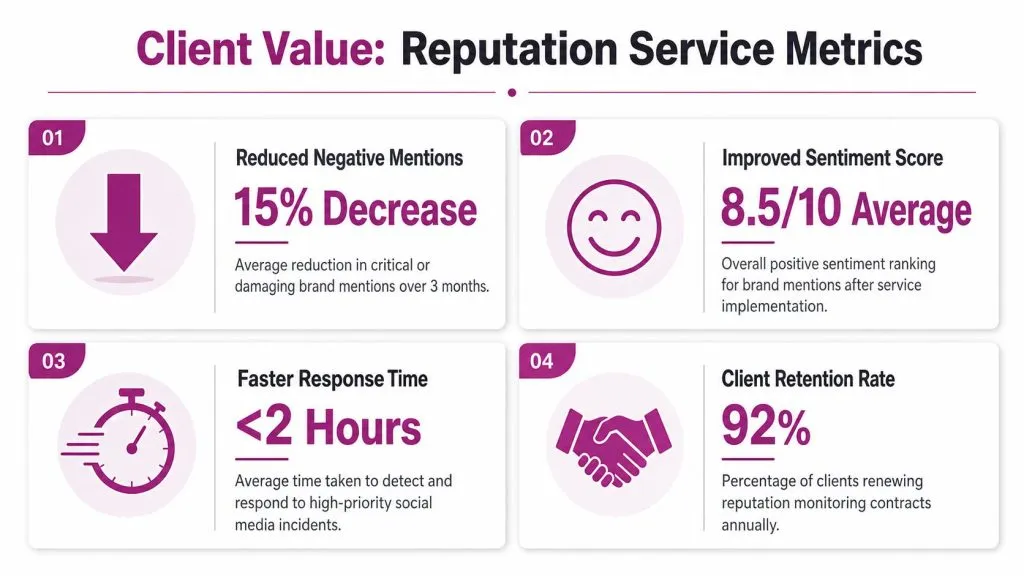
Package the service like managed detection
Use clear tiers. Keep them operational.
A practical white-label offer often includes:
- Monitoring tier with watchlists, alerting, and scheduled review
- Response tier with triage, client notification, and guided actions
- Protection tier with takedown coordination, executive monitoring, and cross-channel escalation support
The pitch should sound familiar to clients who already buy managed security services. You’re extending detection and response to a public-facing attack surface they’ve been underestimating.
Report outcomes, not activity
The Square’s guidance on social media reputation management is the right benchmark here: effective reporting measures outcomes rather than just activity, including whether recurring issues decrease, how quickly negative sentiment stabilizes, and trends in overall perception.
That means your monthly report shouldn’t lead with mention count. It should lead with what changed, what was detected, what was removed, and what still needs client attention.
Client-Facing Reputation Monitoring KPIs
| KPI Category | Metric | Description |
|---|---|---|
| Detection quality | Critical incidents identified | Tracks high-risk findings such as impersonation, scam activity, or manipulated media |
| Response performance | Time to acknowledge and triage | Shows whether the service is meeting agreed response expectations |
| Outcome trend | Negative sentiment stabilization | Indicates whether harmful conversations are cooling after intervention |
| Root-cause improvement | Repeat issue reduction | Highlights whether the same complaint clusters keep returning |
| Brand protection | Takedown progress | Summarizes fake accounts, fraudulent posts, or abuse cases moved toward removal |
| Executive exposure | Leadership-related alerts | Shows whether named individuals are being targeted or impersonated |
White-labeling is part of the value
The service is stronger when the client experiences it as part of your security practice, not as a random reseller bolt-on. White-labeled reports, branded alert summaries, and consistent naming help reinforce that position.
This also improves retention. If your firm is already handling email security, dark web visibility, and external threat intelligence, reputation monitoring becomes a logical extension. For clients who still think that public brand abuse is a marketing issue, articles on the benefits of dark web monitoring often help frame the broader idea that external exposure has real business consequences even when the threat sits outside the firewall.
A profitable managed service gives the client one accountable operator, not three disconnected vendors arguing over whether the problem belongs to PR, IT, or security.
What works and what doesn’t
What works:
- Defined scope so clients know which channels, people, and threat types are covered
- Named SLAs for alert review and client notification
- Analyst-written summaries instead of raw exports
- Quarterly tuning of watchlists, thresholds, and escalation contacts
What doesn’t:
- Vanity reports built around follower chatter
- Unlimited response promises with no staffing model behind them
- No separation between service complaints and malicious activity
- A hidden subcontractor model where the client never knows who is responding
When packaging is clear, reporting is outcome-based, and delivery is white-labeled, the service stops looking experimental and starts looking like a standard part of external risk management.
Conclusion Your Next High-Value Security Service
Clients already understand that their exposure doesn’t end at the network edge. What many of them still miss is that their social presence can be used as an attack channel, a fraud channel, and a public pressure channel all at once.
That’s why social media reputation monitoring fits MSPs and MSSPs so well. You already know how to monitor noisy environments, classify risk, define escalation, and turn alerts into action. The difference here is the setting. The threat plays out in public, often before internal controls show any sign of compromise.
The providers that do this well won’t treat it like outsourced community management. They’ll build it like a managed detection function with clear sources, strong triage, integration into existing tooling, and client reports centered on outcomes. They’ll package it under their own brand, tie it to broader external threat monitoring, and give clients one place to turn when public trust is under attack.
If you’re reviewing your service catalog, this is the moment to add it. The demand is already there. The attack surface is already active. The MSPs who operationalize it cleanly will create a stronger client relationship and a more defensible recurring service.
If you’re building a white-label external threat monitoring stack, InsecureWeb is worth a close look. It gives MSPs and security providers a way to monitor social media reputation risks, deepfakes, fake accounts, dark web exposure, and broader internet threats under their own brand, with API access included so the service fits into the tools you already run.