Data Breach News14 min read
Cyber Threat Intelligence Services Explained for 2026
By InsecureWeb Team
This report reflects observations of dark web activity. InsecureWeb makes no representations regarding the accuracy of this data.
Your SOC dashboard is full of alerts, yet your team may still be learning about an important threat too late. A stolen employee credential can appear on an underground marketplace before an attacker uses it, while a newly exploited vulnerability may already be relevant to your customers, suppliers, or internet-facing systems. If that information stays in a report or a separate portal, it won’t help an analyst decide what to investigate next.
Cyber threat intelligence services address this gap by collecting external signals, adding context, and delivering intelligence inside the workflows your security team already uses. The important question isn’t how many indicators a provider can send. It’s whether the service helps your team detect incidents sooner, respond with less uncertainty, and prioritize the threats that matter to your business.
Why Cyber Threat Intelligence Services Exist
Suppose an MSP learns that credentials belonging to one of its clients are being advertised on a criminal forum. The discovery matters, but the value comes from what happens next. The MSP needs to confirm whether the credentials are genuine, identify the affected client, check for related domains or campaigns, notify the right contact, and help the client reset access before a phishing attempt turns into a compromise.
A conventional monitoring stack may not see the first signal. SIEM, EDR, firewall, and endpoint tools primarily observe activity within the environments they protect. External intelligence expands that view to public websites, criminal communities, social platforms, malware infrastructure, leaked credentials, and vulnerability activity. The service becomes useful when it connects those outside signals to assets, identities, alerts, and response procedures inside the organization.
A working definition
A cyber threat intelligence service combines three capabilities:
- Collection: Gathering information about threat actors, campaigns, infrastructure, malware, vulnerabilities, and exposed data.
- Analysis: Removing duplicates, testing reliability, connecting related observations, and explaining likely relevance.
- Operational delivery: Sending prioritized intelligence to analysts, executives, ticketing systems, SIEM platforms, EDR products, SOAR playbooks, or vulnerability-management tools.
That last step separates intelligence from data. An IP address without confidence, context, age, associated activity, or recommended action is an input. A validated indicator linked to a campaign, mapped to a detection rule, and routed to the analyst responsible for the affected system is operational intelligence.
Practical rule: If the recipient still has to ask, “What does this mean for us, and what should we do now?”, the service hasn’t finished its job.
Providers typically package this capability as a managed analyst service, an automated feed, a platform, an API, or a combination of these models. Some focus on dark web monitoring and exposed credentials. Others specialize in malware analysis, vulnerability intelligence, geopolitical risk, sector-specific campaigns, or security operations integration.
The category has grown beyond a niche SOC add-on. One market estimate places the cyber threat intelligence market at USD 14.59 billion in 2023, with a projection of USD 36.53 billion by 2030 at a 14.7% CAGR. The same source reports that North America held the largest regional share at 35.1% in 2023. These figures come from Research Nester’s cyber threat intelligence market analysis, and the exact estimates vary by market definition. The broader message is consistent: organizations increasingly treat CTI as a control layer alongside vulnerability management, monitoring, and incident response.
The Four Levels of Threat Intelligence Explained
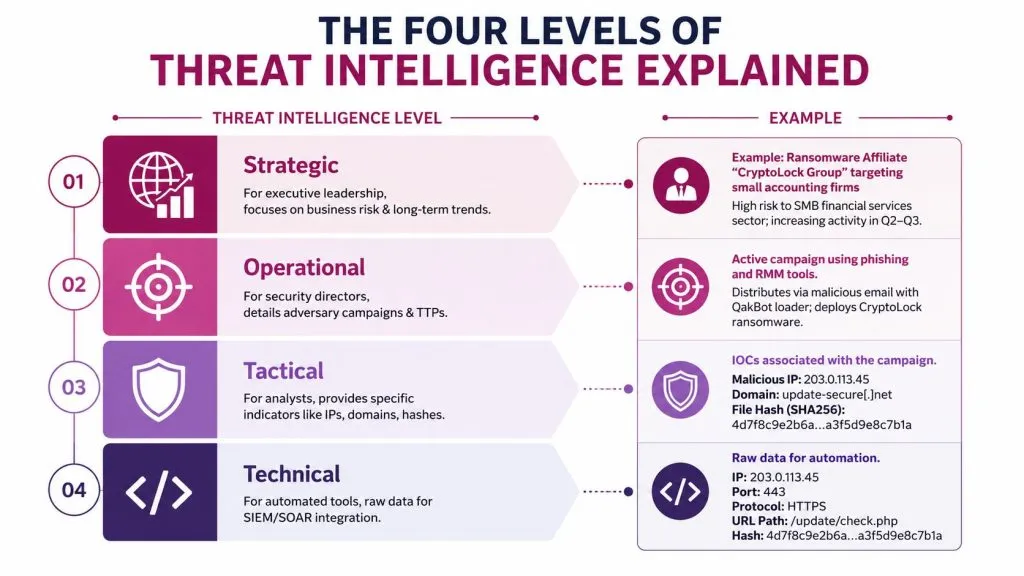
A single threat can produce four different intelligence products, each designed for a different decision-maker. Consider a ransomware affiliate targeting small accounting firms. The executive team, security manager, threat hunter, and automated detection tools shouldn’t receive the same explanation.
Strategic intelligence
Strategic intelligence answers, “What does this threat mean for the business?” A leadership briefing might describe why accounting firms are attractive targets, which business processes could be disrupted, and whether the organization’s exposure warrants investment in identity controls, backup resilience, or third-party risk work.
This layer avoids an indicator list. Executives need risk, likely business impact, affected services, and decisions that require funding or policy changes. A strategic report might also compare the threat with the organization’s sector, geography, technology dependencies, and customer obligations.
Operational intelligence
Operational intelligence asks, “How is the campaign developing?” Analysts examine the affiliate’s targeting patterns, access methods, partners, extortion behavior, and changes in campaign activity. The focus is on intent and execution over time.
For the accounting-firm example, that could mean identifying a phishing campaign aimed at payroll staff, an initial-access broker selling credentials, or a ransomware operation that repeatedly abuses remote access. The output helps security leaders prepare detections and response coordination before an alert appears.
Tactical intelligence
Tactical intelligence translates adversary behavior into defensive hypotheses. The team can map observed tactics, techniques, and procedures to the MITRE ATT&CK framework, then ask whether its controls can detect credential theft, privilege escalation, lateral movement, or data staging.
This layer belongs in threat hunting, detection engineering, incident response preparation, and purple-team exercises. It should produce practical questions such as which authentication events to review, which endpoint behaviors deserve a rule, and which logs are missing.
Technical intelligence
Technical intelligence provides machine-consumable artifacts, including domains, IP addresses, file hashes, detection patterns, and YARA rules. Security tools can use these artifacts to search historical telemetry, enrich alerts, block known infrastructure, or open investigation tickets.
Technical data is valuable, but it has a short useful life and can create noise when distributed without context. A serious program connects all four levels. Executives receive business relevance, managers receive campaign understanding, analysts receive hunting direction, and tools receive structured data.
A benchmarking exercise evaluating five CTI services used historical IOCs, 6 threat actors, and 4 exploited CVEs across 33 criteria, according to AI Multiple’s comparison of cyber threat intelligence services. The useful lesson isn’t the benchmark’s sample size. It’s that service quality depends on normalization, enrichment, and operational use, not on raw data volume.

Managed Services, Feeds, and Platforms Compared
The right delivery model depends on who will interpret the intelligence and who will maintain the workflow. Buying a feed when nobody has time to tune it creates an expensive queue of unreviewed data. Buying a fully managed service when your team wants to build custom detections may limit flexibility.
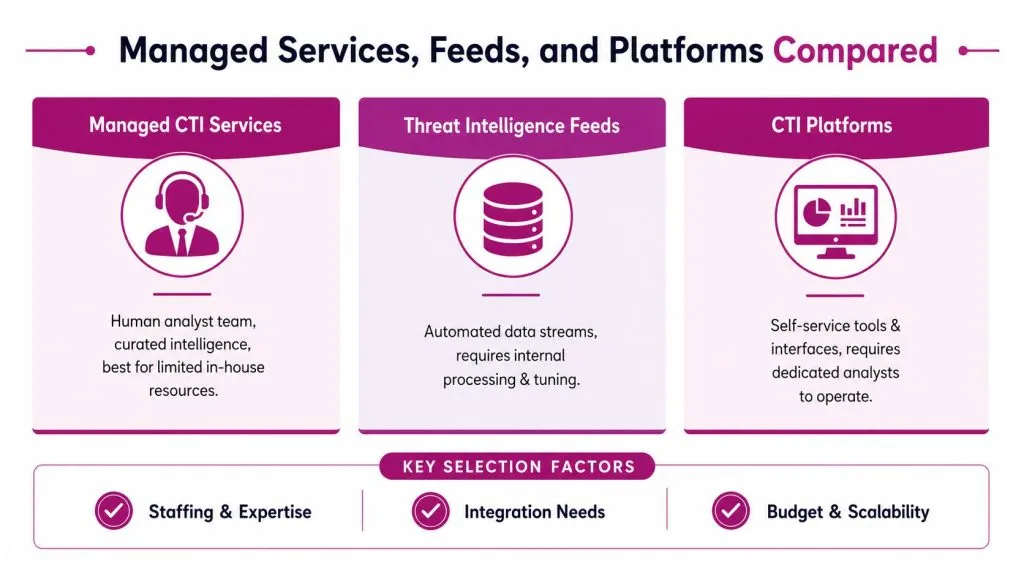
| Delivery model | What you receive | Best fit | Main trade-off |
|---|---|---|---|
| Managed CTI service | Curated intelligence, analyst interpretation, alerts, reports, and often response guidance | Organizations with limited CTI expertise or analyst capacity | Less control over underlying workflows and potential provider dependency |
| Threat intelligence feed | Automated streams of indicators for SIEM, EDR, firewalls, or a TIP | Teams with internal analysts and detection engineering capability | Your team owns filtering, validation, tuning, and response |
| CTI platform or API | Search, enrichment, dashboards, exports, APIs, and integration building blocks | Mature teams creating custom investigations and automations | Requires people, process ownership, and ongoing administration |
The staffing question
A managed service carries more of the analytical workload. An MSP or smaller security team can receive a prioritized alert, ask an analyst for context, and use a predefined escalation path. That can shorten time to value, but the buyer should verify how much human support is included and whether the provider understands the customer’s environment.
Feeds suit teams that already have a TIP, SIEM, or detection pipeline. They can be powerful when analysts know how to assess confidence, age indicators, suppress duplicates, and connect detections to playbooks. Without that discipline, a feed can increase alert fatigue.
Platforms and APIs provide the deepest customization. They let an internal team enrich a suspicious domain, query actor relationships, create watchlists, and automate actions. The cost shifts from provider analysts to internal engineering and operations.
Choosing without a feature race
Start with the workflow you need to improve. If the problem is exposed credentials and brand impersonation across many clients, a managed or API-enabled service may fit an MSP. If the problem is alert enrichment inside an established SOC, a platform or feed may be more appropriate.
For MSPs considering external exposure monitoring, this guide to dark web monitoring for managed service providers offers a useful way to frame the service around client workflows rather than standalone reports. Evaluate integration effort, analyst access, customization, data ownership, and exit options before comparing indicator counts.
Real Use Cases for MSPs, MSSPs, and SMBs
An MSP can use CTI as a shared early-warning capability across its customer portfolio. The service watches client domains, brand names, executive identities, and exposed credentials, then routes each finding to the correct tenant and escalation path.
Consider a provider supporting professional-services firms. An alert about a leaked employee credential shouldn’t land in a generic queue with no owner. The MSP can validate the exposure, notify the client contact, recommend credential resets and session revocation, search for related activity, and document the action in the client’s ticketing system. A quarterly briefing can then summarize recurring risks, defensive priorities, and unresolved exposure without overwhelming the customer with raw indicators.
That workflow gives the MSP two forms of value. It improves client protection, and it gives account managers a concrete security conversation based on an observed risk rather than a vague promise to “stay ahead of threats.” The provider can also use the intelligence to support incident response when a client reports suspicious activity.
External intelligence becomes commercially useful when the MSP can connect an alert to a named customer, a defined action, and a documented outcome.
An internal SMB team uses the same category differently. An IT or security lead may compare active threats in its sector with the company’s technology stack, exposed services, and vulnerability backlog. Instead of patching solely by severity score, the team can prioritize weaknesses associated with active exploitation or campaigns relevant to its business.
The security lead can also turn CTI into a leadership briefing. A board or executive team usually needs to understand business exposure, likely consequences, and planned safeguards, not a long list of hashes. The same intelligence can guide a tabletop exercise, improve incident-response preparation, and help compliance or data-protection officers assess whether exposed information creates notification or control concerns.
For practical examples of how organizations apply exposed-data monitoring, see these dark web monitoring use cases. The important distinction is that the MSP sells a repeatable service around intelligence, while the internal team uses it to prioritize scarce time and communicate risk.
How to Evaluate Providers and Run an RFP
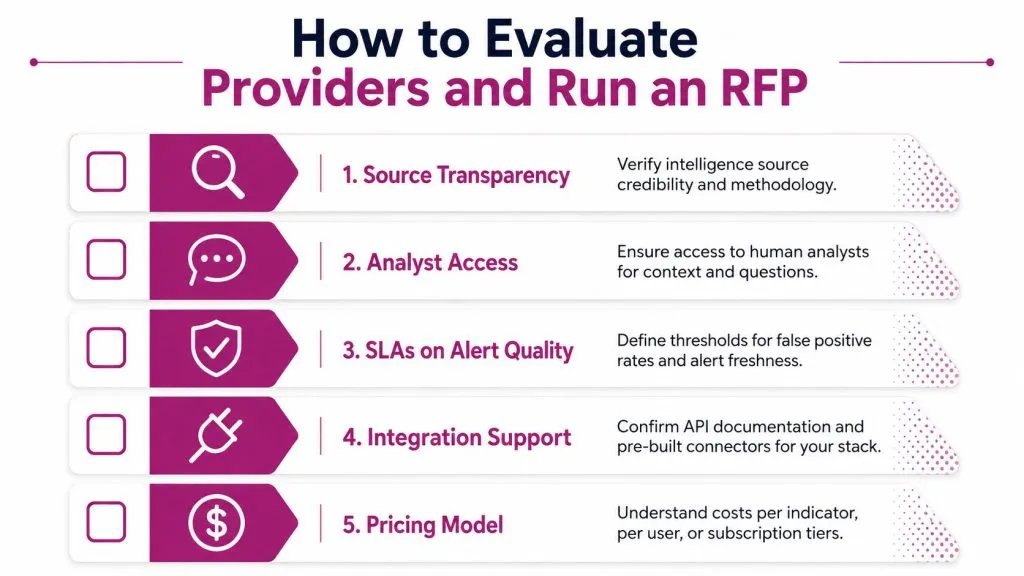
A provider’s feed size tells you little about whether your analysts will make better decisions. Evaluate the service as an operating component, not as a library of threat data.
Score the evidence behind the claim
Source transparency should cover source categories, collection methods, legal boundaries, and retention. A provider doesn’t need to expose sensitive sources, but it should explain how it assesses credibility and how it handles stale or conflicting information.
Analyst access matters when attribution is uncertain or an alert affects a high-value system. Ask whether analysts can answer questions during an investigation, provide briefings, and explain confidence levels.
Alert quality needs operational definitions. Ask how the provider measures false positives, indicator freshness, confidence, and delivery time. A service that sends quickly but overwhelms the queue may perform worse than a slower, better-curated service.
Coverage should match your risks. Check open, deep, and dark web visibility, relevant languages, sector expertise, geographic focus, and support for the strategic, operational, tactical, and technical layers.
Commercial terms deserve equal attention. Clarify data ownership, redistribution rights, tenant separation, API limits, export options, renewal terms, and what happens to historical intelligence when the contract ends.
Questions to put in the RFP
Use questions that force the provider to describe a process:
- Indicator validation: How do you validate and enrich a new indicator before delivery?
- Attribution confidence: How do you confirm actor or campaign attribution, and how do you communicate uncertainty?
- Correction handling: What happens when a high-confidence alert proves incorrect?
- Update cadence: How often do you refresh, expire, or re-score indicators?
- Integration support: Which SIEM, SOAR, EDR, TIP, and ticketing integrations are supported?
- Outcome reporting: Can you report on triage time, false positives, detection, and response usage?
Red flags include refusing to describe source categories, measuring success only through feed volume, and offering no clear explanation of update or expiration practices. SecAlliance’s provider-evaluation guidance similarly emphasizes relevance, accuracy, timeliness, actionability, integration, and analyst support over data quantity.
API and Integration Considerations That Decide Success
A portal or PDF can be useful for a briefing, but it won’t become part of daily detection and response by itself. Analysts need intelligence where they already investigate alerts, while automated systems need predictable formats, permissions, and update behavior.
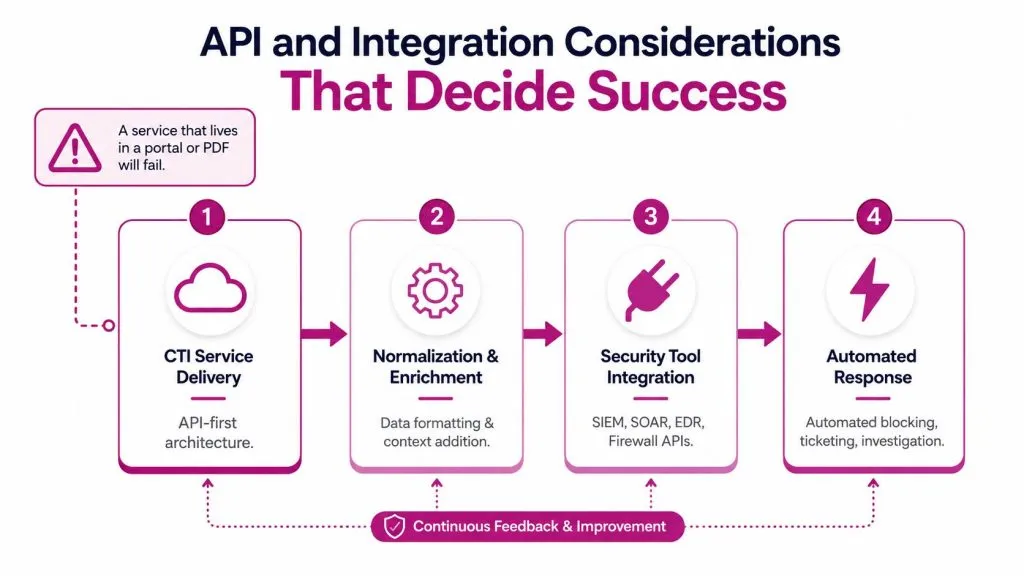
Match delivery to the action
A SIEM can use CTI to enrich an event with reputation, campaign, actor, confidence, and first-seen context. An EDR platform can search endpoints for a newly associated artifact, while a SOAR playbook can create a ticket, request enrichment, or recommend containment when multiple signals meet a defined threshold.
Vulnerability-management integration solves a different problem. The service can add threat context to a vulnerability record, helping the team distinguish a theoretical weakness from one connected to observed exploitation or relevant adversary activity. A TIP can serve as the central layer for normalization, relationship mapping, scoring, and distribution to downstream tools.
Inspect the engineering details
Ask for documentation before signing. STIX and TAXII compatibility, schema stability, versioning practices, authentication, rate limits, pagination, filtering, and webhook behavior all affect implementation. A schema change that breaks a parser can stop detections, so the provider should explain notification and testing procedures.
MSPs also need tenant isolation. One client’s watchlist, credentials, alerts, and analyst notes must not appear in another client’s environment. Confirm role-based access, tenant-specific API keys, audit logs, and export controls.
Emergency delivery deserves a direct question too. When a major vulnerability or campaign emerges, can the provider issue a targeted push, and can your tools consume it without manual copying? Integration work is a hidden total-cost line item because every unsupported connector, custom parser, and fragile workflow consumes engineering time.
A 2025 survey reported that only 13% of respondents said automation between CTI and SecOps tools was working well, while nearly 40% struggled to coordinate data across TIPs, SIEMs, and vulnerability-management platforms. The same survey found only 17% shared intelligence across SecOps, incident response, and vulnerability teams in real time, while 22% shared it rarely or not at all, as reported by BetaNews. Those findings make integration a buying criterion, not a post-purchase detail.
For organizations that need external exposure signals connected to existing security processes, InsecureWeb’s dark web scanning capability is one example of a service model that can complement monitoring and response workflows.
Measuring ROI with Metrics That Actually Move
A report count is an output. A large indicator library is an output. Neither proves that the SOC is making better decisions.
The operational test is whether intelligence changes detection, investigation, prioritization, and response. Useful measures include Mean Time to Detect, Mean Time to Respond, alert-triage time, attacker dwell time, false-positive rate, and the percentage of intelligence-driven recommendations that analysts complete.
Build a baseline before onboarding
Choose a reporting period that reflects normal operations, then record how the team currently handles relevant alerts. Document the existing detection path, investigation steps, escalation points, and delays. Without a baseline, a later improvement may reflect staffing, a new EDR rule, or a change in incident volume rather than CTI.
Attribute outcomes to specific intelligence inputs. For example, record whether a new detection came from an actor report, whether a hunting hypothesis found related activity, or whether a SOAR playbook used an enriched indicator to reduce manual triage. This creates a defensible link between the service and the result.
Research on CTI effectiveness recommends measuring MTTD, MTTR, false-positive reduction, attacker dwell time, and alert-triage automation across consecutive reporting periods. The approach is practical because it treats CTI as a contributor to measurable operational change, rather than claiming that every security improvement came from one provider.
Report outcomes to different audiences
An internal CISO may want a monthly view of detection coverage, response efficiency, unresolved exposure, and major intelligence-driven decisions. An MSP can provide each client with a concise service report showing alerts by risk, actions taken, open recommendations, and trends that deserve executive attention.
Don’t collapse the program into a single score. A lower triage time could hide a coverage gap. A falling false-positive rate could reflect aggressive filtering that also suppresses useful signals. Pair speed metrics with quality checks, analyst review, and explicit notes about what the service cannot observe.
A credible ROI report explains which intelligence changed which decision, not just how much data the provider delivered.
Pitfalls, Best Practices, and Your Next Step
Many CTI programs fail without notice. The organization connects a feed, imports indicators, receives reports, and assumes the work is complete. Analysts then ignore repetitive alerts, nobody tunes the confidence rules, and the intelligence service remains outside incident response.
Common failure patterns include:
- Treating CTI as a one-time ingest: Threat data changes, so indicators need expiration, re-scoring, and review.
- Buying too many feeds: Multiple sources can create duplicates and conflicting confidence levels without a normalization process.
- Skipping workflow ownership: Every alert needs a destination, an accountable team, and a defined action.
- Ignoring tuning: Analysts should review false positives, stale indicators, suppressed matches, and missed enrichment.
- Briefing leaders with indicator lists: Executives need actor-level trends, business exposure, decisions, and risk reduction priorities.
Start with one question that matters. An MSP might ask, “Can we identify exposed client credentials and route each finding to the right tenant?” An internal team might ask, “Can CTI help us prioritize vulnerabilities connected to threats affecting our sector?” A narrow pilot makes integration defects and ownership gaps visible before the service becomes a broad dependency.
Write the playbook before expanding coverage. Specify who validates an alert, who contacts the customer or system owner, which controls are checked, when an incident is opened, and what evidence is retained. Schedule recurring tuning with SOC, incident response, vulnerability-management, compliance, and data-protection stakeholders.
Partners should also assess packaging options. MSPs, MSSPs, hosting providers, and security resellers may need white-label presentation, tenant separation, APIs, and permission controls so intelligence becomes part of their own client service. Internal teams should require a pilot with baseline metrics, integration acceptance criteria, analyst feedback, and a renewal decision based on operational outcomes.
The market’s expansion shows strong demand, but demand alone doesn’t make a CTI program effective. The service earns its place when it helps a person or an automated workflow choose the next action with greater speed and confidence.
InsecureWeb provides dark web monitoring, threat intelligence, fake-site and account detection, vulnerability scanning, AI-guided penetration testing, and reputation monitoring for businesses and service providers. MSPs and security firms can use its white-label and API capabilities to connect external threat signals, including exposed credentials and IOC feeds, to their existing workflows, so visit InsecureWeb to assess whether it fits your CTI pilot.