Data Breach News3 min read
Adobe Commerce Data Breach: 40,000 Records Exposed on Dark Web
By InsecureWeb Team
This report reflects observations of dark web activity. InsecureWeb makes no representations regarding the accuracy of this data.
Data Breach Summary
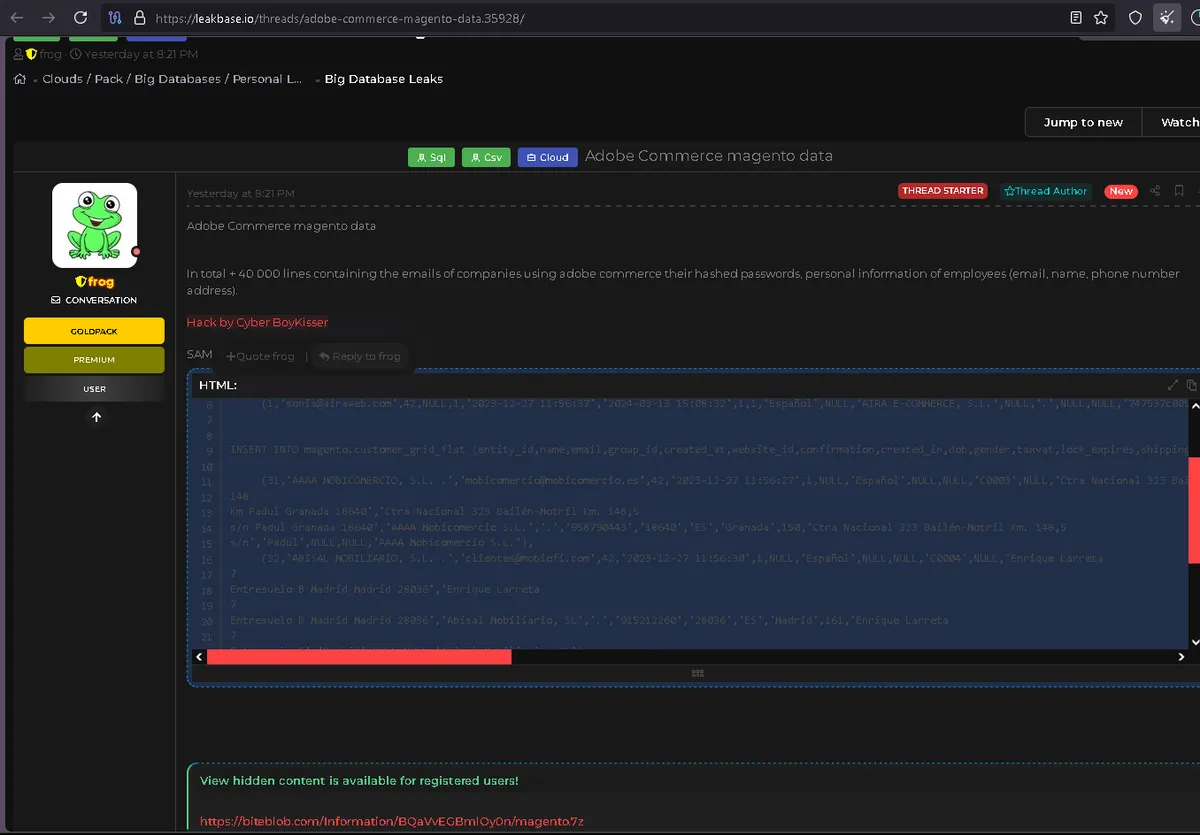
On March 16, 2025, a significant data breach involving Adobe Commerce (formerly Magento) was disclosed on the dark web forum leakbase.io by a user named ‘frog’. The breach, attributed to the hacker group ‘Cyber BoyKisser’, exposed over 40,000 records containing sensitive information of companies utilizing Adobe Commerce. The compromised data includes company email addresses, hashed passwords, and personal details of employees such as names, phone numbers, and addresses.
This incident underscores the critical need for robust security measures within e-commerce platforms. The exposure of such comprehensive information not only jeopardizes the affected companies but also poses significant risks to their employees, potentially leading to identity theft, phishing attacks, and other malicious activities.
Where and How?
The breach was publicized on leakbase.io, a known platform for sharing compromised data, indicating that the attackers had infiltrated Adobe Commerce’s infrastructure to extract and disseminate this sensitive information. The exact method of intrusion remains unspecified; however, it highlights potential vulnerabilities within Adobe Commerce’s security protocols.
Company Data Breach History
Adobe has experienced several notable security incidents in the past:
- 2013 Breach: Hackers accessed Adobe’s networks, stealing user information and source code for various Adobe products. Approximately 153 million user records were compromised, including internal IDs, usernames, emails, encrypted passwords, and password hints in plain text.
- 2024 Vulnerability Exploitation: A critical vulnerability in Adobe Commerce, tracked as CVE-2024-34102, was actively exploited in the wild. This improper restriction of XML external entity reference (XXE) flaw could allow attackers to execute arbitrary code. Adobe released patches in June 2024 to address this issue.
- CosmicSting Exploit (2024): Approximately 5% of all Adobe Commerce and Magento stores were hacked by malicious actors exploiting a vulnerability dubbed ‘CosmicSting’. This critical flaw allowed attackers to steal secret encryption keys and inject malicious scripts, compromising over 4,000 e-commerce sites.
- These incidents highlight recurring challenges in Adobe’s security landscape, emphasizing the necessity for continuous improvement in their cybersecurity measures.
- Further Action: It is imperative for Adobe Commerce to conduct a thorough investigation to identify the breach’s origin and implement enhanced security protocols to prevent future occurrences. Transparent communication with affected clients is essential to maintain trust and inform them of the steps being taken to mitigate risks.
Recommendations for Personal Data Protection
How Users Can Protect Their Information
To safeguard personal information and accounts, users should consider the following steps:
- Change Passwords Regularly: Use strong, unique passwords combining letters, numbers, and symbols.
- Enable Two-Factor Authentication (2FA): Whenever possible, activate 2FA to add an extra layer of security to accounts.
- Use Unique Passwords for Each Account: Avoid reusing passwords across different platforms to prevent multiple account compromises.
- Be Cautious of Phishing Attempts: Stay vigilant against suspicious emails or messages that may contain malicious links or solicit personal information.
- Monitor Accounts for Unusual Activity: Regularly review account statements and activities to detect and respond promptly to unauthorized actions.
By adopting these practices, users can enhance their personal data security and reduce the risk of unauthorized access to their information.
What is InsecureWeb?
InsecureWeb is a Dark Web monitoring service that keeps track of recent data breaches and tracks their impact by monitoring the darkest places of the internet.
Our commitment lies in providing top-notch cybersecurity services to our clients. Through continuous monitoring of the dark web and advanced threat detection methodologies, we strive to identify potential breaches promptly, enabling swift response and mitigation efforts. With our state-of-the-art tools and expertise, we prioritize the confidentiality, integrity, and availability of our clients’ data.